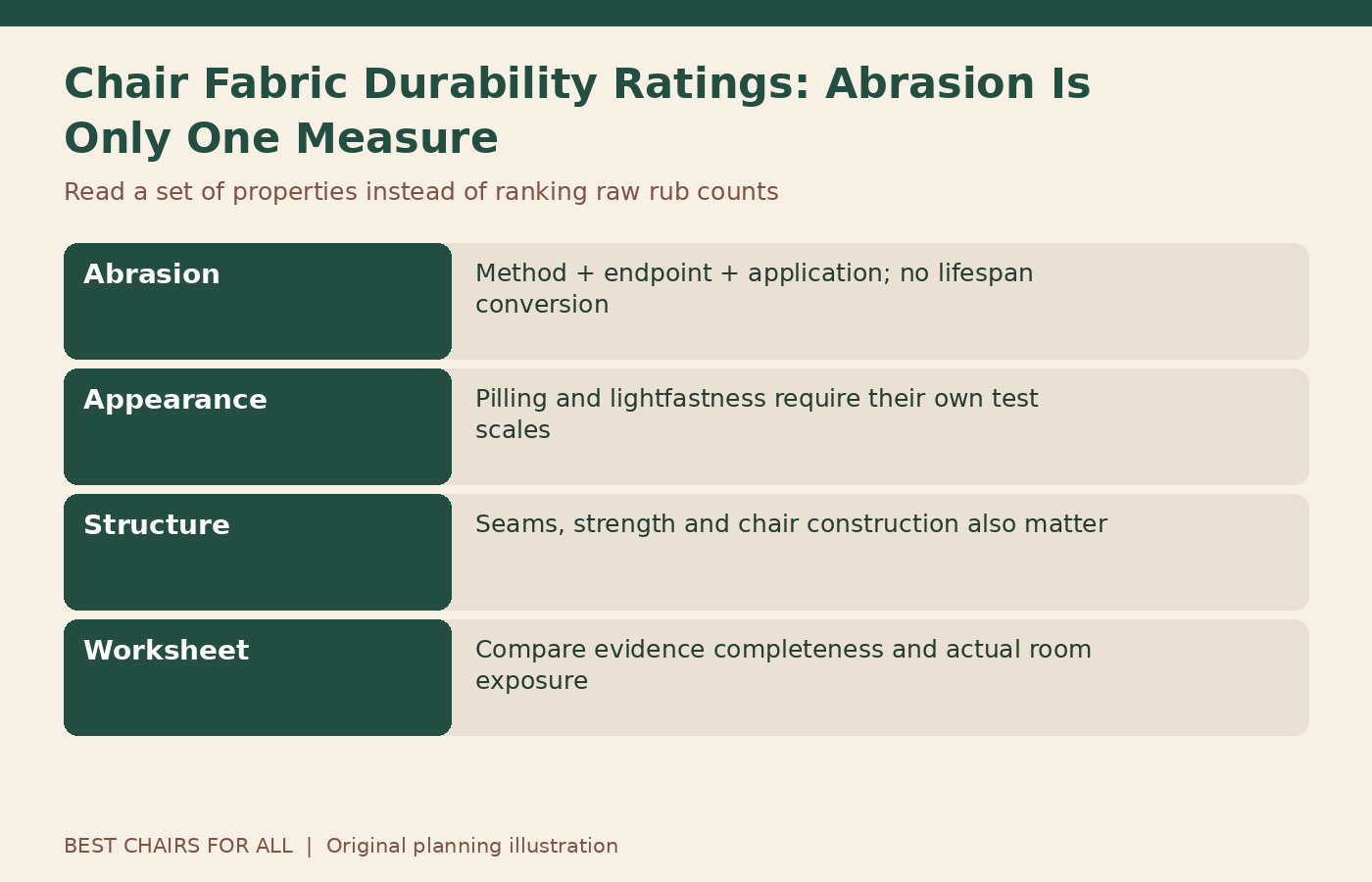
Compare chair-fabric durability by reading a set of test results and use conditions, not by choosing the largest abrasion number. Abrasion measures resistance to a particular laboratory rubbing process. It does not establish resistance to claws, every stain, sunlight, seam stress, or repeated cleaning. Ask for the exact textile code, test method, result, and other relevant performance evidence before treating a fabric as suitable for your room.
This guide provides a specification-comparison worksheet and an example showing why different test methods cannot be ranked by their numbers alone. It does not predict a chair’s lifespan or turn a laboratory score into a guarantee of years in a household.
Start with the expected exposure
Describe how the chair will be used: occasional conversation, daily reading, shared family seating, a sunny window position, or a pet’s usual resting place. List the likely failure concerns separately: worn surface, fuzzing, fading, snagging, stains, seam movement, or cleaning damage. Those concerns require different evidence. A frequent-use chair in a shaded room does not have the same priorities as a lightly used chair in strong sun.
Record the chair design as well as the fabric. Tight curves, projecting piping, cushion seams, and upholstery tension can affect where stress occurs. A fabric-only specification cannot establish the durability of the complete chair. Ask the furniture manufacturer whether the selected textile is approved for that frame and configuration.
Identify the abrasion method first
Two commonly cited methods are Wyzenbeek, often reported in double rubs, and Martindale, often reported in cycles or rub counts. They use different motions and test arrangements. A number without its method is incomplete evidence. Ask for the standard or test designation, the result, and whether the figure represents failure or a point at which testing stopped.
The Association for Contract Textiles’ abrasion disclaimer explains important limits on interpretation. A fabric with twice the abrasion cycles does not establish twice the service life. That point matters when a retailer uses a very large number as the main reason to choose one upholstery over another.
Do not convert between methods
The ACT woven-fabric abrasion guidance states that Wyzenbeek and Martindale results do not have a correlation that permits conversion. Do not use a homemade multiplier to turn one into the other. Even if a chart lists guidance values for both methods, those category examples are not a conversion equation for individual fabrics.
If Candidate A reports 50,000 Martindale cycles and Candidate B reports 100,000 Wyzenbeek double rubs, you cannot conclude that B has twice A’s abrasion performance or lifespan. Obtain comparable evidence or assess each against its appropriate documented application guidance. The comparison worksheet should mark different methods rather than silently sorting the raw values from high to low.
Understand what a test endpoint means
A specification may say a fabric passed a stated number of cycles, reached a test limit, or failed at a particular endpoint. Those descriptions can differ. Ask whether the manufacturer stopped testing at a chosen ceiling and which failure criterion applied. A stopped test does not prove the fabric would fail on the next cycle, while an unusually high result does not predict unlimited household use.
Keep the wording attached to the result. Do not shorten tested to 100,000 cycles without failure into lasts 100,000 uses. Sitting, moving clothing, dirt, cushion geometry, and cleaning do not reproduce one laboratory cycle. The useful role of the test is evidence about a defined property under defined conditions.
Include variation and uncertainty
Laboratory results can vary between tests, and actual service conditions differ. ACT’s disclaimer emphasizes that absolute abrasion figures are not a precise lifespan scale. Avoid ranking two fabrics as meaningfully different solely because one reports a modestly larger number under otherwise similar testing. Ask the supplier how it interprets the result for the intended application.
This uncertainty does not make testing useless. It changes the question from which number is biggest to does the evidence support this use, and what else could limit appearance or performance? Keep any missing method, test date, sample identity, or endpoint visible. A transparent incomplete specification is better than a confident comparison built on assumptions.
Assess pilling independently
Pilling concerns small balls or fuzz that form on a fabric’s surface. A textile can resist abrasion while developing an appearance the owner dislikes. Ask for the pilling test method, rating scale, result, and manufacturer’s explanation. Do not assume that every five-point scale or test procedure is identical, and do not infer a pilling result from fiber content alone.
Kvadrat’s performance-indicator guide treats pilling separately from abrasion and explains its stated rating system. Use that separation when reading other manufacturers’ data. A chair can remain structurally upholstered while looking fuzzy, which is why appearance retention deserves its own row rather than being hidden under a general durability heading.
Read lightfastness with its method and exposure
Lightfastness concerns resistance to color change under a specified light-exposure test. Ask for the method, scale, exposure conditions, and result. Different rating systems should not be compared as though the same printed number has the same meaning. A test result also does not guarantee that a chair beside a bright window will never fade.
Mark the actual room exposure on the worksheet, including direct sun and whether the chair remains in one orientation. Ask the manufacturer about placement precautions and the selected color. Do not treat a fade-resistant claim as permission to ignore the furniture-care instructions. Abrasion cannot compensate for a light-exposure mismatch because it measures another property.
Ask about seam slippage and strength
A fabric’s surface can remain intact while yarns shift near a seam or a stressed area opens. Ask whether the specification includes seam slippage, tensile strength, or other relevant physical tests and what the results mean for the intended upholstery application. The chair maker’s construction and stitching remain part of the assessment.
This matters for sculptural or tightly upholstered chairs, where material is shaped around curves and corners. Do not assume a high-rub textile is automatically suitable for every frame. Ask whether the furniture manufacturer offers and supports that exact fabric on the model. An upholsterer may also need to assess pattern, stretch, backing, and seam placement before using a customer-supplied textile.
Keep snagging and pet damage separate
A claw catching a loop is not the same event as repeated standardized rubbing. Ask for documented snagging evidence where available and examine an approved sample’s structure. Prominent loops or decorative yarns give you specific questions to raise, not a quantified prediction of failure. Do not perform destructive key, scissors, or pet-claw tests and call them comparable data.
If the supplier has no snag result, record that limitation. A pet-friendly marketing phrase may refer mainly to cleaning or stain release. It does not establish resistance to chewing or every scratching behavior. Match the evidence to the actual pet contact pattern rather than using abrasion as a substitute for an untested risk.
Add cleaning and color transfer to the worksheet
Durability in use includes the care the fabric can tolerate. Obtain the cleaning code and complete finished-chair instructions. A high abrasion result does not make a solvent-only fabric water washable, and a performance finish does not authorize arbitrary bleach or steam. Consider whether the approved care routine fits the household’s likely spills and maintenance habits.
Ask about colorfastness to rubbing where relevant, particularly with strong colors or contrasting clothing. Keep the test method and wet or dry conditions attached to the result. Do not infer dye-transfer resistance from lightfastness, because those concern different exposures. If a technical sheet omits the property you need, ask rather than assuming a broad durability label includes it.
Build a specification-comparison worksheet
Use rows for fabric identity, approved chair application, abrasion method and endpoint, pilling, lightfastness, seam or strength information, snagging, cleaning, and warranty. Add columns for Candidate A, Candidate B, and Unanswered questions. Keep original units and scale labels. Do not create a total score by adding unrelated test numbers.
Write the room exposure and expected use above the table. Then mark which rows are decisive for that use. A sunny reading chair may make lightfastness and placement advice especially relevant, while a heavily used shared seat may put greater attention on abrasion, pilling, seams, and routine cleaning. All candidates still need suitable complete-chair construction and seated fit.
A worked comparison without a false winner
Imagine Fabric A reports 60,000 Martindale cycles, a documented pilling result, and clear cleaning instructions. Fabric B advertises 150,000 double rubs but supplies no method detail, pilling information, or finished-chair care guide. The raw number on B is larger, but the evidence is less complete. The next action is to obtain B’s missing specification, not declare it more durable.
Now imagine B’s supplier provides its test method and the missing properties. You can assess whether each candidate meets the relevant application guidance and which care routine suits the room. These are invented examples, not results for real textiles. They demonstrate how complete documentation can matter more than a headline figure that appears impressive in isolation.
Distinguish a test claim from warranty coverage
A test result describes evidence; a warranty defines specified remedies and conditions. A fabric can publish strong laboratory results while excluding ordinary wear, pet damage, fading, or improper cleaning from a particular warranty. Read the actual terms, including claimant eligibility, reporting requirements, and whether the furniture or textile supplier handles a problem.
Ask about labor, transport, and matching replacement material as separate questions. A cloth replacement may not include reupholstery work or a complete chair. Keep the technical sheet and warranty together so a sales conversation does not blur performance testing into a promise of free service. Avoid translating either document into a guaranteed number of usable years.
Make the final decision evidence-based
Write why the chosen textile suits the actual exposure, citing the relevant documented properties and manageable care routine. Record unresolved limitations explicitly, such as snagging not established or direct-sun placement still restricted. Retain the exact sample code and specification because similar names or later revisions may not identify the same textile.
A useful durability comparison respects what each test measures and what it cannot answer. Abrasion helps assess rubbing resistance under a known method; pilling, fading, seams, cleaning, and construction complete the picture. The strongest decision comes from a coherent set of evidence for the chair’s intended use, not from treating the largest rub count as a lifespan forecast.
Something unclear or out of date? Send a correction with this article’s title and the detail to check.
Sources, research & corrections policy ↗