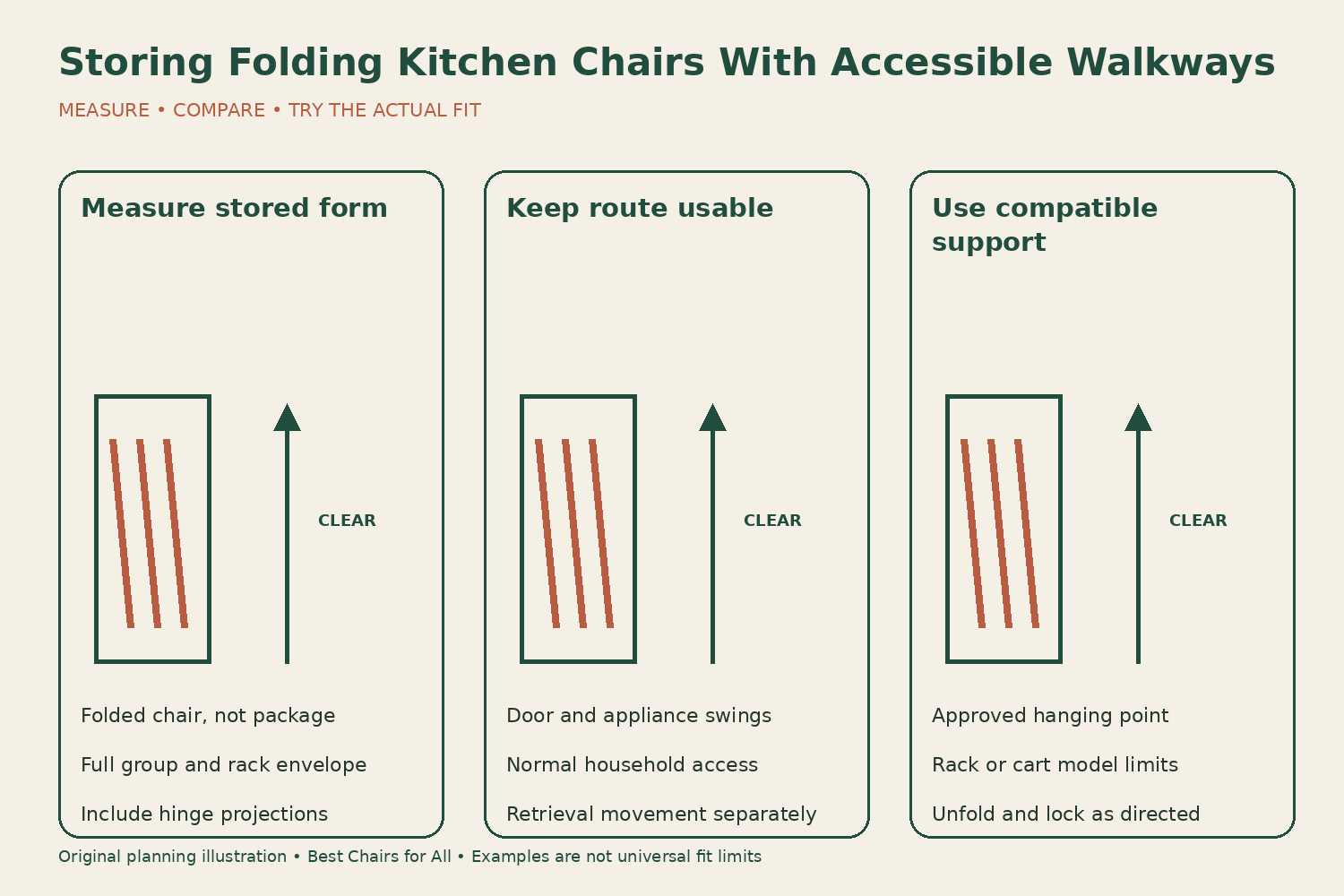
Store folding kitchen chairs in a defined place that holds them securely and leaves the household’s normal routes usable. Measure the folded chair, storage hardware, and retrieval movement separately. A chair that occupies little space when folded can still become an obstruction if it leans into a doorway or must be pulled across a busy passage. Follow the chair and storage-system instructions, and plan how someone will take out one chair without disturbing the rest.
Start with the route that must remain usable
Map doors, appliance openings, cabinet access, and the usual path through the kitchen or dining area. Include the space used by a walking aid or other household equipment where relevant. The storage location should not consume the route people actually need. Do not judge it only by whether the folded chairs look tidy against a wall.
The National Institute on Aging’s home fall-prevention guidance emphasizes addressing the home environment and seeking professional home-safety advice where needed. For chair storage, that supports keeping clutter and awkward obstacles out of everyday routes. This guide is a household planning method, not a determination that a route meets any accessibility code or a person’s assessed needs.
Use the actual users in the assessment. A gap one person can sidestep through may be unsuitable for another person carrying dishes or using mobility equipment. If the storage arrangement affects an individually assessed route, consult the relevant professional instead of substituting a generic clearance figure from a decorating guide.
Measure the folded chair itself
Find the manufacturer’s folded dimensions if published, then verify the form of the actual chair without forcing its mechanism. Record folded width, height, and maximum depth, including projecting hinges, feet, or padded parts. Open-chair dimensions describe a different condition, and package dimensions can include cardboard or a different packing orientation.
The IKEA FRÖSVI listing distinguishes the chair’s product dimensions from packaging and says the chair can be hung on a wall, with hooks not included. The hanging feature does not identify which wall fixing suits your wall or establish a load limit for an unrelated hook. Those details require their own compatible storage plan.
Measure the group too. Folded chairs may nest or may stand apart because of frames and upholstery. Do not multiply one chair’s thinnest dimension by the count and assume that is the storage depth. Arrange them only in a manufacturer-permitted way and measure the actual envelope, including any rack or retaining component.
Use an envelope calculation with an access allowance
Suppose four chairs, arranged as permitted, occupy a measured group envelope 22 inches wide, 14 inches deep, and 36 inches high. A storage nook 24 inches wide and 16 inches deep appears to contain that envelope. It still needs a retrieval check: fingers, hooks, a retaining strap, and the motion needed to lift one chair may require space the static dimensions omit.
Mark the full storage envelope on a paper floor plan and show the door swing beside it. Then draw the path used to remove a chair and turn it toward the room. These example dimensions are not recommended minimum clearances; they demonstrate why containment and access are separate questions.
Check the storage space with surrounding items present. A broom, vacuum, or shopping bag placed in the same nook can eliminate the working room you measured. If the area has several uses, assign each item a defined place rather than treating the chair space as a flexible gap that will somehow stay clear.
Choose a storage method the chair supports
Floor storage, a purpose-made rack, a compatible cart, and manufacturer-permitted wall hanging are different systems. A folded chair should not be balanced in a way that can slide or fall into a path. Follow the storage product’s instructions for retention and loading, and check that the chair’s shape suits the support points.
Wall hanging requires compatible hardware and a suitable wall installation. The fact that a chair has a hanging opening does not establish the strength of plasterboard, masonry, a fixing, or a hook. Use a properly specified system and qualified installation advice where needed. Do not hang multiple chairs from a decorative hook because one chair seemed to stay up during a brief trial.
Avoid hanging by upholstery, a folding linkage, or another part not identified as a storage point. Do not add a hole to the chair frame to create one. A furniture modification can change both structure and folding behavior, and the result is outside a normal storage task.
Respect cart and rack compatibility
Storage equipment has its own model limits. The Lifetime 80669 chair-cart page specifies compatibility with certain Lifetime Commercial Folding Chairs and explicitly excludes other chair families, including padded and Generation II types. Its capacity should not be transferred to a different cart or a miscellaneous household chair collection.
If using a rack or cart, match the chair model and load arrangement to its manual. Consider whether its footprint fits the storage area and whether its loaded route is practical. A cart that works in a hall or institution may be unnecessarily large for a kitchen, even if its headline capacity seems attractive.
Follow wheel-brake, loading, and movement instructions where present. Do not park a loaded cart on a slope or rely on a doorway to stop it. Keep hands and feet clear of the rack’s moving and hanging parts, and avoid adding chairs beyond the specified arrangement. A count is meaningful only within the compatible system.
Plan retrieval before filling the storage space
Try removing one chair while the rest remain in their stored positions. Check whether you can use the intended handholds and maintain control without stretching over another object. A high storage location can make a light chair awkward to handle. Do not climb on another dining chair to reach stored seating.
Try the last chair as well as the first. A row may become unstable or shift when one support is removed. Follow any retention instructions and do not improvise a precarious leaning stack. If retrieval repeatedly requires rearranging the whole group, consider a different location or approved storage system.
Carry the chair along the actual route to its dining position. Check the narrowest doorway and turning point using the folded chair’s full projection. Keep the route clear during handling, and get help when the chair is too heavy or awkward to manage comfortably. The storage method should support the household’s real capabilities.
Fold and unfold according to the chair’s instructions
Before storage, follow the correct folding sequence with fingers away from hinges and closing gaps. Do not force a resistant mechanism or alter a locking part to make it fold flatter. If the chair does not fold as intended, inspect the instructions and seek service guidance. A storage problem can reveal a maintenance issue that should be resolved before the next use.
When taking a chair out, unfold it fully and engage any specified lock before anyone sits. Check for damage, missing protectors, or loose components noticed during handling. A chair that was sound when put away can still need attention after a move or storage incident. Do not discover the condition by asking a guest to try sitting first.
Keep the operating instructions accessible near the storage record. Guests may not understand an unfamiliar folding mechanism, and the way one chair opens may not apply to another. A simple label identifying each model helps someone find the correct guidance without pulling at the wrong part.
Store clean and appropriately dry
Follow the chair’s material-care instructions before storage, particularly after a spill. Do not put damp upholstery or a wet frame into an enclosed space merely because it will be out of sight. Allow the product to dry as directed and address uncertain contamination appropriately. A folding design is not automatically suitable for outdoor or damp storage.
FRÖSVI’s referenced listing recommends indoor use and gives specific textile-care restrictions, including vacuum cleaning rather than washing. Those directions apply to that product. Another folding chair may use a different seat, coating, or cleaning method, so keep care information by model rather than treating all extra seating as utility furniture.
Avoid storing chairs against heat sources, where liquids may leak, or where other objects will be dropped on their frames. Protecting the finish should not involve wrapping material around hinges in a way that obstructs operation or traps moisture. Use only suitable protective storage methods consistent with the product guidance.
Make a retrieval and route checklist
Record the chair count, folded group envelope, storage-system model, compatible chair models, and any stated loading limit. Add the route that must remain clear and the doors that need to open. This makes it obvious when someone adds an extra chair or object that changes the arrangement.
Create a short return sequence: inspect, clean as permitted, dry appropriately, fold correctly, and return to the defined position with retention in place. Add a before-use sequence covering retrieval, full unfolding, locking where applicable, and a condition check. Keep those steps specific to the actual chair instructions rather than inventing a universal mechanism rule.
Recheck after moving furniture or changing the household’s access needs. Storage that once worked may become awkward when a cabinet changes, a new appliance arrives, or a walking aid needs another route. The successful arrangement is secure, compatible with the products, and easy to use without turning spare seating into an everyday obstacle.
Keep a clear count on the storage record. If borrowed chairs are added for a gathering, return them to their own appropriate storage rather than expanding a rack’s load or leaning them against the regular group. Temporary hosting arrangements should be removed promptly so they do not become an unreviewed permanent obstacle.
Something unclear or out of date? Send a correction with this article’s title and the detail to check.
Sources, research & corrections policy ↗