As an Amazon Associate, we earn from qualifying purchases. Read our affiliate disclosure. Retailer links below search for matching listings; verify the exact model and seller before ordering.
The best swivel hunting chair gives you the turning movement you can actually use in your ground setup. My starting pick is the Millennium G100 for back-supported carrying, with the Browning Sportsman as a deliberate backless option and the Browning Huntsman for a full-backrest setup where carry weight is less restrictive. Their published mechanisms allow 360-degree rotation, but the user, clothing, ground, and surrounding space can limit the usable turn.
This comparison concerns portable furniture, not shooting technique or equipment operation. We researched manufacturer specifications on November 6, 2026 and did not conduct load, noise, or field tests. No product is awarded a silence rating or universal terrain approval. Use the supplied instructions and perform furniture-fit checks without weapons.
The sources behind these choices
We compared the G100 product page, Browning Sportsman specifications, and Browning Huntsman listing. We use their named capacities and dimensional labels without turning marketing descriptions into measured performance. Browning’s manufacturer information was accessible through its indexed specifications while direct automated requests were restricted.
Confirm current stock, seller, and revision before paying. A retailer search can return other hunting stools, replacement pads, or similar family names. The linked searches do not guarantee a matching offer, included accessory, or current price. If a supplier cannot resolve a dimension essential to your setup, leave the purchase pending.
Three different swivel configurations
1. Millennium G100 Ground Chair G-100-00
Best for: a back-supported swivel with a low listed carry weight.
The G100 is my first comparison for someone who wants rotational repositioning and a backrest without beginning with a heavy steel chair. Its 7.4-pound listing, aluminum construction, and removable three-leg base make it a practical carry candidate. The relevant advantage is the documented combination of features; we have not verified how silently or effortlessly its mechanism turns under load.
Before buying, ask for the occupied sweep and the deployed leg footprint, then compare those with your site. The published width describes the seat rather than the largest rotating outline with a person in it. A carry strap or loose coat can become the contact that limits movement even when the bearing itself offers a full turn. Keep accessories within the manufacturer’s supported configuration.
Product Details
| Brand | Millennium |
|---|---|
| Model | G-100-00 |
| Listed weight | 7.4 lb |
| Manufacturer capacity | 400 lb |
| Listed seat dimensions | 20.75 H × 19.75 W × 16.5 L inches, maker labels |
| Height adjustment travel | 3.5 inches; confirm absolute endpoints |
| Construction | Powder-coated aluminum; three-leg base |
Additional Product Information
| Movement | 360-degree swivel |
|---|
Pros
- Backrest and full advertised rotation in the lightest listed package here.
- Removable-leg storage gives a specific transport arrangement to evaluate.
Cons
- No measured noise or rotational-force data is available in this comparison.
- Seat dimensions do not supply complete rotating or deployed-base clearance.
Choose if its back support and packing method suit the outing and the rotation envelope is confirmed. Do not pay extra solely for an unverified expectation of silent operation.
2. Browning Sportsman Swivel Seat 8510020
Best for: a deliberate backless alternative with documented height endpoints.
The Sportsman is worth comparing when a backrest is not part of your requirement. It substitutes a shaped padded seat and a published 18-to-24.5-inch range for a full chair back. That changes the upper-body furniture outline, which can matter in a compact observation setup, but it does not make the occupied sweep equal to the small seat rectangle.
The 15-by-11-inch support area is smaller than the back-supported candidates’ published seat dimensions. Try that kind of support and confirm your ability to sit and rise normally before ordering. Its lower listed weight than the Huntsman comes partly with a different seating category, not a free improvement in every feature. A person seeking supported leaning should not assume the backless model supplies it.
Product Details
| Brand | Browning |
|---|---|
| Model | 8510020 |
| Seat width × depth | 15 × 11 inches |
| Seat thickness | 3.5 inches, manufacturer description |
| Seat height | 18–24.5 inches |
| Folded size | 20 L × 15 W × 11 H inches |
| Listed weight / capacity | 8 lb 4 oz / 300 lb |
Additional Product Information
| Configuration | Backless swivel seat; three adjustable legs |
|---|
Pros
- Published absolute seat-height endpoints make one fit check straightforward.
- Compact listed folded shape may suit a particular pack or vehicle space.
Cons
- Backless configuration is unsuitable when you require a chair back.
- Smaller seat support and thick padding require a deliberate fit trial.
Pick only when backless sitting is acceptable and the stated height range is useful. Verify the exact model and do not infer a swivel lock or rated side-loading feature from the description.
3. Browning Huntsman Chair 8526811
Best for: a full-backrest swivel when carry weight is secondary.
The Huntsman provides a steel-framed comparison for a buyer who can accept more carry weight in exchange for its documented seat-height range and backrest. I would consider it for a nearby ground blind or a vehicle-served setup where the published 13-pound weight is less important than matching an established raised sitting position.
The useful comparison with the Sportsman is not simply steel against steel. The Huntsman offers a backrest and a larger seat, so it creates a different moving outline and different support. Check clearance behind the back as well as in front of your knees. The 360-degree mechanism description does not establish that an enclosure, strap, or pocket leaves a complete usable circle.
Product Details
| Brand | Browning |
|---|---|
| Model | 8526811 Huntsman |
| Seat width × depth | 18 × 15 inches |
| Seat height | 17.5–24 inches |
| Backrest height | 18.5 inches |
| Folded dimensions | 24 L × 19 W × 7 H inches |
| Listed weight / capacity | 13 lb / 300 lb |
Additional Product Information
| Construction | Powder-coated steel; TechMesh; three adjustable legs |
|---|
Pros
- Backrest with a published 17.5-to-24-inch seat-height range.
- Seat and folded dimensions allow a more specific supplier fit inquiry.
Cons
- Highest listed carry weight among these three swivel choices.
- Chair variant stock needs confirmation separately from the compatible cover.
Choose after checking the full backrest sweep and carry route. If the chair touches the shelter in a normal turn, choose a better-fitting configuration rather than forcing rotation through contact.
Measure three turning zones
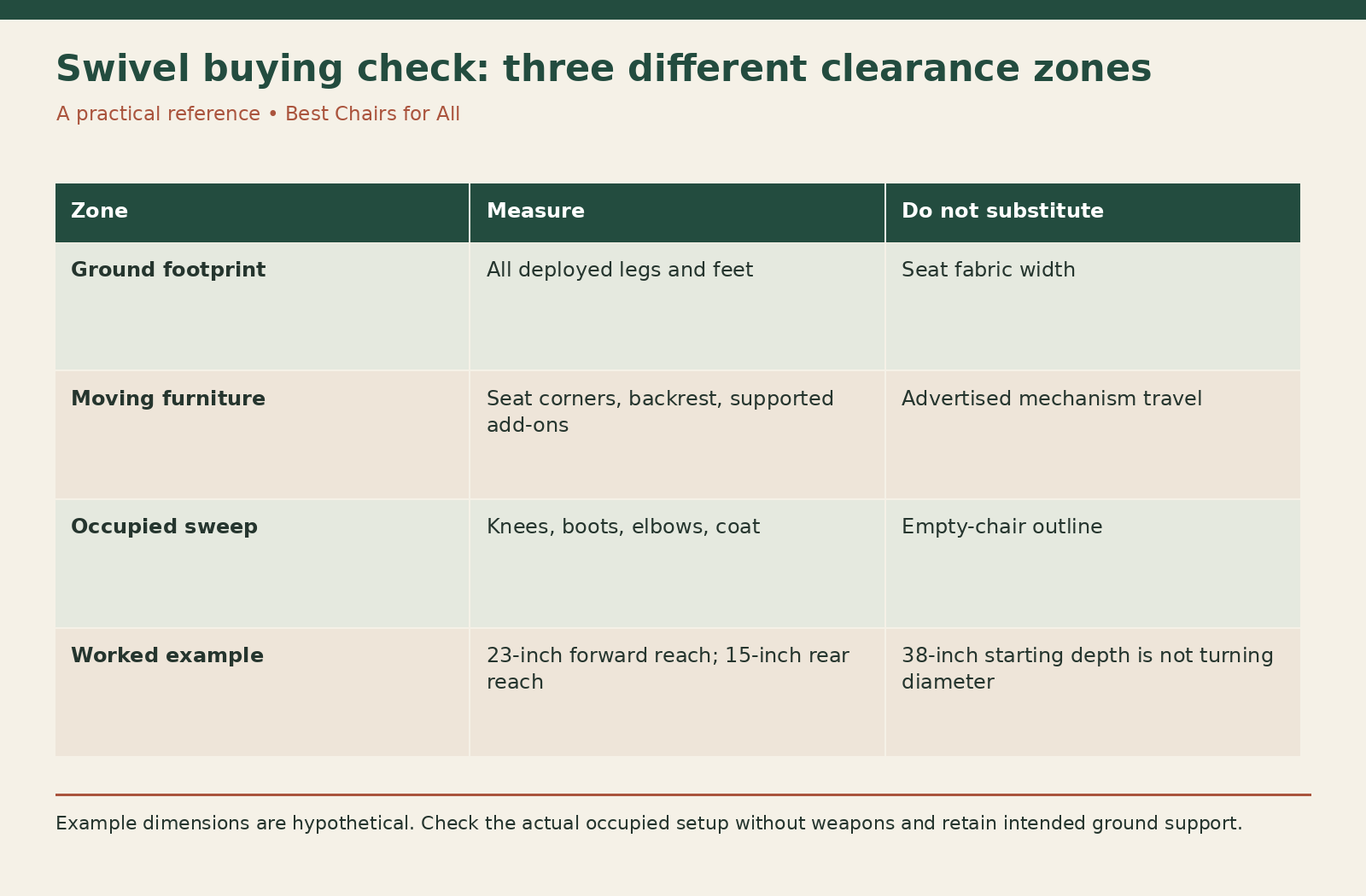
The first zone is the ground footprint: every foot and leg in its fully supported configuration. The second is the moving furniture outline: seat corners, backrest, controls, and permitted accessories. The third is the occupied outline: knees, boots, elbows, coat, and carried items. A narrow fabric seat measures only a small part of this system.
Ask for the maker’s maximum deployed dimensions where available. Then sketch the occupied movement in your actual enclosure or practice space. Keep the base stationary as intended and observe ordinary movements. Do not rock the chair onto fewer feet to gain a little more clearance, and do not use a capacity figure to justify side loading.
A backless Sportsman may have less furniture behind your torso than a Huntsman, but the person’s knees still need room in front. The G100’s lighter carry weight says nothing about the size of that occupied sweep. These distinctions make the three-zone measurement more useful than ranking by seat width alone.
A worked turning-space example
Suppose a hypothetical occupied setup reaches 23 inches forward from the rotation center when your boots and knees are included, and 15 inches behind when the backrest is included. In an unrestricted full turn, the larger forward reach would require attention in every direction. A 38-inch front-to-back measurement at the starting position is not a guaranteed 38-inch turning diameter.
The example deliberately avoids assigning those measurements to a product. Users and settings differ, and the rotation center may not coincide with the center of the visible seat. Measure your actual configuration and request missing frame dimensions. Use a full-scale practice layout if the available space is close.
If the site only allows a limited turn, record that limit as part of the use case rather than promising full rotation. You may decide that a fixed chair is adequate, or that a smaller supported configuration is preferable. A 360-degree feature has little practical value when every useful direction brings the backrest into a wall.
Compare back support before mechanism travel
The G100 and Huntsman have backrests; the Sportsman is a backless seat. Decide whether resting against a chair back is part of your requirement. A thicker pad is not a replacement for a backrest, and a backrest’s presence does not establish a clinical benefit or guaranteed long-duration comfort.
Try the intended sitting style in normal clothing where possible. Check usable support dimensions, front-edge contact, foot support, and the movement used to stand. A chair that is easy to turn can still be an unsuitable seat if you cannot find a comfortable ordinary position within its designed range.
Do not add a homemade back, extension, or accessory arm to a backless swivel. That changes loading and clearance beyond the documented configuration. Compare a complete chair designed with the support you need rather than converting one category into another after purchase.
Separate height travel from seat-height endpoints
For the Sportsman and Huntsman, the published absolute ranges can be checked against a known suitable sitting position. For the G100, the current page gives adjustment travel and dimension labels but does not clearly publish the same endpoint pair. Ask the manufacturer to identify the current minimum and maximum setting for the exact offered model.
Padding and surface shape also affect the occupied position. The Sportsman’s described thick shaped seat should be evaluated as part of the complete seat, not added numerically to the published height as if the maker had excluded it. Ask how a dimension is measured if the description is unclear.
If a blind window determines the height requirement, use the detailed window-fitting guide. Keep viewing geometry separate from any hunting-equipment safety determination. Furniture measurements alone cannot approve the operation of other equipment.
Evaluate rotation contact before pursuing lubrication
A strap brushing the frame, a jacket rubbing the back, or a knee touching the blind can create a sound or stop movement. Those problems are not necessarily bearing faults. Keep loose items clear and observe the exact contact during a permitted furniture trial.
We have not verified silent operation for any of these models. If sound matters, inspect the delivered unit under its care instructions and return conditions. Do not open an enclosed swivel or apply an unspecified oil merely because another owner recommends it. Use the exact maker’s maintenance route for the actual mechanism.
Our swivel-noise diagnostic addresses source isolation separately. A reduction in sound is not evidence that a worn lock, damaged leg, or unstable setup is safe to keep using. Deal with structural concerns before comparing acoustic behavior.
Finish with a usable-rotation contract
Write four commitments before ordering: the required support type, the absolute seat height needed, the ground footprint the site can accommodate, and the occupied turning area available. Add the chair’s actual packed form and total carry load. Each item should have a verified answer or a clearly marked question for the supplier.
The G100 is the carry-focused backrest candidate to measure first. The Sportsman is appropriate only if a smaller backless support is intentional. The Huntsman is worth its additional listed weight only when its support and height range solve your real requirements. Select the model whose complete configuration fits those conditions; full advertised rotation is one feature within that decision.
Something unclear or out of date? Send a correction with this article’s title and the detail to check.
Sources, research & corrections policy ↗