As an Amazon Associate, we earn from qualifying purchases. Read our affiliate disclosure.
The best baby floor seat should be chosen for a limited, awake, closely supervised floor activity that matches the exact child’s readiness and the product’s instructions. Compare Bumbo Floor Seat Lite and Tray for a floor-only molded seat, Chicco Bento for a mode-specific folding floor feeding seat, and Upseat Original for a different molded seat with separate booster-conversion equipment. None is a sleep space, a bath seat, or a shortcut to an infant developmental milestone.
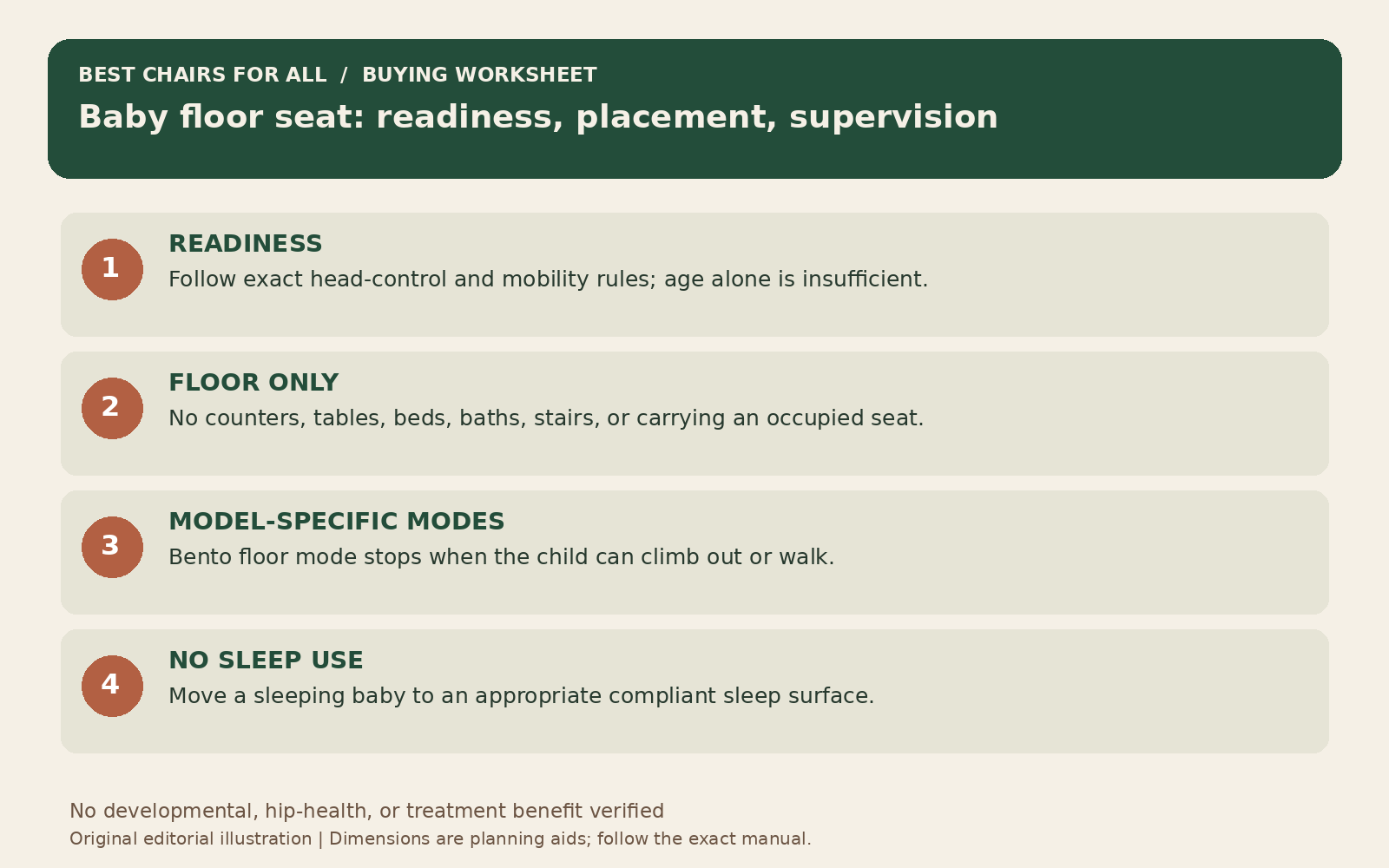
We checked manufacturer dimensions, current US listings, manuals, and official recall information on November 6, 2026. We have not tested stability, fit, muscle development, or hip outcomes. We do not treat therapist-designed or doctor-approved marketing as proof that a seat is necessary or clinically beneficial. This guide’s placement-and-readiness checklist is designed to keep the decision tied to actual use rather than promotional development claims.
Three distinct systems and their limits
| Model | Verified dimensions | Readiness or stopping information | Current stock limitation |
|---|---|---|---|
| Bumbo Floor Seat Lite | 15.50 W ×14.5 D ×9.25 H in; leg openings about 3.5–4 in | Manufacturer says head control; age 3–12 months is approximate | US Lite/Tray collection lists current $39.99 models; confirm selected finish |
| Chicco Bento | 17 ×14 ×17.5 in; folded 19.5 ×14 ×4.5 in | Floor mode: head held unassisted; stop when child can climb out or walk | Style selection required; advertised from 6 months |
| Upseat Original | FAQ:4-in leg openings;6-in pommel-to-back;10-in backrest | Head/neck control; follow actual generation manual;30 lb maximum | Checked $119.99 page said more stock coming soon |
Bumbo Floor Seat Lite: floor-only use, with the belt always required
The current Floor Seat Lite and Tray collection lists two $39.99 products. Bumbo’s US FAQ gives the Lite a 15.50-inch width,14.5-inch depth,9.25-inch height, and approximately 3.5-to 4-inch leg openings. These are different from the narrower leg openings and dimensions of the original Bumbo Floor Seat. Do not choose a listing solely by the word Bumbo or interchange a tray between models without approval.
The manufacturer describes the floor-seat family for an approximate three-to 12-month period but requires the child to support their own head. The official safe-use page requires the restraint belt, direct adult supervision, a firm level floor, and separation from walls or objects a child can push against. The seat must never be placed on a chair, counter, table, bed, or near stairs. A fitted belt does not make an elevated surface permissible.
Investigate Lite only when the exact current model, child fit, complete belt, and floor activity are appropriate. It is unsuitable as an adult-chair booster, child carrier, bath seat, car seat, or infant sleep product. It is also a poor choice if the child no longer fits without forcing the legs or if increasing mobility makes the seat inappropriate. Do not cut the foam, add loose supports, or remove the belt to extend its useful life.
Chicco Bento: read the floor-mode rules separately from booster mode
The Bento 3-in-1 listing publishes an assembled 17-by 14-by 17.5-inch size, a 5.5-pound weight, and a 19.5-by 14-by 4.5-inch folded package. Its two height positions, tray, folding frame, and distinct feeding-chair mode make it a different type of floor seat from a molded foam bucket. The current listing showed $34.99 with style selection needed for availability, and the product family is advertised from six months up to 50 pounds.
The actual US manual provides mode-specific rules. In floor feeding-chair mode, it requires the child to hold the head up without help, the complete snug restraint, floor-only placement, and a stop when the child can climb out or walk. It also prohibits lifting an occupied product and use in or near water. Those stopping milestones can occur before the advertised maximum weight or later toddler-chair marketing becomes relevant.
This model is worth investigating for a folding floor activity seat when the correct mode and child readiness fit your needs. It fails if the only intended location is an elevated surface or the child has passed its floor-mode stopping criteria. Booster mode is a separate arrangement requiring an approved dining chair, both attachment straps, and unassisted upright sitting. Do not use the floor-mode readiness wording as permission to attach a less-ready infant to an adult chair.
Upseat Original: useful published inner measurements, generation details matter
The Upseat FAQ gives four-inch leg openings, six inches from pommel to seat back, and a 10-inch backrest. It specifies a 30-pound capacity and emphasizes head-and-neck control rather than age alone, with an approximate four-month-to-two-year product range. These are useful inner fit measurements, but they do not provide a complete floor-footprint drawing. Ask the maker for the current outer dimensions if your storage or placement space is tight.
The US Original listing showed $119.99 and more-stock-coming-soon language during research, alongside an ordering control. Treat inventory as unresolved until the exact selected option is confirmed. The package includes a tray, child harness, and booster-conversion straps. Original differs from the floor-only Upseat Core, so a lower price for Core is not a price for the same convertible product.
Use the manufacturer manual selector to match the actual seat generation. Its linked instructions and current FAQ differ about which tray can be used in booster mode; do not resolve that conflict by selecting the more convenient rule. Obtain written model-and-tray confirmation before any conversion. For this guide’s floor use, keep the complete restraint, remain with the child, use only the intended floor location, and never carry the seat with the child in it. Development or hip-positioning claims are not independently verified benefits in this comparison.
Decide whether a floor seat has a useful role
Name the actual activity you want to do with the child: a brief supervised play interaction on the floor, reading a board book together, or a permitted feeding arrangement for a child who meets the relevant requirements. A vague goal such as teaching the baby to sit is not the same as an appropriate product use. We have not established that any of these seats accelerates unsupported sitting or improves a developmental outcome.
A floor seat is optional equipment, not a required milestone purchase. If the child does not meet the exact instructions or does not fit comfortably in the supplied configuration, do not use the product yet or choose a different appropriate activity. Do not add pillows, towels, straps, or blocks to compensate for inadequate head control or a poor fit. Individual developmental or feeding questions belong with an appropriate qualified professional familiar with the child.
Keep age, weight, and mobility as separate checks. A child may be below a weight limit but able to climb out, making a particular floor mode inappropriate. Another child may reach an advertised minimum age without meeting its head-control requirement. The youngest age on a product page cannot override those conditions. Check them again as the child changes rather than treating the purchase date as permanent approval.
The floor-placement checklist
Before the child enters the seat, choose a firm, level floor location allowed by the manual. Keep the seat away from stairs, elevated edges, pools, baths, heaters, cords, unstable objects, and furniture the child could push against or pull over. A bed is an elevated soft surface, not an acceptable substitute for the floor. A countertop may bring the baby closer to an adult’s face but greatly changes the hazard and is prohibited.
Place the empty product in its complete instructed configuration and inspect the restraint and supports. For Bento, the frame and mode-specific parts must be correctly locked. For molded seats, inspect the foam, belt attachment, and tray components. Never use a product with a damaged buckle, torn support, missing part, or uncertain configuration. Remove the child before moving or adjusting the seat.
Stay with the child and keep them in view throughout the activity. A belt does not turn the product into a contained play yard that can be left unattended. Pets and older children also need separation from the occupied seat. If your routine requires leaving the room, arrange an appropriate separate place for the child rather than assuming a floor seat can provide unattended care.
A worked fit comparison without forcing the child
The published Lite leg openings are approximately 3.5 to 4 inches, while Upseat reports four inches. That apparent similarity does not prove equal usable space: opening shape, foam, seat depth, and the child’s body proportions matter. Bumbo’s original seat has substantially different listed openings, so copying the original model’s fit impressions to Lite can mislead a buyer.
Make a list of the measurements you need rather than measuring the baby into a homemade approval formula. Ask the manufacturer about the intended fit and stopping indicators for its own model. When trying an eligible child in the supplied setup, follow the instructions and do not force legs through an opening or leave the child slumped in a position the product does not support. Stop if the fit is uncomfortable or uncertain.
For storage, compare actual outside dimensions separately from inner fit. Bento’s 19.5-inch folded length may be less convenient than a compact molded seat in one cupboard, while its shallow folded thickness may work better in another. Upseat’s inner dimensions do not establish whether the complete tray-and-seat package fits your shelf. Obtain the missing measurements instead of borrowing a shipping-carton number.
Recalls are a model-and-date question
The August 15, 2012 CPSC Bumbo Baby Seat recall directed owners of affected older seats to stop use until the repair kit and updated warnings were installed. It also stressed that the belt does not permit raised-surface use. This history matters particularly for secondhand original Bumbo seats; it should neither be hidden nor used to claim that every current model has the same notice.
Search the current CPSC database using the exact model and date code before buying or accepting a hand-me-down. An unidentified old seat without a complete restraint or readable label is a poor candidate. Contact the maker for the actual remedy or approved parts and do not copy a homemade belt installation. Keep registration details so later notices can reach you.
No floor seat in this guide is a safe sleep space. If the baby falls asleep, follow CPSC guidance and move them to an appropriate compliant sleep surface. Do not add blankets, leave a sleeping infant seated, or use a floor seat to manage reflux or another medical condition without individualized professional direction.
For a floor-only molded option, investigate Bumbo Lite with its complete belt and actual current stock. For a folding mode-specific system, compare Bento and respect its climb-out or walking stopping rule. Treat Upseat Original as conditional on selected stock, correct generation, and the supplied manual. The useful purchase is an appropriate supervised activity seat whose limits you can follow, with no developmental or medical promise needed to justify it.
Something unclear or out of date? Send a correction with this article’s title and the detail to check.
Sources, research & corrections policy ↗