As an Amazon Associate, we earn from qualifying purchases. Read our affiliate disclosure.
The best baby high chair is the one that fits your child’s current sitting ability, your eating surface, and the cleaning routine you can repeat after every meal. For a straightforward wipeable chair, start with the IKEA ANTILOP. For an adjustable wooden seat that can stay at the family table as a child grows, consider the Abiie Beyond Junior Y. For a light chair you can fold between meals, the Chicco Zest 4-in-1 is the more useful comparison.
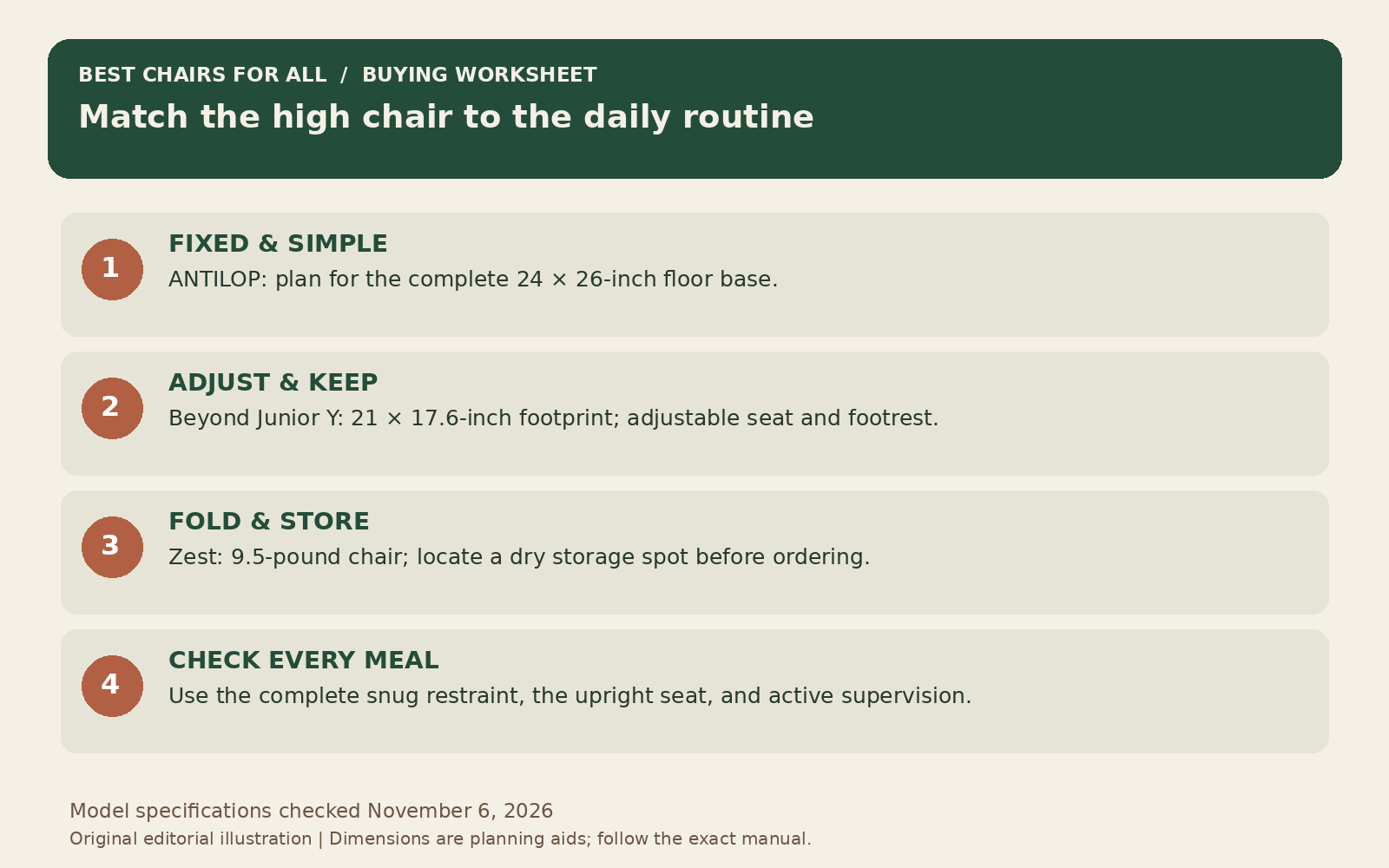
These are research-based selections, not results from our own laboratory or household testing. We checked the manufacturers’ US listings, dimensions, cleaning directions, and official safety guidance on November 6, 2026. We have deliberately separated a low initial cost from long-term adjustability: neither automatically makes a chair the best purchase. A chair should first work safely in its feeding configuration before later toddler or youth modes receive any credit.
Three useful starting points
| Chair | Published assembled size | Best reason to shortlist | Main compromise |
|---|---|---|---|
| IKEA ANTILOP | 24 W × 26 D × 35⅜ H inches | Simple shell; low initial price | Fixed seat; tray purchased separately in this listing |
| Abiie Beyond Junior Y | 21 L × 17.6 W × 34.5 H inches | Adjustable seat and footrest; included tray set | Does not fold |
| Chicco Zest 4-in-1 | 21.25 × 26 × 34.25 inches | 9.5-pound folding frame; wipeable seat | Simple seating geometry rather than extensive adjustments |
IKEA ANTILOP: start here if simplicity matters most
The current US ANTILOP listing includes the safety belt and lists a polypropylene shell with steel legs. It is intended for children able to sit unaided, up to three years or 33 pounds. The listed price was $18.99 for the white chair without the optional tray; local stock requires a postcode check. That is useful price context rather than a promise that a complete delivered feeding setup will cost the same amount everywhere.
Its strongest feature is the lack of upholstery to remove after ordinary splashes. IKEA specifies a mild soapy solution followed by drying with a clean cloth. The tradeoff is a fixed seat: its published seat height is 21¼ inches, seat width 9⅞ inches, and seat depth 8⅝ inches. Those dimensions are more helpful than assuming every six-month-old will sit comfortably in the same shell. Do not compensate for a poor fit with unapproved padding, homemade restraints, or improvised accessories.
The chair’s small-looking bucket also understates its floor needs. The feet occupy 24 by 26 inches, so compare that entire rectangle with the aisle beside your table. This is a good option for a family that wants a dedicated, uncomplicated feeding chair and has room to leave it assembled. It is less suitable if you need a height-adjustable foot platform or must fold the chair into a cupboard after every meal. The detachable legs make occasional transport possible, but that is a different routine from operating an everyday folding mechanism.
Abiie Beyond Junior Y: choose adjustability over folding
The Beyond Junior Y manufacturer page publishes a 21-by-17.6-inch footprint, a 34.5-inch overall height, and an 18-pound chair weight. It includes the frame, seat cushion, backrest cushion, tray, and plastic tray cover. That package detail matters: comparing its complete feeding setup with a bare wooden chair can make the apparently expensive product look disproportionately costly.
The seat height adjusts from 10.5 to 24.6 inches, and the footrest can be repositioned with the EZ-Seat system. For a household with a conventional dining table, this gives more scope to adjust the chair as the child grows than a single fixed bucket. Still, adjustability does not remove the need to inspect the fit at the tray and harness, and it does not establish suitability for a particular infant. Use the instructions for the exact version delivered to you.
The price of that flexibility is a chair that stays assembled rather than folding flat. Its wooden parts also require different care from an all-plastic shell. Abiie says not to submerge the wood, place it under running water, or put it in a dishwasher. The manufacturer’s current assembly and care information is the right source for component-specific cleaning. This is our most useful shortlist choice when the chair will remain beside the family table and a caregiver is willing to reset the seat and foot platform periodically. It loses its advantage if the household primarily needs a lightweight chair to move between rooms several times a day.
Chicco Zest 4-in-1: useful when cleanup and storage share priority
The Zest Capri listing showed $69.99 and an in-stock message on our research date. It gives assembled dimensions of 21.25 by 26 by 34.25 inches and an assembled weight of 9.5 pounds. The one-piece seat avoids a fabric liner, while the tray stores on the rear legs when folded. Those are practical features for an apartment kitchen that becomes a play or work area between meals.
The Zest includes a five-point harness and removable tray. Its later configurations include a lower feeding chair, toddler chair, and youth stool; Chicco advertises the product family from six months to 60 pounds. That total is a product-range claim rather than permission to put any 60-pound child in every configuration. Keep the harness and tray in their instructed feeding setup until the exact manual allows a transition. Never remove restraints merely to imitate a photograph of an older child’s stool mode.
Review high chair harness versus tray and follow the exact product instructions when comparing restraint and feeding features.
Chicco specifies spot-cleaning the harness with warm water and mild detergent, then air drying; it expressly says not to machine wash that harness. Wipe the plastic and hardware with a damp cloth. A fabric-free seat therefore reduces one category of laundry without making the whole product dishwasher-safe. The Zest makes sense if you value manageable weight and a simple fold. It is less compelling when your main priority is fine seat-height and foot-platform adjustment rather than storage. An optional manufacturer footrest appears on the listing, so verify what the chosen box includes before comparing complete prices.
A first-week setup worksheet
Before ordering, record five items on one sheet: the child’s current sitting ability, the dining surface height, the widest clear floor space, the storage location, and the person responsible for cleaning. Then write the exact model and package beside each candidate. This simple record prevents a useful accessory, such as a tray or footrest, from disappearing between the product photo and checkout.
For a worked space example, suppose the clear area beside the dining table is 30 inches wide and 32 inches deep. An ANTILOP’s published 24-by-26-inch base fits inside that rectangle, leaving six inches in each direction overall. That arithmetic does not prove the setup is safe or comfortable: the adult still needs room to approach, fasten the harness, and remove the child without striking furniture. Tape the full base outline on the floor and physically rehearse the route with the chair empty. Door swings and pulled-out dining chairs can consume the apparent spare space.
Once the chair arrives, assemble it from the actual manual and check every lock before adding the child. With the child meeting the model’s readiness requirements, review the upright seating fit and the complete snug restraint. Keep packaging and the return deadline until you know the chair works in your room. Any fitting uncertainty is a reason to contact the manufacturer rather than alter the structure. Photograph the model label and store the instructions where another caregiver can find them.
Think in complete cleaning cycles
A removable tray cover is useful only if you also clean the surface underneath it and refit it correctly. Look for food at harness slots, tray guides, underside seams, and leg junctions. Establish a short after-meal wipe and a separate periodic inspection for loosened hardware or damaged straps. Dry components as their instructions require before reassembly. Do not assume the wooden chair, polypropylene bucket, and nylon harness tolerate the same cleaner.
For a buyer deciding between two acceptable fits, imagine the messiest meal the household actually serves. If the cleanup plan requires a spare cover that nobody owns, count that cost now. If the chair must fold while its tray is still wet, determine where the tray will dry without blocking a walkway. These ordinary details are more likely to affect satisfaction than an additional advertised mode that the household never uses.
When to pay more, and when to keep the chair simple
Pay for an adjustable seat and foot platform when the chair will be used at one table for a long period and you are willing to make adjustments as the child changes. Pay for folding when a real storage location exists and you will use it regularly. Choose a fixed, wipeable chair when the current fit is appropriate and the household benefits from a dedicated feeding station.
Do not buy a chair based solely on an advertised number of stages. A later youth stool cannot correct an awkward current harness, and an attractive wooden frame cannot correct a footprint that obstructs the kitchen. It is reasonable to buy a simpler chair for the present stage and later choose a separate suitable child seat. The useful comparison is the complete safe setup you need now, plus the realistic value of any later configuration.
Restraints, readiness, and the model label come first
A feeding chair is for a child who meets the exact model’s sitting and developmental requirements. A birthday or advertised minimum age alone does not establish readiness. Use the seat upright for meals; a reclining feature does not make a chair suitable for feeding a younger infant. Keep the child supervised and within reach, use the complete fitted harness every time, and use the required passive crotch restraint. A tray is a work surface rather than a substitute for restraint. CPSC explains these high-chair precautions. Keep the chair away from surfaces the child could push against and never allow standing or climbing.
Check the product label, date code, exact model, and country version against the current CPSC recall database before buying, including secondhand. Our research date is November 6, 2026; this article cannot guarantee a particular unit remains unaffected by a later notice. Register the chair and retain the instructions. Do not interchange harnesses, trays, gliders, or inserts between superficially similar versions, and do not improvise missing restraints. A used bargain without an identifiable label, complete hardware, and manufacturer support is a poor candidate. If any latch, restraint, or frame part is damaged, stop use and contact the maker.
The buying decision
Start with ANTILOP for straightforward wiping and a low entry price, Beyond Junior Y for adjustment at a permanent dining station, and Zest for light weight and folding. Before paying, verify the precise included tray, harness, accessories, local availability, delivery cost, and return conditions. Select the chair that passes your current fit and floor-space checks, then register it and keep its instructions with the household feeding routine.
Something unclear or out of date? Send a correction with this article’s title and the detail to check.
Sources, research & corrections policy ↗