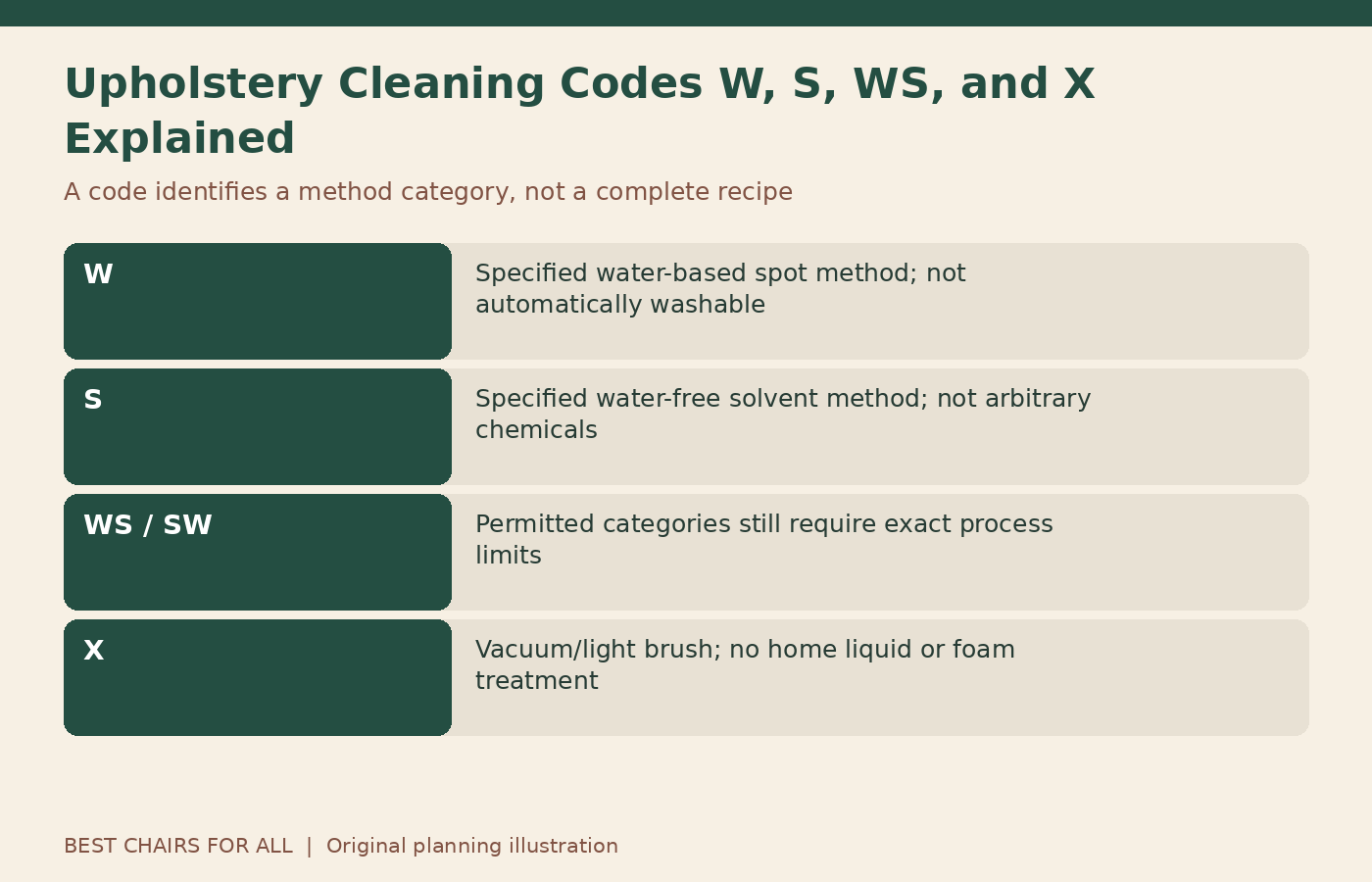
Upholstery cleaning codes identify a permitted category of spot-cleaning method: W generally means water-based, S means water-free solvent, WS or SW allows specified water-based or solvent methods, and X means vacuuming or light brushing without liquid cleaner. The code is a starting point. The finished chair’s instructions, fabric details, stain, and cleaner label still determine what can be done.
The most costly misunderstanding is treating W as washable or S as permission to remove a cover and send it to a dry cleaner. Neither follows automatically. This guide provides a tag-to-action decision sheet that separates the code, approved process, and circumstances that call for professional advice.
Find the code on the actual furniture
Check accessible care labels, the receipt, fabric swatch, and the manufacturer’s product record. A tag describing filling materials is not necessarily the cleaning-code label. Record the chair model and cover code alongside the cleaning letter so advice can be matched to the actual upholstery. Do not infer a code from fiber content or a similar-looking fabric on another chair.
If the code is missing, ask the retailer or manufacturer to identify the cover. Photograph the full label and chair rather than transcribing only a partly legible letter. Until the instructions are confirmed, avoid applying liquid or solvent as an experiment. A hidden-area test is not a substitute for identifying an unknown cleaning method.
Read W as a restricted method category
W commonly permits an appropriate water-based upholstery shampoo or foam for spot cleaning under the maker’s directions. It does not mean flood the seat, use every household detergent, or wash the casing. The amount applied, pretesting, residue removal, drying, and whether the assembled chair permits a method remain important. Excess moisture can reach filling and backing beyond the visible spot.
La-Z-Boy’s fabric-care page specifically limits its W guidance and says hot-water extraction and steam cleaning are not recommended. That is a clear example of why water-compatible does not mean every water-based machine process is acceptable. Use the exact manufacturer’s restrictions for your chair rather than assuming a rented cleaner is suitable.
Read S as water-free solvent guidance
S generally directs spot cleaning with a specified water-free dry-cleaning solvent. It is not a recommendation to use any solvent from a garage or cleaning cupboard. Follow the furniture and product instructions, including precautions and professional-cleaning advice. If you cannot identify an appropriate approved product or use it under the required conditions, involve a qualified upholstery cleaner.
Do not automatically remove a cover for dry cleaning. The fabric, backing, lining, thread, and assembled shape can respond differently when cleaned separately. Manufacturer instructions may expressly prohibit that removal. Record S, approved solvent process, and cover-removal restriction as separate fields on the decision sheet rather than shortening the whole instruction to dry clean.
Read WS, W-S, or SW in context
These combined codes generally allow specified water-based or solvent spot-cleaning approaches, but they do not make every chemical or technique acceptable. The stain and manufacturer’s detailed instructions may determine the choice. Do not mix products or alternate several unrelated cleaners simply because the code contains both letters. A broader permitted category still needs a controlled process.
Ashley’s care-and-cleaning guide lists SW and WS alongside W, S, and X and includes limits on saturation and casing treatment. Treat these as instructions for the furniture covered by its guidance. When another maker has different detailed directions, follow that item’s instructions rather than building a hybrid recipe from several brands.
Read X as a firm limit on home spot chemicals
X generally means vacuuming or light brushing for loose soil without water, foam, or solvent cleaner. A stubborn mark does not change that code. Avoid trying a tiny amount of liquid because the spot is small or because the cleaner is described as gentle. The next useful action is to ask the manufacturer or an appropriate professional about the specific problem.
Keep brush and vacuum choices compatible with the fabric. A coarse brush can damage a delicate surface even when brushing is allowed in principle. Do not turn light brushing into aggressive scrubbing. Photograph the mark and record what caused it if known. That evidence is more useful to a cleaner than a surface already altered by several attempted treatments.
Separate spot cleaning from overall cleaning
A code often addresses localized spot treatment, while overall soil can require professional cleaning of the complete upholstered item. Cleaning one patch differently from the surrounding fabric can leave a ring or uneven appearance. The goal is not to apply a permitted product everywhere until the chair looks uniform. Follow the manufacturer’s guidance about when a professional service is appropriate.
The Crate & Barrel care brochure discusses professional cleaning, possible rings from spot treatment, and its code definitions. It also treats slipcovers separately from fixed upholstery. That distinction is useful for any owner: a spot code, full-cleaning instruction, and removable-slipcover laundering instruction answer different questions.
A zipper does not supply laundering permission
A cushion cover can unzip for assembly, insert replacement, or service without being designed for a washing machine. Shrinkage, backing changes, seam distortion, color differences, or fitting problems can result when the wrong process is used. Ask for explicit washing or dry-cleaning instructions for that particular casing if removal is intended.
If a product is expressly machine washable, use its actual cycle, temperature, drying, and refitting directions. Do not borrow those instructions for another cushion on the same chair unless the manufacturer says they match. A loose decorative pillow, seat casing, and full slipcover can have different care requirements. Label the records so household members do not treat all removable fabric alike.
Build the tag-to-action decision sheet
Use six fields: chair and fabric identity, code, detailed manufacturer instruction, cleaner permitted, cover-removal rule, and stop conditions. Attach a label photograph and source link or manual page. Keep the raw code visible alongside your plain-language interpretation. This lets a professional check whether the proposed method follows the whole instruction rather than only one letter.
Add a separate field for the current problem: fresh spill, dry soil, unknown mark, odor, overall soiling, or finish change. A method suitable for one problem may be ineffective or inappropriate for another. If the sheet has an unknown code, unknown stain, or no confirmed cleaner, the next action is clarification rather than a guessed household mixture.
A three-chair worked example
Imagine Chair A is W, with instructions allowing a particular water-based spot cleaner and prohibiting extraction. Chair B is S, with professional solvent cleaning advised and no casing removal. Chair C is X, permitting only loose-soil removal at home. All three have visible zippers, but none gains machine-washing permission from that feature.
The decision sheet leads to different actions: A can follow its approved spot process after the required test; B needs the specified professional route; C needs manufacturer or professional advice about a stain rather than liquid treatment. These are hypothetical examples, not substitute instructions for actual furniture. The value is seeing how code, detailed limits, and problem type combine.
Pretest only within an approved process
When the instructions require a hidden-area test, use the stated cleaner and method on an appropriate part of the same material. A test on a different underside fabric does not establish how the seat face will respond. Follow the required waiting and drying guidance before judging color, texture, or transfer. Do not declare success while the area is still wet.
Stop for unexpected color change, stickiness, texture alteration, or finish transfer and ask for advice. Do not immediately add another product to reverse the effect. Layered treatments make it harder to identify the original stain and the cause of any damage. Record the product, amount or method used as instructed, time, and observed result for the provider.
Respond to a fresh spill without inventing a recipe
Follow the furniture maker’s immediate spill instructions. Where blotting with a suitable clean absorbent cloth is directed, distinguish that from scrubbing the stain outward. Do not assume that adding water is always the correct first response, particularly on S or X upholstery. Identify the code and approved process promptly while avoiding unnecessary spreading or saturation.
For ink, dye transfer, adhesive, oil, bodily fluids, or unknown substances, obtain specific guidance when the ordinary permitted method is not clear. A household cleaning hack may be incompatible with the fabric or leave residue. The code tells you a category, not a guaranteed remedy for every stain. Do not promise that any one method will restore the original appearance.
Check mixed materials and nearby components
A chair may combine fabric, leather, vinyl, wood, metal, buttons, or powered controls. The fabric code does not authorize cleaning every component with the same product. Protect adjacent surfaces as directed and keep liquid away from electrical parts. If a spill may have entered powered components, stop operation and ask the provider before resuming use.
Do not steam a leather panel because a nearby fabric section has W instructions, or apply a fabric solvent to exposed wood trim without compatibility guidance. Record each material on the decision sheet if the chair uses more than one care system. A whole-chair photograph helps a professional understand these boundaries before recommending a treatment.
Ask useful questions when the instructions conflict
If a fabric supplier’s guide permits a method but the assembled-chair instructions prohibit it, ask the furniture maker which restriction governs that item. Backing, adhesives, filling, and construction can explain a difference. Do not select whichever source allows the strongest cleaner. Provide the exact model, cover code, labels, and relevant documents for a written answer.
If the retailer suggests machine washing despite a conflicting label, ask for model-specific confirmation and what responsibility they accept for the outcome. Keep the answer with the chair records. A casual statement about what usually works on polyester is not the same as an instruction for your casing, even if the visible fiber content appears simple.
Keep the record for future cleaning
Store the code photograph, complete care instructions, approved product details, and any professional service report together. Tell other household members where they are. Update the record after reupholstery or a replacement cover, because the original chair model no longer identifies the fabric alone. Retain a sample and new cover code where available.
The practical reading rule is to move from code to detailed instructions, then from the actual problem to an approved method. W is not a washing-machine symbol, S is not permission for arbitrary solvents, WS is not unlimited cleaning freedom, and X is not a challenge to find a gentle liquid. Correct interpretation protects the whole upholstered chair, not just the visible spot.
Something unclear or out of date? Send a correction with this article’s title and the detail to check.
Sources, research & corrections policy ↗