A double camping chair may state a combined capacity, a limit for each seat, or both. Read the wording for the exact model before dividing or adding numbers. A 500-pound total does not automatically mean either side can support 500 pounds, and two 250-pound seat limits do not permit one occupant to use all 500 pounds on one side. The load distribution and intended configuration remain part of the instructions.
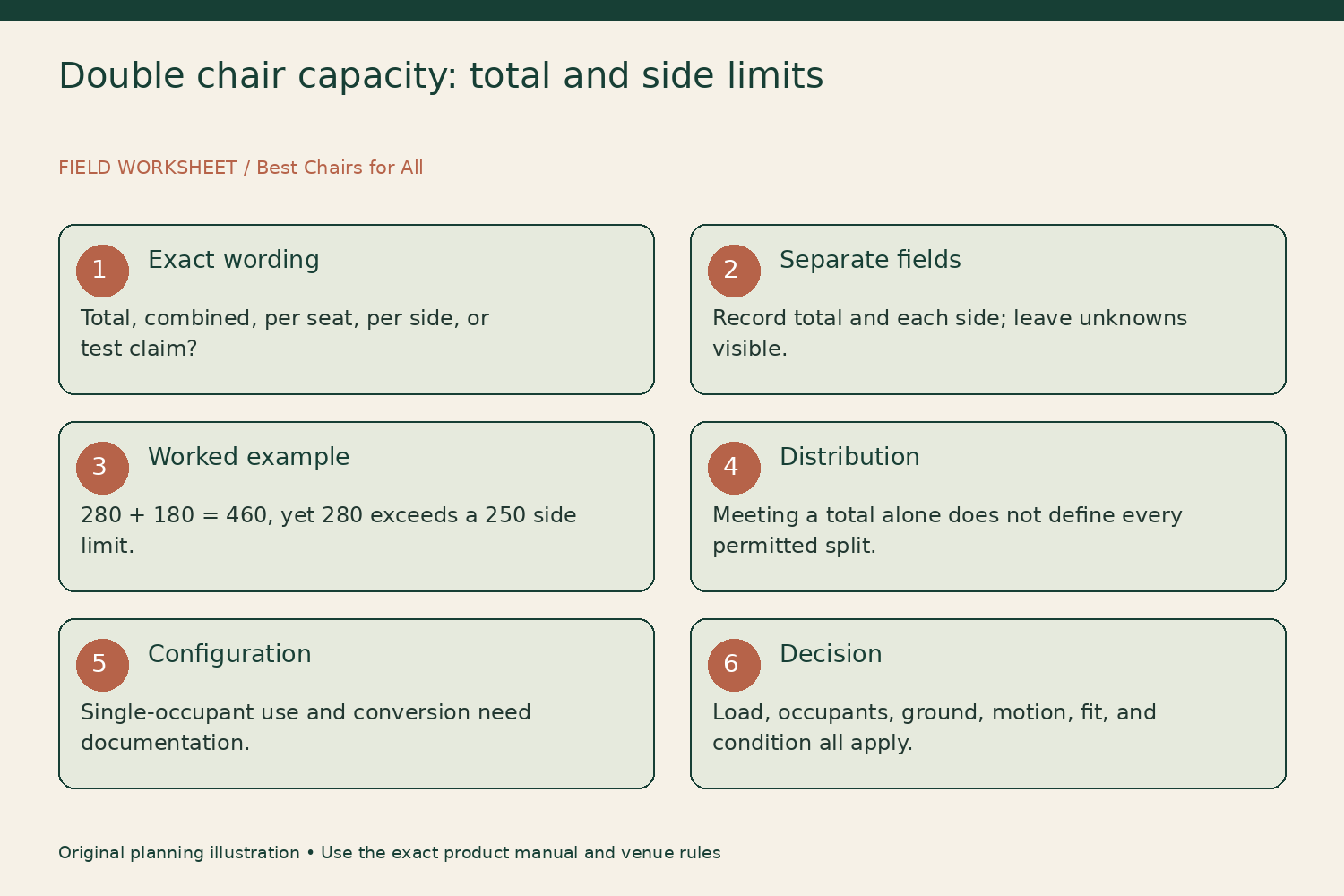
This guide provides a capacity worksheet with worked examples and a comparison of current manufacturer wording. It does not establish a safe load for an unidentified loveseat or prescribe an extra safety margin that overrides the label. Confirm the chair’s model, manual, seating positions, and ground requirements. If the manufacturer leaves per-seat or single-occupant use unclear, ask rather than turning a combined number into an invented rule.
Copy the exact capacity wording
Record the number, units, and words immediately around it: ‘total,’ ‘combined,’ ‘per seat,’ ‘per side,’ or another definition. Include the source and date. A retailer filter that lists only ‘weight capacity’ may omit the most important part. Save the manufacturer document or photograph the label so the wording remains connected to the product rather than a remembered number.
Also record the model and version. A standard loveseat, low loveseat, rocking tandem, and wide bench from the same brand may have different ratings and structures. Do not transfer a capacity because the upholstery or brand is the same. If an online listing uses several model names interchangeably, resolve which product will actually arrive before using its specification in your decision.
Compare two real wording styles
The Kelty Loveseat manufacturer page lists a 600-pound weight capacity for the named two-person product. That single figure should not be divided into a claimed 300-pound per-seat limit unless the manufacturer specifies it, nor treated as a 600-pound allowance on either side. Ask for the current manual’s distribution and occupant-use instructions when those details matter to your purchase.
The GCI Tandem Rocker manufacturer page, by contrast, explicitly states 250 pounds per seat. That is clear seat-specific wording. It also describes a particular convertible arrangement, so follow its instructions for the selected configuration. These are documentation examples rather than hands-on recommendations, and the rating of one design should not be applied to another double chair.
Keep total and side conditions separate
Create worksheet fields for total limit, left-seat limit, right-seat limit, number of occupants, and allowed configuration. Write ‘not specified’ when a source does not give a particular limit. This prevents a missing per-seat number from being silently filled with half the total. It also prevents a clear per-seat limit from disappearing behind an attractive combined headline.
When both total and per-seat conditions are stated, each has to be satisfied. A candidate cannot pass because one condition looks generous while another is exceeded. If only one type of number is supplied, ask how it applies to your intended occupants. The correct answer may be in a manual or label that the product page does not reproduce, so request that document rather than guessing from the frame shape.
Work through a per-seat example
Suppose a hypothetical double chair has a 500-pound combined limit and a 250-pound limit per side. Two hypothetical occupants weigh 280 and 180 pounds, for a total of 460. The combined number is below 500, but the 280-pound occupant exceeds the side limit. That use fails the stated conditions even though forty pounds remain beneath the total. The example is arithmetic, not a specification for a named product.
Swap the seats and the problem remains: the same occupant still exceeds either side’s limit. Buying a wider loveseat does not solve the rating unless its actual limits support the intended use. Likewise, moving closer to the center is not an approved workaround unless the manufacturer explicitly describes that seating arrangement. Capacity questions should be resolved through the documented positions, not through experiments in sharing the load.
Work through a total-only example
Now consider a hypothetical chair that states only 600 pounds combined. Two occupants totaling 520 pounds satisfy that one numerical comparison. It does not follow that every distribution totaling 520 is permitted. If one occupant is substantially heavier than the other, ask the manufacturer about the specific distribution, intended positions, and whether separate side restrictions exist in the manual.
Do not report the candidate as confirmed while those necessary details remain unknown. Mark it ‘total comparison met; distribution unresolved.’ That phrase preserves what you actually know without making the larger claim. It also gives customer support a precise question to answer. A total-only listing is not necessarily unsuitable; it simply supplies less information than a document that defines both total and per-seat conditions.
Distinguish sitting capacity from test language
Static testing, maximum load, and recommended user capacity can be described differently. The ALPS Brands FAQ says its listed capacities are based on exceeding static weight tests. That statement explains something about its own published ratings; it does not give owners permission to reproduce a load test or apply the same interpretation to every brand. Read the instructions for ordinary use separately from test descriptions.
Do not convert a capacity into permission for bouncing, standing, rocking a static frame, or dropping into the seat. Those actions are not justified by unused pounds in a simple arithmetic comparison. Follow the maker’s intended movement and setup. A strong-looking frame and an impressive test phrase do not replace the warnings about how the furniture is meant to be occupied.
Ask how accessories and carried items count
Include the actual use arrangement in a manufacturer inquiry: occupants, permitted cushions, and any item held or placed on the seating surface. Do not assume that a heavy bag disappears from the applied load because it is on someone’s lap. At the same time, do not invent a universal definition of what every manufacturer’s occupant rating includes. Ask when the manual’s wording does not answer the question.
Side tables, cupholders, cooler pouches, and accessory mounts can have separate limits. Do not treat a chair’s total sitting capacity as their capacity. A cooler integrated into an arm is not an extra seat, and a central fabric space is not automatically a third occupant position. Read seating capacity and weight capacity together so a broad bench shape does not become permission for more users than the maker intends.
Check single-occupant use separately
Ask whether the double chair is designed to be used by one person, in which position, and in which configuration. Do not assume that the unused seat’s capacity transfers across. A convertible tandem may have explicit single-seat instructions, while a fixed loveseat can have different use conditions. The named GCI product describes conversion, but that feature belongs to its documented design rather than every two-person chair.
Do not fold only one half of a chair unless the instructions specifically permit it. A shared frame can depend on its full open geometry even when just one person sits down. Similarly, a pet or bag on the second side should not be treated as a required counterweight. The chair must be suitable for the intended use through its own instructions, not through a balancing arrangement invented by the owner.
Inspect the shared support structure
Identify the complete opening sequence, frame locks, feet, seat supports, and any central components in the manual. A double chair can share members between seating areas, so damage beneath one side can matter to the whole product. Inspect visible connections and fabric supports before use. Do not keep using the apparently intact side of a chair with unresolved structural damage unless the manufacturer explicitly assesses and permits that arrangement.
A sagging seam, bent brace, cracked fitting, or repeated loosening deserves documentation. Photograph the full frame and the affected area, then contact the maker for the specified remedy. Do not add a board, extra strap, or homemade brace to restore the advertised capacity. A repaired appearance does not establish that the original rating remains applicable after an unapproved structural modification.
Include the ground and movement instructions
Use the surface and setup required for the exact chair. A capacity measured or stated for proper use does not approve a slope, soft ground, or an incomplete opening. A double chair’s larger footprint may encounter more varied contact points than a single seat. Check every support rather than assuming that two people will press the frame evenly into place.
For a rocker, follow the intended motion and clearance requirements; for a static loveseat, do not imitate a rocking design. Do not use a lower combined occupant weight as a reason to lean the frame onto fewer feet. Ground compatibility, permitted motion, and capacity are separate conditions. A worksheet should show each one rather than compressing them into a single overall strength rating.
Resolve conflicting online specifications
Compare the received label, current manual, manufacturer page, and seller description. If numbers differ, contact the manufacturer with the exact SKU, photographs, and purchase details. Do not choose the highest rating or average conflicting figures. A revised model or copied listing may explain the difference, but the explanation needs confirmation before you rely on it.
Keep the reply with the purchase file. Ask the seller to identify which version it is supplying if the difference affects your choice. A statement that the product is suitable for ‘two adults’ does not answer a numerical capacity question for your intended occupants. Supply the relevant load arrangement privately to the manufacturer when needed, without assuming a generic adult weight or body size.
Make a concrete capacity decision
Your final worksheet should state the documented total and side limits, intended occupant count, planned distribution, permitted configuration, ground requirements, and any unresolved wording. Use pass, fail, or needs clarification for each essential condition. Do not let a comfortable trial or generous width overrule a failed load condition. Fit and capacity both need answers.
Choose a different chair or separate seats when the documented conditions do not match the intended users. If information is missing, obtain it before purchase or use rather than creating a personal per-seat rating. Double camping chair capacity is straightforward once the wording is preserved: total limits govern the stated combined arrangement, per-seat limits govern the stated seating positions, and neither can be reallocated by arithmetic alone.
Something unclear or out of date? Send a correction with this article’s title and the detail to check.
Sources, research & corrections policy ↗