A telescopic stool’s load limit does not override its ground restrictions. If the instructions require a firm, level surface, a high advertised capacity is not permission to use it on a slope, loose sand, or an uneven bank. Check the exact model, the supported height settings, the lock engagement, and the intended sitting position before considering the number on the label. Capacity is one condition of use, not an all-purpose stability guarantee.
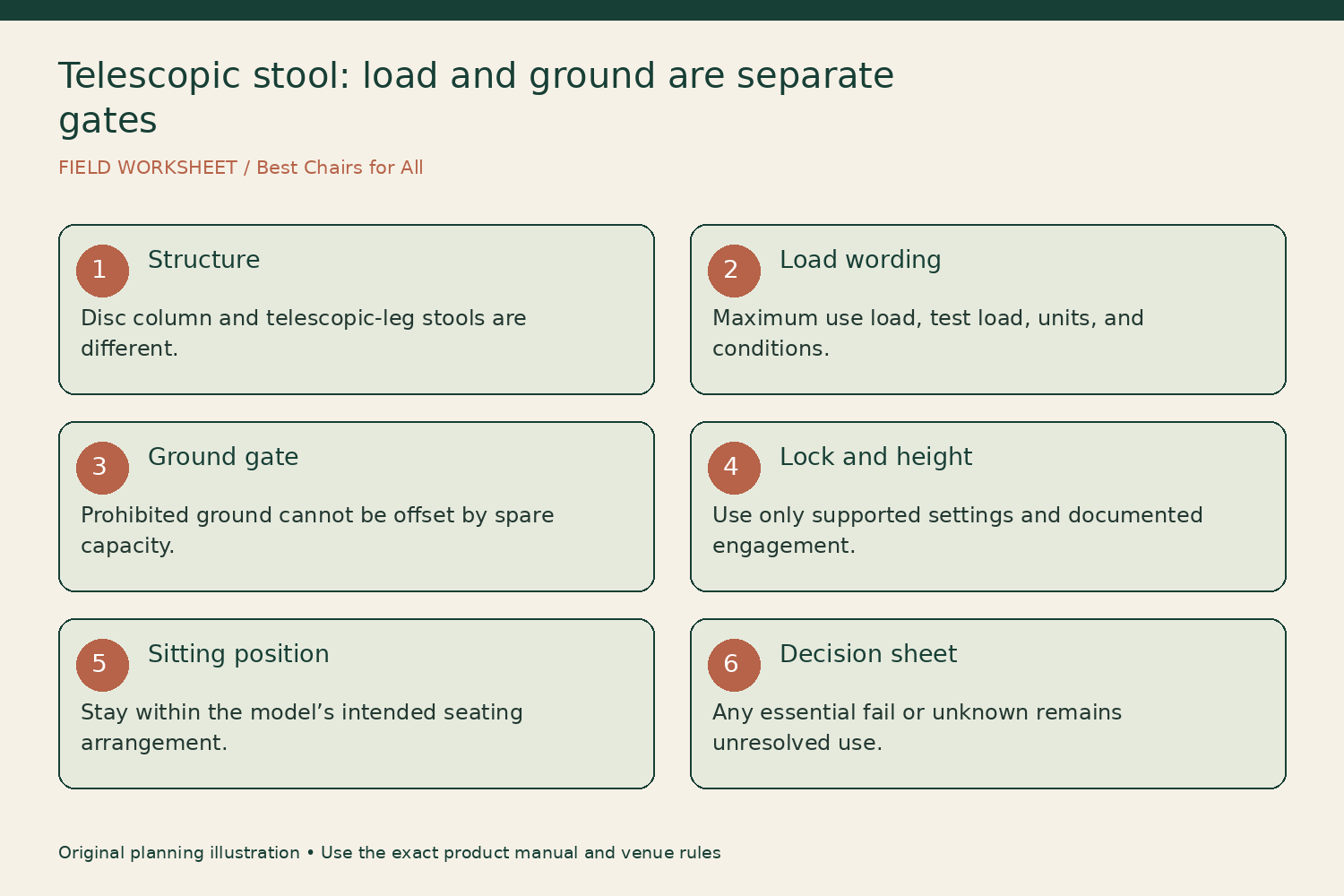
This guide provides a load-and-ground decision worksheet and compares documented examples. It separates disc-style retractable stools from three-legged stools with telescopic legs, because both can appear under the same shopping term while using different structures. It does not provide a universal slope limit, a homemade leveling method, or a calculation that converts a flat-surface rating into a safe load on uneven ground.
Identify the structure behind the name
A disc-style telescopic stool expands from a compact round package into a column of interlocking segments. A telescopic-leg stool has a seat and several extending legs. Their locking systems and ground contact are different. Find the product label and manual, then compare the actual object with the drawings. A similar folded size or color does not establish the same construction or load limit.
Record the model, manufacturer or importer, maximum load wording, allowed heights, and surface restrictions. If the seller cannot identify the stool or provide instructions, leave those fields unresolved. Do not use another seller’s visually similar manual as proof of compatibility. Small changes in latches, segment material, feet, or locking arrangement can matter even when the overall silhouette is familiar.
Read capacity with the restrictions beside it
The Amtech U8000 product page pairs a 100-kilogram maximum load with a firm, level surface requirement and expressly identifies uneven or soft surfaces as unsuitable. Read those conditions together. The product’s outdoor use description does not erase its ground restriction, and the maximum load is not a recommendation to test a stool under every outdoor condition.
Keep the source date and exact model in your notes. These examples use manufacturer and supplier documents to explain label interpretation, not to recommend a particular model’s availability in the United States. If the product offered locally differs from the documented version, confirm the instructions and rating before purchase. Do not assume that the most generous number found online applies to the stool in your hand.
Distinguish supported load from a test claim
A listing can mention maximum supported load, test load, static load, or another figure. Ask what the manufacturer intends the user to follow. A test claim is not automatically a user limit, and a capacity without stated conditions leaves questions. Do not select the largest number across several sellers or convert a promotional demonstration into permission to lean, bounce, or sit on the edge.
For any unclear wording, ask the maker to identify the maximum user load for the exact model, permitted configurations, and ground conditions. Save the reply. The answer should resolve the operating limit rather than simply repeat a strong-material claim. ‘Reinforced,’ ‘fish-scale structure,’ and ‘heavy duty’ describe marketing or construction language; they do not provide a missing load condition or engagement procedure.
Check units without changing the limit
Keep the manufacturer’s units and avoid rounding a capacity upward. For comparison, 100 kilograms is approximately 220 pounds. The conversion is useful for reading a label, but it does not create extra capacity from rounding or describe how the load is distributed. If two listed units are materially inconsistent, ask which official limit applies rather than silently choosing one.
Include clothing and any carried item that the instructions say forms part of the applied load. Do not assume an occupant can hold a heavy bag without affecting the stool because the bag is not directly on the seat. Ask the manufacturer when its definition is unclear. A load worksheet should show the uncertainty rather than presenting a neatly calculated pass based on an interpretation the maker never supplied.
Treat ground as a separate gate
Make a surface row before the capacity row: firm, level, and otherwise permitted by the manual? If the answer is no, stop that use plan even when the intended load is well below the rating. This avoids a common reasoning error in which a large spare capacity is treated as compensation for a prohibited surface. A lower load does not rewrite the instructions.
For an illustrative case, a person below a hypothetical 220-pound rating plans to use a stool labeled for level surfaces on a visibly sloping bank. The load condition may be met, but the surface condition is not. No arithmetic subtraction fixes that mismatch. Choose a permitted location or research seating documented for the actual conditions, rather than calculating a personal discount factor for the stool’s capacity.
Understand contact and uneven loading
A flat disc base needs its intended support beneath it. A three-legged design distributes load through separate contacts. Neither description alone establishes suitability for every irregular surface. Walkstool’s manufacturer FAQ explains that uneven ground can place a larger share of load on individual legs and gives model-specific use guidance. That discussion belongs to its telescopic-leg design, not to disc stools generally.
Do not transfer a three-legged stool’s soft-ground accessories or instructions to an interlocking-column model. Likewise, a wider disc does not automatically solve loose ground or rocking contact. Keep the ground restriction attached to each model on your comparison sheet. The relevant evidence is the maker’s documented intended use, not an intuitive claim that one shape ought to be stable.
Verify the height and locking arrangement
Find which heights are permitted and how engagement is confirmed at each one. A stool that can be physically stopped halfway open is not necessarily intended for use at that height. Follow the exact opening and locking sequence, keeping hands clear of the identified pinch points. Do not copy a twist direction or release method from another stool whose latches may work differently.
Inspect the engagement as instructed before sitting. If a segment appears uneven, a latch is damaged, or the stool does not achieve the specified locked state, stop use. Do not sit gently to find out whether it settles into place. A partial extension or a random click is not a substitute for the model’s required confirmation. Ask for a clear diagram when the supplied instructions leave the locked condition ambiguous.
Respect the intended sitting area
The FXPTS supplier datasheet specifies central sitting and warns against sitting on the edge for that stool. Use the current instructions for your own model. A large seat diameter does not mean every point on its surface is an equivalent permitted load location, and it does not authorize leaning the stool to reach something beside you.
Plan the task so you can remain in the documented sitting position and stand without pulling on a nearby object. If you need to reach far sideways repeatedly, choose another layout or seating design. Do not treat the stool as a balance tool, step, or ladder. A seated load rating is not a standing or climbing rating, even when the folded object looks solid under a foot.
Reject improvised leveling
Do not place a disc stool partly on a stone, board, folded towel, or other loose support to imitate a level surface. Such arrangements can create incomplete contact or shifting layers. Do not add homemade legs, widen the base with an unapproved plate, or wedge the stool against another object. These modifications create a new support system without the manufacturer’s instructions.
If the maker offers an approved accessory, check the exact models, surfaces, and installation it covers. An accessory for a particular telescopic-leg stool does not grant permission for a different product. Where the documented requirements cannot be met, the practical solution is a different location or suitable equipment, not an increasingly elaborate way to keep the original stool in the plan.
Inspect condition independently of capacity
Look for visible cracks, damaged segment edges, deformed parts, missing feet, loose seat attachment, and a lock that no longer behaves as described. Record changes after impacts or difficult transport. Do not paint, tape, or glue a load-bearing crack and assume the original rating still applies. Ask for the specified replacement or stop-use remedy.
Do not perform home proof tests with weights, bouncing, or another person. A stool surviving one improvised test does not establish its remaining condition, and failure can injure the tester. Use only the manufacturer’s prescribed pre-use checks. Keep a suspect stool clearly out of circulation so another household member does not see a neatly folded package and assume it is ready for use.
Follow material-specific care
Clean and dry the stool through its own instructions. Do not lubricate an interlocking mechanism or telescopic leg simply because it moves. Walkstool, for example, instructs users not to oil its telescopic legs. That is useful evidence that movement does not automatically imply lubrication. Another model needs its own guidance, including how dirt should be removed from latches or segments.
Avoid disassembly unless the manufacturer explicitly identifies a user procedure. Keep dirt and loose items from interfering with the documented closed transport state. Store the product in its specified conditions and inspect again before the next use. The load label describes a correctly functioning product used as intended; it does not remove the need to address damage, contamination, or an uncertain lock.
Complete the load-and-ground decision sheet
Use separate pass, fail, or unresolved entries for identity, load wording, units, permitted height, lock engagement, surface, sitting position, and condition. A failure in a necessary condition should stop the proposed use, while an unresolved item requires an answer. Do not add the entries into a score that lets a high load rating outweigh a prohibited ground condition.
Before buying, send the manufacturer your actual use case and ask about the specific surface and task. Before using, verify the stool and instructions match what you researched. Telescopic stool weight limits are meaningful only alongside the setup and warnings that define them. Reading both the capacity and ground requirements gives you a usable decision without inventing a universal allowance for uneven terrain.
Something unclear or out of date? Send a correction with this article’s title and the detail to check.
Sources, research & corrections policy ↗