Clean HDPE outdoor chairs by identifying the manufacturer and starting with its ordinary soap-and-water method. Use the approved soft tool to reach the surface texture, rinse as directed and treat metal hardware and upholstery under their own instructions. Do not assume every chair sold as poly lumber permits the same bleach solution, abrasive pad or pressure-washer setting.
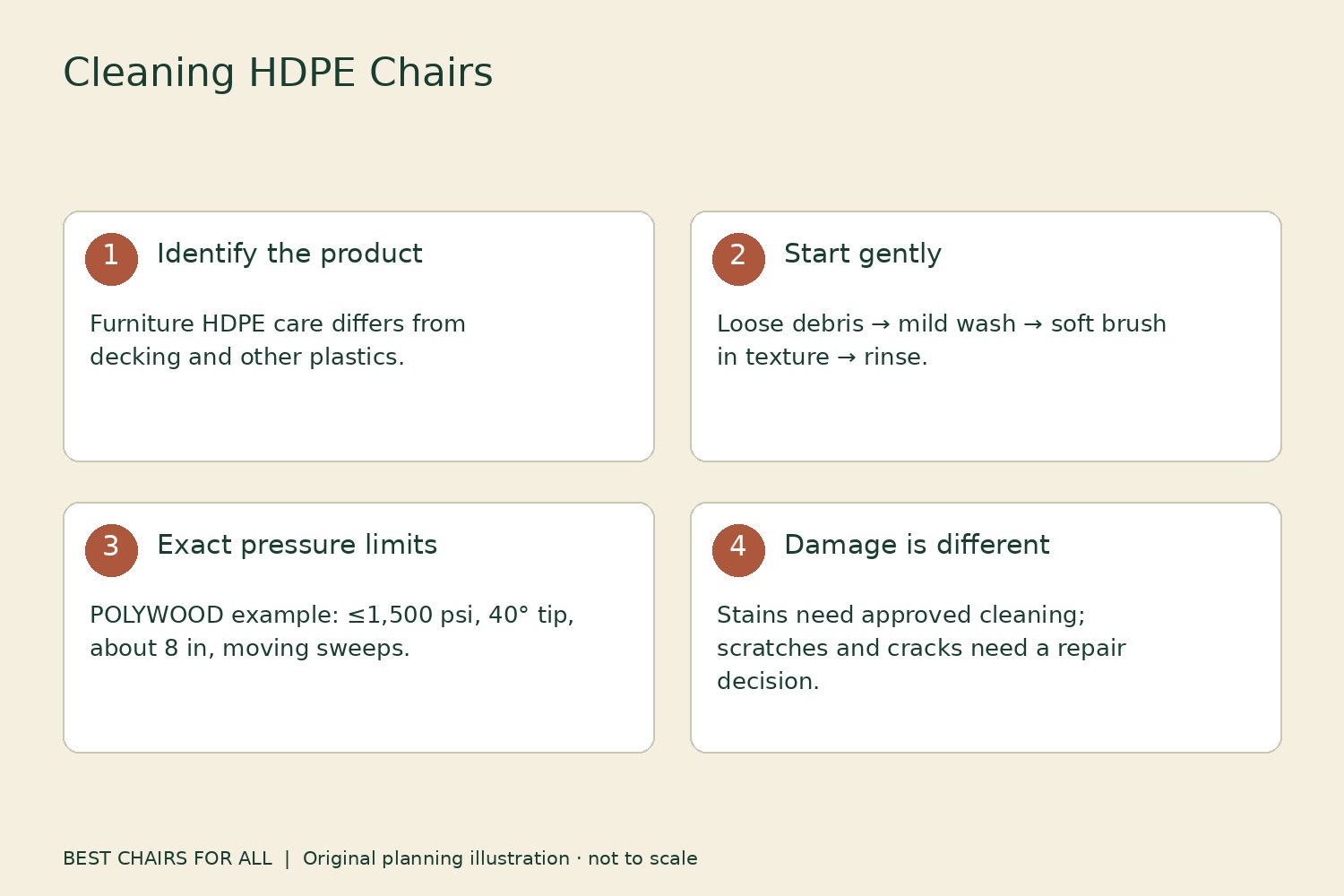
The chair’s wood-like form can be misleading. HDPE lumber is not a wooden surface to sand and refinish when a mark remains. A cleaning routine should remove contamination while preserving the manufactured texture. The method-selection card below separates ordinary washing, persistent stains, permitted pressure washing and actual surface damage so each gets the right response.
Establish the product identity
Find the model and serial label, usually on an accessible underside, and retain a photograph. Read the current furniture care guidance rather than a decking document from the same brand family. A composite deck, polymer sheet and HDPE furniture lumber can have different constructions and cleaning limits even when their names look related.
Confirm which components are HDPE and which are not. The chair may include metal hardware, hinges, glides and cushions. A permission for cleaning the lumber does not automatically apply to those parts. Remove loose upholstery where the design permits and keep it away from the frame-cleaning area unless you are deliberately cleaning it by its separate method.
If the chair is unidentified or the finish history is uncertain, do not begin with an aggressive treatment. Ask the seller or maker for the correct care sheet. A wood-grain pattern or solid color does not prove a universal chemical tolerance. Keep unknown components out of a planned pressure-washing operation until the instructions are resolved.
Distinguish dirt from damage
Brush off loose debris using the permitted gentle tool, then inspect the surface. Dirt in a groove, a greasy spill, a scratch and a gouge are different problems. A scratch may remain visible after cleaning because material has been changed or removed. Repeated scrubbing will not necessarily restore the original texture.
Photograph a persistent mark before escalating. Note whether it appeared after a spill, dragging, a hot object or prior cleaning. That context helps support identify a suitable method. Avoid calling every dark area mold or assuming every pale area is removable residue. A household inspection can describe appearance without establishing a precise cause.
Check structural components at the same time. A cracked member, loose joint or damaged folding mechanism requires attention beyond cleaning. Do not sit in a questionable chair to see whether it still holds. Keep it out of use and ask for the approved repair or replacement route. A clean polymer surface does not certify the condition of the assembly.
Use the ordinary wash first
Trex Outdoor Furniture’s care page describes removing loose debris, using mild dish soap with warm water, cleaning the lumber with a cloth or soft-bristle brush, then rinsing and air drying. This is a practical named example of routine care. Follow the actual maker’s equivalent method for your chair.
Work through the slats, edges and accessible underside rather than only wiping the broad seat panels. Textured areas can hold dirt where a flat cloth does not reach. Use light deliberate brushing without forcing a tool into a joint or scraping around a fastener. Keep a separate dirty-ground-contact cloth so grit from chair feet is not carried onto the sitting surfaces.
Refresh dirty water and clean tools as necessary. Repeatedly moving a soiled cloth across a pale chair can spread residue rather than remove it. Rinse each area according to the instructions before deciding whether a mark remains. A soapy wet surface can look different from its final dry condition, so avoid judging the result halfway through.
Reach narrow spaces without scratching
Use only non-damaging tools permitted by the maker. A soft brush with a manageable head can reach between slats without levering them apart. Do not use a metal pick, knife or screwdriver to clear a small gap. Those tools can score the lumber or damage a finish on nearby hardware.
Keep moving parts within their normal range while cleaning. If you need to open a folding chair to reach a joint, follow the manual and keep fingers clear. Do not remove structural bolts merely because a gap is difficult to wash. Routine access and a repair operation are different tasks, and unnecessary disassembly can create a new assembly problem.
Look underneath after rinsing. Dirt washed from the top can collect on a lower rail or around a glide. Check those areas without dragging the chair across the patio. Use its approved lifting points when repositioning it. A chair’s substantial weight is another reason to plan the work area before starting rather than turning it awkwardly while it is slippery.
Pressure washing requires an exact permission
POLYWOOD’s lumber care instructions permit pressure washing within specified conditions: equipment rated no higher than 1,500 psi, a 40-degree fan tip, a nozzle about eight inches from the surface and slow even sweeps. Those details belong together. Copying only the pressure number leaves the procedure incomplete.
Trex Outdoor Furniture gives corresponding product-care limits for its lumber, but that does not establish permission for an unknown HDPE chair. Check the maker’s current directions for your model. Do not substitute a narrow nozzle or hold the wand close because a stain remains. A broad material name is not a specification for jet cleaning.
Keep the wand moving as directed and follow the pressure-washer’s own safety instructions. Protect adjacent materials and people from the spray. If you cannot reproduce the permitted setup or identify the equipment rating and tip, use the approved hand-cleaning route instead. A pressure washer is an optional method where authorized, not a necessary stage of every cleaning job.
Keep fabric out of the lumber-cleaning method
POLYWOOD explicitly says not to pressure wash cushions, fabrics or pillows. Treat that as a separate restriction even when the cushion rests on a chair whose lumber may be pressure washed. Remove upholstery as permitted before starting and keep it where overspray cannot reach it.
If a chair has permanently attached fabric, obtain instructions for the complete product rather than trying to shield it with an improvised plastic wrap. Water can enter around the edges or become trapped. A mixed-material chair needs a cleaning method that works for all exposed components, not merely for the largest polymer pieces.
Clean upholstery under its fabric and filling instructions, with its own drying plan. Do not assume a diluted cleaner approved for the frame is safe on cushion trim or stitching. Keeping the work separate can be simpler and more reliable than attempting to clean everything with one solution in one pass.
Stubborn stains need a documented next step
Read the maker’s stain or sanitizing instructions for the actual lumber. Stronger products and dilution ratios can differ between care documents and brands. Use the current instructions and product label together. If they conflict or the stain is unidentified, ask the manufacturer before treating the entire chair.
Do not mix bleach with other cleaners, acids or ammonia. Protect yourself, surrounding surfaces and the environment under the label directions. A cleaner called natural still has chemical properties and compatibility limits. Repeated treatments without rinsing or understanding the residue are a poor way to troubleshoot a persistent mark.
Test where the maker directs and keep a short record of the product, concentration and date. This is especially useful if support later recommends a second method. You can provide an exact history rather than saying that several household cleaners were tried. If gentle cleaning reveals a scratch instead of a stain, stop escalating the wash and ask about surface repair options.
Do not sand or paint by assumption
Trex Outdoor Furniture’s FAQ advises against sanding its Genuine POLYWOOD lumber and says painting is unnecessary and affects warranty coverage. POLYWOOD also warns against abrasive cleaning or polishing scrubbers in its care guidance. These restrictions matter when a mark tempts you to treat the chair like wood.
A sanding block can change the texture beyond the original scratch and make an area look different in reflected light. Painting can introduce adhesion and future peeling issues. Do not infer a safe repair procedure from the fact that color may extend through a polymer material. Surface appearance and structural properties are separate questions.
If a gouge or damaged part needs attention, contact the manufacturer with the model label and photographs. Ask whether a compatible replacement component or approved repair exists. Do not melt the surface with a hot tool or fill a structural crack with a general adhesive. Cosmetic improvisation does not establish restored strength or a durable finish.
Use a method-selection card
| Finding | Appropriate route |
|---|---|
| Loose dirt or pollen | Approved soft tool, then routine wash if needed |
| General soil in texture | Mild soap, water and the maker’s soft-brush method |
| Persistent specific stain | Current manufacturer stain guidance and compatible cleaner |
| Authorized deep wash | All pressure, tip, distance and movement limits together |
| Scratch or gouge | Ask about repair; do not automatically sand |
| Crack or unstable joint | Stop use and resolve structural condition |
| Fabric or hardware | Separate component-specific care |
Keep the card with the chair’s model information rather than posting one rule for every plastic item in the garden. The useful question is always what the exact maker permits on this surface and construction. A method that works on a nearby deck or a different chair can be inappropriate even when both products are called outdoor plastic.
Finish with hardware and dryness
Clean accessible hardware according to the chair guidance and inspect for loose or missing parts. Trex discusses corrosion that can appear on hardware in salt-air environments despite its corrosion-resistant materials. That is a reminder that an HDPE chair can still need metal-component care. Do not cover a damaged fastener with paint before documenting and resolving the problem.
Allow the chair to dry before replacing cushions or fitting its cover. Inspect lower rails and joints where rinse water can remain. Keep the care record current if a new stain or repair changes the routine. Regular gentle cleaning, with escalation only through the exact manufacturer’s instructions, preserves both the chair’s surface and your ability to understand its actual condition.
Something unclear or out of date? Send a correction with this article’s title and the detail to check.
Sources, research & corrections policy ↗