A rocking chair walks when repeated rocking leaves it in a different position on the floor. Possible contributors include uneven contact between the runners, a slope or irregular surface, a rug edge, mismatched or damaged protection, loose assembly, or movement that loads one side differently. The pattern needs investigation before adding grip or modifying the runners.
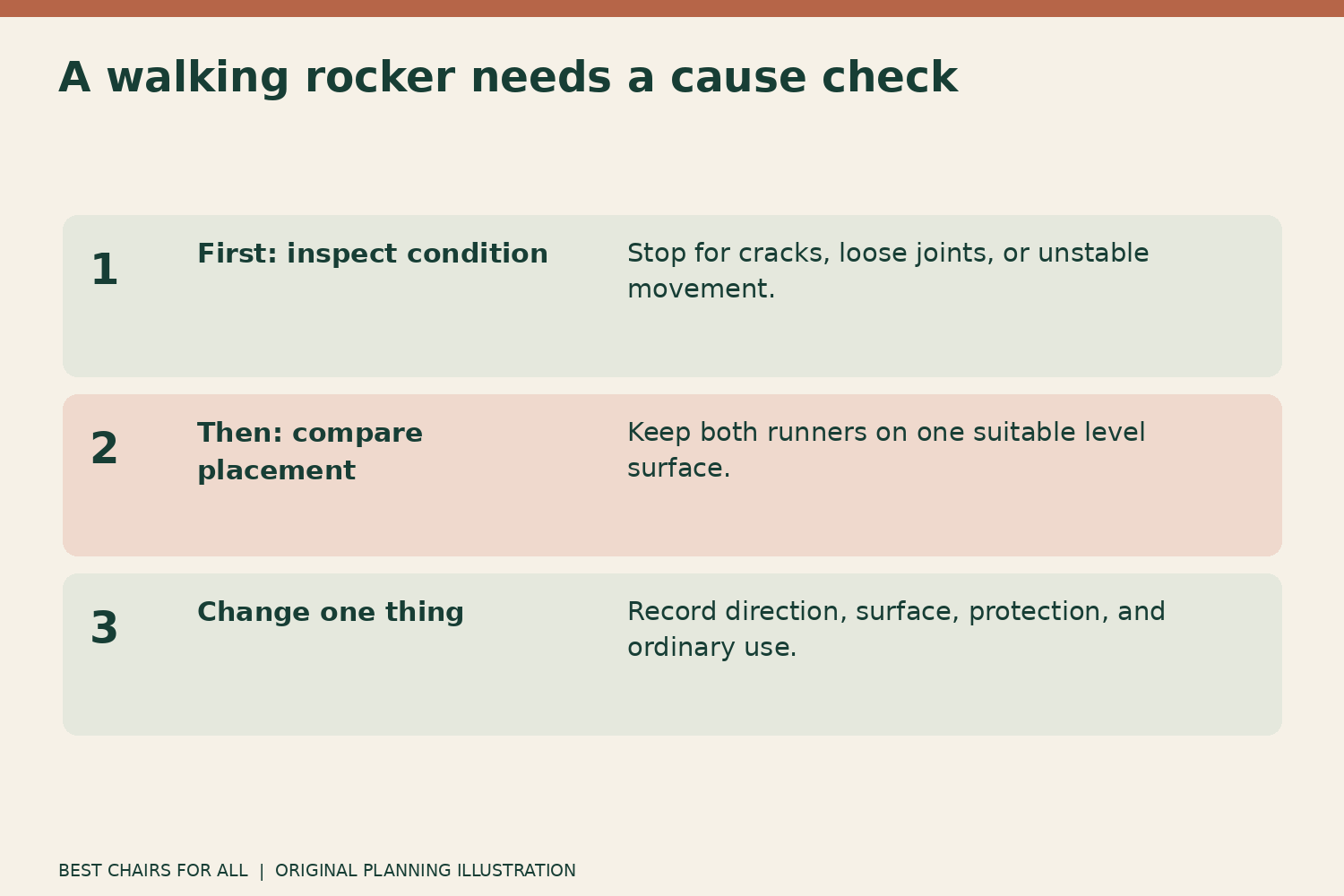
Start with a condition check, then compare the chair on a suitable level surface with both runners supported consistently. Stop using a chair that wobbles, has cracked parts, or shifts unexpectedly enough to compromise its clearance. The diagnostic steps below are practical observations, not a substitute for the manufacturer’s assessment of a damaged frame.
Define the movement before choosing a remedy
Describe what walking means in your case. Does the chair move forward, backward, sideways, or rotate? Does it happen during ordinary gentle motion or only when the user pushes strongly with one foot? Did it begin after moving the chair, changing a rug, replacing felt, or assembling a new frame?
Photograph its starting position against a fixed room reference and make a brief note after a short ordinary session. Place any removable tape beside the chair’s area only if the floor finish permits it; do not attach a marker under a runner or inside the moving path. A clear description is more useful than saying the chair sometimes slides.
A new symptom deserves different attention from a long-standing slight drift. If the motion suddenly changes, inspect the chair and surroundings before another trial. A loose connection, lifted strip, or newly uneven surface should not be concealed with a grippier mat while the underlying cause remains unknown.
Check the floor and rug transition first
Both runners should operate on the same suitable surface throughout normal travel. A runner partly on a rug while the other is on a hard floor can encounter different resistance. A rug edge crossing only one contact path can introduce an uneven transition during each cycle. Reposition the empty chair so the whole operating path is consistent.
POLYWOOD’s patio-rocker guidance calls attention to a firm, level surface and to uneven pavers or gaps when planning placement. Although its setting is outdoors, the underlying placement question is relevant indoors too: the rocker needs stable support appropriate to its design.
Inspect the room location without putting a person in a suspect chair. Look for raised flooring joints, a rug pad folded beneath the rug, or debris under one runner. A floor can appear level from across the room while containing a local irregularity at the precise place the chair contacts it.
Inspect the runner contact surfaces safely
With the chair empty and safely supported for inspection according to its instructions, examine accessible runner bottoms. Look for a shifted strip, exposed adhesive, rough damage, grit, or unequal wear. Do not put hands beneath a chair that can rock or ask someone to hold it tilted while you reach into an unstable position.
Gary Weeks & Co. describes fitted felt strips for its own rocker runners and provides a replacement route. That example shows why the condition and identity of an existing runner covering matter. It does not mean adding felt to any chair will correct migration.
If one runner has a different covering or thickness from the other, record it and contact the maker about the proper configuration. Do not compensate by layering material onto the other side until the chair looks level. Unequal or poorly attached protection can change contact in ways that are not obvious when the chair is parked.
Check assembly against the exact instructions
A frame assembled out of square or with loose fasteners may contact the floor differently from its intended geometry. Inspect visible joints and hardware without forcing or dismantling anything. Follow the manual’s sequence, tools, and tightening instructions. Over-tightening can damage components and is not a reliable cure for a chair that walks.
Standard Chair of Gardner’s care guidance includes a specific instruction about screws securing its rocker runners. That instruction applies to the maker’s construction. Another chair may use different joints or hardware, so the lesson is to obtain the correct model’s procedure rather than applying a universal runner-screw fix.
If a required part is missing or a joint remains loose after the permitted adjustment, stop and contact the manufacturer or a furniture professional. Do not add extra screws, glue an unidentified joint, or reshape a runner based on a generic tutorial. Those changes can make later diagnosis more difficult and alter the chair’s intended structure.
Use a controlled location comparison
If the chair passes the condition and assembly checks, move it empty to another suitable level area with ample clearance. Keep the user and ordinary activity the same. Observe whether the migration pattern changes. This is a troubleshooting comparison, not a durability test, and it should stop immediately if the chair feels unstable.
If the problem appears only in one location, the surface or placement becomes a stronger lead. If it follows the chair to a second appropriate location, the chair’s contact surfaces, assembly, or interaction with the user deserve closer attention. Neither observation proves a cause; it helps organize the next question for the manufacturer.
A second comparison can change the chair’s orientation within a suitable open area, provided both placements meet its instructions. Note whether drift follows the room direction or stays relative to the chair. Do not conduct the trial beside stairs, a wall, or furniture that could become an obstacle if it moves.
A one-change diagnostic log
This original log keeps a practical investigation from becoming a series of random modifications. Change only one reversible condition at a time and keep all manufacturer requirements satisfied. Leave uncertain results marked uncertain rather than repeatedly rocking harder to force an obvious answer.
| Observation | What it suggests checking | Appropriate next action |
|---|---|---|
| Started after rug change | Edge, pad folds, surface consistency | Inspect and restore suitable placement |
| One runner has a lifted strip | Contact material and attachment | Use maker’s replacement guidance |
| Visible loose joint or crack | Frame condition | Stop use and obtain assessment |
| Only one room location causes drift | Local floor shape or slope | Use a verified suitable location |
| Persists in several suitable locations | Chair geometry, assembly, contact surfaces | Send the evidence to the manufacturer |
| Changes with different ordinary users | Fit and normal motion interaction | Evaluate comfort and suitability per user |
For a worked example, imagine a rocker begins rotating slightly after an old felt strip is replaced on only one runner. The first useful action is to identify the intended replacement system and compare the two contact surfaces. Adding a rubber mat immediately might change the symptom while leaving the mismatched protection unresolved.
Consider how the user initiates motion
A person may naturally push more with one foot or sit slightly off center. That can interact with the chair and floor, but do not blame the user before checking the furniture. The seat height and depth may make balanced foot placement difficult, especially when the chair was chosen for a different household member.
During an ordinary trial, note whether both feet can rest comfortably and whether the person shifts to one side to hold a book or reach a table. Move the table if that is the trigger rather than asking the user to adopt a strained posture. A chair should suit its intended activity without requiring constant conscious correction.
If normal use by the intended person consistently produces troublesome migration despite suitable placement and sound condition, discuss suitability with the manufacturer. Another chair design may be a better match. The goal is dependable ordinary use, not teaching someone a special rocking technique to compensate for unresolved behavior.
Why more friction is not always the answer
A grippy pad can reduce sliding while also changing how a runner rolls or catches. A soft rug can change resistance and support. Those effects are reasons to check approved materials rather than assuming that the highest-friction product must solve the problem. A runner needs a consistent contact relationship across its intended travel.
Rubber, adhesive, and rug backings also need floor compatibility. An anti-slip claim does not establish that a material is non-staining on a particular vinyl or wood finish. Consult the floor manufacturer and chair maker before changing the contact system, and keep any recommended product identity with the chair’s records.
Do not wedge the runner, tether the chair to furniture, place a heavy object behind it, or use the wall as a stop. Those measures can obstruct motion or create another hazard. Reposition or stop using the chair while the cause is investigated instead of physically trapping it in the desired location.
Leave runner geometry to qualified assessment
The curve, alignment, and attachment of the runners are part of the chair’s design. Sanding one runner flatter, cutting an end, or bending a component can change how the chair moves. A chair that appears to walk less after such an alteration has not necessarily become correctly balanced or structurally sound.
For an antique or handmade rocker without an available manual, consult an experienced furniture restorer or chair maker. Provide photographs of the whole frame, joints, runner contact surfaces, and the observed movement. Ask for an assessment before authorizing a repair, especially if the chair has previous alterations or a valuable original finish.
Prepare useful evidence for support
Send the manufacturer the model and serial information, assembly date if known, floor and rug description, any runner coverings, direction of migration, and the results of the location comparison. A short side or front recording can help if made safely in an open area without anyone near the moving parts.
Include when the symptom began and what changed immediately beforehand. Distinguish normal use from a deliberate exaggerated rocking trial. This evidence gives support a better basis for advising on approved parts, assembly checks, a service visit, or a return than a request for a generic non-slip accessory.
Resume normal placement only after the relevant condition has been resolved and the chair operates consistently within its intended use. Recheck the wall and table clearances afterward. A rocker that has migrated before needs its successful placement preserved, with routine inspection of the contact surfaces that helped restore dependable motion.
Something unclear or out of date? Send a correction with this article’s title and the detail to check.
Sources, research & corrections policy ↗