Choose between mesh and upholstery by separating the seat from the backrest, then checking fit, temperature, cleaning, and repair. “Mesh chair” can describe a chair with a mesh back and a foam seat or a fully suspended mesh design. Those two arrangements can feel very different even though both appear in the same shopping filter.
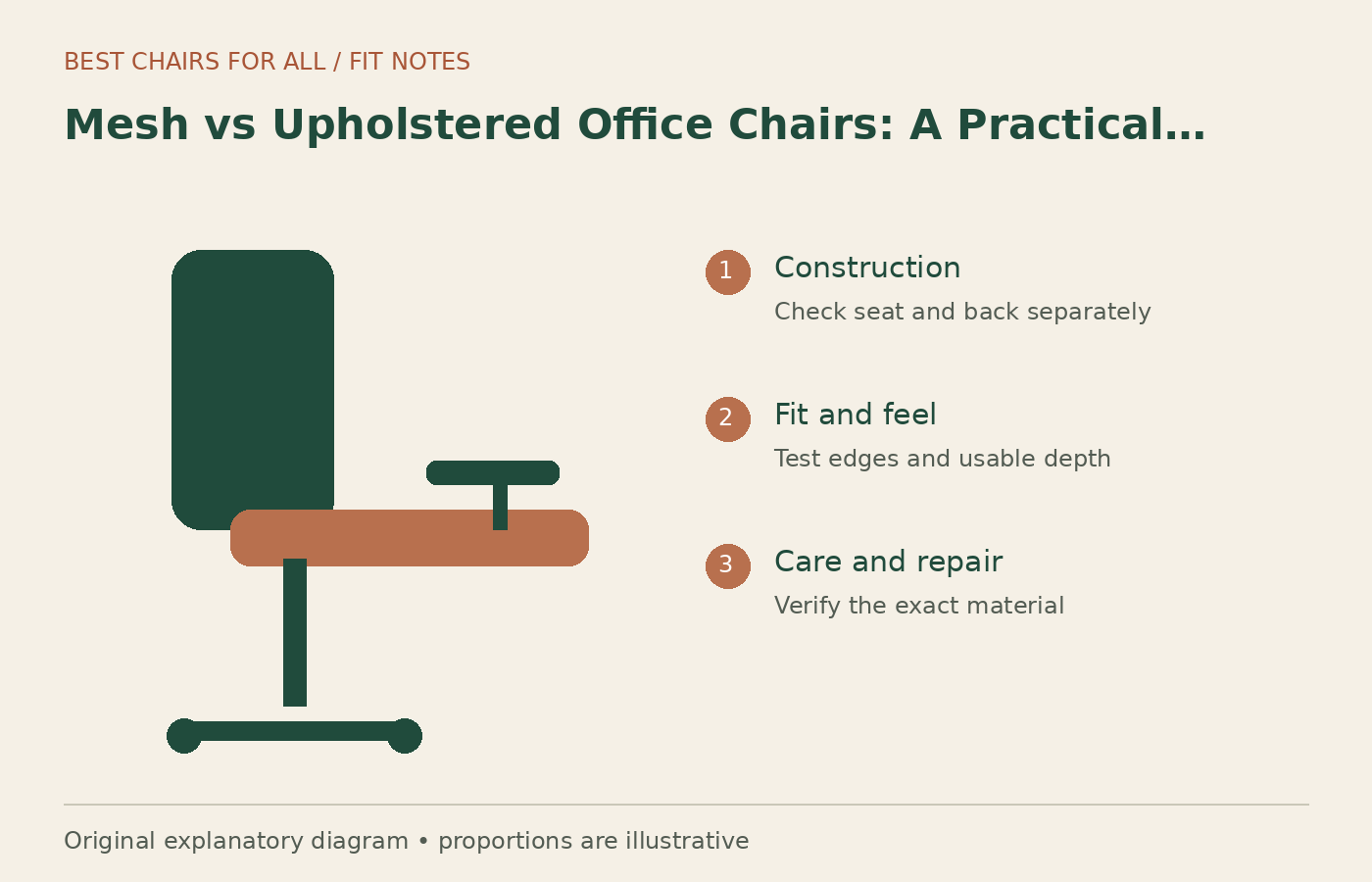
There is no universal winning material. A supportive upholstered chair that fits your dimensions is a better starting point than a mesh chair whose frame presses into your legs. Equally, a breathable suspended seat may suit someone who dislikes the feel of thick foam. This guide provides a comparison process; it does not claim hands-on testing of specific products.
First identify what the chair actually uses
Look at the specification for both the seat and back. Write “suspended mesh,” “mesh over padding,” “fabric over foam,” or the description supplied by the manufacturer. A close-up photograph can help you ask better questions, but it does not tell you foam density, mesh tension, or durability by itself. Do not infer construction from color or a marketing name.
An upholstered seat typically places a textile or other cover over cushioning and a support structure. A suspended mesh seat carries the user on a tensioned surface attached to a frame. Many hybrid task chairs combine a flexible mesh back with a cushioned seat. The word “mesh” alone therefore cannot predict the whole sitting experience.
Keep synthetic leather, genuine leather, and woven upholstery separate in your notes. Their cleaning requirements and surface feel are different. If a seller uses “premium fabric” without naming the material or providing care instructions, treat that as missing information. Ask for the upholstery code and the chair’s official care guide before making comparisons.
Fit comes before fabric
Begin with seat height, usable depth, width, back support, and arm position. CCOHS’s ergonomic-chair guidance treats chair selection as a question of fitting the user and work. A fabric category is only one input. Use our measurement worksheet before sorting candidates by material.
On a suspended seat, pay attention to where the frame sits relative to your thighs. A frame edge that you keep contacting is a fit problem to investigate, not something to dismiss because the mesh is expensive. On a cushioned seat, check usable depth with the cushion compressed. The seat may feel different after you settle than it did during the first few seconds.
Try leaning back and reaching for the mouse as well as sitting upright. A seat that feels fine in a static pose may interact differently with clothing and movement. No material compensates for a chair that is too deep, too high, or too wide at the arms. Resolve the dimensional mismatch before deciding that mesh or upholstery is inherently uncomfortable.
Temperature: compare ventilation without assuming a guarantee
Open suspended mesh can allow air movement through areas that a solid upholstered surface covers. That construction may appeal if you feel warm while working, particularly when both the seat and back are open. The effect still depends on room conditions, clothing, the mesh itself, and how much of the chair is actually ventilated.
For a specific example, Herman Miller’s Aeron buying guide describes its Pellicle suspension as allowing air, heat, and water vapor to pass through. That is a product-specific manufacturer description. It should not be converted into a claim that every mesh chair performs the same way or reduces body temperature by a predictable amount.
A hybrid design offers a useful middle option to evaluate: airflow at the back, with a padded seat surface. If you work in a cool room, dislike drafts, or prefer a soft textile against your legs, those preferences matter too. Test in your usual clothing where possible and avoid expecting a chair to solve a room’s ventilation problem.
Pressure and surface feel: avoid the soft-versus-firm shortcut
A padded seat can feel inviting immediately but still have a shape that does not suit you. A suspended seat can feel firmer initially yet allow comfortable supported movement. Neither first impression establishes how the chair will work through an ordinary task session. Record the location of pressure or support rather than rating only overall softness.
During a trial, ask four practical questions. Can you contact the backrest without pressure behind the knees? Do your thighs remain supported when you change position? Does a rigid edge contact the sides of your legs? Can you sit in your normal working position without sliding forward or repeatedly shifting to escape one spot? These observations work for both materials.
Do not use an unapproved cushion as the automatic answer to a poor fit. Adding thickness can change seat height, backrest contact, and arm position. If you already rely on a cushion, take it to the trial and assess the complete arrangement. Persistent numbness, pain, or other symptoms warrant appropriate advice rather than repeated experiments with increasingly soft layers.
Cleaning: the material code matters more than the category
Read the manufacturer’s care instructions for the exact surface. “Fabric” does not mean any upholstery cleaner is safe, and “mesh” does not mean the chair can be soaked. Different coverings, coatings, backing materials, and foams may react differently to moisture or chemicals. Keep any care label with the purchase record.
Steelcase’s cleaning guidance specifically cautions that disinfectants can be incompatible with upholstery materials unless the material has been approved for that use. This is a reason to verify compatibility, not to improvise a stronger mixture. Cleaning and disinfecting are different tasks, and a product approved for a hard plastic part may not be suitable for the seat.
For ordinary home use, ask whether crumbs or dust will be easy to remove around the frame, seams, and underside. Mesh can have an accessible open surface while still collecting debris in its perimeter. An upholstered seat can have a simpler top surface but seams that need care. The useful comparison is the whole chair’s access and instructions, not a claim that one material is always low maintenance.
Spills, pets, and shared workspaces
Imagine the mishap you are most likely to have: a coffee spill, lunch crumbs, pet hair, or a chair used by several people. Ask how the exact material should be cleaned after that event and how long it must dry before use. A replaceable seat pad may be useful, but verify that it is actually available for the model and region.
If pets share the room, inspect exposed edges and loops that could catch claws. A woven seat is not necessarily pet-proof, and neither is mesh. Do not infer resistance to scratching from an abrasion-test number. If you need a cover, check whether the manufacturer permits it and whether it would interfere with movement, ventilation, or adjustment controls.
For a shared office, include the person responsible for cleaning in the decision. A care routine that requires unavailable supplies or long drying time may be impractical even if the chair feels good. Keep compatible product names and instructions accessible. Do not promise stain resistance or hygienic benefits unless the manufacturer documents them for the exact supplied surface.
Durability: ask about parts, not just the surface
There is no responsible blanket lifespan for all mesh or all upholstered chairs. Construction quality, loading, usage patterns, care, and replaceable parts vary too much. Fabric abrasion data can be useful when correctly identified, but it does not describe every way a complete chair can fail. A long warranty also needs to be read for exclusions and coverage.
Ask whether the mesh panel, upholstered cushion, arm pads, casters, and height mechanism can be replaced separately. Find out whether a replacement surface comes as a complete seat assembly and whether fitting it requires an authorized technician. A theoretically replaceable component is less helpful if the part cannot be ordered where you live.
When comparing used chairs, inspect the actual condition rather than assuming one material ages better. Look for damage, persistent odors, loose fittings, and uneven support. Ask for the model and manufacturing label so the correct documentation can be found. Decline a chair with questionable structural condition even if the upholstery or mesh looks attractive.
A practical comparison table for your shortlist
Use a worksheet with one row per chair and columns for construction, fit limits, temperature preference, care instructions, replaceable seat parts, return terms, and unresolved questions. Put factual dimensions in one part of the row and your trial observations in another. This keeps “seat depth is adjustable” separate from “I could comfortably sit against the backrest.”
For an all-mesh candidate, prioritize edge clearance and the feel of the tensioned seat. For an upholstered candidate, prioritize compressed seat height, usable depth, and the care code. For a hybrid, check whether the combination provides the features you actually wanted rather than assuming it gives the advantages of both without tradeoffs.
Add a decision rule before shopping: reject chairs that fail essential fit requirements, then compare the remaining candidates for care and comfort preferences. This prevents a stylish finish or a dramatic ventilation claim from outweighing an unsuitable dimension. Price belongs in the final comparison, along with delivery, assembly, and potential return costs.
How to run a fair trial
Adjust each chair before evaluating the material. Use the same desk task, footwear, and working surface where possible. Our adjustment sequence can help you avoid comparing one well-set chair with another left at an arbitrary setting. Record any dimension you could not make work.
Spend the trial doing work rather than searching for a showroom pose. Type, use the pointer, read while reclining, and move closer to the desk. Notice whether the material changes how you sit, whether heat becomes an issue, and whether a specific edge bothers you. Recheck those observations after making only one adjustment at a time.
Before ordering, confirm the exact configuration shown in the listing and the seller’s return rules. Color names can hide different upholstery options, and chair photographs may show an upgraded version. A clear purchase record, usable return period, and available care guide provide more practical protection than choosing a material based on generalized promises. The better option is the chair whose fit, surface, and ownership requirements suit your actual workspace.
Something unclear or out of date? Send a correction with this article’s title and the detail to check.
Sources, research & corrections policy ↗