As an Amazon Associate, we earn from qualifying purchases. Read our affiliate disclosure.
The best toddler dining chair depends on whether the child still needs a contained feeding setup or is ready for a later independent chair under that product’s instructions. Compare Abiie Beyond Junior Y for an adjustable dedicated dining station, OXO Tot Nest for a booster attached to a suitable adult chair, and Stokke Tripp Trapp for a long-term adjustable system whose bare US chair is labeled from three years. These are different configurations, not interchangeable stages selected by appearance.
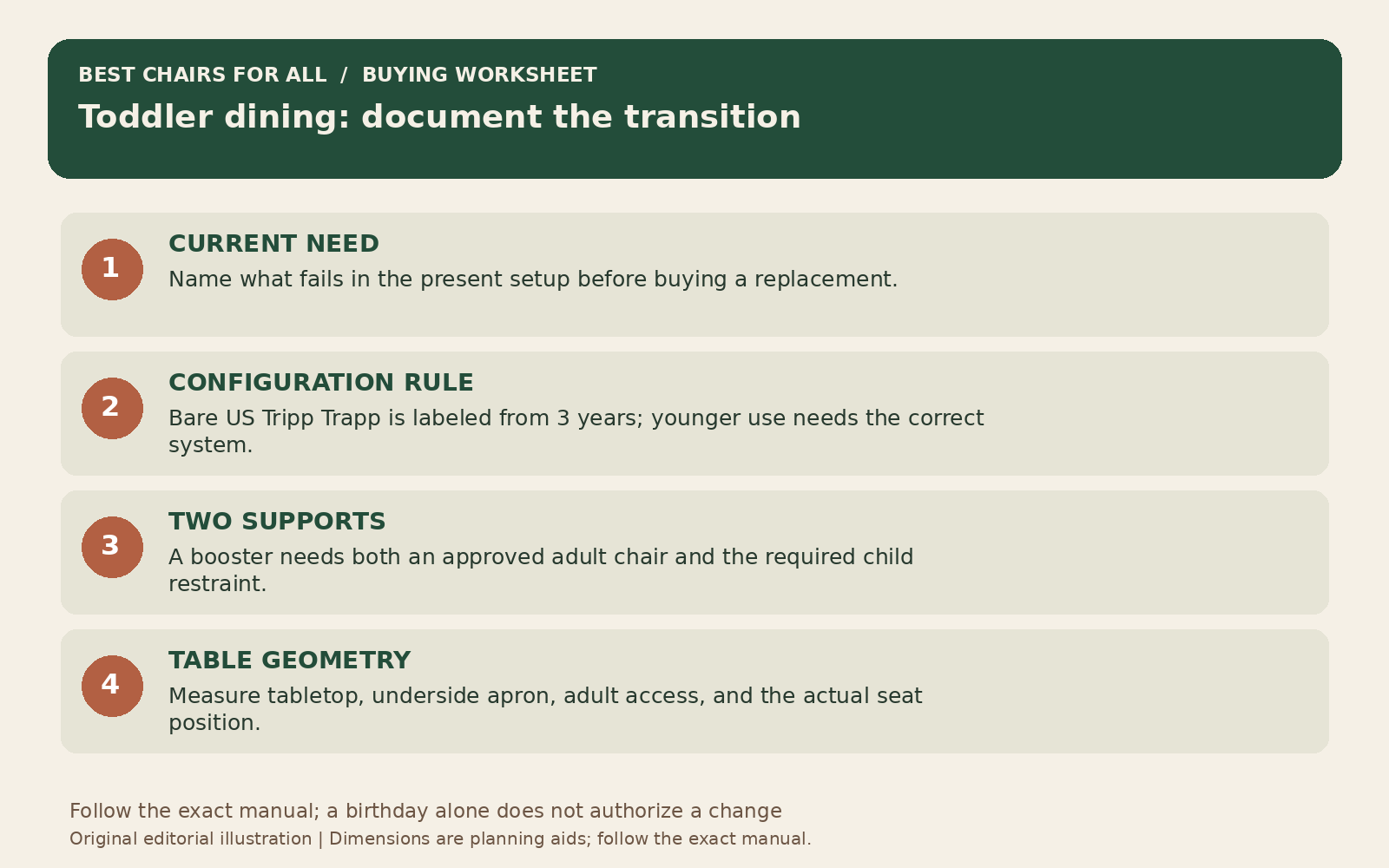
We reviewed current manufacturer information and official feeding-seat safety guidance on November 6, 2026. This is a research-based comparison rather than a hands-on fit test. The guide’s transition worksheet helps you document the child’s current needs, the required restraints, and the table geometry before removing a high chair or buying a replacement. An age range alone does not establish readiness for an unrestrained chair.
Three routes to the family table
| Chair system | Published measurements | Relevant configuration | Primary limitation |
|---|---|---|---|
| Abiie Beyond Junior Y | 21 L × 17.6 W × 34.5 H in; seat height 10.5–24.6 in | Current instructed feeding or later dining setup | Does not fold; retain required restraint components |
| OXO Tot Nest | 12.8 × 14.8 × 12.5 in;5.32 lb | Attached dining booster with child harness | Adult chair must meet exact manual requirements |
| Stokke Tripp Trapp | 19.3 L ×18.1 W ×31.1 H in | Bare US chair from 3 years; younger stage needs compatible accessories | Base price does not include infant setup |
Beyond Junior Y: keep one adjustable place at the table
The Beyond Junior Y manufacturer page gives a 21-by-17.6-inch footprint and 34.5-inch overall height, with seat adjustment from 10.5 to 24.6 inches. It includes cushions, a tray, and a plastic tray cover, and weighs 18 pounds. These details make it a useful starting point for a toddler who still needs the supplied feeding arrangement while the family wants a chair that can later remain in the dining room.
The practical advantage is the ability to adjust the seat and footrest within the manufacturer’s system rather than adding an improvised cushion to an adult chair. That does not mean restraints can be removed whenever a child seems interested in climbing. Follow the exact current manual’s configuration and stopping rules. A published adult capacity describes a later chair arrangement and should never be treated as a blanket permission for every infant or toddler mode.
Choose it when the dedicated footprint works and you are willing to revisit the approved adjustments as the child grows. It is less suitable if the chair must disappear into a closet between meals or if the family already has an adult chair that works better with a suitable booster. Abiie also prohibits soaking wooden parts or placing them under running water, so establish a wipe-and-dry routine that fits the dining area rather than treating the whole chair as washable plastic.
OXO Tot Nest: retain an adult dining chair, add a supported booster
The Nest Booster manufacturer page describes a high back, removable cushion, three-point child harness, and separate back and bottom attachment straps for the adult chair. It publishes dimensions of 12.8 by 14.8 by 12.5 inches, a 5.32-pound weight, and a 50-pound maximum. Its age description begins at nine months, but the exact supplied instructions and the child’s sitting ability still control appropriate use.
The current Drizzle listing showed $55.99 and an available purchase control during research. Its role is different from an adjustable wooden chair: the adult chair provides the base, and the booster changes the child’s position above that seat. The overall height of the booster is not the same as the amount it raises the seated child, so do not add 12.5 inches to your dining-chair seat height and call that the new eating position.
Nest is worth investigating when a suitable stable dining chair can be dedicated to it and the actual tabletop fit works. It is less suitable where the host seat, backrest, or strap route cannot meet the exact manual. The marketing phrase most grown-up chairs should not replace that compatibility check. Obtain the current minimum host-chair dimensions before ordering for a tight or unusual chair, and do not use a dining booster on a bar stool, folding seat, or other support unless the maker explicitly permits it.
Tripp Trapp: an older-toddler chair, with younger configurations kept distinct
The current US Tripp Trapp bare-chair page labels that product from three years. It explains that a compatible Baby Set is a separate addition for earlier high-chair use. A two-year-old therefore should not be placed in the bare configuration merely because the frame resembles a dining chair. Confirm the correct current US accessories, restraints, and instructions for the actual child’s stage.
Stokke’s official dimension information gives approximately 19.3 inches long,18.1 wide, and 31.1 high. The adjustable seat and footplate are the central long-term features. The base chair showed $249 and in-stock status during our research, before any required younger-stage accessories or optional tray. Compare complete packages rather than an infant high chair against the price of an older child’s bare frame.
Investigate Tripp Trapp when its current approved configuration fits and a continuing place at the family table has real value. It is less convenient if you want a single simple purchase without compatibility decisions. Older secondhand frames and Baby Set generations need manufacturer confirmation; a familiar name and a photograph are insufficient. Keep required gliders, restraints, approved hardware, and instructions together so a later conversion or sibling reuse does not become guesswork.
A transition worksheet before replacing the high chair
Write four items: current chair configuration, what no longer works, the next proposed configuration, and the manual rule allowing that change. An honest problem statement might be the tray collides with the table apron, the present footrest setting needs adjustment, or the family needs a second seat for a sibling. A child protesting restraint does not by itself establish readiness to remove it.
Next, separate the questions of child restraint and product attachment. A dining booster may remain attached to the adult chair even after its instructions eventually permit a child-harness transition. A convertible wooden high chair may need specific parts removed or retained for its next approved stage. These processes differ by model. Read the actual manual rather than borrowing a rule from another family’s chair.
Finally, record how adults will supervise meals and prevent climbing or pushing away from the table. The new chair should support the household routine without introducing a habit of standing on it, carrying the child while seated, or leaving a contained child unattended. If any transition criterion is unclear, contact the manufacturer. Do not set a universal birthday deadline based on this article.
Measure the table above and below
Record the tabletop height, underside apron height, and the available approach space. A chair can place the child near the tabletop yet fail to slide in because the tray, back, or infant accessory strikes an apron. The tabletop number alone cannot establish a usable dining arrangement. Ask the maker for any missing accessory height or clearance before assuming an adjustable seat solves the problem.
For a worked example, imagine a table top at 29 inches and a deep apron ending at 25 inches. That leaves a four-inch band between the underside obstruction and eating surface. It does not mean four inches of free knee or accessory clearance in every position. A tray, booster shell, or Baby Set may occupy that same area. Test the empty chair’s approach first and never force an occupied chair underneath the table.
For a booster, measure the adult chair as well. The seat’s usable width and depth, backrest, stability, and strap route all matter. A padded dining chair may have external measurements that conceal a much smaller usable surface. The booster needs the support required by its own instructions, with no overhang or loose attachment. Do not stack extra cushions under it to change the eating height.
Fit at the table is a whole-body question
Look for an appropriate supported position in the exact permitted setup, with the child’s back and feet supported as the product provides. Do not use a rigid online posture formula as a reason to add blocks, tie on homemade footrests, or alter the restraint. A child with particular feeding or positioning needs deserves individualized advice from an appropriate qualified professional, rather than a chair specification being treated as a prescription.
A dedicated adjustable chair and a booster solve different geometry problems. Beyond Junior’s seat can move relative to its own frame; Nest relies on the adult seat height and its shell; Tripp Trapp uses a configurable platform system. If one method fails your table, a different type may work better than buying more accessories for the wrong base. Try the actual configuration where practical, and retain the return terms until the fit is confirmed.
A chair that fits one sibling may not fit another. Keep a short record of the permitted setting and review it when the child changes or another caregiver takes over. Rechecking does not mean constant adjustment after every meal; it means recognizing that a long-lived chair is not permanently set correctly for every stage.
Clean the dining system, not only the tray
At family-table height, food can reach the underside of the table, the adult chair, the booster attachment straps, and nearby joints. A trayless arrangement reduces one object to wash but does not eliminate cleanup. Plan access to those surfaces and let components dry according to their instructions before reassembly. Food trapped beneath a booster can interfere with its placement and make the adult chair unpleasant to use.
Wooden frames, foam cushions, textile restraints, and plastic covers have different care requirements. Follow the actual manufacturer directions rather than assuming everything described as wipeable tolerates bleach, a dishwasher, or soaking. Inspect the restraints, attachment points, and hardware for damage while cleaning. Stop using a seat with a broken buckle, missing required component, or damaged frame and obtain an approved solution.
Safety and purchase checks
CPSC distinguishes dining boosters from other chair types and emphasizes correct attachment. Check the current recall database by exact model and date code, including secondhand products, then register the chair. A current listing is not a unit-specific safety guarantee. Stay near, use the required snug restraint, keep the chair on its permitted support, and prevent the child from standing or pushing away from the table.
None of these dining chairs is a sleep product, vehicle restraint, or step stool. If a child falls asleep, follow appropriate sleep guidance rather than leaving them in a feeding seat. Keep cords, hot food, and items that could be pulled over outside reach. The meal arrangement needs a safe surrounding area as well as a suitable seat.
Investigate Beyond Junior for an adjustable dedicated place, Nest for an approved adult-chair booster arrangement, or Tripp Trapp when its exact age-appropriate US configuration and later dining role suit the child. Price the complete required setup, confirm current stock, and write down the rule for any planned transition. The best toddler dining chair supports today’s meal safely before it earns credit for years of future use.
Something unclear or out of date? Send a correction with this article’s title and the detail to check.
Sources, research & corrections policy ↗