As an Amazon Associate, we earn from qualifying purchases. Read our affiliate disclosure. Amazon buttons search for matching listings; they do not confirm the exact model, seller, price, or stock.
The best swivel bar stool should turn in a way that serves the room without the seat, back, arms, or knees meeting an obstruction. Winsome Fina provides a documented 360-degree swivel in a nominal 30-inch Bar size. West Elm Devon Bar offers a padded swivel seat at 30 inches, with its angle not established from the reviewed page. Ashley Tallenger D380-724 is a 24-inch Counter comparison with a self-returning swivel. Choose the correct height category first, then the turning behavior.
These US manufacturer listings were researched online on November 6, 2026. We did not physically rotate or sit in the products. The recommendations are conditional starting points, and missing rotation or load information stays visible. No price ceiling, tested durability ranking, or accessibility benefit is promised.
Three different meanings of swivel
A 360-degree specification identifies the extent of rotation a maker claims for a particular model. A self-returning swivel identifies a return behavior but does not by itself establish an unrestricted full circle. A listing that simply says swivel establishes rotation without specifying its full travel. Those are different pieces of information, so do not replace them all with a generic spins-anywhere description.
Think about what the movement is for. Turning toward a person in the living room requires a different useful arc from rotating completely around to get off. A stool at a wall may have no reason to turn through a full circle even if its mechanism allows it. A self-returning seat can help restore a tidy parked orientation, but the person must still like how it moves during use.
Verify the exact variants in the manufacturer references: Winsome Fina swivel seat bar stool, Walnut, 94159; West Elm Devon swivel bar stool, Toasted Oak; Ashley Tallenger counter height bar stool D380-724, Linen/Brown. Specifications were checked November 6, 2026.
1. Winsome Fina swivel seat bar stool, Walnut, 94159
Best for: Documented 360-degree Bar option.
Fina is the clearest full-rotation candidate here because the maker explicitly states 360 degrees. It combines a contoured wood seat with an arched chair-style back.
Winsome lists nominal 30-inch Bar size and overall dimensions of 16.4 by 18.9 by 43.7 inches. A loading figure and all usable seat measurements were not established from the reviewed maker page.
Product Details
| Brand | Winsome |
|---|---|
| Overall dimensions | 16.4 W × 18.9 D × 43.7 H in |
| Seat height | 30 in nominal Bar size |
| Manufacturer load wording | No load figure established from source |
| Materials | Solid wood; 360-degree swivel; arched back |
Pros
- Rotation extent is explicitly described
- Exposed solid-wood format avoids fixed textile care
Cons
- Critical loading needs require another maker answer
- Bare seat and missing usable dimensions need a personal fit check
Confirm the exact 94159 Bar model and any missing specification before ordering.
2. West Elm Devon swivel bar stool, Toasted Oak
Best for: Padded Bar swivel option.
Devon is the upholstered alternative for a raised bar, with a 30-inch seat and enclosing back. Its rotation angle remains a question if the room requires a specific arc.
The maker lists 21.4 inches overall width, 19.75 inches depth, 17.75 inches seat width, and a 275-pound capacity. The current description identifies swivel without the angle used in this comparison.
Product Details
| Brand | West Elm |
|---|---|
| Overall dimensions | 21.4 W × 19.75 D × 38.5 H in |
| Seat height | 30 in |
| Manufacturer load wording | 275 lb stated capacity |
| Materials | Rubberwood frame; foam and engineered wood seat/back; selected upholstery |
Pros
- Published usable seat width and depth
- Padded seat and back in a selectable upholstery
Cons
- Unestablished swivel angle needs confirmation if essential
- Fabric choice changes the care commitment
Assess both its occupied turning outline and the selected material.
3. Ashley Tallenger counter height bar stool D380-724, Linen/Brown
Best for: Counter-height self-return comparison.
Tallenger D380-724 is specifically the 24-inch Counter model with a self-returning swivel. It is included for a different surface category, not as a 30-inch Bar substitute.
Its maker lists 19.5 inches seat depth, 17 inches between arms, and a 30.25-inch arm height. No unrestricted 360-degree angle or equivalent load figure is assumed.
Product Details
| Brand | Ashley |
|---|---|
| Overall dimensions | 23.63 W × 23 D × 37.5 H in |
| Seat height | 24 in |
| Manufacturer load wording | No load figure established from source |
| Materials | Wood; polyester upholstery; foam cushioning; self-returning swivel |
Pros
- Self-return behavior is explicitly identified
- Arm spacing and height have published values
Cons
- Counter height excludes many raised-bar applications
- Deep seat and arms enlarge the fitting problem
Filter the surface height before investigating its return mechanism.
The turning-envelope worksheet
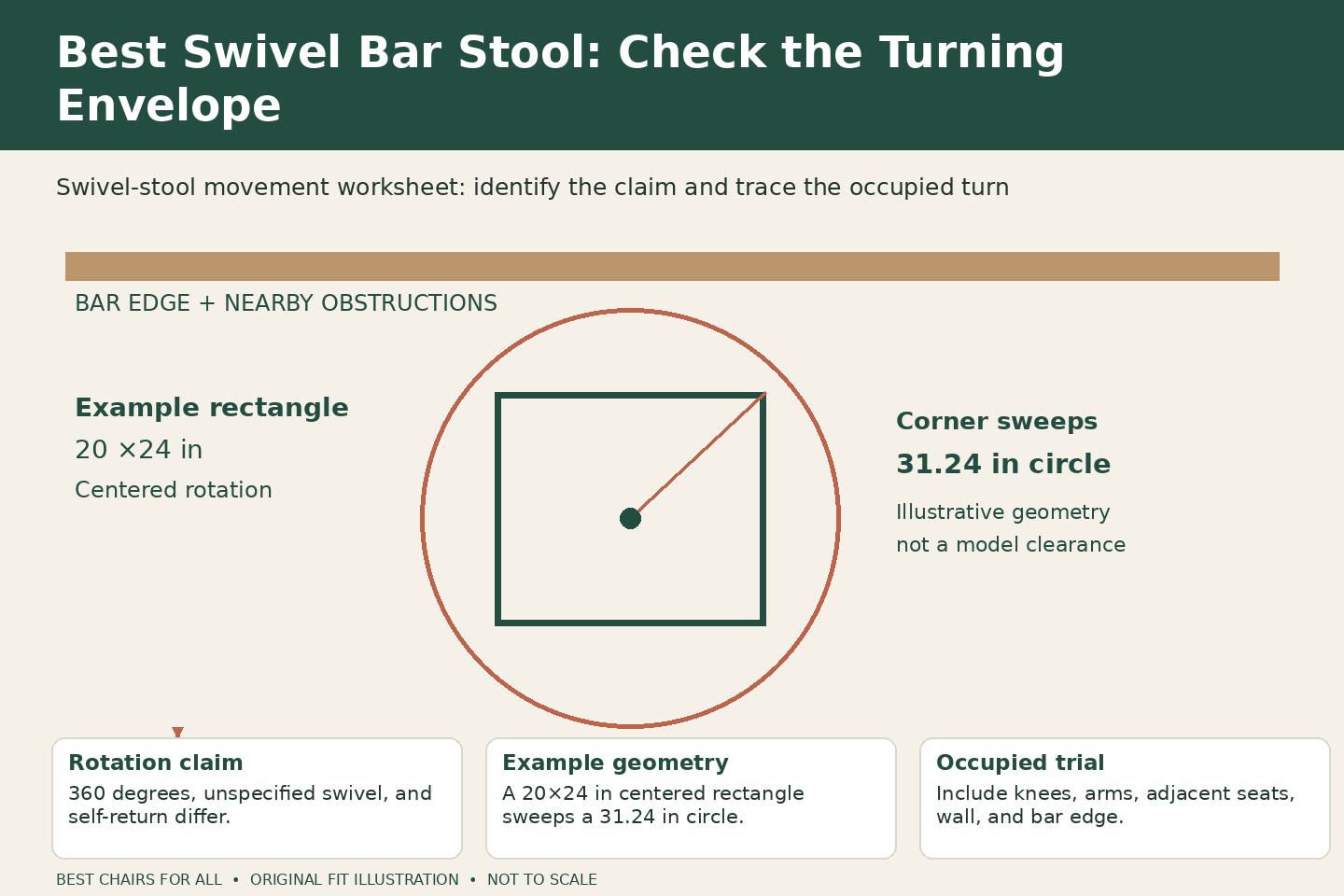
Draw the bar edge, end wall, nearby handles, and adjacent seats from above. Mark the stool’s normal center position and its outer width and depth. Then record the intended movement: face the counter, turn toward a companion, return, and leave. The worksheet is a plan for ordinary use, not an instruction to spin forcefully or test mechanical limits.
A static rectangle does not describe every position it reaches while rotating. For a purely hypothetical 20-by-24-inch rectangular body rotating around its geometric center, the corner sits about 15.62 inches from that center, based on half the rectangle’s diagonal. The corresponding circle is about 31.24 inches across. This is geometry for an example, not a measured clearance requirement for any model below.
Real stools can have rounded corners, an off-center pivot, projecting arms, and occupied knees extending beyond the furniture. The example therefore explains why a narrow parked gap can become a collision during turning; it does not certify a circle around a purchased product. Ask for a dimensioned moving-envelope drawing if the supplier has one, and complete a careful ordinary-use trial in the room.
Put the likely collision points on the drawing rather than assuming only the bar matters. A tall back can meet a wall. An arm can meet the countertop corner. A knee can meet an adjacent seat while both frames remain clear. A footrest can be fixed to a different part from the turning seat, changing how the user’s feet move. Establish the actual arrangement from the exact product and instructions.
Read the three mechanisms precisely
Winsome explicitly describes Fina’s contoured seat as swiveling 360 degrees. That makes it the clearest full-rotation candidate in this shortlist. It does not mean you should exploit the whole circle in a cramped room or use the chair for playful spinning. Use the permitted movement for ordinary seating and follow any supplied operating and assembly directions.
Devon’s current page identifies a swivel base without establishing an angle in the reviewed specifications. It remains a useful candidate if padded seating is the priority, but ask the maker for the arc if the layout requires a specific amount of travel. A missing number is not proof of a restriction or proof of a full circle. Keep it as an unanswered purchasing question.
Tallenger D380-724 has a self-return feature and a different Counter-height geometry. Its 24-inch seat should not be ordered for a raised bar requiring a roughly 30-inch position simply because the article category says swivel bar stool. We include it as a clearly labeled mechanism comparison for counter-height shoppers. If a true Bar-height Tallenger variant is considered, research that exact variant separately rather than transferring these dimensions.
Height filtering before movement filtering
Record the surface top and underside first, then choose between Counter, Bar, or another appropriate range. Fina is identified by the maker as a 30-inch Bar size, Devon Bar has a 30-inch listed seat height, and the selected Tallenger is listed at 24 inches. That six-inch difference is larger than many subtle comfort distinctions and should be resolved before upholstery or mechanism preference.
Overall height is a separate field. Fina is listed at 43.7 inches overall, Devon Bar at 38.5 inches, and Tallenger Counter at 37.5 inches. The backs will therefore occupy different visible space even where the seats share a height. Back contact, parking beneath an edge, and room appearance each need their own check; no one overall number answers all three.
Use the actual underside where the stool will sit. A bar can have a thick top, apron, or bracket that changes the approach. A swiveling seat may face the surface comfortably but turn into the corner of the overhang. Put that geometry in the top-view plan and assess normal movement without carrying hot food or creating a deliberate collision.
A worked two-seat conversation layout
Imagine two stools at the open side of a home bar, with a wall near one end and a sofa behind. One diner wants to turn partly toward the sofa while the other continues facing the counter. Mark both people’s occupied outlines rather than assuming the stools rotate in isolation. Check the gap between knees and the neighboring seat during that partial turn.
If the end stool’s back meets the wall, moving it slightly outward may restore movement but reduce the walking route behind. If the two seats need more separation, reducing a three-stool plan to two may be more useful than seeking a slimmer swivel. The intended social activity should drive the arrangement instead of maximizing the number of seats shown on the bar plan.
A self-returning stool may be appealing if an angled parked seat regularly obstructs the room. It still needs to be comfortable to hold in the conversational position, which requires a personal trial. We have not measured return tension or resistance on Tallenger, so we do not rate how effortless that behavior is. The feature’s existence and its feel are different claims.
Seats and arms change the experience
Fina uses a contoured wood seat and an arched back. It is the exposed-surface route for someone who prefers that contact format. Devon uses foam and selected upholstery with an enclosing back. Tallenger adds arms, polyester padding, and a notably deep 19.5-inch published sitting surface. The chair that turns best in the room can still fail personal seat fit.
For Tallenger, the maker lists 17 inches between the arms and a 30.25-inch arm height. Those measurements should be compared with the diner and surface rather than inferred from its broad outside width. For Devon, published seat width is 17.75 inches and depth 17.5 inches. Winsome’s reviewed Fina page does not establish every usable seat dimension, so request critical missing values before buying for a specific fitting need.
Try ordinary eating as well as turning. If the back is too far away, a swivel mechanism cannot correct it. If feet cannot rest comfortably on the intended foot support, rotating may feel awkward even when the seat moves smoothly. A useful trial checks the entire sitting arrangement at the desired height before giving the mechanism credit for convenience.
Mechanism and floor care
Follow the maker’s assembly instructions and verify that the stool stands evenly on an appropriate surface. A wobble, loose joint, or damaged part needs attention through the supplier. Do not assume the rotating connection is the cause of every noise, and do not lubricate or adjust it with an improvised product when the maker has not directed that action.
Keep floor-contact parts appropriate for the floor and inspect them for wear and grit. A stool that moves unexpectedly across the floor while the user intends only to swivel can behave differently from a fixed base. Do not change glides merely to make repositioning easier without considering the resulting movement. Use the intended base configuration.
The current Devon page states a 275-pound capacity. An equivalent loading figure was not established from the reviewed Fina and Tallenger pages, so a buyer with a critical requirement needs a written answer before treating them as suitable. A substantial-looking wood frame and a smooth-turning seat are not substitutes for a documented loading specification.
Make the first sample earn its place
Fina is the first full-rotation investigation for someone who wants an exposed wood Bar stool. Devon Bar is the padded 30-inch alternative, with rotation angle to be confirmed if essential. Tallenger D380-724 is the Counter-height option for a self-returning, armed format after its load and clearance questions are resolved.
Keep the movement worksheet through the trial period. A successful swivel stool should serve the intended conversation or entry movement, return or park acceptably, and leave the surrounding room usable. Choosing a documented feature and verifying the moving envelope is a stronger decision than assuming every product labeled swivel behaves the same.
Something unclear or out of date? Send a correction with this article’s title and the detail to check.
Sources, research & corrections policy ↗