As an Amazon Associate, we earn from qualifying purchases. Read our affiliate disclosure. Amazon buttons below search for matching listings; they do not confirm stock, an exact seller, or a current price.
The best salon chair for a styling station is the chair-and-base combination that supports the salon’s services, client access, stylist working height, and cleaning routine. Our manufacturer-researched shortlist is Collins Cody 3700 for a broad conventional styling seat, Collins Access 7700 for its distinctive movable footrest and arm arrangement, and Takara Belmont Nagi ST-M70 for a configurable styling-chair system. These are client styling chairs; a shampoo unit, reclining barber chair, or technician stool is a different purchase.
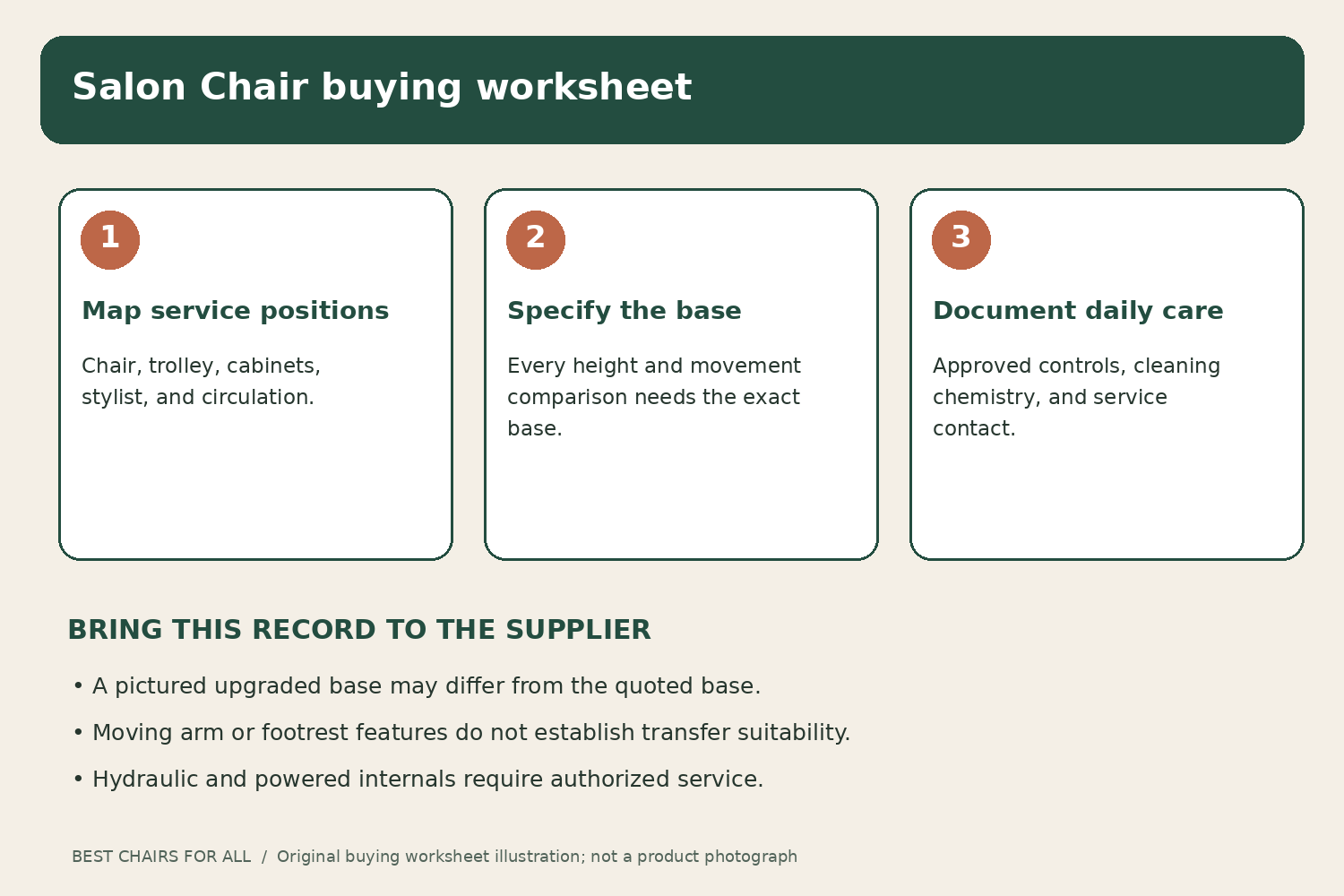
Manufacturer pages and operating-document resources were checked on November 6, 2026. We have not sat in, operated, stain-tested, or durability-tested these chairs. Current installed totals, stock, and lead times are not independently verified. The recommendations are conditional starting points for a supplier quotation and demonstration, with particular attention to the base used in every measurement.
Choose the service category first
Write down what happens at the station: cutting, coloring, blow-drying, consultation, or another service. If the service requires a recline, head support, integrated basin, or special leg arrangement, specify that requirement rather than assuming a styling chair can do it. The words salon chair cover several equipment categories online. A product should be used only for the purpose and configuration identified by its manufacturer.
Then list the people who use the station. A shared station may serve several stylists with different working heights and approaches. The client’s seated head height changes with both the chair and the person. A published seat height is only one input; ask the supplier to demonstrate the actual chair-and-base combination through its approved range with representative service tasks. Do not promise a medical benefit from a chair described as ergonomic.
Finally, determine whether one model can satisfy the salon’s common requirements or whether different stations should have different equipment. Matching upholstery can still unify the room when one station needs another access layout. A uniform purchase of several chairs is convenient, but it can multiply a poor fit if the first station has not been evaluated carefully.
Three manufacturer-verified options
| Model | Documented distinguishing feature | Why investigate | Where it can fail |
|---|---|---|---|
| Collins Cody 3700 | 22 inches between arms; 20-inch seat depth | Broad conventional styling seat | Room size or stylist access may favor another layout |
| Collins Access 7700 | Split movable footrest and removable arm | A specific client-access arrangement | Features do not establish individual transfer suitability |
| Takara Belmont Nagi ST-M70 | Multiple base options on the US page | Chair-top and base configuration discussion | Mixed base measurements create an invalid comparison |
Collins Cody 3700: generous dimensions need a station-space check
The Cody manufacturer page lists 22 inches between the arms, 25.5 inches outside the arms, a 20-inch seat depth, and 33.5-inch overall depth. The listed 20-inch height to the seat is explicitly based on the standard 4250 base. Collins notes that the base pictured may differ from the default option.
Investigate Cody when its broad seat and conventional molded-arm arrangement suit the salon’s clients and services. Its limitation is the space used around the station and the need to evaluate the selected base. A large seat does not guarantee comfort for every client. Ask the supplier to document the complete working-height range, outside footprint, footrest, base model, and permitted load for the actual package. Do not use carton weight or another retailer’s dimension as the assembled specification.
Check matching Collins Cody 3700 styling chair listings on Amazon (paid link)
Collins Access 7700: a different footrest and arm layout
The Access 7700 product page describes a footrest split into two halves that move to the sides and an arm that can be removed and secured again. It lists 22 inches between the arms, 26 inches outside, and 36-inch overall depth. The stated heights again depend on the standard 4250 base.
This chair is worth investigating when a movable access layout is a defined station requirement. It is less compelling when the extra mechanism is not useful or the full outline does not fit. Have the supplier demonstrate the manufacturer’s intended ordinary operation and confirm how the components are secured. The design does not establish a transfer method or suitability for every disabled client; discuss individual access needs respectfully and obtain appropriate professional advice where needed.
Check matching Collins Access 7700 styling chair listings on Amazon (paid link)
Takara Belmont Nagi ST-M70: evaluate the whole chair-and-base package
The Nagi US manufacturer page identifies model ST-M70 and presents several base choices, including hydraulic and electric options with different dimensions. It describes a contoured upholstered styling-chair top. Confirm the exact complete assembly and its current measurements with the US supplier rather than mixing chair-top dimensions with an unrelated base.
Consider Nagi when the seat form and available base combinations merit a demonstration for the salon’s service menu. The limitation is the configuration work needed to compare it fairly with a standard complete chair. Ask for the base model, operating range, footrest, load specification, upholstery, included covers, and service arrangement on one quotation. Manufacturer comfort language is not evidence of pressure relief or a clinical outcome for a client.
Check matching Takara Belmont Nagi ST M70 chair listings on Amazon (paid link)
Original artifact: the station choreography worksheet
Make a scaled overhead drawing of one station with the mirror, cabinet, chair center, trolley, nearby station, and circulation route. Draw the complete chair envelope, including footrest and base. Then mark where the stylist needs to stand for the actual services. This creates a service-space record rather than a furniture-only layout. The supplier should help identify any additional manufacturer clearances.
Use a separate row for each service phase: consultation, cutting behind the client, work at the sides, color application, blow-drying, and cleaning. In each row, record the trolley position, frequently reached tools, required chair orientation, and any obstruction. The exercise is not a prescribed salon layout or a substitute for applicable accessibility requirements. It identifies the practical questions to test with the selected equipment.
For an invented example, suppose a station has a 44-inch-deep area from cabinet front to an internal circulation line. A chair listed at 36 inches overall depth appears to leave eight inches. That arithmetic does not establish working space, because the chair’s location, rotation, occupied client space, stylist position, and footrest motion still need evaluation. A dimensionally possible installation can remain a poor service station.
Repeat the drawing for the Access footrest in its manufacturer-permitted positions or any other moving component on the selected chair. A static outline can miss a collision with a trolley or cabinet. Ask the supplier to demonstrate the movement and the correct secured state. If an essential service task requires moving the chair outside its permitted setup, revise the station or select different equipment.
Build the working-height comparison around the actual base
The base determines more than appearance. Its height, travel, footprint, and controls affect the assembled chair. A photograph may show an upgraded base while the listed starting specification refers to a standard one. Collins makes that distinction explicit on the cited pages. Keep a row headed “base model used for these measurements” in every comparison so it cannot disappear during a color or footrest change.
During a supplier demonstration, ask each regular stylist to evaluate the relevant service positions using the correct ordinary controls. Record practical observations, such as whether the quoted low and high settings cover the intended tasks, without declaring an ergonomic certification. If a stylist has pain or an injury concern, professional occupational advice may be appropriate. Purchasing a chair cannot diagnose or treat that problem.
Do not assume the electric option is automatically better than a foot-operated hydraulic one. Evaluate how controls fit the service routine, where cables or pedals belong, and which maintenance and installation requirements apply. Ask the supplier to confirm the appropriate power and floor arrangement for an electric system. The same chair top on a different base is a different complete purchase.
Check salon chair installation and floor requirements for the exact base before ordering or planning the workstation layout.
Client access should be discussed without assumptions
Ask clients about the assistance and arrangement they need instead of inferring it from age, body size, or a mobility aid. The salon can record relevant appointment requirements while respecting privacy. A removable arm or movable footrest may be useful, but it does not guarantee that a person can or should move into that chair. Discuss alternatives and appropriate professional assessment when an individual need is uncertain.
Include the route into the station, room to position a mobility aid where appropriate, and access to other services such as washing. A styling chair alone does not establish that the whole salon visit is accessible. Consult the relevant professionals and local requirements for the premises rather than relying on a product’s marketing label. Keep the equipment discussion specific to the actual client-facing service.
Upholstery and cleaning need a chemical-compatibility record
Request the manufacturer’s care instructions and upholstery cleaning guidance before selecting a color or finish. Ask which products are permitted for ordinary cleaning, disinfection where required, and prompt removal of salon chemicals. Do not assume that all vinyls tolerate the same solvent or that a general-purpose bleach routine is acceptable. Patch-testing or spot treatment should follow the manufacturer’s instructions rather than an improvised online recipe.
The worksheet should identify seams, gaps, footrest surfaces, and removable components that need access during cleaning. Ask whether protective covers are compatible and what they protect. A cover is not proof that every dye, developer, or disinfectant cannot affect the upholstery. Confirm the procedure for damaged or torn material and the availability of model-specific replacement sections where offered.
Hydraulic controls and repairs
Takara Belmont’s US hydraulic-chair operating document identifies these as professional salon products for trained users and requires the installation and operating instructions to be read. Have the supplier provide the manual that applies to the actual chair and base and demonstrate ordinary raising, lowering, and rotation-lock operation. Do not borrow the control sequence from a superficially similar model.
If a chair sinks, drifts, leaks, binds, or has an unexplained control problem, remove it from service and contact the authorized support route. Do not open a hydraulic pump, gas mechanism, powered drive, or sealed component to troubleshoot it. Record the model, base identity, symptom, and any visible damage for the service provider without dismantling the mechanism. A generic repair video cannot establish a model-specific remedy.
Compare the purchase as an operating asset
Get a written total for the exact top, base, footrest, upholstery, covers, delivery, assembly, and any installation work. Ask about custom-order cancellation and return restrictions before choosing a special upholstery. A starting product price does not establish the total for a complete configured station, and this guide does not make a budget promise. Obtain current lead times directly from the supplier.
Read the component warranty rather than treating one long pump term as coverage for every part and service visit. Ask who supplies replacement upholstery, who services the selected base locally, how freight damage is reported, and what downtime arrangements are realistic. For a multi-chair order, consider approving one complete station configuration before multiplying the purchase, while retaining the agreed specifications for every delivered unit.
Choose Cody when a broad conventional styling layout works, Access when its movable layout solves a defined client-access requirement, and Nagi when a particular chair-and-base combination fits the service brief. The strongest purchase decision closes the station choreography worksheet, documents the actual base, and leaves the salon with model-specific operating and cleaning instructions.
Something unclear or out of date? Send a correction with this article’s title and the detail to check.
Sources, research & corrections policy ↗