As an Amazon Associate, we earn from qualifying purchases. Read our affiliate disclosure. Amazon buttons search for matching listings; they do not confirm the exact model, seller, price, or stock.
The best saddle bar stool should suit the actual surface height and the user’s preference for a backless contoured seat. Winsome Satori offers a bare wooden saddle, Boraam Sonoma an acacia alternative, and Winsome Mona a curved faux-leather cushion. The researched variants below are counter-height choices despite the broad bar-stool category name. A genuinely higher bar needs its own correctly measured variant.
We checked current maker information online on November 6, 2026. We have not measured the contours or performed hands-on comfort tests. Saddle refers here to the seat’s furniture shape, not a medical or posture benefit. No hard budget claim or universal comfort ranking is made.
What a saddle seat actually changes
A saddle-shaped furniture seat is usually elongated and curves through part of the sitting surface. The degree and direction of that contour vary. A bare wooden curve feels different from a padded curve, and two products described with the same term can provide very different usable depth. The name alone does not tell you how the seat meets a person’s body.
These are also backless seats. A diner who specifically wants to lean against a back for a longer conversation should consider a backed stool instead of expecting contour to replace that function. A backless design may tuck more readily in some rooms, but the base and footrests can still stop it moving inward. The appealingly small top is only one part of the furniture.
Verify the exact variants in the manufacturer references: Winsome Satori saddle seat counter stool, Black, 20084; Boraam Sonoma backless saddle counter stool, Barnwood Wire-Brush, 75024; Winsome Mona cushion saddle seat counter stool, Black/Walnut, 94064. Specifications were checked November 6, 2026.
1. Winsome Satori saddle seat counter stool, Black, 20084
Best for: Bare wooden saddle reference.
Satori 20084 is the exposed-wood starting point for someone who intentionally wants a backless contoured seat. Its actual sitting surface should be checked separately from the flared furniture outline.
Winsome lists 17.5 inches overall width, 14.5 inches depth, and 24 inches height for the black Counter model. A manufacturer loading figure was not established from the reviewed page.
Product Details
| Brand | Winsome |
|---|---|
| Overall dimensions | 17.5 W × 14.5 D × 24 H in |
| Seat height | 24 in |
| Manufacturer load wording | No load figure established from maker page |
| Materials | Solid wood; contoured bare saddle seat |
Pros
- Simple bare saddle format
- Exact maker model and overall dimensions are available
Cons
- Usable top depth needs confirmation if critical
- Loading requirement needs an additional maker answer
Do not assume the 14.5-inch outer depth is all usable sitting surface.
2. Boraam Sonoma backless saddle counter stool, Barnwood Wire-Brush, 75024
Best for: Acacia Counter alternative.
Sonoma 75024 is the selected Barnwood Wire-Brush Counter variant. It offers a different overall depth and a documented capacity rather than an interchangeable version of Satori.
Boraam lists 17.75 W by 11.75 D by 24.5 H inches, acacia construction, and a 300-pound capacity. Verify the finish and SKU because the family contains several sizes.
Product Details
| Brand | Boraam |
|---|---|
| Overall dimensions | 17.75 W × 11.75 D × 24.5 H in |
| Seat height | 24.5 in |
| Manufacturer load wording | 300 lb stated capacity |
| Materials | Acacia wood; contoured saddle seat |
Pros
- Maker and assembly document identify capacity
- Acacia and exact variant dimensions are stated
Cons
- Backless contour still needs a personal sitting trial
- Overall dimensions do not replace usable-top measurements
Keep the 75024 specification and assembly instructions with the order.
3. Winsome Mona cushion saddle seat counter stool, Black/Walnut, 94064
Best for: Padded faux-leather alternative.
Mona 94064 is the curved-cushion option for someone who prefers padding to an exposed wooden top. Its faux leather requires its own care rather than a genuine-hide treatment.
The maker labels it nominal 24-inch Counter height and lists 24.9 inches overall height, with a 17-inch-wide cushion. Overall width and depth are 17.5 and 14.5 inches.
Product Details
| Brand | Winsome |
|---|---|
| Overall dimensions | 17.5 W × 14.5 D × 24.9 H in |
| Seat height | 24 in nominal Counter size; 24.9 in overall height |
| Manufacturer load wording | No load figure established from source |
| Materials | Solid wood frame; curved faux-leather cushion |
Pros
- Curved padded top creates a distinct contact preference
- Cushion width is identified by the maker
Cons
- Nominal and listed overall heights differ
- No load figure or machine-wash instruction is assumed
Trial the occupied height and confirm any missing critical information before purchase.
Our top-surface worksheet
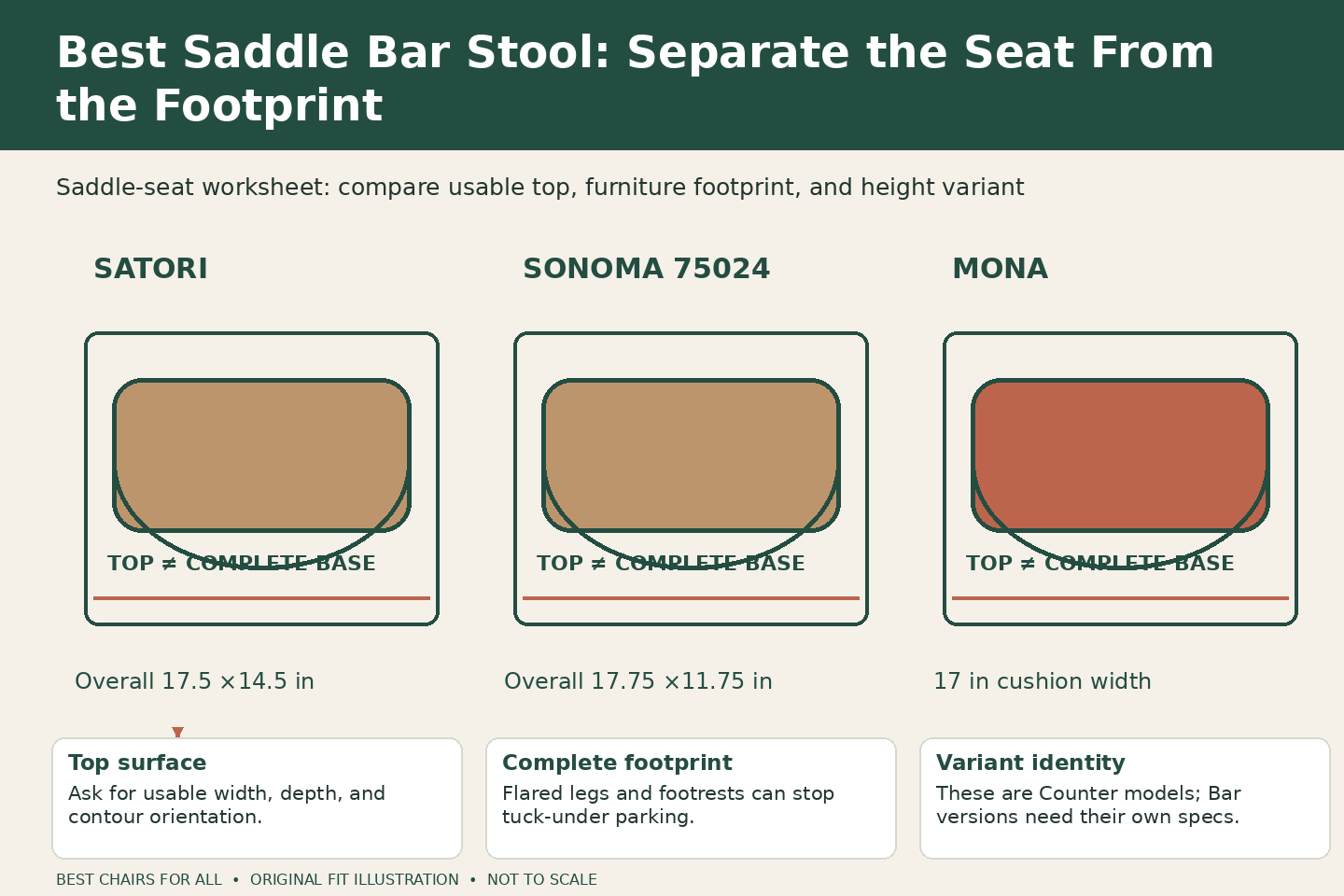
Make a small sketch viewed from above and label overall width, overall depth, usable sitting width, usable depth, and the direction of the dip. Leave a blank when the maker has not established a usable measurement. This is particularly important for saddle stools because a broad footprint can coexist with a surprisingly short sitting surface.
Winsome’s Satori 20084 maker page lists an overall 17.5-by-14.5-inch footprint and 24-inch height. That depth describes the furniture, not a verified 14.5-inch usable top. Some retailer information gives a smaller seat-depth figure, but a buyer needing an exact top measurement should confirm it for the supplied model. We do not silently upgrade an overall dimension into a sitting-space claim.
Boraam’s selected Sonoma 75024 is listed at 17.75 inches wide, 11.75 inches deep, and 24.5 inches high. That is a different overall depth from Satori even though their widths are close. Do not infer that the deeper furniture necessarily gives more comfortable support. Compare the real top, front edge, and foot placement in a personal trial.
Mona 94064 is labeled a nominal 24-inch Counter model, while the maker lists 24.9 inches overall height. Its 17-inch-wide curved cushion is explicitly described, and the overall footprint is 17.5 by 14.5 inches. Retain both the nominal label and the actual listed height rather than pretending they are identical. With padding, the occupied sitting position still needs observation.
A worked footprint comparison
Suppose your island has a 56-inch clear seating run. Three 17.5-inch-wide Satori frames total 52.5 inches. Three 17.75-inch-wide Sonoma frames total 53.25 inches. Those totals leave little room beyond the furniture itself, and neither establishes enough space for three adults. The small numerical width difference matters less than the occupied arrangement and elbow movement.
Now consider depth beneath the overhang. A shallow-looking seat can sit on flared legs and stretchers that meet the cabinet front before the top reaches your preferred position. Mark the complete footprint and inspect the base where it approaches the island. A stool that remains outside the edge can narrow the walking route even though its backless top does not block the view.
Try ordinary entry from the side and departure as well as forward-facing sitting. A saddle contour can encourage a preferred orientation, so turning sideways to converse may feel different from a flat round stool. That is a personal preference to test, not a flaw or an ergonomic promise. Match the seat to how the household actually uses the island.
Bare wood versus a padded saddle
Satori and Sonoma expose the wood sitting surface. A firm contour can feel right to one person and too definite to another. A quick hand press tells you little about front-edge pressure during a meal. Try the seat in the actual posture and clothing likely to be used, with the feet comfortably placed on the intended support.
Mona adds a faux-leather curved cushion over a wooden frame. That changes both the contact feel and the maintenance questions. Faux leather is not animal hide, so do not apply a genuine-leather care routine without explicit compatibility. The maker’s reviewed page does not establish machine washing or a removable cover, and we do not infer either from the upholstered appearance.
Padding can also affect the height comparison. A nominally 24-inch cushioned stool should not automatically be treated as equal in occupied height to a bare 24-inch wooden seat. Ask for the exact specification and trial with the person. If the surface barely clears the thighs before padding is considered, a softer top may not solve the fit issue.
Counter height hidden inside a bar-stool search
The chosen Satori, Sonoma, and Mona are Counter variants. Similar families can include taller Bar versions with different overall dimensions. Save the exact model and height selection at checkout. A search result featuring the correct color can still lead to the wrong height dropdown, and a generic product image may not reveal the difference.
Measure your top and its lowest underside before choosing the variant. Use the maker’s numerical specification as the comparison, then confirm eating reach and thigh space. A high footrest and a narrow seat do not turn a counter stool into an appropriate raised-bar seat. Conversely, a taller bar variant can create a cramped relationship beneath a standard-height island.
Do not cut legs or add blocks to correct a variant error. The intended structure, bracing, and floor contact are part of the product. Selecting the right height or returning an unsuitable stool is preferable to modifying a frame whose loading information applies to its supplied configuration. A saddle shape is not a reason to compromise the basic surface relationship.
Footrests and usable posture
Look at where the stretchers sit relative to the saddle orientation. A rectangular stool may offer bars on several sides, but those bars can be at different heights or shaped differently. The reviewed maker pages do not establish a complete footrest-height comparison for all three, so we do not rank them on a guessed number. Ask if a specific measurement is essential.
At the intended counter, check whether you can use the sitting surface and foot support together. If you must hover on the edge or pull the feet into an uncomfortable position, the stool may not fit. A contour that feels excellent in isolation can fail once a shallow overhang prevents the legs from using the expected space. Evaluate the full combination.
A footrest should be used only as intended. Do not assume a stretcher is a climbing step, and do not treat a backless seat as a platform for reaching cupboards. If mounting a high stool is difficult, consider a lower dining-height solution or individual assistance advice. We make no accessibility or therapeutic claim for a saddle-seat design.
Load evidence and assembly questions
Boraam’s current Sonoma page and assembly document state a 300-pound capacity for the relevant series and SKU family. The selected 75024 Barnwood Wire-Brush Counter variant is identified to avoid confusion with other sizes. Winsome’s reviewed Satori and Mona maker pages did not establish equivalent load numbers. A buyer with a critical requirement should obtain those answers before considering either suitable.
Do not import a retailer’s rating from another finish, height, or model just because the top looks similar. If a seller supplies an important figure, keep the documentation and confirm which exact item it covers. A structural loading statement is also separate from usable sitting space; a stool can meet the first need and fail the second.
Follow the supplied assembly sequence and use the intended fasteners. A contoured top or wooden rail should not be forced into alignment by drilling or substituting hardware. If parts do not fit as instructed, contact the seller. Once assembled, inspect the stool on a level surface and address wobble or damage through an appropriate supplier route.
A concise saddle-seat trial log
Write five observations after an ordinary use trial: contour location, front-edge feel, foot placement, reach to the surface, and willingness to use it for the intended activity. Avoid a single vague comfort score. If the user likes the top but dislikes the backless format, that is useful evidence to choose a backed stool rather than buying a thicker cushion for the same structure.
Repeat the trial after the first impression with the actual counter and another occupied place beside it. A stool that suits a short solo coffee may not suit the household’s longer breakfast routine. The product should match that real brief, not an idealized photograph of a clear island with nobody sitting there.
Start with Satori for a simple bare wooden saddle, Sonoma for the specifically documented acacia Counter alternative, or Mona for a padded curved faux-leather seat. Confirm the top measurements, loading requirement, and correct height variant. The useful saddle stool is the one whose contour and complete footprint both make sense for the person and counter.
Something unclear or out of date? Send a correction with this article’s title and the detail to check.
Sources, research & corrections policy ↗