As an Amazon Associate, we earn from qualifying purchases. See our affiliate disclosure. Amazon links search for matching listings; check the exact model and seller.
The best portable chair with backrest depends on how it travels. My research-based shortlist is the Helinox Chair One for a compact case and a 320 lb published capacity, the REI Co-op Flexlite Camp for its lower listed weight, and the GCI Outdoor Freestyle Rocker for short carries from a vehicle. These are recommendations from manufacturer documentation, not claims of hands-on testing.
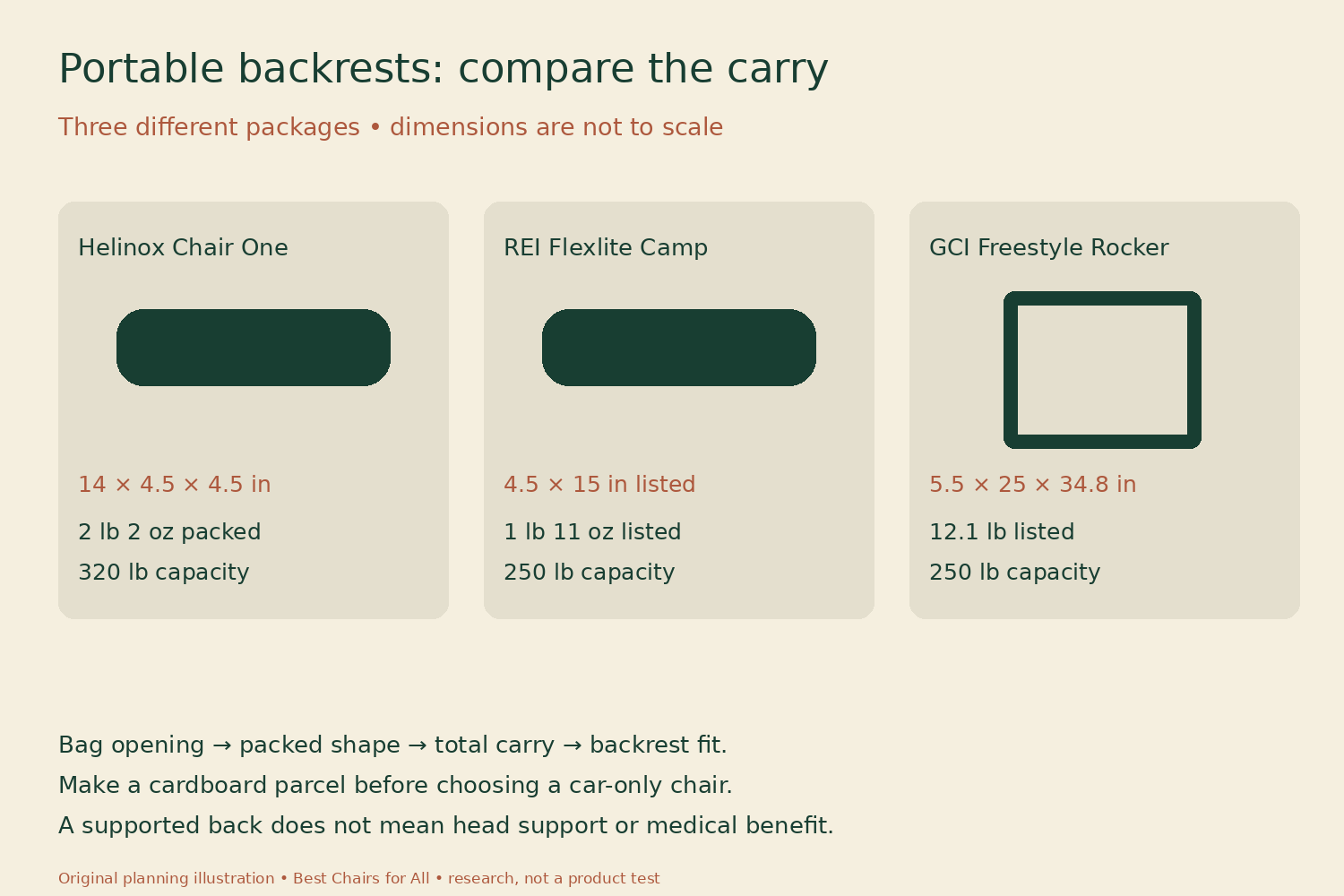
This guide covers freestanding outdoor chairs that provide a fabric backrest. A stadium seat attached to a bleacher, a floor chair, and a chair with a full headrest solve different problems. If your priority is supported neck rest or an upright dining position, do not assume that every portable backrest will supply it. Start with the posture you need, then find a package you can transport.
Three documented choices, three different compromises
The Helinox Chair One page, REI Flexlite Camp page, and GCI Freestyle Rocker page are the sources for the specifications below, checked for this guide on November 6, 2026. No current-price threshold or stock promise is part of the recommendations. Compare the complete delivered cost with any accessories you actually require.
1. Helinox Chair One
Best for: a compact backrest chair with a higher published capacity.
The Chair One is my research-based middle option for buyers who want a real backrest in a small carry case. It is a sensible first comparison when a stool feels too bare but a large folding chair overwhelms the rest of the gear. Its published capacity also distinguishes it from the other two selections.
The trade is assembly and a low, sling-like sitting experience. Try sitting down and getting up before committing to this style. A backrest is valuable only if its fabric edge and reclined posture suit you. Do not transfer dimensions or accessories from Chair One High-Back, Chair One (re), or Chair Zero to this exact version.
Product Details
| Brand | Helinox |
|---|---|
| Open size | 25.5 H × 20.5 W × 20 D in |
| Packed size | 14 × 4.5 × 4.5 in |
| Packed weight | 2 lb 2 oz / 965 g |
| Capacity | 320 lb / 145 kg |
| Frame | DAC aluminum alloy |
Pros
- Small package can suit walking trips and tightly packed vehicles.
- Documented product guide explains assembly and use conditions.
Cons
- No conventional padded arms or headrest.
- Requires properly joined frame sections before loading.
Choose the Chair One when its package and posture work for you, especially if you need its documented capacity. Add any compatible accessory to the carry calculation instead of comparing the bare chair against a fully equipped alternative.
2. REI Co-op Flexlite Camp Chair
Best for: walking trips where the listed carry weight matters.
The Flexlite Camp is the lightweight candidate in this particular comparison. I would consider it for a picnic or camp stop reached on foot when having back support is worth carrying a separate chair. The useful question is whether the low scoop shape suits your normal seated movement.
REI lists a two-number folded size rather than three rectangular dimensions. Treat that as the manufacturer’s description, then verify the actual bag shape if space is tight. The model name matters: the Flexlite family contains different chairs, and an older listing or another version can have different specifications.
Product Details
| Brand | REI Co-op |
|---|---|
| Open size | 25 H × 20 W × 20 D in |
| Folded size as listed | 4.5 × 15 in |
| Listed weight | 1 lb 11 oz |
| Seat height | 11 in |
| Capacity | 250 lb |
| Frame | Aluminum |
Pros
- The listed weight makes it worth comparing for repeated carries.
- A separate fabric sling and collapsible frame create a small bundle.
Cons
- A low seat may be inconvenient for some users.
- The published capacity is lower than the Chair One’s.
Buy this exact Camp model after checking the current item page and your required load. A nearby store with a display chair can settle posture questions more effectively than a packed-size photograph beside an unfamiliar object.
3. GCI Outdoor Freestyle Rocker
Best for: car-to-seat outings with room for a flat package.
The Freestyle Rocker fits a different kind of portability: carrying from a parked vehicle to a nearby viewing spot. Its backrest, padded armrests, and rocking mechanism can be more relevant there than the smallest possible bundle. I would shortlist it only when rocking is something the buyer actually wants.
This chair folds flat rather than becoming a short tube. That makes its largest dimensions important in a trunk, elevator, or crowded storage area. The manufacturer describes rocking on a range of flat surfaces; that should not be expanded into a promise about slopes, loose ground, or every kind of sand.
Product Details
| Brand | GCI Outdoor |
|---|---|
| Open size | 24.4 W × 25 D × 34.8 H in |
| Folded size | 5.5 W × 25 D × 34.8 H in |
| Item weight | 12.1 lb / 5.5 kg |
| Capacity | 250 lb / 113.4 kg |
| Features | Rocking mechanism; padded armrests; carry handle |
Pros
- Carry handle and flat folding suit some vehicle storage arrangements.
- Armrests provide a different sitting experience from the two compact slings.
Cons
- Substantially heavier and larger to carry.
- Rocking requires attention to the surrounding space.
Choose the Freestyle for short carries and a suitable flat location. If the route includes a long walk, stairs, or several other bags, rehearse the entire load before deciding that its familiar chair shape is worth transporting.
The carry-route worksheet
Write the route as a sequence before choosing a chair: storage shelf, vehicle, parking area, path, final seating spot. Add stairs, gates, public transport, or soft ground where relevant. A chair that travels beautifully in the trunk can still be awkward on the last section. “Portable” becomes meaningful when you know who carries it, in which hand or bag, alongside what other equipment.
For each candidate, make four worksheet columns: longest packed dimension; packed cross-section; complete carried weight; and your carrying method. Copy the manufacturer’s wording instead of silently changing a listed item weight into a packed weight. Helinox explicitly separates those figures. REI’s page gives a listed weight and folded dimensions; if you need to know exactly what the weight includes, confirm with REI before doing a very tight packing calculation.
Next, add the actual trip load. For example, a hypothetical outing might already require a 6 lb cooler and a 3 lb tote. With a 12.1 lb chair, those items total 21.1 lb before water or any other gear. This arithmetic is an illustration using assumed cooler and tote weights, not a recommended carrying limit. It shows why evaluating the chair in isolation can lead to a purchase you rarely bring along.
Rehearse the route with household objects representing the overall load and package shape. Keep the rehearsal manageable and avoid carrying anything that strains you. The purpose is to discover practical conflicts: the same hand may be needed for a gate, the chair may bump a stair rail, or the cooler may force a second trip. A more compact chair can be worthwhile even when its seat offers fewer conveniences.
A parcel test for the flat-folding option
Make a cardboard rectangle approximately 25 by 34.8 inches to represent the broad dimensions of the folded Freestyle Rocker. Allow another 5.5 inches of thickness with a box or spacer. This is a screening envelope based on GCI’s stated folded measurements, not an exact model of every protrusion. Try the package through the real trunk opening with your normal luggage in place.
An opening may accept the rectangle upright but leave nowhere to turn it once inside. A shallow trunk can accept it flat while sacrificing the space needed for a cooler. Test both the opening and the final resting position. If you transport two chairs, make two envelopes: the space between irregular folded frames should not be assumed to disappear just because one chair fits neatly.
For the smaller models, use a rolled towel or cardboard parcel representing their listed bundles. A slim, long bag compartment and a short, wide pocket are different opportunities. Check whether the chair can stay inside the bag rather than dangling from a single loop. Include the space needed to open the bag and retrieve the chair without unpacking food, rainwear, or other items you expect to use first.
This exercise is especially useful when shopping online because photographs distort scale. A product held by a tall model may look smaller than it feels beside a compact car. Measurements give you a repeatable comparison while avoiding unsupported claims about how easy every buyer will find the carry.
Evaluate the backrest in the position you will use
A scoop chair and a folding rocker support the seated body differently. During a fit check, sit in your ordinary position, place your feet naturally, and notice where the top of the fabric contacts your back. Hold a book or look toward an imagined playing field. If you repeatedly lean forward away from the backrest to do your intended activity, the chair may be a poor match despite having the feature in its name.
Also compare reaching and rising. Place a water bottle on the ground beside you, then consider whether that location invites an awkward lean. A small table can solve a reach problem, but it adds another item to carry and store. Back support, convenient access to belongings, and transport weight belong in the same decision rather than being scored as unrelated extras.
Do not use overall chair height as a backrest-height measurement. Overall dimensions include the seat’s position above the ground and the frame geometry. Likewise, an advertised capacity does not establish that a narrow fabric edge will feel comfortable. Personal fit may eliminate a model that appears excellent in a numerical comparison. None of these selections is presented as a treatment for a back condition.
Assembly and ground conditions deserve their own decision
The Chair One product guide says to use the chair on a flat, solid surface and explains that the capacity assumes even weight distribution. It warns about unbalanced loads and shock. Those instructions should guide site selection even when promotional photographs show adventurous settings. A small packed chair does not automatically become suitable for any patch of terrain you encounter.
Before the trip, assemble the chair with enough light and space to inspect the joints. Follow the exact diagram so every required pole connection and fabric attachment is properly seated. Shock cord keeps sections organized; it is not a substitute for joining them fully. If assembly requires forcing something out of alignment, stop and check the instructions instead of treating resistance as proof that the frame is secure.
GCI provides a model-specific opening and closing demonstration. Watch it before using an unfamiliar folding system. Keep fingers away from moving joints, and leave room around the rocker for its movement. The flat location must also suit the activity: a narrow viewing area with people passing immediately behind you may favor a stationary chair instead.
Storage can change which chair is easiest to own
An easily transported chair can become inconvenient if it returns home wet and has no drying place. Plan a spot where the frame and fabric can dry open without blocking your household. A small packed case is useful for travel, but it should not become the place where damp gear remains forgotten between outings.
Helinox’s product page says to spot-clean the seat with warm water and dry it fully; it does not approve machine washing. GCI’s care guidance describes mild soap and water, fresh-water rinsing after beach use, and complete drying before storage. It also says its chairs should be kept indoors when not in use. Apply each instruction to that brand’s product rather than assuming identical fabrics and frames need identical treatment.
A chair regularly exposed to sand also needs inspection before the next assembly. Look for trapped grit near connections, missing feet, fabric damage, and components that no longer move as the instructions describe. Use the manufacturer’s parts or repair route when something is damaged. An accessory selected for another model can change the fit at the feet or frame and should not be assumed compatible.
Choose by the outing you repeat most
For a mixed pattern of walking and vehicle trips, start with the small-package candidates and decide whether their low posture suits you. The Chair One is particularly relevant when its published capacity matters; the Flexlite Camp deserves attention when the listed carry weight is the stronger priority. Confirm the actual model and current instructions before ordering, especially when a retailer groups several variants on one page.
For a nearby sideline or campsite reached from a parked vehicle, the Freestyle Rocker becomes a more plausible choice if its rocking action, arms, and flat package fit the space. Use our rocking versus regular camping chair comparison to examine that specific tradeoff. Choose the chair you can transport, set up, sit in, and dry after the outing you make repeatedly; an appealing feature list cannot complete those steps for you.
Something unclear or out of date? Send a correction with this article’s title and the detail to check.
Sources, research & corrections policy ↗