As an Amazon Associate, we earn from qualifying purchases. Read our affiliate disclosure. Amazon links below search for matching model listings; verify the seller, model and pack size before ordering.
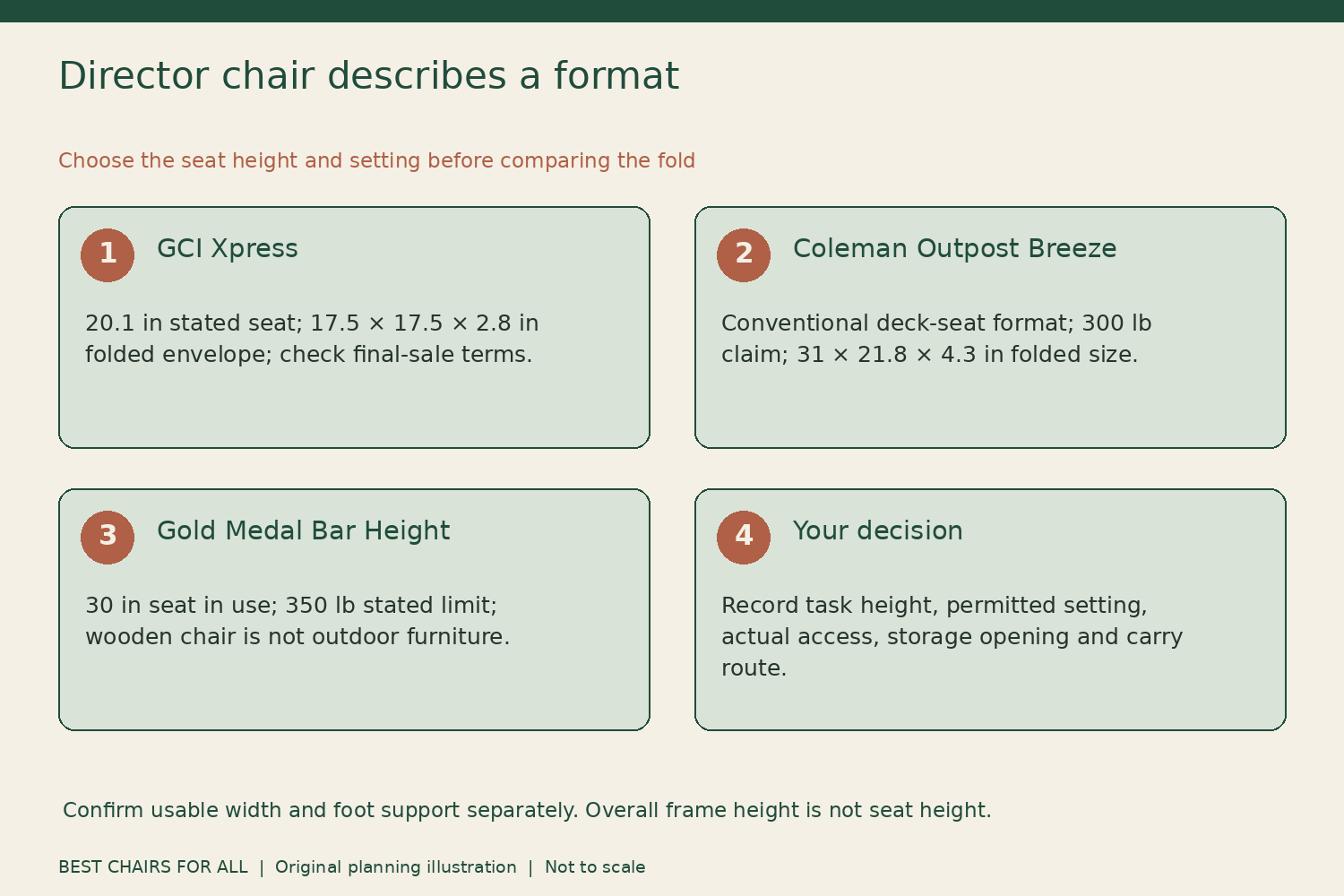
The best director chair depends on whether you want a compact outdoor carry, a conventional-height deck seat or an elevated wooden chair for an indoor counter or studio. Our research-based shortlist is the GCI Xpress Director's Chair for its small flat packed form, Coleman Outpost Breeze for a mesh-back outdoor seat, and Gold Medal Contemporary Bar Height for a fixed 30-inch sitting height. They share a recognizable format but solve very different seating problems.
We have not tested these chairs. The choices come from manufacturer specifications and the practical limitations they reveal. A director-style frame does not establish the same seat height, weather suitability, folded package or warranty across products. No current-price or availability guarantee is made, and any exact fit or access requirement should be confirmed for the current model before purchase.
Choose the sitting height first
“Director chair” can describe a chair near dining height or a much taller bar-height seat. The total back height is a separate measurement. A listing that emphasizes a tall frame without identifying where the seat sits can lead to a costly mismatch with a counter, table or working position.
For table use, check the actual table apron, seat-to-surface relationship and foot support. For an elevated studio position, check where the person's hands or face need to be and how they enter and leave the chair. A thirty-inch seat is not simply a more professional version of a seventeen-inch seat; it creates a different access and working relationship.
Next decide whether the chair travels on foot or mainly moves between storage and a fixed location. The folding style can create a thin broad slab, a short telescoping package or another shape. Measure the route and storage opening before assuming that every director chair offers the same portability.
GCI Xpress Director's Chair: compact packed-shape candidate
The GCI Xpress official dimensions and selected-offer sale terms lists a telescoping folding design with built-in carry strap, padded armrests, a 250-pound capacity and nine-pound chair weight. It gives a 20.1-inch seat height, open dimensions of 17.5 by 24.4 by 36.6 inches, and folded dimensions of 2.8 by 17.5 by 17.5 inches. Those figures are the main reason to investigate this model rather than treating it as a generic camp chair.
The short square-like folded shape is its distinctive transport advantage. A person with a shallow vehicle compartment or short storage bay can compare that envelope directly with the opening. It may fit where a long bagged chair is awkward, even though it is not an ultralight product. The nine-pound listed mass still deserves consideration for a long walk.
The 20.1-inch sitting height may feel relatively high to someone used to lower camp seats. Try it with ordinary footwear and check foot contact and arm position. The published overall width does not establish usable between-arm space, so ask for that measurement if it affects the decision. A compact packed mechanism does not guarantee roomy sitting dimensions.
Check the exact seller offer particularly carefully. The current direct page displays final-sale language, no returns and no warranty for the selected offer. Do not assume the site's general warranty headline overrides that specific condition. We would want written clarification and a satisfactory fit demonstration before choosing a final-sale chair where returnability matters.
Check matching GCI Outdoor Xpress Directors Chair listings on Amazon (paid link)
Coleman Outpost Breeze: conventional outdoor deck-seat candidate
The Coleman Outpost Breeze official model description and specification fields describes model 2000019421 with a mesh back, angled back and arms, padded solid armrests, steel frame and carry handles. The description lists a 20.5-inch seat, a 17-inch sitting height and 300-pound capacity. Its specification fields list 10.3 pounds, folded dimensions of 31 by 21.8 by 4.3 inches, no carry bag, and a 16.5-inch seat-height field.
That half-inch seat-height discrepancy should be resolved if an exact table or access measurement decides the purchase. For a general shortlist, the product is clearly a conventional-height deck chair rather than an elevated bar chair. We would not borrow a dimension or side table from another Outpost variant simply because a marketplace title uses similar wording.
The appeal is its outdoor-oriented sitting arrangement and solid padded arms, with a mesh back rather than full upholstery. Someone who wants a separate deck or campsite seat can compare that contact arrangement with a suspended bag chair. We have not measured airflow, firmness or how much support the arms provide during any movement.
Its limitation is the broad folded rectangle. The 31-inch length and 21.8-inch width need space even though the chair folds relatively thin. The absence of an included bag also matters if you want a protected package or a strap carry. Use the documented handles and carrying method; do not assume the frame is meant to attach to another piece of equipment.
Check matching Coleman Outpost Breeze Deck Chair 2000019421 listings on Amazon (paid link)
Gold Medal Contemporary Bar Height: elevated indoor candidate
The Gold Medal Contemporary Bar Height official seat rating and care states that the Contemporary Bar Height director chair's seat measures thirty inches from the floor in use and gives a 350-pound weight limit. It identifies residential, commercial and trade-show settings, while explaining that the wooden chair is not outdoor furniture and should not remain outdoors or be stored there. That care limitation is central to its place in this comparison.
The reason to choose it is the elevated sitting position and wooden director-chair format. It can be relevant for an indoor counter, display area or studio setup where the thirty-inch seat relationship has been checked. It is not a recommendation to buy a tall chair for every makeup artist, customer or event; those uses need their own fitting and access assessment.
The biggest limitation is that the height is fixed. A shorter user may need a different chair or support arrangement, and the frame's intended foot support must be assessed as part of the complete seat. Follow the manufacturer's access instructions and do not assume a footrest is a climbing step. If the intended user cannot use the chair comfortably as designed, choose another appropriate format.
Obtain full open and folded dimensions and carrying weight if transport or a cupboard fit matters. The cited page's thirty-inch seat figure cannot answer those questions. Also confirm the exact frame and fabric configuration on the order; a back panel or replacement seat canvas that looks similar is not automatically the approved part for the model.
Compare three kinds of portability
The Xpress's documented small folded square is useful where longest-axis length limits storage. The Outpost's broad flat fold may be easier to slide into a specific vehicle gap but awkward along a crowded route. The Gold Medal requires additional current folded measurements before a tight-space recommendation can be made. These are different ownership scenarios rather than a single portability ranking.
Make a worksheet with folded length, width, thickness, product mass, supplied carry method and destination. Add the narrowest doorway or compartment opening. A nine-pound chair with a strap and a heavier handled chair involve different carrying tasks, but we have not compared their carrying comfort for a particular person.
If a chair remains at a fixed indoor station, folded storage may matter only occasionally. In that case, suitable seat height and daily use can reasonably outrank a compact package. If the chair travels every day, repeated setup, carrying and repacking become part of the core purchase decision rather than minor conveniences.
A director-chair fit worksheet
Record the complete model, seat height, usable seat width and depth, between-arm clearance, back contact, foot support, permitted load and intended use. Mark whether each measurement is explicitly published, supplier-confirmed or still unknown. Put overall frame dimensions in a separate section.
Then name the actual activity: eating at a table, watching an outdoor game, working at a counter or another defined use. Check whether the chair lets the person approach the work without an armrest or frame member meeting the table. A chair can fit the person in open space while failing at the furniture where it will be used.
For an ordinary trial, use normal shoes and the intended supporting surface. Sit and leave only as instructed, and stop if the chair does not open or remain in the correct configuration. Do not test stability by leaning onto two legs or asking another person to add weight. The goal is fit, not an informal strength demonstration.
Worked selection: compact vehicle storage versus indoor height
Imagine a buyer who needs a chair to fit a vehicle compartment with a clear opening twenty inches square and four inches deep. The Xpress's published 17.5-by-17.5-by-2.8-inch folded envelope is a promising geometric candidate. The Outpost's 31-inch axis does not fit that same aligned envelope, even though it is also described as folding.
Now consider an indoor studio that has already established a thirty-inch seat requirement through a proper trial. The Gold Medal becomes relevant, while the lower chairs do not meet that stated position. The studio still needs to confirm client access, usable dimensions and care. The vehicle buyer and studio buyer can sensibly choose different director chairs without either choice being universally superior.
The example also shows why one attractive dimension should not decide the whole purchase. The compact chair's sitting height may be wrong for the user, and the tall chair's storage dimensions may remain unknown. Keep both the use case and unresolved fields visible until they are settled.
Side tables and accessories are model-specific
A side table can be useful for a drink or small item, but it also changes the footprint and may introduce a stated load limit. None of the three exact configurations should be assumed to include a table just because a related series offers one. Check the actual model's included parts and optional accessories.
Do not hang heavy bags from an arm or back unless the manufacturer specifically supports that arrangement. An organizer that fits around a frame is not proof that the complete chair is intended to carry its contents. The same applies to umbrellas, lights and improvised back panels. Use equipment designed and documented for the task.
Replacement canvas and glides should match the exact frame. A seat that attaches physically can still have the wrong dimensions or tension. Ask the supplier for approved parts and fitting instructions rather than treating a decorative fabric swap as independent of the chair's structure.
Care follows the complete construction
The Gold Medal's wooden frame needs its specified storage conditions even if the fabric seems suitable outdoors. The Coleman and GCI have their own material and care instructions. Do not generalize from metal versus wood alone, and do not assume all fabric covers tolerate machine washing, disinfectants or prolonged damp storage.
After use, inspect accessible hinges, supports, fabric attachment and floor contact through the approved routine. Remove damaged or unpredictable equipment from service. A chair that folds with unexpected resistance should be assessed rather than forced with extra leverage or repaired with arbitrary hardware.
Read return and warranty terms for the exact offer. The Xpress example demonstrates why a general brand statement and a specific sale condition can differ. A purchase that depends on an at-home fit trial needs an actual returnable offer, not an assumption based on another retailer's policy.
Which director chair to investigate
Start with GCI Xpress for the short telescoping package, after resolving current sale conditions and checking the 20.1-inch seat relationship. Compare Coleman Outpost Breeze for a conventional-height outdoor deck format, confirming the current height field where precision matters. Consider Gold Medal Contemporary Bar Height for an elevated indoor position with its thirty-inch seat and wood-care restrictions understood.
Match the exact current product to the source and check delivered cost, configuration and included carrying equipment before ordering. A director chair is a format, not a specification. The best one is the version whose height, permitted setting and folded journey fit your actual plan.
Manufacturer specifications and cited listings checked November 6, 2026. Research-based selection; no hands-on testing or current-price guarantee.
Something unclear or out of date? Send a correction with this article’s title and the detail to check.
Sources, research & corrections policy ↗