A camping rocking chair adds movement and therefore needs attention to the surface beneath it, the space around it, and the mechanism that makes it move. A fixed chair usually needs less movement clearance, but it still requires proper setup and suitable ground. Choose between the actual designs you are considering, because “rocking chair” covers several different mechanisms.
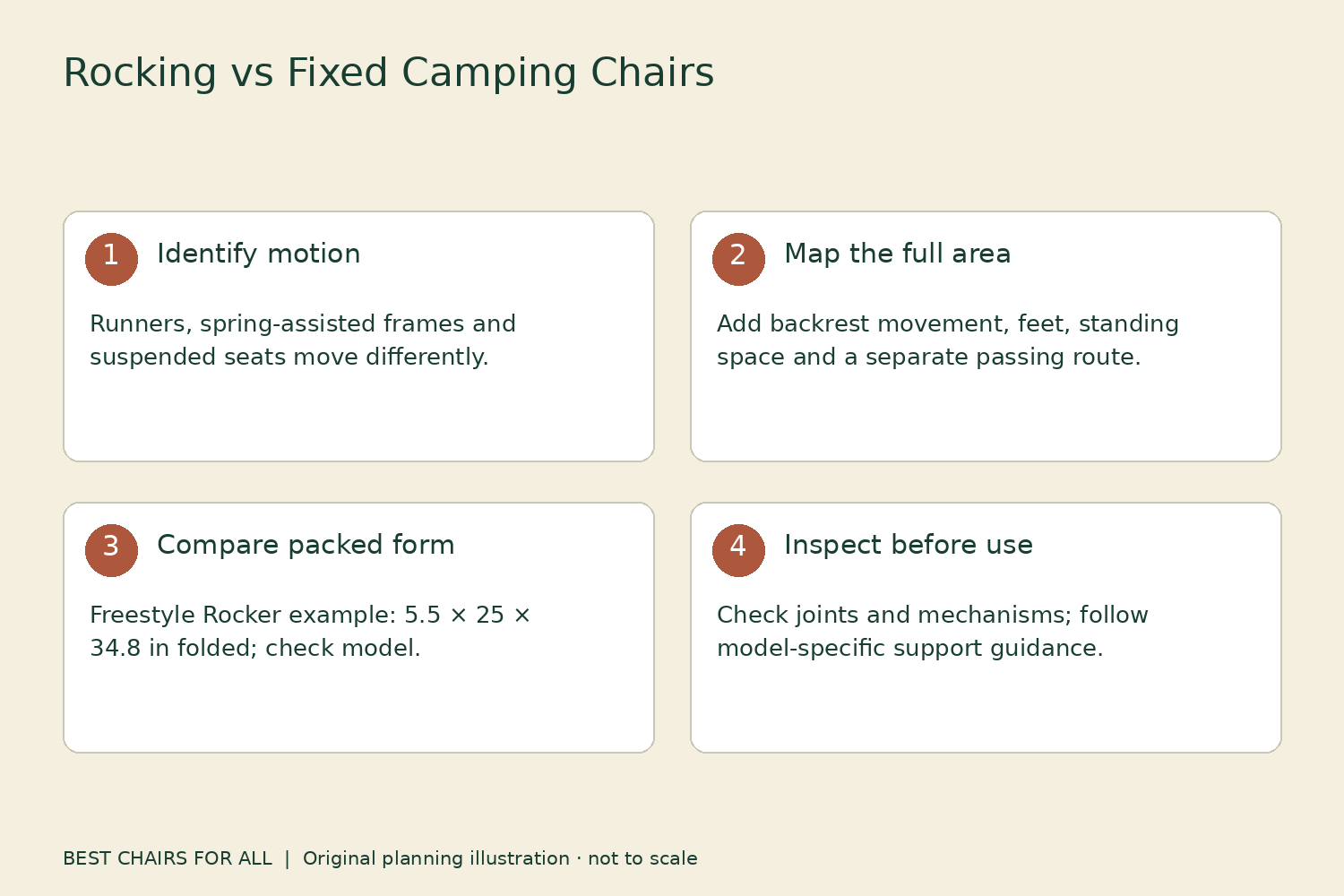
A spring-assisted camping rocker does not work exactly like a traditional chair with curved runners. A fixed pole-frame chair with an approved rocking accessory is another configuration again. Their support points, folded packages and operating instructions differ. A product photograph showing relaxed movement does not establish what ground is allowed or how close it can sit to a wall.
Identify the mechanism first
Look underneath the chair and read the manual. Curved runners move across the ground. A spring-assisted design can create rocking movement while using a different support arrangement. A suspended seat may move within a stationary frame. These distinctions affect which parts must remain clear and what kind of surface interaction to expect.
For a documented example, GCI Outdoor’s Freestyle Rocker uses its Spring-Action Rocking Technology and is described for a range of flat surfaces. That is a statement about the named product. Do not transfer it to another rocker, infer suitability for slopes, or assume “outdoor” means every patch of ground is appropriate.
If a fixed chair accepts a rocking accessory, confirm the exact compatibility list and installation method. The full setup becomes the chair plus that accessory. A similar-looking pair of runners from another model may connect poorly or change the support geometry. Ask the manufacturer when the model name or generation is unclear rather than relying on the approximate distance between the legs.
Measure the area the chair uses while moving
Begin with the open dimensions, then account for the chair’s permitted movement and your body. A static footprint is only a starting point. The backrest, arms, knees or feet may move outside the rectangle described by the feet. Leave enough room to enter and leave without stepping around bags or squeezing between moving hardware and a table.
You can make a planning sketch at home. Place the chair on the surface its manual permits, mark the outside of its stationary supports using removable markers suitable for the floor, and observe the space occupied through normal permitted movement. A second person can note the outer extent without placing hands near the mechanism. Do not force the chair to find a maximum mechanical limit.
Record the needed clear area for your arrangement rather than publishing it as a manufacturer clearance. The observation is specific to your chair, setup and occupant. Add room for the ordinary path behind or beside it. A chair that narrowly avoids a wall while rocking may still be a poor fit if someone must pass through that same gap.
A fixed chair still needs stable support
Fixed seating removes the intended rocking action, but it does not excuse incomplete assembly or unsuitable ground. The Helinox Chair One handling guide, for example, calls for flat, solid ground and warns about shock and uneven load distribution. Leaning back onto two feet is not a safe substitute for a designed rocking mechanism.
Look at the complete footprint. A fixed chair with a narrow stance may fit a small camping pad, while a broad folding chair may occupy more width than a particular rocker. Measure actual candidates. “Regular chair” is too broad a category to support useful assumptions about size, stability or ease of standing.
If you will use sand or soft soil, confirm the chair’s permitted surface and any compatible ground accessory. A ground sheet for a fixed chair is not automatically suitable beneath moving runners or a spring mechanism. It can bunch, interfere, or provide an unsupported edge. Follow the instructions for the exact combination rather than adapting an accessory solely because it is already in your gear bag.
Compare activities, not only the first impression
Rocking can be pleasant during a long pause when you have space and want movement. A fixed chair may be more convenient for eating from a table, tying a boot or frequently getting up. This is a matter of activity fit, not a claim that one category provides a health benefit or is universally more comfortable.
Try the whole routine before buying. Sit, reach toward an unheated tabletop, turn toward a companion, and stand normally. Notice whether movement surprises you during a reach or makes an adjacent table awkward to use. Keep hot drinks and cooking equipment out of the trial. A cup holder’s presence does not guarantee that every container stays secure while the chair moves.
Consider the people sharing the space. Small children, pets and passing campers may not anticipate a moving backrest or linkage. Arrange seating where others can pass without entering the mechanism area. Supervision and the product’s age restrictions still apply. A crowded pitch can favor a fixed chair simply because it is easier to place outside the main route.
Use a two-layout site worksheet
Draw the camping pad or patio section to a convenient scale and add fixed obstacles: tent entrance, picnic table, vehicle, wall or storage box. Sketch each candidate chair in its intended location. For the rocker, include the observed or manufacturer-specified movement area. For both chairs, include the room required for feet and standing.
| Layout check | Rocking candidate | Fixed candidate |
|---|---|---|
| Surface allowed by manual | Write exact restriction | Write exact restriction |
| Open width and depth | Use current model specification | Use current model specification |
| Movement beyond supports | Account for intended rocking | Account for occupant and ordinary use |
| Entry and exit | Check during a normal trial | Check during a normal trial |
| People passing nearby | Keep mechanism area clear | Keep access path clear |
| Folded storage position | Test complete package | Test complete package |
A failed essential check is a reason to change the layout or candidate. Do not shrink the movement area in your drawing simply to fit another chair. If a small pitch leaves no sensible arrangement, use fewer pieces or simpler seating. The sketch is useful because it makes the compromise visible before a busy campsite turns it into a daily obstacle.
Account for carrying and packed shape
The current Freestyle Rocker page lists an item weight of 12.1 pounds and folded dimensions of 5.5 by 25 by 34.8 inches. These specifications illustrate that a rocker can form a relatively broad folded package. They are not a comparison against every fixed chair, and they should not be applied to GCI models with different names or sizes.
Measure the actual hatch or locker opening and make sure the package can turn into its storage position. A broad flat fold can fit neatly beside luggage in one vehicle and be awkward in another. Include the carry handle, bag or accessory feet you will actually use. For longer walks, compare the complete carried package rather than assuming the rocker feature alone determines weight.
Practice handling the folded chair with the rest of your ordinary load. A handle that works in an empty driveway may be inconvenient while carrying a cooler. Keep the chair’s moving parts and folded edges away from children during loading. Secure the package according to the vehicle or storage system’s guidance so it does not become loose cargo.
Mechanisms add inspection points
Before use, inspect the rocking system without dismantling it. Look for visible damage, missing parts, loose hardware, trapped debris or a movement that binds. Stop using a chair with a damaged mechanism and contact the maker. Do not open a sealed spring assembly or improvise a replacement linkage because it seems mechanically simple.
A squeak is a reason to check the specific support guidance, not to spray a household lubricant over every joint. GCI Outdoor’s product support links a rocker-specific squeak solution and instructions for opening and closing its models. Different mechanisms can require different products and application points. Keep lubricants away from fabric and ground surfaces unless the actual instructions permit that contact.
For a fixed chair, inspect its joints, locks, feet and seat attachments with the same seriousness. A simpler mechanism does not mean no maintenance. A missing cap or partially engaged lock can matter more than the presence or absence of a rocker. Store a photograph of each chair’s model label so replacement requests identify the correct parts.
Plan for weather and storage
Camping furniture is often gear that needs drying and indoor storage between trips. GCI specifically says its chairs are not made from weatherproof materials and should dry fully before folding and storage. Follow that guidance for GCI products and consult the maker for other brands. Do not confuse an outdoor use description with permission for permanent exposure.
After a beach trip, remove sand and follow the manufacturer’s cleaning instructions. Check areas around moving parts where contamination can be harder to see. Leave the chair open while it dries in an appropriate place, then fold it using its intended sequence. Avoid forcing a stiff mechanism just to get the equipment into the vehicle faster.
Keep the original manual with the stored chair or in an accessible equipment folder. Mark the opening and closing sequence separately from any maintenance instructions so another household member can handle the chair without guessing at the moving parts.
Choose a rocker when its movement is part of what you want and the actual chair fits your surface, clear area and transport. Choose a fixed chair when simpler placement and your routine point that way. The best comparison ends with a workable layout and a manageable packed chair, not just a pleasant first sit in a display aisle.
Something unclear or out of date? Send a correction with this article’s title and the detail to check.
Sources, research & corrections policy ↗