As an Amazon Associate, we earn from qualifying purchases. Read our affiliate disclosure.
For awake nursing or bottle-feeding, start with the DaVinci Olive if you want a straightforward glider and included ottoman, the DaVinci Piper if a wider seat and manual leg rest matter, and the Babyletto Kiwi if a powered position change is a requirement. None is the best fit for every parent. The deciding test is whether your arms, feet, back, supplies, and standing route work together during a complete feeding-session sequence.
These are research-based candidates drawn from manufacturer specifications checked November 6, 2026. We have not conducted hands-on feeding trials or measured comfort. The product links lead to matching Amazon searches; verify the exact model and seller because a search result can include accessories, used units, or related versions. Prices outside a stated budget comparison are deliberately not treated as a current ranking criterion.
These chairs are for awake adult caregiving, not infant sleep. If there is any chance you may fall asleep while feeding, avoid an armchair or couch and follow NICHD safe-sleep guidance. Move a sleeping baby to an appropriate separate infant sleep space; a reclined nursery chair is not that space.
Start with the whole feeding station
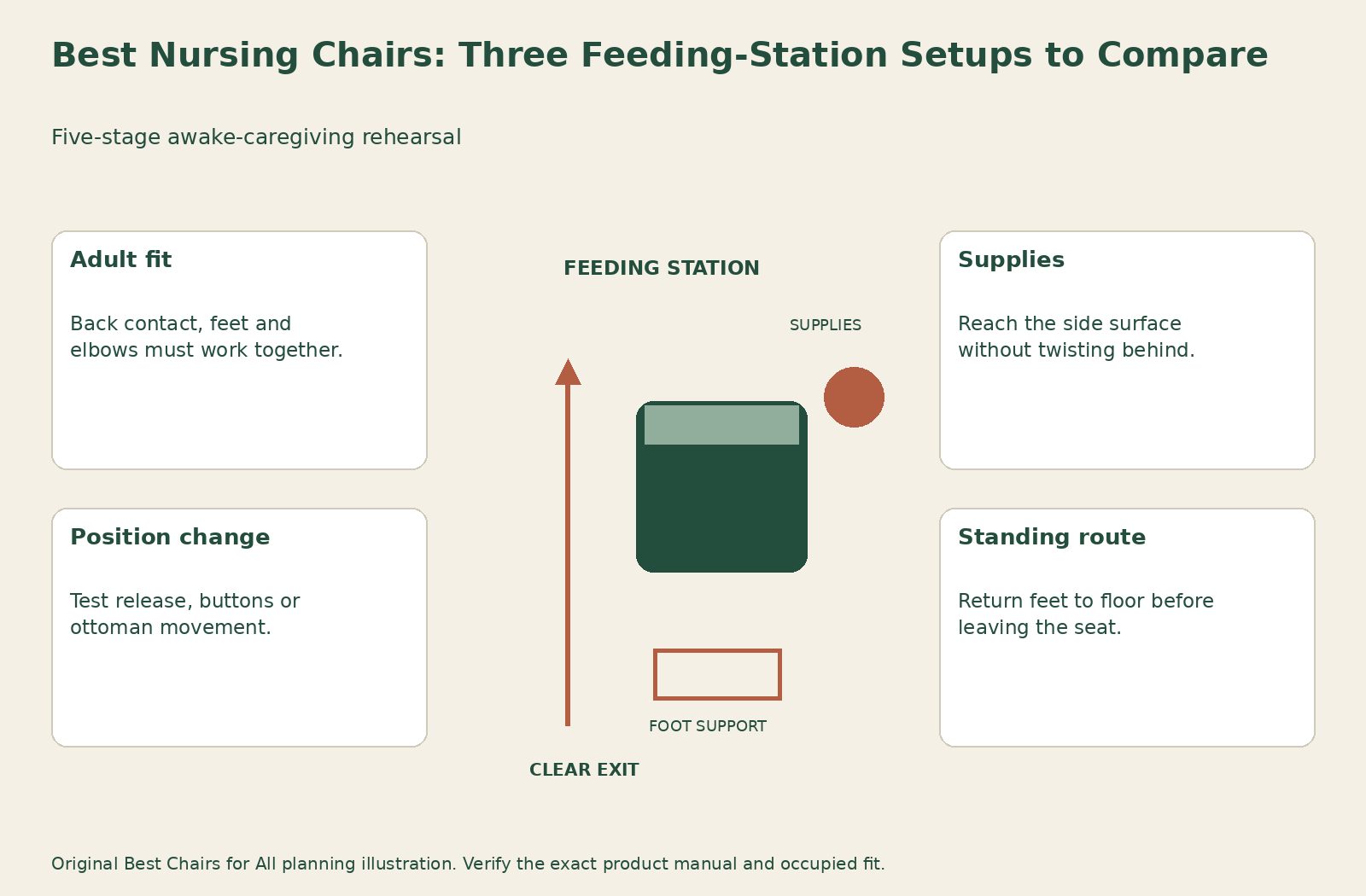
Write down who will use the chair and where supplies will sit. Direct nursing, bottle-feeding, and expressing milk can involve different equipment, but the chair still needs to fit the adult comfortably. A side surface that can hold the intended items without forcing a long reach is often more useful than another decorative cushion. Do not put supplies where you need to reach through the chair’s moving mechanism.
Make a clear distinction between adult comfort accessories and the baby’s sleep area. A pillow on the adult chair is not permission to create a padded infant sleeping place. Follow the relevant feeding or clinical guidance for any individual support needs, and keep the separate infant sleep space ready. The purchase should help an awake adult care for a baby, not promise that either can safely sleep in the recliner together.
Verified differences that affect nursing fit
The DaVinci Olive Glider and Ottoman specifications distinguish its 25-inch exterior width from a 19.5-inch seat and identify the included ottoman. The DaVinci Piper Recliner and Swivel Glider lists a wider 22-inch seat and a manual reclining system. The Babyletto Kiwi Electronic Recliner and Swivel Glider identifies electronic recline, a 21.75-inch seat width, and upright gliding. These are the meaningful starting differences; decorative names and an inviting photograph cannot establish which support arrangement matches your body.
Seat depth deserves particular attention. Olive is listed at 21.25 inches, while Piper and Kiwi list 22 inches. Those figures do not include a custom fit judgment about a particular person or accessory. Sit back, check the front edge against your legs, and notice whether you move forward to reach the floor. If so, a showroom adviser should help establish whether the chair fits before you add more cushions.
Three candidates and where each falls short
1. DaVinci Olive Glider and Ottoman
Best for: a simple chair-and-ottoman feeding station.
Olive is the first candidate to investigate when you want ordinary gliding and a separate place for the feet without paying for a powered recline system. Its 25-inch overall width is helpful for screening a narrow corner, while the included ottoman makes the purchase a complete two-piece layout rather than a chair-only comparison.
The tradeoff is the 19.5-inch seat width, which is much narrower than the exterior silhouette might suggest. Test your occupied room with any adult support accessory you intend to use, and check that the arm height feels useful rather than forcing your shoulders upward. The ottoman remains in the room when unused, so the narrow chair does not guarantee the smallest occupied station.
Product Details
| Brand | DaVinci |
|---|---|
| Dimensions | 31.5 in deep × 25 in wide × 39.25 in high |
| Seat | 21.25 in deep × 19.5 in wide; 20 in high |
| Back above seat | 24 in |
| Ottoman | 20.6 × 17.5 × 16.25 in |
| Motion | 360-degree swivel and gliding; separate included ottoman |
Pros
- Included separate ottoman can be positioned for your leg reach.
- No power cord is needed for the chair’s stated gliding function.
Cons
- No built-in recline or retracting footrest is specified.
- A narrow seat and separate floor piece will not suit every caregiver.
Choose Olive if the upright feeding position fits and you can preserve a clear standing route beside the ottoman. It is less compelling when you want an integrated leg rest or need more usable width.
2. DaVinci Piper Recliner and Swivel Glider
Best for: more seat width with manual recline.
Piper offers a different compromise: a 22-by-22-inch seat and a manual reclining arrangement with an integrated leg rest. It belongs on the nursing shortlist when Olive feels too confined and you prefer a chair whose foot support can close back into the furniture instead of remaining as a separate piece.
The 20-inch seat height is not adjustable in the way an office chair would be. Check your own foot contact and whether you can sit against the back comfortably. Its 6.5-inch arm-to-seat specification also differs from the other candidates, so do not assume their arm support will feel equivalent. A release that is reachable does not prove closing the footrest is easy for you.
Product Details
| Brand | DaVinci |
|---|---|
| Dimensions | 34 in deep × 30.5 in wide × 39.25 in high |
| Seat | 22 in deep × 22 in wide; 20 in high |
| Back above seat | 26 in |
| Fully reclined length | 61.75 in |
| Motion | Manual recline, swivel and gliding |
Pros
- Wider published seat than Olive.
- Integrated manual footrest avoids a permanently separate ottoman.
Cons
- Recline requires a 61.75-inch published extended-length check.
- Manual closing effort needs an individual demonstration.
Piper is a sensible conditional choice when the seat and arms fit and the return-to-upright sequence is manageable. Test operation empty-handed first; do not discover a difficult closure while holding an infant.
3. Babyletto Kiwi Electronic Recliner and Swivel Glider
Best for: caregivers who prefer a powered position change.
Kiwi is the candidate for someone who has already established that a powered adjustment is worth the added cost and electrical planning. It combines electronic recline with a 21.75-inch-wide seat, while its 29-inch overall width is slightly narrower than Piper’s. Those facts make it worth comparing, not an automatic superior nursing chair.
The useful question is whether you can reach and operate the buttons comfortably at your actual feeding position. Its 22-inch seat depth may be too long for some users even when the exterior width suits the room. Babyletto specifies gliding in the upright position, so do not assume every movement remains available at every recline angle. The cord path must remain clear of motion and children.
Product Details
| Brand | Babyletto |
|---|---|
| Dimensions | 38 in deep × 29 in wide × 41 in high |
| Seat | 22 in deep × 21.75 in wide; 20.25 in high |
| Back above seat | 25.5 in |
| Fully reclined length | 64 in |
| Motion | Power recline; 270-degree swivel; glides upright |
Pros
- Powered recline can be compared without a manual release pull.
- Published dimensions distinguish seat size from overall size.
Cons
- Needs suitable power placement and a 64-inch extended-length check.
- Deep seating can be a mismatch for a shorter caregiver.
Consider Kiwi when you can demonstrate the full operating sequence and its seat fits everyone who will use it. Choose the original model deliberately; Kiwi Plus and other named variants should not inherit this specification table.
Use a five-stage feeding-session rehearsal
First, sit down empty-handed and establish your ordinary position. Check foot support, access to the backrest, and the location of your elbows. The chair should not require you to lift the shoulders to use its arms or perch at the front merely to reach the floor. Record your shoes and any intended adult accessory so another showroom visit can reproduce the comparison.
Second, place your hands where they would work during your feeding method and check the arm relationship. You can use a folded towel or similarly harmless object to understand space without conducting a first mechanism experiment while holding a baby. This is a furniture-fitting rehearsal, not instruction in feeding technique. A qualified feeding professional can advise if pain or a specific positioning difficulty affects your needs.
Third, reach for the intended supply location without leaving a stable seated position. If the table is too far away, move the table rather than choosing a chair solely for a greater swivel range. Frequently used items should not require reaching behind a moving backrest. Check the arrangement from the other caregiver’s position as well; different arm lengths can expose a layout problem.
Fourth, test the complete position change you expect to use. For Piper, demonstrate release and return to upright according to its instructions. For Kiwi, locate the buttons and check the power arrangement. For Olive, bring the ottoman into a useful position and then identify how your feet return to the floor. Record the sequence that works rather than describing all three as simply comfortable.
Fifth, stand up normally with an empty-handed first trial. Check whether the footrest or ottoman obstructs your feet and whether the chair moves in a way you can manage. Do not stand on an ottoman or use an extending leg rest as a step. If you have access or transfer requirements, get appropriate individual and product-specific advice rather than relying on the usual nursery marketing photograph.
A comparison sheet for two caregivers
Give each person separate rows for seat depth, foot contact, elbow support, controls, supply reach, and exit. Use verified, unresolved, or unsuitable with one plain observation. A result such as “controls reachable but deep seat leaves feet unsupported” is more useful than a star score. Do not average away a failed fit because the other caregiver likes the chair.
For a hypothetical example, one user may fit Piper’s width and lower arm relationship while the other finds its deep seat difficult. Kiwi does not automatically solve that because it also lists a 22-inch depth. Olive changes the width and arm relationship but still needs an occupied trial. This is why swapping brands is less useful than identifying which dimension actually causes the conflict.
Decide what to order after the rehearsal
Choose the configuration that passes the full sequence, then confirm upholstery, included pieces, delivery access, and return conditions. Olive’s included ottoman should appear on the order. A Kiwi listing should identify the original version or the specific alternative you actually tested. A Piper offer should match the manual-recline model rather than another DaVinci chair with a similar silhouette.
During a home trial, place the chair in the real station and repeat the unresolved parts of the rehearsal before the return deadline. Keep cables and moving areas clear, inspect the assembly as the manual requires, and report unexpected mechanism behavior. The useful outcome is a feeding station that supports the adult’s work with clear transitions and an appropriate separate infant sleep plan, rather than a chair chosen only for its first soft impression.
Something unclear or out of date? Send a correction with this article’s title and the detail to check.
Sources, research & corrections policy ↗