As an Amazon Associate, we earn from qualifying purchases. Read our affiliate disclosure.
For tall parents, investigate the Namesake Crewe when a higher seat and taller back are the priority, the Babyletto Kiwi when a deep seat and electronic adjustment matter, and the DaVinci Piper when you want a deep-seat manual option. Standing height alone cannot choose among them. The useful distinction is whether your limiting dimension is lower-leg height, thigh support, torso contact, or the position of the arms.
Check nursery chair seat height for parents using the adults who will share the chair, including foot contact and the effort needed to stand.
This guide compares manufacturer specifications retrieved November 6, 2026 and offers a proportion-based fitting worksheet. No hands-on tall-parent testing or personal height-range guarantee is claimed. Retailer search links can include different bases and variants, so the exact ordered configuration must match the specifications you use. A product described as high back or tall-parent approved still needs an occupied trial.
These chairs are for awake adult caregiving, not infant sleep. If there is any chance you may fall asleep while feeding, avoid an armchair or couch and follow NICHD safe-sleep guidance. Move a sleeping baby to an appropriate separate infant sleep space; a reclined nursery chair is not that space.
Identify which tall-person problem you have
Write down the failing relationship in your current chair. “Knees feel crowded at the available seat height” is different from “seat ends too far back under the thighs” or “upper cushion meets my shoulders instead of a useful head-rest position.” A taller back will not solve every one of those problems. Nor does a higher seat automatically provide a deeper sitting area.
Use your normal shoes and a comparable supported seat to establish a rough fitting reference. Record the height and depth that feel useful, then separately note where comfortable back and upper contact occur. These are personal screening observations, not medical measurements or a prescription to hold a rigid pose. If discomfort or a physical limitation requires individual advice, obtain it before committing to a particular furniture shape.
Read the relevant dimensions together
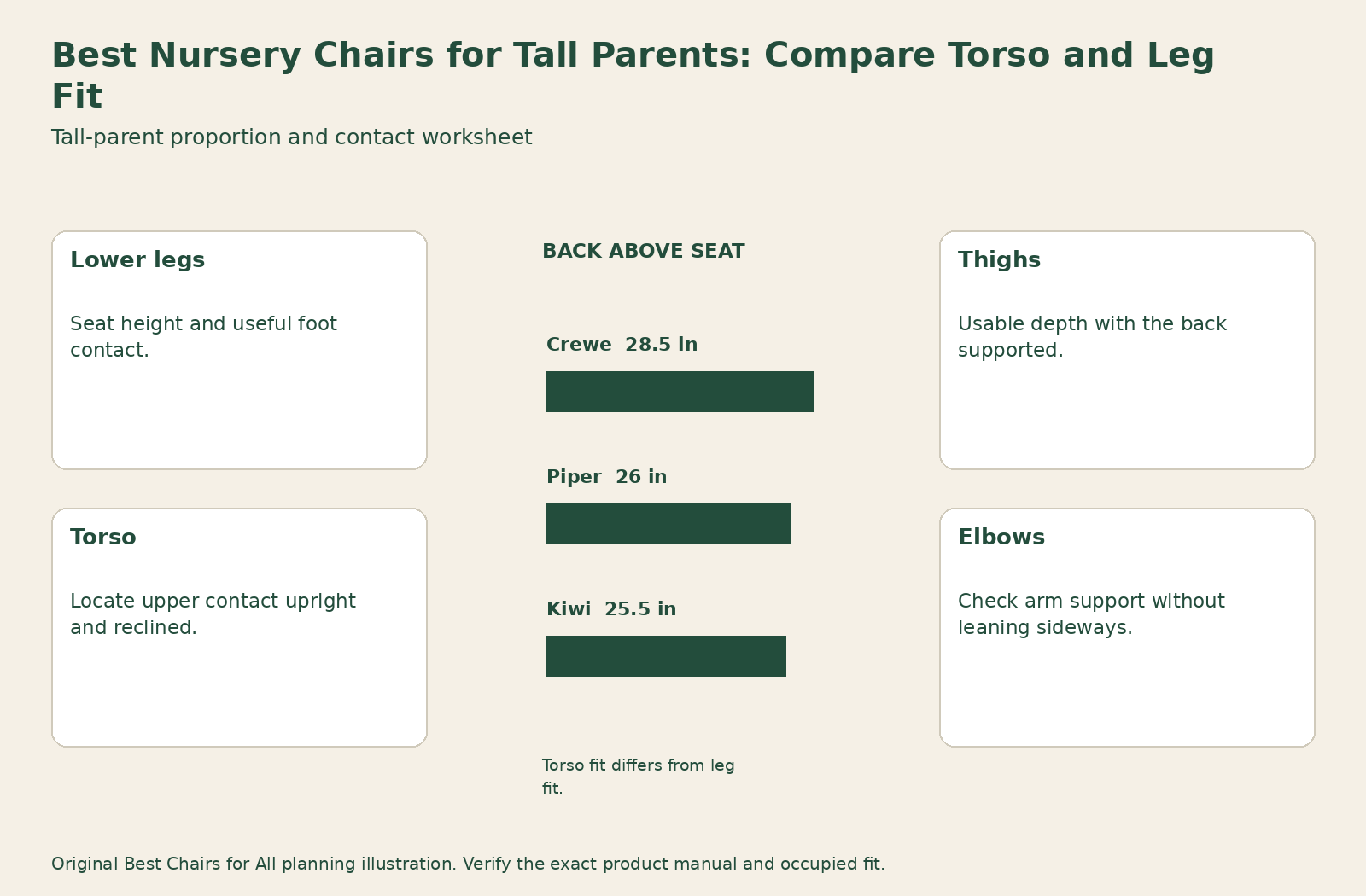
The Namesake Crewe Electronic Recliner and Swivel Glider lists a 21.5-inch seat height, 20.5-inch seat depth, and 28.5-inch back above the seat. The Babyletto Kiwi Electronic Recliner and Swivel Glider lists 20.25 inches, 22 inches, and 25.5 inches respectively. The DaVinci Piper Recliner and Swivel Glider lists 20 inches, 22 inches, and 26 inches. This combination shows why choosing the largest overall-height number can produce the wrong result for your particular proportions.
Overall height includes the seat’s position above the floor and the upper structure. It is not interchangeable with back height above the seat. Similarly, overall chair depth includes structures behind and around the pan; it does not directly tell you thigh support. Keep the field label with each measurement so a retailer’s copied dimension cannot silently turn into the wrong fitting assumption.
Three different geometry profiles
1. Namesake Crewe Electronic Recliner and Swivel Glider
Best for: a long-torso fitting trial.
Crewe is the first candidate here for someone whose principal problem is back and head contact rather than seat depth. The manufacturer lists a 28.5-inch back above the seat, the tallest of these three published figures, plus a 21.5-inch seat height. Those measurements create a reason to try it; they do not establish a guaranteed fit for a given standing height.
Its 20.5-inch seat depth is shorter than Piper or Kiwi, so a tall person with long thighs should not automatically choose it. Compare the front support while sitting naturally against the back, then check the contact in the ordinary reading recline. A higher seat can help one user’s leg position and leave another’s feet poorly supported. The paired dimensions matter.
Product Details
| Brand | Namesake |
|---|---|
| Dimensions | 40 in deep × 30.5 in wide × 42 in high |
| Seat | 20.5 in deep × 22 in wide; 21.5 in high |
| Back above seat | 28.5 in |
| Fully reclined length | 64.5 in |
| Motion | Electronic recline, 270-degree swivel and gliding |
Pros
- Tallest published back above the seat in this comparison.
- Higher seat offers a different lower-leg relationship.
Cons
- Shorter listed seat depth than the other candidates.
- Needs a 64.5-inch fully extended-length check in the room.
Choose Crewe when its added upper contact and higher seat produce a coherent fit, not merely because the whole chair is tall. Reject it if the gain at the back costs the thigh support or entry arrangement you require.
2. Babyletto Kiwi Electronic Recliner and Swivel Glider
Best for: a deep-seat powered option for comparison.
Kiwi belongs on the shortlist when useful thigh support is the problem and you prefer electronic adjustment. Its 22-inch seat depth gives a different geometry from Crewe’s 20.5-inch specification. At 29 inches wide overall, it also offers a narrower furniture body than the other candidates while retaining a published 21.75-inch seat width.
The back above the seat is listed at 25.5 inches, so it is not the tallest-back choice here. A long-torsoed user should check where the top contour meets the shoulders and head in the intended recline. Do not let the deeper seat compensate for an upper contact problem, or let a pleasant head contact distract from unsupported legs. Verify any base option because configurations can affect height.
Product Details
| Brand | Babyletto |
|---|---|
| Dimensions | 38 in deep × 29 in wide × 41 in high |
| Seat | 22 in deep × 21.75 in wide; 20.25 in high |
| Back above seat | 25.5 in |
| Fully reclined length | 64 in |
| Motion | Power recline; 270-degree swivel; glides upright |
Pros
- Deep published seat is useful evidence for a long-thigh trial.
- Electronic recline is a distinct control preference.
Cons
- Back-above-seat dimension is shorter than Crewe or Piper.
- A deep seat can fail another shorter caregiver sharing the chair.
Consider Kiwi when the pan supports your thighs and the upper contact remains comfortable. Its tall-parent marketing should not replace your own occupied measurements or transfer automatically to other Kiwi variants.
3. DaVinci Piper Recliner and Swivel Glider
Best for: a deep-seat manual alternative.
Piper gives a 22-inch-deep, 22-inch-wide seat with a 26-inch back above it and a 20-inch seat height. It is the manual candidate for a tall adult who finds that combination useful and does not need the higher seat of Crewe. Its published fully reclined length is 61.75 inches, shorter than the two powered candidates.
Extended length is a furniture dimension rather than a measure of how much lower-leg support your body receives. Check where the footrest contacts you and whether your preferred recline leaves the upper body supported. Then demonstrate the manual closing sequence from the fitted position. A tall adult can still find a release or return movement inconvenient; stature does not establish operating strength or access.
Product Details
| Brand | DaVinci |
|---|---|
| Dimensions | 34 in deep × 30.5 in wide × 39.25 in high |
| Seat | 22 in deep × 22 in wide; 20 in high |
| Back above seat | 26 in |
| Fully reclined length | 61.75 in |
| Motion | Manual recline, swivel and gliding |
Pros
- Same published depth as Kiwi with a slightly wider seat.
- Manual reclining offers an alternative to electronic controls.
Cons
- Lower seat than Crewe may not suit every long lower leg.
- Manual operation needs a personal trial alongside body fit.
Keep Piper when both the occupied geometry and manual movement work. It is a reasonable comparison option rather than a universal recommendation for all people over a particular height.
Build a proportion-based rejection sheet
Create four rows headed lower legs, thighs, torso, and elbows. For each, record the current problem, the candidate dimension that might address it, and the occupied result. Keep a separate column for the second caregiver if you share the chair. A feature can solve your own requirement while creating a problem for someone with different proportions, so do not combine both people into an average body.
For lower legs, observe whether the seat lets your feet find useful support without forcing an uncomfortable leg position. Crewe’s higher published seat makes it a candidate to test, not a direction to use a high seat at any cost. If a shorter caregiver cannot use it comfortably, decide whether a documented separate support arrangement works or a different chair is needed.
For thighs, sit against the backrest before judging the front edge. Kiwi and Piper offer deeper published pans, but you still need comfortable clearance near the knees and freedom to change position. A contour or included lumbar cushion can affect usable room. Record the actual position with the intended accessories rather than assuming the full numerical depth becomes support beneath every person.
For torso contact, check upright caregiving and a controlled adult reading recline separately. The tallest fixed back can still meet the wrong location if the contour is unsuitable. Do not crane your neck to prove the chair offers head support. If an independently adjustable headrest is required, verify that exact feature rather than attributing it to a high-back label.
For elbows, note where the arms land with shoulders relaxed in your intended task. These three chairs list different arm-to-seat relationships, and padding shape matters as well. A tall torso can leave a low arm pad unhelpful even when the seat height suits the legs. Avoid leaning sideways just to reach a pad and calling the chair fitted.
Work through two tall-user scenarios
Imagine two adults with the same standing height. One has a longer torso and finds upper-back contact too low in a current chair. Crewe’s 28.5-inch back-above-seat specification gives that person a reason to try it first. The second adult mainly needs more thigh support and finds a very high seat unnecessary. Kiwi or Piper’s deeper published seat is then a more relevant first comparison.
Neither scenario proves the final choice. The long-torsoed person may reject Crewe because the upper contour feels intrusive, while the long-thighed person may find the deeper pan shape unsuitable. The worksheet makes the next question precise. You are using dimensions to reduce random shopping, then using actual contact and movement to decide whether the theoretical advantage survives.
A third practical conflict arises when a taller and shorter adult share the nursery. A fixed deep seat is not an adjustable seat slide. Adding cushions can change several relationships at once, and a makeshift adaptation should not be assumed to solve the difference. Test each user’s full position and decide whether the chair provides a workable shared arrangement before ordering.
Check the reclined support length
Published full lengths are 64.5 inches for Crewe, 64 for Kiwi, and 61.75 for Piper. Those figures help plan the room but do not measure the support under your calves or feet. Try the intended position and note where the leg rest ends relative to your body. A long chair can still provide a contact pattern you dislike, while a shorter dimension may be adequate for another person’s preference.
Also check the route out. Long legs need room to return to the floor without striking an ottoman, side table, or nearby furniture. Demonstrate the correct close-and-stand sequence empty-handed first and follow the manual. If entry or transfers require specific support, obtain appropriate individual assessment; neither taller dimensions nor powered recline establish that capability.
Turn measurements into the final order
Save the tested configuration, source dimensions, and personal rejection sheet. Confirm whether a base change alters the installed height and whether the delivered model has the exact control system you used. A taller-looking wood base or different named variant should be checked as its own configuration rather than quietly inheriting the original table. Ask for clarification when a seller quotes a conflicting measurement.
When the chair arrives, recheck torso contact and leg support in the real room before the return deadline. Give preference to the candidate that resolves your actual limiting relationship while preserving the other three. Crewe, Kiwi, and Piper offer useful differences to investigate, but a defensible tall-parent recommendation is an observed fit profile, not a standing-height cutoff or a broad promise about comfort.
Something unclear or out of date? Send a correction with this article’s title and the detail to check.
Sources, research & corrections policy ↗