As an Amazon Associate, we earn from qualifying purchases. Read our affiliate disclosure.
For a shorter adult, investigate Human Touch Super Novo 2.0 first if the budget allows a chair with an explicit manual shoulder-setting category for users five feet to five feet two inches. Compare Real Relax PS5200 for its shallower published seat and adjustable features, after confirming its current fit range. Ogawa Refresh 3D is another conditional fit-trial candidate, but its current product page and general comparison chart describe different specifications and should not be blended.
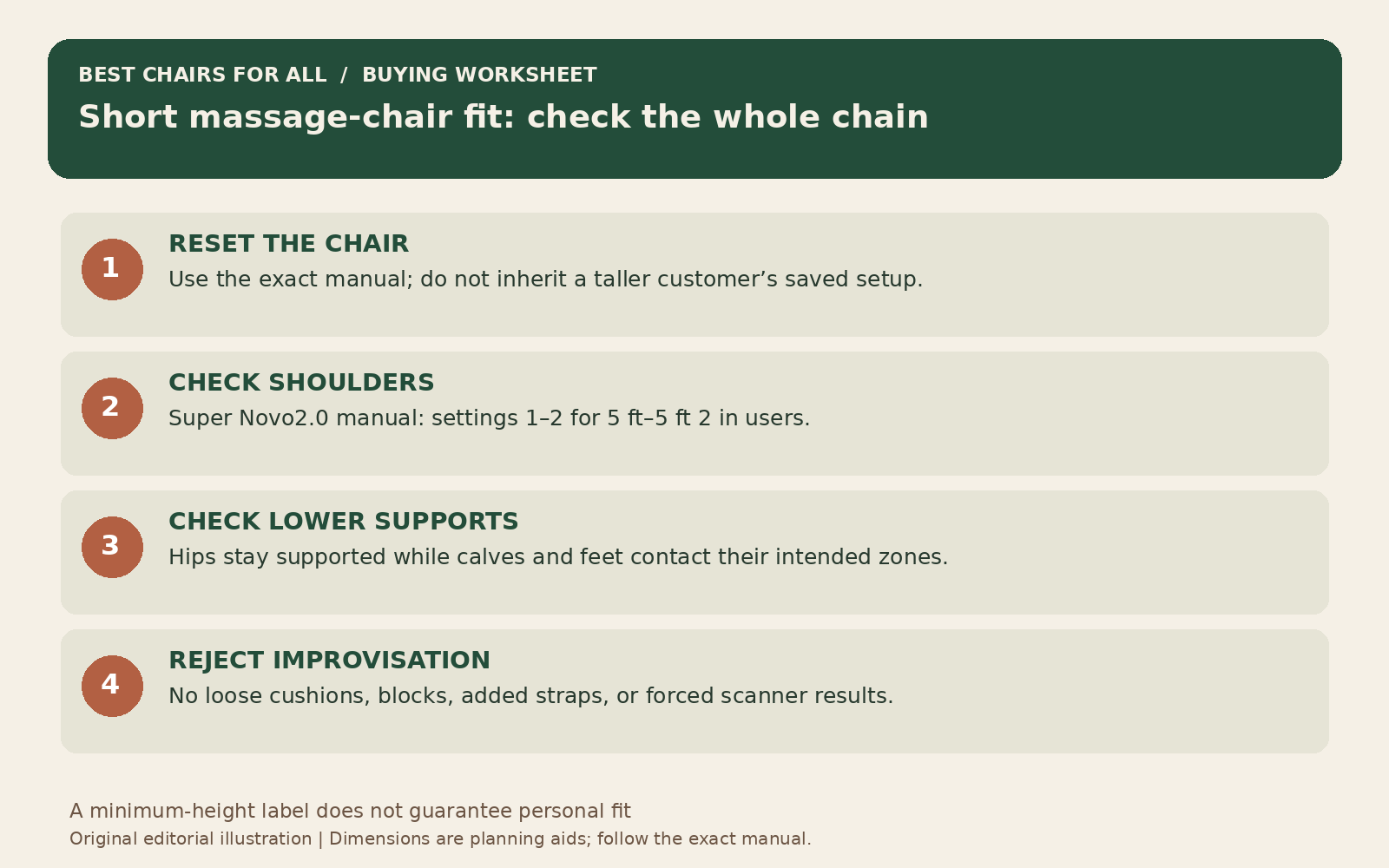
A low advertised minimum height does not guarantee correct neck, shoulder, calf, or foot contact. We checked manufacturer pages and instructions on November 6, 2026, and have not performed hands-on trials with shorter users. This guide emphasizes the failure patterns shorter adults should check and gives a reset-and-retest worksheet. It does not prescribe a seating arrangement for a medical condition.
Review how height ranges and foot rollers affect fit before assuming that a body scan will align the leg section.
Compare the evidence for shorter-user fit
| Model | Useful published measurement | Fit evidence | Unresolved question |
|---|---|---|---|
| Super Novo 2.0 | Seat 20 W × 18 D × 21 H in | Manual shoulder settings 1–2 for 5 ft–5 ft 2 in | Confirm leg contact and seat entry personally |
| PS5200 Black | Seat depth shown as approximately 16.93 in | Current product and older official fit ranges differ | Obtain exact current height range and manual |
| Ogawa Refresh 3D | Current seat width 21.3 in; seat height 20.1 in | General chart lists 5 ft lower range | Confirm current revision and complete inner geometry |
Super Novo 2.0: the clearest documented shoulder adjustment here
The Super Novo 2.0 manual includes a specific five-foot-to-five-foot-two shoulder category using settings one to two. It also explains the choice between automatic shoulder detection and manual adjustment. This is more useful evidence than a retailer merely saying petite-friendly because it gives a model-specific control to investigate in a demonstration. The setting still needs to put the rollers where intended for the individual adult.
The current product listing publishes a 20-inch seat width, 18-inch depth, 21-inch seat height, and 285-pound maximum load. Upright dimensions are 63 by 33 by 46 inches, and reclined dimensions are 74 by 33 by 32 inches. The chair weighs 313 pounds and was listed at $10,999 with a purchase option during research. It is therefore a premium fit candidate rather than an economical default for every shorter user.
Investigate it when manual shoulder correction is valuable and the complete chair fits the room and budget. It is less suitable if the seat is too high for comfortable entry, the legs cannot reach the designed lower supports, or the premium features are not needed. Do not assume an explicit shoulder category proves footrest fit. Ask for a demonstration using the supplied padding and the exact model instructions, then check the lower-body contact separately.
PS5200 Black: a shallower seat deserves a closer look
The current PS5200 Black page lists a seat-depth figure formatted as approximately 16.93 inches, with seat width approximately 19.88 inches. Those are useful reasons to investigate it for an adult who finds deeper capsule seats difficult to use. The page’s formatting and height-range statement need clarification from the manufacturer, especially because an older official dimension page gives a different recommended range.
The outer chair measures 57.5 by 29.1 by 44.5 inches upright and 70.1 by 29.1 by 38.6 inches reclined, with a 174.2-pound net weight. Its observed base price was $1,799.99 with a purchase option. The SL-track, automatic shoulder detection, adjustable massage intensity, adjustable air pressure, and extendable footrest are relevant functions to try, but none alone establishes a correct shorter-user fit.
This model is a conditional candidate when a shallower seat and lower price address your needs. Pass if the maker cannot confirm the exact current range or if a demonstration still places the upper rollers too high or the calf section too low. Do not interpret a decimal notation such as 4.9 feet as four feet nine inches without clarification. The more useful answer is a confirmed model revision and a workable demonstrated position, not an optimistic conversion of a poorly entered number.
Refresh 3D: verify the current seat and controller rather than a legacy chart
The current Ogawa Refresh 3D page gives a 21.3-inch seat width and 20.1-inch seat height, with upright dimensions of 58 by 29.9 by 44.5 inches and reclined dimensions of 70.9 by 29.9 by 33.5 inches. It lists a 162-pound net weight and 320-pound capacity. The observed $1,999.99 listing showed in-stock status, making it a current product to investigate rather than an unsupported retired recommendation.
Ogawa’s general comparison chart lists a five-foot lower height boundary but different Refresh dimensions from the current product page. This could reflect a revision or stale information; we cannot decide which without a model-specific answer. Ask for the current recommended height range, seat depth, shoulder-scan adjustment procedure, and minimum footrest configuration. Do not use the chart’s lower bound as a guaranteed fit claim for the newer listed chair.
Refresh is worth considering if a demonstration confirms a useful seated position and the wired control’s manual and custom options suit you. It is less attractive when the evidence conflict remains unresolved or the lower supports cannot reach the intended contact areas. Its higher capacity is not a petite-fit feature, and a roomy seat can still leave a shorter user unable to maintain the supported posture the chair expects. Check the actual shell contours and padding rather than only the outside width.
The short-user fit problem is a chain, not one number
Start at the hips. If a deep seat causes you to slide forward to reach the leg section, the shoulders may move away from the place the scanner expects. If you move back to correct the shoulders, the calves or feet may lose the intended contact. A chair can appear to satisfy a minimum standing height while failing this chain of support for a particular combination of torso and leg length.
Record your approximate comfortable seat depth and the supported position you prefer in an ordinary firm chair. Use that as a discussion point, not as a formula proving a massage chair fits. Curved shells, sloping cushions, and powered reclining change the geometry. Ask the manufacturer how the seat-depth number is measured and whether supplied pillows or pads alter the functional position.
Compare the published numbers cautiously. PS5200’s approximately 16.93-inch depth is about 1.07 inches less than Super Novo’s 18 inches, while Refresh’s current page does not provide a clearly comparable seat-depth figure. That difference can justify a closer trial, but it does not prove PS5200 is better. A shallow seat with a poorly placed upper mechanism can fail just as readily as a deeper seat with a suitable supported arrangement.
A reset-and-retest demonstration card
Ask the demonstrator to reset the chair according to its instructions before the trial. A position saved for a taller customer can make a shorter person’s first impression misleading. Sit in the supplied configuration, follow the model’s body-scanning process, and check where the upper rollers operate at a mild setting. If the manual permits shoulder correction, make it and repeat the check.
Keep a simple four-row record: hips and back remain supported, shoulder location is correct, lower-leg and foot contact is appropriate, and controls can be reached and stopped easily. Mark each pass, fail, or needs clarification. Do not let a pleasant foot sensation offset a failed shoulder position. The requirement is a workable whole seated arrangement, not one comfortable feature.
Recline only within the model’s intended use while keeping hands, clothing, and nearby objects clear. Check whether the lower section fits at the beginning and end of the movement and whether a spring-loaded extension needs continued pressure to remain in position. Ask the manufacturer to explain its intended operation rather than bracing against a component. Stop if a position is uncomfortable or the mechanism contacts an unintended area.
Then return upright and rehearse getting out. A 20-to-21-inch published seat height may matter differently to an adult depending on footwear, leg length, and the chair’s front edge. We cannot determine entry and exit suitability from that measurement alone. If mobility or balance concerns affect the task, obtain individualized advice and test with appropriate assistance rather than assuming a shorter-user label makes the transfer safe.
What not to do when the chair almost fits
Do not build up the seat with loose cushions, insert blocks in the foot well, add straps, or remove protective padding to trick the scanner. Such changes can alter the contact geometry, expose moving parts, or conflict with the manual. Use only the supplied or specifically approved adjustment method. If the maker has a suitable approved comfort pad, confirm its compatibility and instructions for the exact model.
Do not lean forward during the scan and then slide back afterward to obtain a different result unless the manufacturer specifically instructs that process. Body sensing is a positioning tool, not a diagnostic system whose output should be forced into a desired number. An incorrect reading should be corrected through the approved manual settings or support procedure.
If the smallest permitted setting still does not align, the chair fails your fit test. A generous discount, long track, or extra preset cannot repair that basic mismatch. Choose another candidate or delay the purchase until you can test a suitable model. Returning a heavy chair is a costly way to discover that its smallest adjustment was never small enough.
A purchase record that protects the fit decision
Ask for the exact model and revision, current minimum range, supplied padding, demonstrated settings, and return terms in writing. If you tried a display unit, confirm the offered chair is the same generation. For PS5200 and Refresh, resolve the conflicting online statements before paying. Keep a copy of the specification and any support answer with the order record.
Where a showroom is unavailable, read the oversized-return policy before assuming an at-home fit trial is practical. Confirm whether collection is arranged, whether the cartons must be kept, and what freight or restocking charges apply. We cannot promise easy returns based on a generic retail banner. A more expensive purchase arrangement with clearer fit protection may be worth comparing, but only the written terms establish that protection.
Use these products as consumer relaxation furniture. Follow the exact manual’s heat, pressure, electrical, and suitability limits, and seek qualified advice where a health concern makes use uncertain. Keep children and pets away from the moving components. Register the chair and consult current recalls using its exact identifier rather than assuming an available listing is a safety guarantee.
The shorter-user shortlist
Start with Super Novo 2.0’s explicit manual shoulder category if the premium price is realistic. Compare PS5200 for its shallower published seat after confirming the current range. Investigate Refresh 3D only with its current-version geometry and fit guidance clarified. Recheck the CPSC recall database and current selected-model availability before purchase. The winning chair is the one that aligns shoulders and lower supports together without improvised padding or a forced position.
Something unclear or out of date? Send a correction with this article’s title and the detail to check.
Sources, research & corrections policy ↗