As an Amazon Associate, we earn from qualifying purchases. Read our affiliate disclosure.
A useful full-body massage chair combines several mechanisms rather than applying the same roller action everywhere. Compare the Real Relax PS6500 for a lower-priced SL-track enclosure, Human Touch Super Novo 2.0 for a premium system with separately described air and heat controls, and the current Ogawa Refresh 3D for a different flexible-track and custom-program package. Choose by the actual body-zone map and fit, not the words full body on the box.
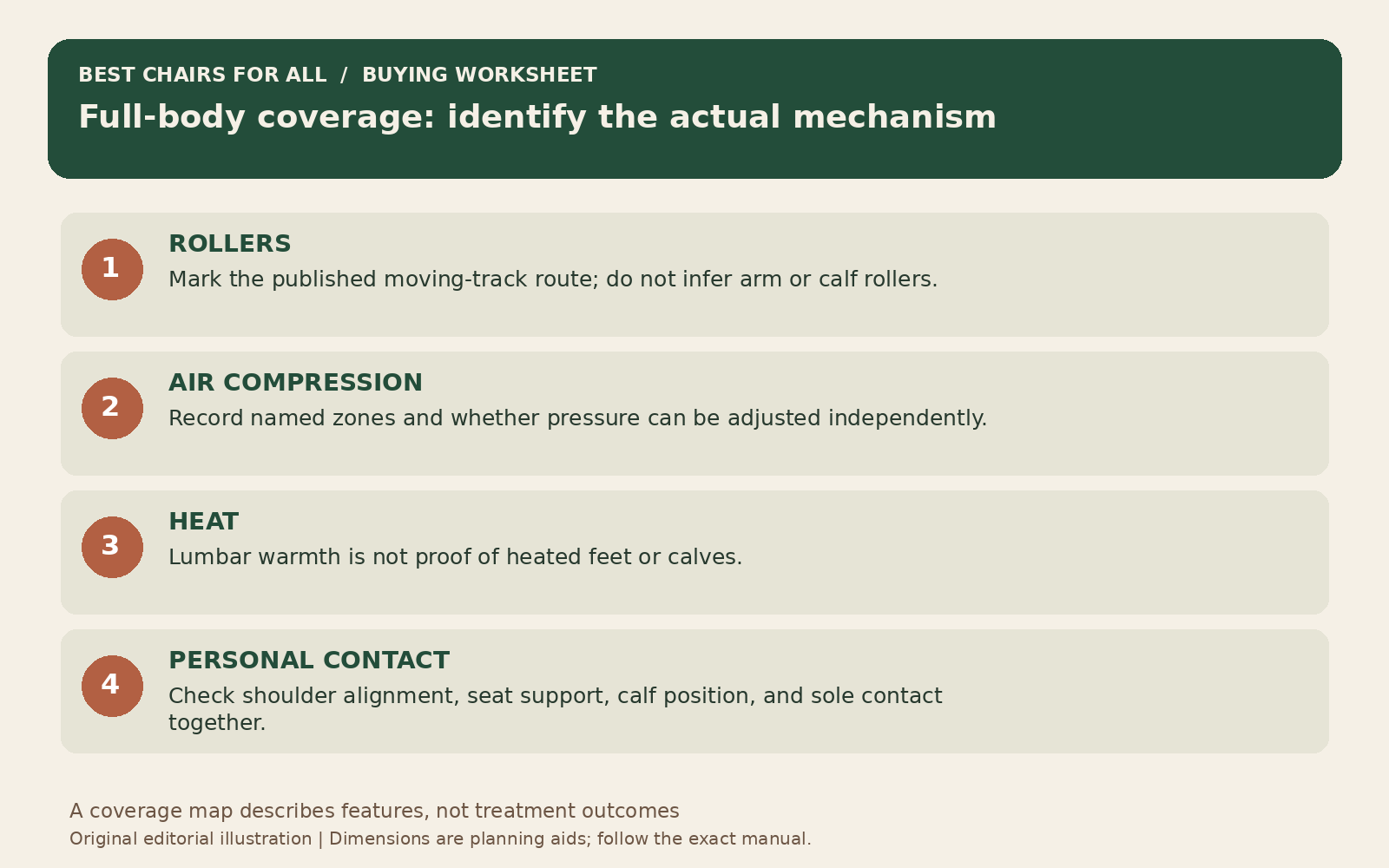
We researched manufacturer product pages and instructions on November 6, 2026. We have not performed hands-on coverage or pressure testing. In this guide, coverage means the maker identifies a mechanism at a body zone; it does not establish a treatment benefit or prove that every person’s body contacts the mechanism correctly. Our coverage worksheet shows how to ask the questions a general feature list leaves unanswered.
Coverage is a combination of systems
| Model | Back-and-seat mechanism | Other listed functions | Observed base price |
|---|---|---|---|
| Real Relax PS6500 Brown | 4D mechanism; long SL-track | Air compression, foot rollers, lumbar heat | $2,599.99 |
| Human Touch Super Novo 2.0 | S-and-L-track 3D mechanism; variable-speed programs | Cloud Touch air massage; heated lower-leg unit; back heat | $10,999 |
| Ogawa Refresh 3D current listing | 3D Vario Motion; Li Flex track | Air compression, foot/sole rollers, lumbar heat | $1,999.99 |
PS6500: a broad feature set with a deep seat to check
The PS6500 Brown manufacturer page lists a long SL-track, 4D mechanism, 28 air cells, foot rollers, waist heating, 27 automatic programs, and an extendable footrest. That combination is relevant when you want more than back-only massage, but the functions are not identical: rollers travel along the track, air cells provide compression, and heat is described at the waist. Do not read full body as proof of moving rollers in the arms, calves, and every other zone.
The current specifications are 61.81 by 30.71 by 48.82 inches upright and 74.02 by 30.71 by 38.98 inches reclined. Published seat width is 21.26 inches, seat depth 23.62 inches, maximum recommended weight 300 pounds, and net chair weight 205 pounds. Its observed $2,599.99 listing had an active cart. The deep seat is a practical reason to check upper and lower contact together rather than assume a larger shell makes coverage more complete.
Investigate it when the track and zone combination suit your priorities and the current model fits. It is less suitable if the foot or calf contact is wrong, you need independently documented heating at additional zones, or the exact model’s ambiguous height notation remains unresolved. We do not credit the advertised AI soreness detector as a medical diagnostic function. A sensor label does not verify that the rollers or air cells contact the right places on your body.
Super Novo 2.0: separately documented controls are useful evidence
The Super Novo 2.0 page describes S-and-L-track coverage along the back and toward the thighs, heated foot-and-calf massage, dual-lumbar heat, and 38 automatic programs. The manufacturer manual is especially useful because it separately explains Cloud Touch air massage, back or leg heat, roller intensity, and manual focus. A buyer can therefore investigate the actual control categories instead of inferring every function from an automatic program name.
Published dimensions are 63 by 33 by 46 inches upright and 74 by 33 by 32 inches reclined, with a 313-pound net weight and 285-pound maximum load. The seat is 20 inches wide and 18 inches deep at a 21-inch height. The observed base price was $10,999 with a purchase option. This is a major premium over the other candidates; it should buy functions and a fit you specifically value rather than the vague expectation of more complete wellness.
The manual notes that air-massage zones and their intensity can be selected, while heat has separate BACK and LEG settings. That independence is worth demonstrating if you want one system operating without everything else. The chair is less compelling if you will mainly use one simple back routine or cannot obtain the correct shoulder and leg alignment. We have not measured the quality of its massage, noise, or long-term reliability, so those remain open questions for an actual demonstration and the written ownership terms.
Refresh 3D: verify the current version’s zone map
The current Refresh 3D listing describes a 3D Vario Motion mechanism, Li Flex track from neck toward buttocks, foot-and-sole rollers, lumbar heating, and air massage for the shoulders, arms, feet, and calves. Those named zones provide a useful starting map for a full-body comparison. They do not make air compression equivalent to kneading rollers, nor establish that the massage feels the same across those zones.
The current manufacturer page gives a 58-by-29.9-by-44.5-inch upright size and 70.9-by-29.9-by-33.5-inch reclined size, with a 162-pound net weight and 320-pound capacity. It lists a 21.3-inch seat width, 20.1-inch seat height, and an observed price of $1,999.99 with in-stock language. The general Ogawa comparison chart gives different dimensions and weight for Refresh, so obtain the current exact model identifier and do not combine specifications from different revisions.
Investigate this chair when the described track, zone selection, and current fit give you the coverage you want at its complete purchase price. It is less useful if you need heat at the feet or calves rather than lumbar warmth, or if the current version cannot be confirmed. A collection of custom modes can be useful, but it cannot create a mechanism at an unlisted body zone. Ask the seller to demonstrate each required system separately before crediting it with full coverage.
Build a mechanism-by-zone worksheet
Draw six rows: upper back, lower back, seat, arms and shoulders, calves, and soles. Add four columns: moving rollers, air compression, heat, and independently adjustable control. For each product, fill a cell only when the current manufacturer specification or manual identifies that function at that zone. Write unknown where the evidence is incomplete. This makes a feature gap visible without pretending that every full-body label means the same thing.
For example, a chair can have an SL-track reaching below the back but only lumbar heat. Another can have a shorter roller path plus a heated calf module. A third may offer air compression at the arms without arm rollers. Those are different experiences and may suit different preferences. The worksheet should preserve those distinctions instead of counting each as a generic yes beside full-body massage.
Use the exact model manual to confirm what can be turned off or adjusted independently. A buyer who dislikes air compression may want the track to run by itself; a buyer who wants warmth without a particular leg routine needs separate control. Ask whether the controls retain settings between users or revert to a default. We do not assume a chair supports every combination merely because the individual features appear on the same page.
A worked comparison of actual priorities
Imagine a buyer whose required features are moving back-to-seat rollers, foot rollers, and controllable air pressure, while calf heating is optional. PS6500 and current Refresh merit investigation from the listed mechanisms; Super Novo’s additional heat controls may be attractive but are not automatically necessary. Now imagine calf-area heat is essential. Super Novo’s documented leg-heat controls become more relevant, while the other two pages’ lumbar heating does not satisfy that requirement by itself.
This exercise does not declare a winner because fit and comfort remain unverified. It does show how a precise priority can change the shortlist without adding invented test scores. A buyer who mainly wants upper-back rollers may be overspending on extensive lower-body hardware. A buyer who specifically wants mild air compression should demonstrate the lowest useful setting rather than choose the model with the highest air-cell count.
Write the acceptable outcome in ordinary terms: shoulders align, soles meet the intended roller area, air pressure can be reduced, and the controls can stop the program. Avoid a medical goal such as curing a circulation problem or correcting a spinal diagnosis. The equipment is consumer relaxation furniture, and its feature names do not establish those outcomes.
Coverage can disappear when body fit is wrong
A long roller track is useful only where the mechanism meets the intended part of the body. If a shorter user slides forward to reach the foot section, the upper rollers may no longer align with the shoulders. If a taller user cannot extend the footrest enough, lower-leg contact may occur in an unwanted place. Standing height is only a rough filter for these linked fit questions.
In a demonstration, reset the chair, follow its approved scan procedure, and inspect upper-body positioning before adding stronger settings. Then check the lower supports through the permitted recline range. Do not use loose cushions, blocks, or altered padding to manufacture contact. If the manual allows a shoulder correction, use it; if the smallest or largest approved setting still fails, choose a different chair.
For shared use, repeat the exercise for every intended adult. A family purchase can have broad feature coverage but narrow practical suitability if only one person fits. Also check access to stop and upright controls from the actual reclined position. The most complete zone map is of little value if the user cannot comfortably operate the chair.
What a showroom can and cannot prove
A demonstration can establish whether the controls are understandable and whether the body appears to align under the approved setup. It can help identify a pressure level you prefer or a particular mechanism you dislike. It cannot prove a medical effect, a guaranteed lifetime, or how the product will behave after years of use. Record comfort impressions as your own observations rather than converting them into universal rankings.
Inspect current-version stock and support separately. Refresh’s specification conflict and PS6500’s differing older official figures show why a display unit’s label matters. Confirm the offered carton and invoice match the version you tried. Read the written labor, parts, and framework coverage, and obtain oversized-return terms before paying. A full-body chair remains large furniture to move and potentially return.
Follow the exact session, heat, and pressure instructions. Stronger or longer use is not automatically better, and a program with a therapeutic-sounding name is not a prescription. Stop if the sensation is abnormal or uncomfortable. If you have a condition or treatment history that makes pressure or heat uncertain, discuss the model and manual with an appropriate qualified professional before use.
The coverage-based decision
Investigate PS6500 for its lower-priced enclosure and listed roller, air, foot, and lumbar-heat functions. Compare Super Novo 2.0 for its premium system and separately documented controls. Consider the current Refresh 3D for its different track-and-zone package after confirming the revision. Check the current CPSC recall database and manufacturer notices, selected-model availability, full operating footprint, and delivered total. The best full-body chair is the one whose verified mechanisms match your priorities and your body without assuming identical massage at every zone.
Something unclear or out of date? Send a correction with this article’s title and the detail to check.
Sources, research & corrections policy ↗