As an Amazon Associate, we earn from qualifying purchases. Read our affiliate disclosure.
For a larger gamer, capacity is the first filter and usable room is the second. Our research shortlist starts with Secretlab TITAN Evo XL and AndaSeat Kaiser 3 XL for buyers who need a manufacturer-listed range approaching 395 pounds. RESPAWN FLEXX is a different option for someone below its 300-pound limit who wants a mesh seat and adjustable depth. We would not call any of these a universal “big guy” chair without checking hip room, shoulder clearance, and the relationship to the desk.
We reviewed official product information online on November 6, 2026. These are specification-based recommendations, not the results of personal load, comfort, or durability testing. The published limits belong to the exact model and size. Do not transfer an XL rating to a Regular chair, and do not buy above a manufacturer’s limit on the assumption that it includes hidden spare capacity.
A capacity-first comparison
| Model | Manufacturer guidance | Reason to consider | Fit question |
|---|---|---|---|
| Secretlab TITAN Evo XL | 80–180 kg recommended; 180 kg maximum load | XL sizing with adjustable built-in lumbar | Does the tall size suit your legs and torso? |
| AndaSeat Kaiser 3 XL | XL guidance 175–395 lb | Four-way lumbar and four-direction arms | Usable width between arms and bolsters |
| RESPAWN FLEXX | 300 lb capacity | Mesh seat, mesh back, depth slider | 20.1-inch seat width and frame contact |
Secretlab TITAN Evo XL: a documented larger size
The TITAN Evo technical specification gives XL a recommended height range of 181–205 cm and recommended weight of 80–180 kg, approximately 175–395 pounds. Its listed maximum load is 180 kg. The document separately gives the smaller chairs different recommended sizing. The XL’s built-in four-way lumbar support and four-direction arms are relevant because a wider body can need both different back contact and more deliberate elbow positioning.
Start here when both your size and your preferred padded-chair layout align with the XL range. An adjustable lumbar mechanism is more useful than a loose pillow if you want to change the support position without repeatedly consuming extra seat depth. The arms can also help when a narrow desk previously forced your elbows inward. Check the actual adjustment directions and spacing rather than assuming “4D” means unlimited outward travel.
The main warning is that a larger weight range comes with larger geometry. A shorter, heavier adult may be below the XL maximum yet find the seat too high or too deep. The manufacturer’s height and weight guides are separate clues, not interchangeable permissions. If your measurements fall between categories, ask Secretlab about the particular fit issue and review return freight before placing an order that may be costly to reverse.
TITAN Evo is available with several covers and editions. Choose the material after selecting the size; a color preference should not pull you back into a smaller chair. We do not quote one fixed price because the final amount changes with size, upholstery, edition, and promotions. Save the completed configuration, including its model size, so you can compare the real bill with the other XL option.
Check matching Secretlab TITAN Evo XL listings on Amazon (paid link) (search results; verify the exact model and seller).
AndaSeat Kaiser 3 XL: another larger padded platform
The Kaiser 3 manufacturer page identifies separate L and XL sizes and places the XL in a 5-foot-11 to 6-foot-11 height range with guidance of 175–395 pounds in the size selector. It describes integrated four-way lumbar adjustment, a magnetic head pillow, and four-direction arms with interchangeable tops. Confirm that the cart says XL; manufacturer and retailer pages can display images from both sizes together.
The Kaiser 3 XL belongs on the shortlist when you want to compare the shape and arm placement of two larger padded chairs rather than trusting one brand’s sizing chart. Two chairs with similar load figures can still position their bolsters, lumbar curve, and arm posts differently. Those differences decide whether you can sit without unwanted contact at the hips or shoulders. Published capacity alone cannot answer that question.
Be especially careful with width labels on this model family. A dimension across the entire seat, including raised sides, is not the same as the flat area between them. Nor does the distance across the outer armrests tell you the room between the inner faces. Ask for the current XL specification sheet and identify which arrows measure the space your body will occupy. Do not use an L-size diagram from a mixed retailer listing as XL evidence.
The official page showed a starting price of $449 during research, but a starting price does not verify the total for every XL cover and stock configuration. We also observed pre-order or out-of-stock indicators among selectable colors. Check the actual selected combination, delivery estimate, and return terms. It is a candidate worth comparing, not a promise that a particular color is ready to ship today.
Check matching AndaSeat Kaiser 3 XL listings on Amazon (paid link) (search results; verify the exact model and seller).
RESPAWN FLEXX: a mesh alternative below its 300-pound limit
The FLEXX specification page lists a 300-pound capacity, 20.1-inch seat width, and depth adjustment from 18.9 to 20.5 inches. Seat height runs from 19.3 to 22.2 inches. The mesh seat and back provide a materially different sitting surface from the padded XL chairs. The observed manufacturer price was $299.99 before tax or any applicable delivery charge.
Choose it for consideration when you do not need a 395-pound rating and want adjustable thigh support or an open mesh construction. A seat slider can help a user find a useful balance between thigh support and clearance behind the knees. It does not make the seat wider, and mesh stretched inside a frame can create a distinct edge feel. Check the usable width and frame relationship with your normal clothing on.
Check the guide to gaming chair seat bolsters digging into thighs if the advertised seat width includes raised edges rather than a flat sitting area.
This is a narrower conditional recommendation than the two XL chairs. A larger body that needs substantial lateral room may rule it out even below 300 pounds. Likewise, its relatively high minimum seat setting can complicate a shorter user’s foot support. We include it to prevent the category from becoming “always buy the largest padded chair,” not to suggest that a standard-size mesh chair suits every larger adult.
Check matching RESPAWN FLEXX listings on Amazon (paid link) (search results; verify the exact model and seller).
Build a personal clearance sheet
Use a firm, stable chair that already fits reasonably well as a reference. Measure its usable width at the point where your hips sit, the distance between any arms, the effective depth from back contact to front edge, and its seat height with your normal shoes. Write down any existing pressure or contact points. A familiar reference is more informative than measuring your body in isolation and adding an arbitrary allowance.
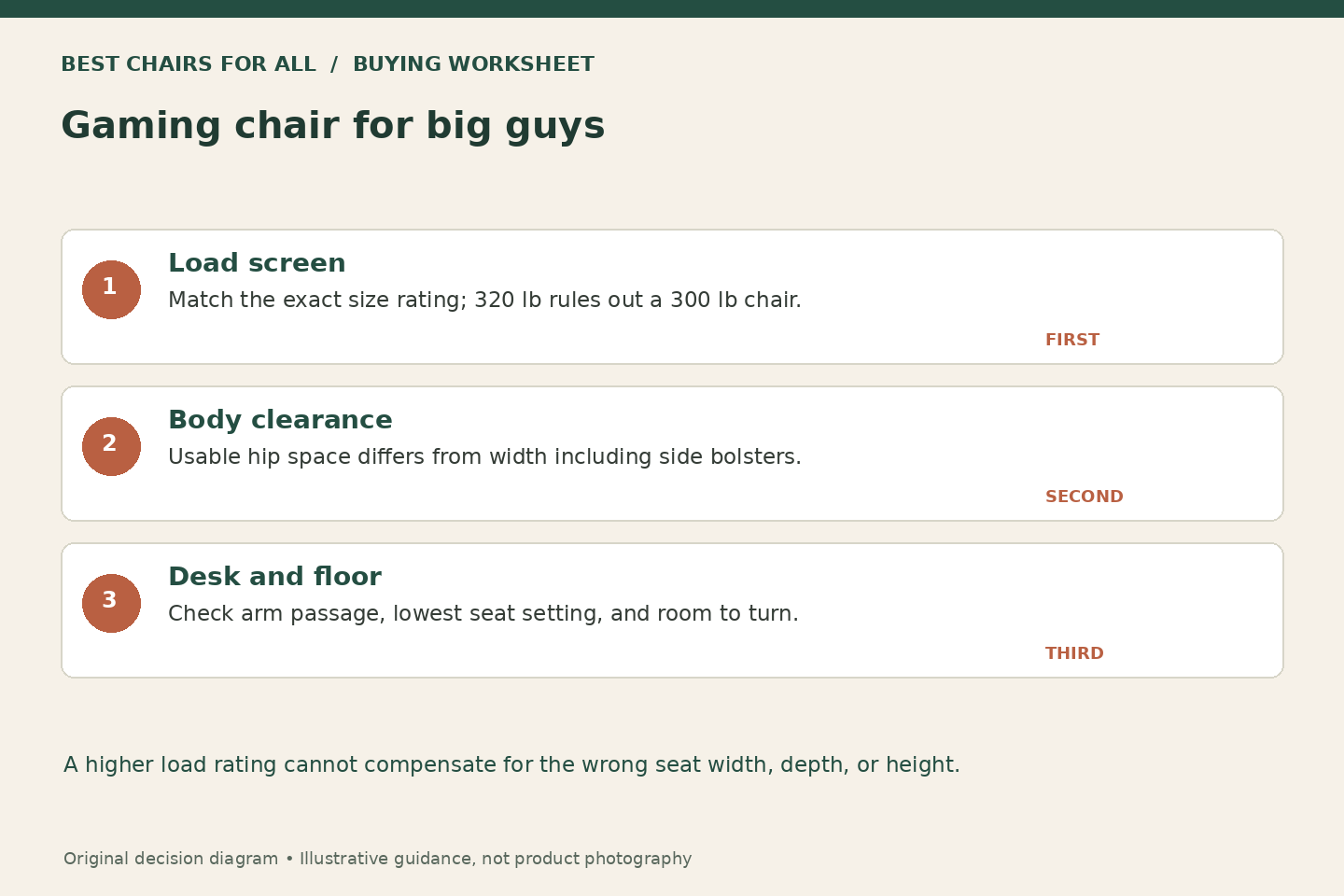
Now make four rows for each candidate: load, hips, thighs, and shoulders. Load needs a published manufacturer rating that covers the user within its stated conditions. Hips need enough usable seat and arm clearance. Thighs need a depth and edge profile that lets you use the backrest without crowding the knees. Shoulders need a back shape and arm position that do not force them forward. A failure in one row is not canceled out by extra space elsewhere.
For a worked example, imagine a buyer at 320 pounds whose reference chair needs more hip room. The FLEXX fails the load screen before its mesh or slider enters the discussion. The two XL chairs remain candidates, but the buyer still needs actual usable-width confirmation. A second buyer at 260 pounds may clear all three load figures and discover that FLEXX’s adjustable depth is the most relevant benefit. These example buyers illustrate the order of decisions; they are not fit guarantees.
Short and heavy is a separate fit problem
A tall XL chair can be the wrong answer for a heavy person with shorter legs. Check the lowest usable seat height at your desk and the ability to sit back without the front edge crowding the knee area. A foot support may help with the floor relationship, but it cannot shorten the seat. Do not treat a pile of cushions as a substitute for finding a chair with suitable depth and back position.
If the listed gaming models do not cover your combination of load and dimensions, widen the search to appropriately rated office seating with explicit seat measurements. The label on the chair matters less than the fit envelope. A chair sold without racing styling can still be used for games. Request written sizing advice from the manufacturer when specifications conflict or a retailer omits which size its rating describes.
Account for the bigger chair outside the seat
Measure the space between desk legs at the height where the arms and seat will pass. Also check the base diameter against nearby furniture and the clearance needed to turn. A larger seat may force the chair farther from a narrow desk, increasing mouse and keyboard reach. That is a workstation problem worth identifying before buying rather than discovering after a heavy carton has been carried upstairs.
Plan delivery and assembly realistically. Ask for packaged dimensions and weight, identify stair turns, and arrange help where needed. Follow the supplied assembly sequence and hardware requirements; do not substitute fasteners based on appearance. A larger chair is still intended for one seated user. Its rating does not authorize standing on the seat, dropping into it, or allowing a second person to sit on the arms.
How to make a useful trial
During a returnable trial, compare two normal tasks: keyboard play close to the desk and controller use with your hands nearer your torso. Note where the seat edge, side bolsters, arms, and head pillow make contact. Change one adjustment at a time so you can distinguish a lumbar-position issue from a seat-depth issue. Keep your observations specific enough to explain them to the manufacturer if advice is needed.
A defect warranty is different from a fit return. Before ordering, find out whether the seller accepts assembled chairs, requires the original box, deducts shipping, or provides collection. Those details are especially relevant for a large chair that is difficult to move. Keep the size label, order confirmation, and specification sheet together. An accurate record helps avoid disputes when multiple sizes share one product-family name.
The purchase decision
Start with TITAN Evo XL and Kaiser 3 XL when their larger rated ranges are necessary and their tall geometry matches your proportions. Compare FLEXX only when its 300-pound limit and narrower seat remain appropriate and mesh or depth adjustment solves a specific problem. Do not choose by capacity alone. The best larger gaming chair is the one that passes every row of your clearance sheet and can be returned under terms you understand.
Something unclear or out of date? Send a correction with this article’s title and the detail to check.
Sources, research & corrections policy ↗