As an Amazon Associate, we earn from qualifying purchases. Read our affiliate disclosure. Amazon buttons search for matching listings; they do not confirm the exact model, seller, price, or stock.
The best dining chair is the one that lets the people in your home eat at your actual table comfortably, clears the table base, and survives the cleaning routine you will really follow. For an adaptable starting point, consider IKEA LISABO. Choose Article Svelti when a wipeable molded seat matters more than cushioning, or IKEA BERGMUND when a removable fabric cover and a taller padded seat suit the household. These are different solutions, not interchangeable winners.
This is a research-based comparison of current US manufacturer specifications checked on November 6, 2026. We have not bought, sat in, or load-tested these chairs. Comfort and suitability remain personal. There is no fixed price ceiling here: compare the final cost for the number of chairs you need, delivery, and any covers or floor protectors before ordering.
First decide what the chair has to do
Write a one-sentence job description before looking at finishes. A chair used for a ten-minute breakfast has a different brief from the chair used for meals, homework, board games, and visiting relatives. In a busy multipurpose dining area, the best compromise may be a moderately sized wooden seat with a separately chosen pad. At a table used primarily for long dinners, you might accept more upholstery care for a back and seat that feel softer.
Also name the person hardest to fit. If the smallest adult cannot rest their feet comfortably, an extra-tall seat is an expensive mismatch. If the largest regular diner feels squeezed, a narrow chair that makes the room look spacious is not the answer. Overall width describes the furniture footprint; usable seat width describes the space the person actually gets. Do not substitute one for the other.
Verify the exact variants in the manufacturer references: IKEA LISABO chair, black; Article Svelti dining chair, Pure Black; IKEA BERGMUND chair, black/Gunnared medium gray. Specifications were checked November 6, 2026.
1. IKEA LISABO chair, black
Best for: Balanced wood option.
LISABO is the strongest starting point here for a household that wants exposed wood construction and manageable dimensions. Its published seat depth is 15 3/8 inches, which is useful to compare with a chair you already find comfortable.
The maker lists a 17 3/4-inch seat height. That lower position gives a different table relationship from the taller upholstered alternative. The black version uses birch and veneer components; it is not an all-solid-ash chair.
Product Details
| Brand | IKEA |
|---|---|
| Overall dimensions | 18 1/8 W × 20 1/8 D × 31 1/2 H in |
| Seat height | 17 3/4 in |
| Manufacturer load wording | 243 lb tested |
| Materials | Birch frame; veneer seat and back |
Pros
- Exposed seat avoids fixed upholstery care
- Armless outline simplifies apron checks
Cons
- Hard surface may need a separately fitted pad
- 243-pound test figure does not suit every user
Try the bare chair first; a thick added cushion can undo the height fit you liked.
2. Article Svelti dining chair, Pure Black
Best for: For wipeable everyday seating.
Svelti suits meals where a molded seat is more practical than textile upholstery. The Pure Black version has a narrow overall outline compared with BERGMUND, although the occupied space still needs testing.
Article specifies an 18-inch seat height and molded polypropylene with fiberglass over metal legs. Do not mistake the material description for a claim that the chair is indestructible.
Product Details
| Brand | Article |
|---|---|
| Overall dimensions | 18 W × 20.5 D × 34.5 H in |
| Seat height | 18 in |
| Manufacturer load wording | 225 lb tested |
| Materials | Molded polypropylene/fiberglass seat; coated metal legs |
Pros
- No fixed fabric seat to launder
- 18-inch seat height is easy to compare at home
Cons
- 225-pound manufacturer test figure is the lowest here
- Maker says it is unsuitable for sustained heavy restaurant use
Choose it for its cleaning format and fit, not a presumed commercial rating.
3. IKEA BERGMUND chair, black/Gunnared medium gray
Best for: For a removable full cover.
BERGMUND is the upholstered candidate for people whose table and body fit a higher seat. Its cover can be removed, a more useful maintenance feature than a vague promise of easy-clean fabric.
The 20 1/8-inch seat height is considerably taller than LISABO. The 16 1/8-inch published seat depth and 23 1/4-inch overall depth describe different things: one fits the diner, the other helps plan the room.
Product Details
| Brand | IKEA |
|---|---|
| Overall dimensions | 20 1/2 W × 23 1/4 D × 37 3/8 H in |
| Seat height | 20 1/8 in |
| Manufacturer load wording | 243 lb tested |
| Materials | Solid wood legs; removable polyester cover |
Pros
- Removable cover supports a planned washing routine
- Seat and back upholstery suit a softer-feeling brief
Cons
- Taller seat can crowd thighs under low aprons
- Large footprint needs more room than the other two
Measure the apron before committing to a matching set.
A five-number table-and-chair worksheet
Our practical buying method uses five measurements taken at home: floor to tabletop; floor to the lowest apron or rail where thighs will sit; clear width between table legs; space behind the occupied chair; and the height of a chair a regular diner already likes. Record the numbers on one sheet and keep them beside the product dimensions. A beautiful set should not get a pass because the measurements are inconvenient.
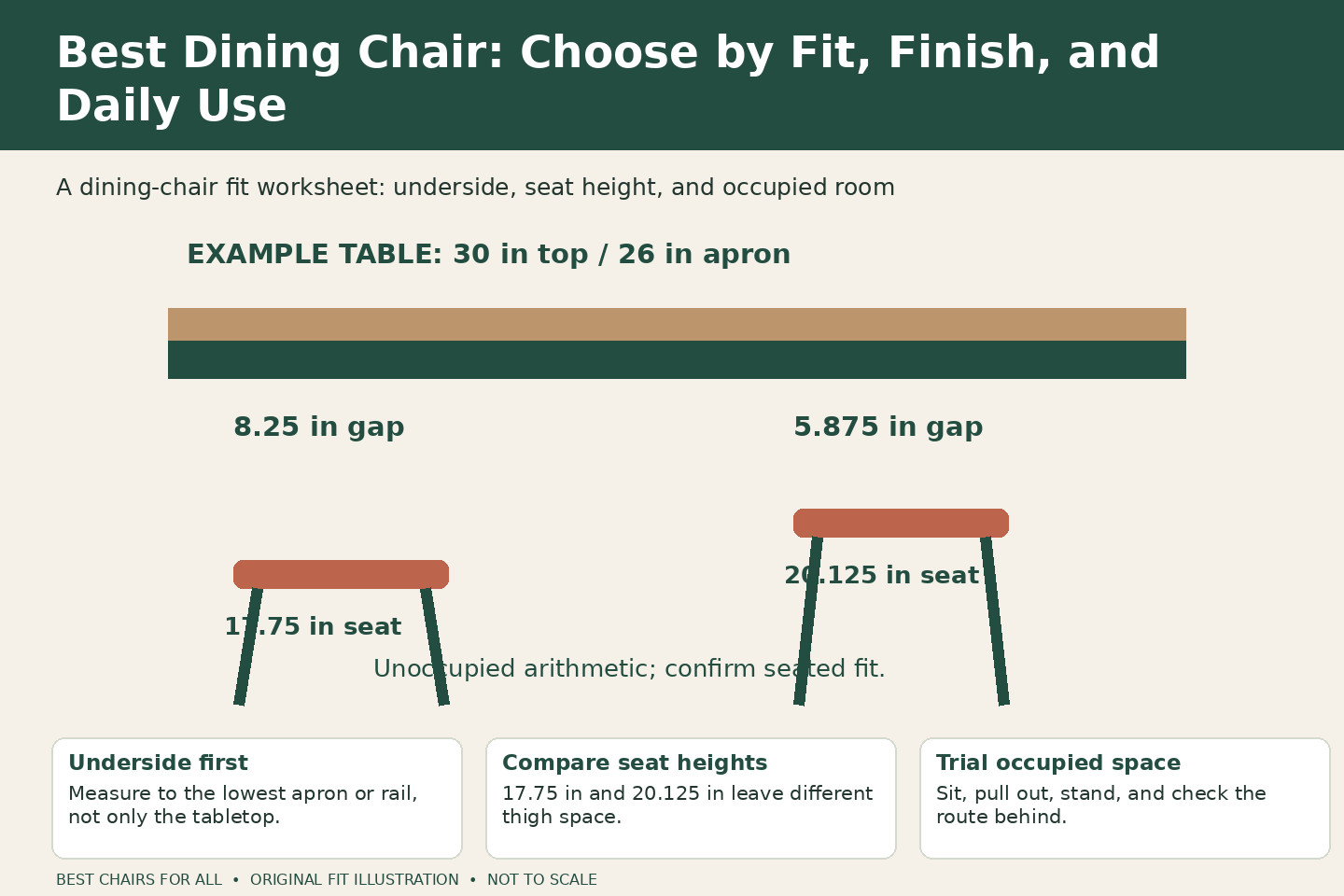
Begin with tabletop height, but make the underside measurement the important one. A 30-inch table can have a 27-inch underside, a deeper apron, or a mechanism that hangs lower in one place. Subtract the candidate seat height from the lowest relevant underside measurement to see the nominal vertical space left for thighs. That arithmetic does not establish a universal safe clearance; it identifies combinations that need a careful real-world trial.
Check dining chair seat height versus table height using your actual tabletop and apron before choosing the chair.
For example, suppose your tabletop is 30 inches and the apron bottom is 26 inches above the floor. A 17.75-inch seat leaves 8.25 inches between its published seat height and the apron. A 20.125-inch seat leaves only 5.875 inches. Those are unoccupied specification differences, not measurements of a person sitting on a cushion. Still, the comparison explains why two ordinary-looking dining chairs can feel very different under the same table.
For width, draw the clear opening between the table legs. If it measures 46 inches, two 20.5-inch-wide chairs use 41 inches before you allow any separation. Two 18.125-inch chairs use 36.25 inches. Neither calculation proves two diners will have enough elbow room; it simply exposes how much flexibility disappears with wider furniture. Repeat the check at the floor, since angled table legs and chair legs can meet below the seat.
Finally, tape the chair’s overall depth on the floor in its expected parked position. Put an existing chair there, sit down, and move back far enough to stand naturally. Ask another person to walk through the remaining route. This occupied trial is more informative than buying from a generic clearance diagram that ignores your radiator, wall, door swing, or sideboard.
How to choose among the three
Choose LISABO if you want an exposed frame, a relatively low seat, and a chair that does not impose a fabric-cleaning routine. Its appeal is balance: the footprint is smaller than BERGMUND’s without being as visually utilitarian as a molded cafe chair. Its limitation is just as clear. A hard seat cannot promise the softness some diners expect, and a pad changes the sitting height and the space under the apron.
Choose Svelti if wiping the seat after everyday meals is your dominant requirement. Its molded surface avoids a fixed textile seat, and the armless shape is straightforward to position. The manufacturer explicitly excludes sustained heavy restaurant use, so do not extrapolate its domestic usefulness into a commercial durability recommendation. Its published 225-pound test figure also makes it the wrong default for a household needing a higher documented load figure.
Choose BERGMUND if you specifically want its taller upholstered format and removable cover. Measure carefully before ordering a whole set: the height and depth are a substantial change from a small wooden chair. A cover that can be removed is useful only if you are willing to remove, wash, dry, and refit it according to the care label. Buying an additional compatible cover can make that routine easier, but check the exact availability and color before treating it as part of the plan.
Materials change the chores
Think about the recurring mess, not an abstract durability ranking. Dry crumbs caught in seams, oily fingerprints on wood, and coffee on fabric require different responses. An exposed seat can often be inspected and wiped quickly, but the joints, back rails, and underside still need attention. Upholstery conceals fewer scratches yet can make stains and lint more noticeable. Neither category eliminates upkeep.
Use the exact maker’s instructions for the selected finish and cover. Avoid assuming that a cleaner marketed for furniture works on every material. A wet cloth left on a wood seat is different from wiping and drying it. Likewise, a removable cover is not automatically tumble-dryer friendly. The relevant specification is the care instruction for the exact variant in your cart.
Floor contact deserves a separate decision. Match protectors to your floor and inspect them for grit, wear, and secure attachment. A quieter chair can make a kitchen feel more comfortable even when the seat itself is unchanged. Recheck the chair after assembly on a known level surface. If it rocks, identify whether the floor or the chair is responsible before daily use; do not hide a loose joint with a thick rug.
Buy one before buying six
A single-chair trial can reveal problems that dimensions cannot. Keep packaging and understand the seller’s return conditions before assembly. Use the chair at the table with the same footwear and placemat arrangement you normally use. Eat a meal, lean back naturally, pull close enough to use cutlery, and get up without moving the table. Ask every regular user to try it.
Record a simple pass or fail for feet, front-edge pressure, back contact, thigh clearance, and getting in and out. The point is not a numerical comfort score; it is to avoid one enthusiastic shopper making a permanent decision for everyone. If one person reports a specific problem, change the chair choice or seating arrangement before the return window closes. Buying mixed chairs can be more sensible than forcing every body into a matching set.
What to check at checkout
Compare units carefully. A listing can show a per-chair price while requiring a pair, and a cover may be separate from a frame. Verify model name, finish, included parts, quantity, delivery charge, assembly responsibility, and return shipping. Matching Amazon search results may include different sellers, lookalikes, used items, or other colors. Use manufacturer specifications as the reference and confirm the retailer’s actual item against them.
Do not buy a generic chair under the assumption that it has the same load testing, materials, or replacement parts as a visually similar branded model. Photos are poor evidence of joinery and usable seat size. If a critical dimension is missing, ask for it in writing. A seller who cannot establish the necessary fit is a reason to keep looking, even when the image is exactly right.
The sensible final choice
Start with one LISABO if your household wants an exposed wood-and-veneer dining chair at a lower sitting height. Start with Svelti if easy surface cleaning is the first requirement and its load figure meets your needs. Start with BERGMUND if a taller upholstered chair is an intentional fit. The best result comes from passing the worksheet and the single-chair trial, then buying the rest of the set with confidence in the actual combination.
Something unclear or out of date? Send a correction with this article’s title and the detail to check.
Sources, research & corrections policy ↗