As an Amazon Associate, we earn from qualifying purchases. Read our affiliate disclosure. Amazon buttons search for matching listings; they do not confirm the exact model, seller, price, or stock.
The best dining chair with arms is one whose arms fit both the diner and the route under the table. Article Zola offers exposed wooden arms with a leather seat. IKEA MÅRENÄS adds upholstered arms and a removable cover. Article Svelti’s armchair version uses a molded shell and is stackable. Choose the structure you want only after checking usable seat space and the full arm path toward the table.
This is a research-based comparison of exact US manufacturer listings checked online on November 6, 2026. We have not physically tested the chairs or measured them in a showroom. Missing arm dimensions remain questions to resolve, and no chair below is represented as a transfer-support device. Current prices and seller availability need checking at order time.
Arms change more than appearance
An armrest gives the forearms another place to rest and makes a chair feel more enclosing. It also changes side entry, table access, overall width, and where the chair can be parked. A diner who turns sideways to join a conversation may prefer an open arm or no arm at all. Someone who enjoys a contained chair after dinner may accept the additional width willingly.
Do not start with a single maximum width. Distinguish overall width across the arms, inside space for the person, seat width at the front, and any narrowing at the back. A chair can be broad on the outside yet tight between its arms. If a critical inside measurement is absent, request it rather than promoting the overall number into a usable-space claim.
Verify the exact variants in the manufacturer references: Article Zola leather dining chair, Black; IKEA MÅRENÄS chair with armrests, black/Gunnared beige; Article Svelti stackable dining armchair, Aloe Green. Specifications were checked November 6, 2026.
1. Article Zola leather dining chair, Black
Best for: Exposed wood-arm candidate.
Zola is useful for someone who wants visible wood arms and a leather seat rather than a fabric-wrapped chair. It provides a documented arm height that can be checked before a trial.
The arms are listed at 27 inches from the floor and the seat at 19.5 inches. Overall width is 21.5 inches, but this is not a verified measurement of space between the arms.
Product Details
| Brand | Article |
|---|---|
| Overall dimensions | 21.5 W × 22.5 D × 30 H in |
| Seat height | 19.5 in |
| Manufacturer load wording | 300 lb tested |
| Materials | Top-grain leather; rubberwood frame |
Pros
- Arm height is explicitly published
- Open frame offers a distinct alternative to full upholstery
Cons
- 27-inch arms can meet a dining-table apron
- Inside arm spacing needs confirmation if critical
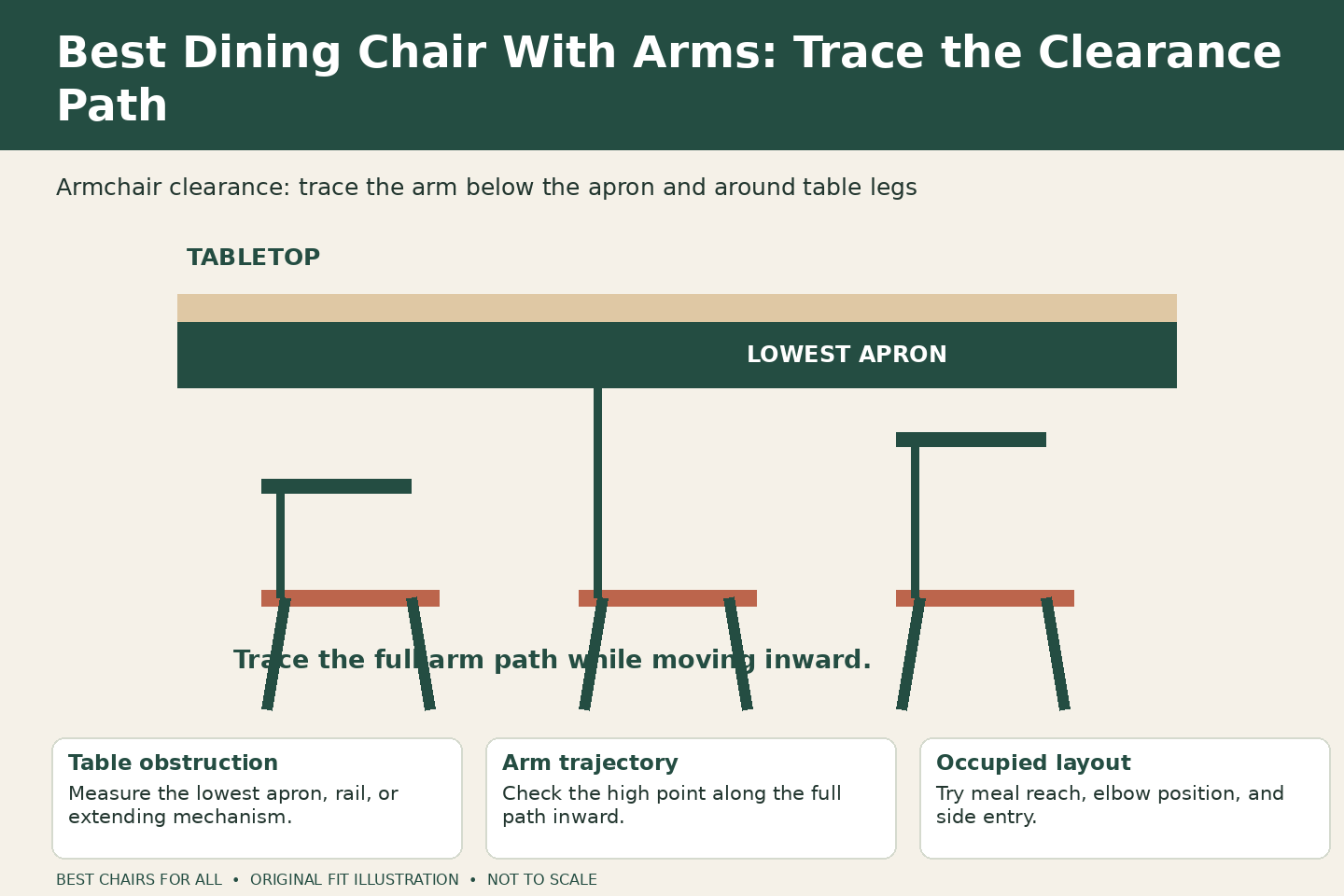
Trace the full path inward rather than checking the tabletop height alone.
2. IKEA MÅRENÄS chair with armrests, black/Gunnared beige
Best for: Covered-arm candidate.
MÅRENÄS is the option for a softer, fully upholstered outline. Its removable cover is a practical reason to consider it when hands frequently touch the arms.
The selected variant lists 20 1/2 inches of seat width and 23 1/4 inches overall width, with a seat height of 18 7/8 inches. Verify the arm high point against your own table.
Product Details
| Brand | IKEA |
|---|---|
| Overall dimensions | 23 1/4 W × 22 D × 31 7/8 H in |
| Seat height | 18 7/8 in |
| Manufacturer load wording | 243 lb tested |
| Materials | Wood legs; upholstered seat, back and arms; removable cover |
Pros
- Removable cover supports planned cleaning
- Published seat width is separated from overall width
Cons
- Arm height requires a retailer or maker answer if not shown
- Broad body can reduce spacing between neighboring places
Order on the basis of a confirmed clearance drawing or a returnable trial.
3. Article Svelti stackable dining armchair, Aloe Green
Best for: Molded stackable candidate.
The Svelti armchair suits a household wanting a molded surface and the ability to store a few chairs together. It is a different size and configuration from the armless Svelti.
Article lists 24 inches of width and depth, an 18-inch seat height, and stacking up to four high. The maker lists a 225-pound test figure; the outer width is not inside sitting width.
Product Details
| Brand | Article |
|---|---|
| Overall dimensions | 24 W × 24 D × 35.5 H in |
| Seat height | 18 in |
| Manufacturer load wording | 225 lb tested |
| Materials | Molded polypropylene/fiberglass; powder-coated metal legs |
Pros
- Documented stacking for this specific armchair model
- Molded shell has no fixed textile upholstery
Cons
- Large square footprint is not a small-chair solution
- Arm clearance and inside spacing still require checking
Choose it for an intentional stacking and cleaning strategy, not because every plastic chair is compact.
The arm-to-apron worksheet
Draw a side view of your table with the tabletop and the lowest apron or rail. Measure floor to each surface at the seat location. If an extending table has hardware that hangs lower near the ends, include it. Then record the candidate’s highest arm point, overall depth, seat height, and the position where the arm starts rising. The last detail may require a dimensioned drawing or an actual trial.
The important question is whether the entire arm can travel inward along the intended path. A low arm at the front can clear the table edge, then rise into the underside farther back. A chair can also rotate slightly as it is pulled out, causing the outer arm to meet a table leg. Checking only a straight-on photograph misses both conflicts.
For a worked example, suppose the tabletop is 30 inches high and the apron bottom is 26 inches. Zola’s listed 27-inch arm height exceeds that opening by an inch. It cannot fully pass beneath the apron at that location. The chair might still work if the diner is comfortable at the resulting distance and the room accepts the parked projection, but those are separate checks rather than reasons to ignore the clash.
Now consider an apron-free table with a 28.5-inch clear underside. The same 27-inch arm has nominal height room, but a pedestal or leg can still stop the chair moving in. Trace the side and top views together. The calculation eliminates one obstacle, not every obstacle. This distinction matters when ordering two armchairs for the ends of a table with a large trestle base.
If your table has a central base, check how to choose chairs for a pedestal table so the arm fit and the foot space both work.
A top-view layout for mixed chairs
Using arms only at the table ends can balance the room, but measure those ends independently. An end position may have more shoulder room and less foot room because of the base. It can also be the location closest to a door or sideboard. Take the measurements where the chair will actually sit instead of copying the clear opening from the long side.
Imagine a 48-inch clear opening along one side. Two 24-inch-wide Svelti armchairs total the entire opening before any space between them is allowed. Two 21.5-inch-wide Zolas total 43 inches. That arithmetic exposes the furniture-width issue, but even the remaining five inches in the second case does not establish a comfortable dining arrangement. Test with people and place settings rather than fitting chair rectangles alone.
A broader chair may work well as a single place at the head while slimmer armless chairs serve the sides. It can also double as a conversational seat elsewhere, provided that second role uses the right table or task height. Do not buy an oversized dining armchair merely because the empty room looks balanced with one at each end. The occupied room is the test that matters.
Open wooden arms versus upholstered arms
Zola’s arms are exposed wood, which creates a defined frame and a surface with wood-care needs. Some diners will prefer that firm contact, while others will want padding. Inspect the shape at the wrist and elbow during the trial. A smooth-looking profile in a photograph cannot tell you whether the contact point is comfortable for a particular person.
MÅRENÄS surrounds the person with upholstery on the seat, back, and arms. Its selected Gunnared cover is removable, making cover care part of the practical advantage. The upholstered outline is wider than the usable seat. Confirm the arm height and inside spacing with the seller if they are not established in the current listing before deciding that it will slide under your table.
Svelti uses a molded armchair shell. That changes both the feel and the cleaning pattern compared with leather and wood or fully covered fabric. The manufacturer gives an 18-inch seat height and allows stacking up to four high for this exact armchair model. Stacking is a storage feature, not permission to create a tall pile in a busy walkway or an assumption that every Svelti version stacks the same way.
Use arms as part of a seated trial
At the table, eat in your normal position. Notice whether elbows rest naturally or whether the arms lift your shoulders. Check if the arms stop you pulling close enough to the plate. Then sit back for conversation and see whether the support becomes useful in that position. It is possible to like the arms after dinner and find them inconvenient while eating.
Try ordinary side entry if that is how the chair will be used, without forcing a movement that feels awkward. Consider clothing, bags, and a nearby wall. A chair with enclosed sides may require more rearward movement than an open-frame design. If the room is tight, that can become the decisive issue even when the arms clear the table vertically.
If a person needs arm support to get up or sit down, do not perform an improvised strength trial. Ask the manufacturer about intended arm use and obtain an appropriate individual assessment when needed. A 225-, 243-, or 300-pound seating test figure does not establish a separate rating for one arm, a sideways load, or a full-body transfer. Ordinary dining furniture should not be sold as mobility equipment by implication.
Cleaning and moving an armchair
Arms receive frequent contact from skin, sleeves, and hands. Choose a material whose routine fits that pattern. Follow the Zola wood-and-leather care notes, MÅRENÄS’s exact cover instructions, or Svelti’s molded-surface guidance. A cleaner suitable for the seat may not suit the frame or cover, and a removable cover does not justify ignoring its drying instructions.
Ask how the chair should be lifted or moved. An arm can look like a convenient handle without being designated for carrying. Use the maker’s instructions and avoid pulling an upholstered edge hard against the frame. Suitable floor protectors can make ordinary repositioning more manageable, but they should not create unintended sliding. Inspect them as they wear and replace only with appropriate compatible protection.
For stacking Svelti, observe the stated maximum and protect the surrounding area. Use a location where removing the upper chair does not require reaching precariously or tipping the pile into a route. At home you may only need to stack two. Storage convenience is strongest when it simplifies a real routine rather than producing another piece of furniture to maneuver around.
Which style deserves your first sample?
Try Zola if you want an exposed-arm silhouette and can accommodate its documented 27-inch arm height. Try MÅRENÄS if padded arms and a removable full cover are the priority, obtaining any missing arm-clearance dimensions first. Try Svelti if a wipeable molded chair and documented stacking suit the room, while checking its 225-pound test figure against the required use.
Before buying a complete set, keep the floor plan and clearance worksheet with one sample chair. A successful armchair should approach the table, fit the person, allow ordinary eating, and move through the room without creating a repeated obstacle. Those practical passes are a stronger reason to keep it than the presence of arms alone.
Something unclear or out of date? Send a correction with this article’s title and the detail to check.
Sources, research & corrections policy ↗