As an Amazon Associate, we earn from qualifying purchases. Read our affiliate disclosure. Amazon buttons search for matching listings; they do not confirm the exact model, seller, price, or stock.
The best dining chair for a small space is not necessarily the narrowest one. It is the chair that works when parked, occupied, and moved aside. Article’s wood Sede is a compact fixed-chair candidate. IKEA TONSTAD with the Fridtuna seat suits a slim padded-seat brief. IKEA VIHALS folding chair is useful when seats must disappear between visits. Those three strategies use limited floor area differently.
We researched these US products online on November 6, 2026. This guide uses manufacturer measurements and original planning calculations rather than physical product testing. We do not claim a particular room can hold a given number of diners from floor area alone. Prices, stock, and delivery must be checked for the actual order.
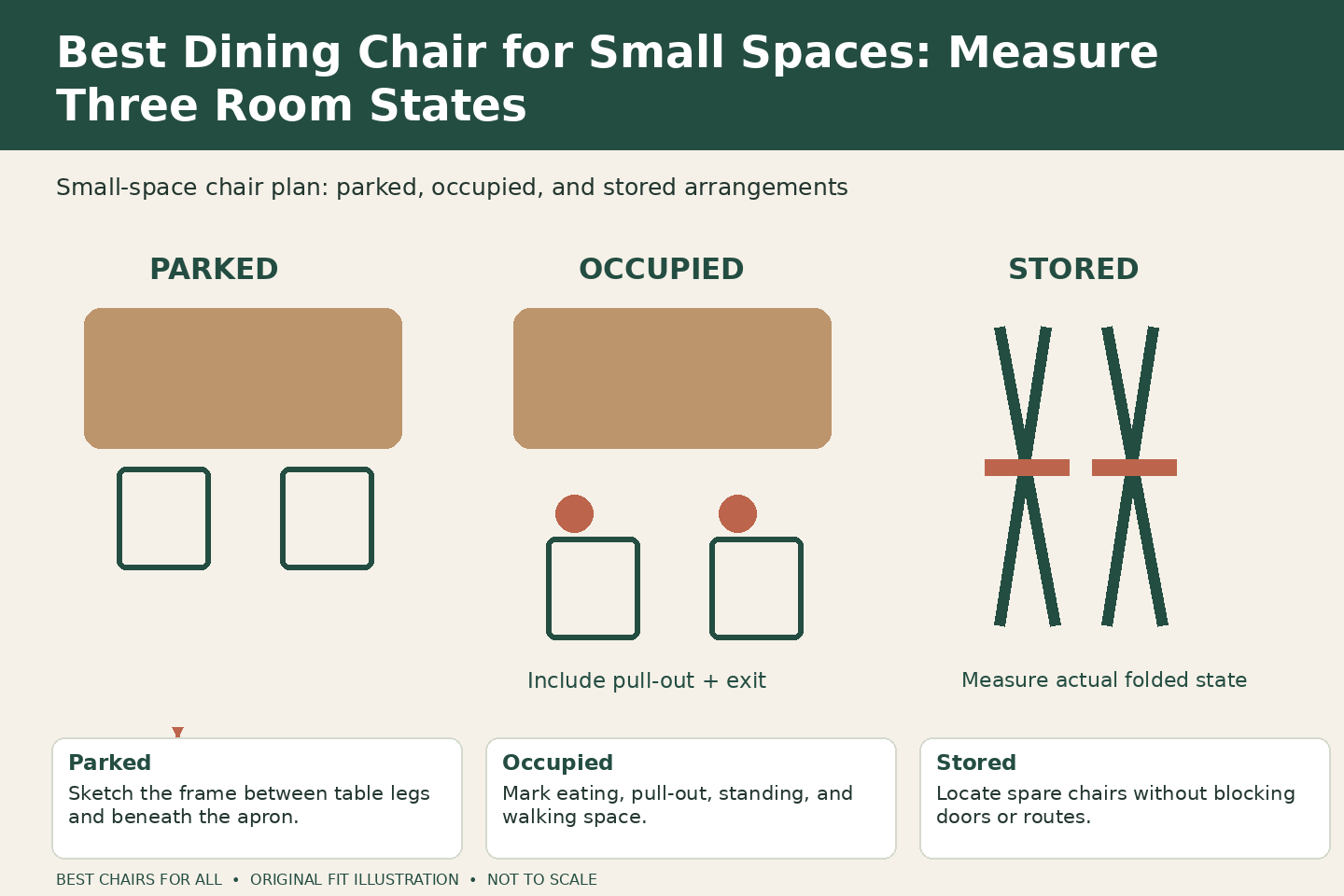
Plan three states, not one attractive photograph
The parked state is how the room looks when nobody is eating. The occupied state includes people, elbows, feet, and chairs drawn back from the table. The stored state is where spare chairs go when the dining area becomes a work zone or walkway. A chair can be efficient in one state and troublesome in another. This is why small-space buying needs a simple floor plan.
Draw the table, walls, door swings, and permanent obstacles on graph paper. Include a radiator, peninsula, sideboard, and the area needed to open a nearby cabinet. Then draw a different color outline for each state. The practical goal is not to find a decorative layout with the maximum number of chair icons. It is to make the most important daily activities possible without repeated furniture shuffling.
Verify the exact variants in the manufacturer references: Article Sede dining chair, Walnut; IKEA TONSTAD chair, brown oak effect/Fridtuna light beige; IKEA VIHALS folding chair, black. Specifications were checked November 6, 2026.
1. Article Sede dining chair, Walnut
Best for: Compact fixed-chair strategy.
The wood Sede is the fixed option for a small dining area where every chair must remain usable each day. Compare its 17-inch overall width and 20.75-inch overall depth separately when marking the floor.
Article lists 17 inches overall width, 20.75 inches overall depth, 31.75 inches overall height, an 18.5-inch seat height, and a 15-inch seat depth for the current rendered SKU373F. This is the unupholstered Walnut version, not the differently sized leather model.
Product Details
| Brand | Article |
|---|---|
| Overall dimensions | 17 W × 20.75 D × 31.75 H in |
| Seat height | 18.5 in |
| Manufacturer load wording | 300 lb tested |
| Materials | Rubberwood, walnut veneer, steel |
Pros
- Narrow documented width for a permanent setting
- Armless frame avoids arm-to-apron conflict
Cons
- Hard seat needs a personal comfort trial
- Compact exterior does not guarantee a generous sitting area
Use it when permanent seating matters more than disappearing furniture.
2. IKEA TONSTAD chair, brown oak effect/Fridtuna light beige
Best for: Slim padded-seat strategy.
The Fridtuna TONSTAD keeps a narrow exposed frame while adding seat padding. It is a useful candidate for someone who wants a less bare sitting surface without a fully covered chair.
The brown oak-effect variant lists 16 1/2 inches overall width, 18 7/8 inches depth, and an 18 1/2-inch seat height. Its removable seat cover introduces a separate laundering routine.
Product Details
| Brand | IKEA |
|---|---|
| Overall dimensions | 16 1/2 W × 18 7/8 D × 34 5/8 H in |
| Seat height | 18 1/2 in |
| Manufacturer load wording | 243 lb tested |
| Materials | Solid wood frame; cotton/polyester removable seat cover |
Pros
- Slim frame with a padded seat
- Exposed back has a visually open profile
Cons
- 16.5-inch seat width needs a body-fit check
- Fixed chair still needs a real storage location if moved aside
Measure this exact variant; other TONSTAD upholstery configurations differ.
3. IKEA VIHALS folding chair, black
Best for: Fold-away guest strategy.
VIHALS is the option when the room needs different daily and guest arrangements. Folding is valuable only with a convenient and stable place to keep the chair between uses.
The open chair is 16 7/8 inches wide and 18 1/2 inches deep, with a 17 3/4-inch seat height. Its 15 3/8-inch seat width is less than its overall width, a distinction worth checking with actual guests.
Product Details
| Brand | IKEA |
|---|---|
| Overall dimensions | 16 7/8 W × 18 1/2 D × 31 1/2 H in |
| Seat height | 17 3/4 in |
| Manufacturer load wording | 243 lb tested |
| Materials | Powder-coated steel; polypropylene seat and back |
Pros
- Folds between uses and arrives preassembled
- Open dimensions are clearly published
Cons
- Narrow usable seat will not suit every diner
- Storage dimensions must be checked separately from the carton
Plan the storage route before buying several as spare seats.
State one: parked beneath the table
Measure the opening between table legs at the seat and floor levels. Angled legs can make a chair fit at one height and collide at another. Check how far the chair can move inward before its back, seat, or frame meets the table. Armless designs avoid an arm-height conflict, but that does not guarantee complete tuck-under storage.
For a worked example, suppose the clear opening between table legs is 40 inches. Two 17-inch-wide wood Sede frames total 34 inches. Two 16.5-inch-wide TONSTAD frames total 33 inches. Two 16 7/8-inch VIHALS frames total 33 3/4 inches. Those modest differences may affect furniture placement, yet none establishes enough elbow room for two people. The parked calculation is only the first drawing.
Depth can matter more than width when a table sits near a kitchen route. Sede’s listed overall depth is 20.75 inches; TONSTAD’s is 18 7/8 inches; VIHALS’s is 18 1/2 inches when open. Those dimensions help you sketch the furniture, but the amount that remains outside your table depends on its exact shape. Do not subtract depth from tabletop width and call the result a guaranteed walking clearance.
State two: occupied and leaving the table
Use an existing chair as a stand-in at the marked position. Sit where a meal would be eaten and place the plate, cup, and cutlery normally. Ask another adult to use the adjacent place. You may discover that chair frames fit while elbows compete. A shorter seat-to-seat arrangement can also make it difficult to approach the table without turning awkwardly.
Next, move the chair back far enough to stand and turn naturally. Mark the rear-most position it reaches in this ordinary movement. Repeat at every chair location, since a wall, door, or cabinet can make one position more constrained than another. The result is a practical occupied envelope for your room. It is deliberately based on your household rather than a universal pull-out dimension.
Have another person use the main walking route while someone is seated. In a small kitchen, that may be the path between refrigerator and sink. In an apartment, it may be the only route to a bedroom. If normal circulation fails, reduce the number of daily chairs, move the table, or reconsider the furniture. A slim chair cannot create space where two activities physically overlap.
State three: where the extra seats live
VIHALS changes the storage state by folding. That is genuinely useful only if you have a place to store it and can retrieve it easily. Measure the intended cupboard, alcove, or approved hanging arrangement against the actual folded chair dimensions supplied by the maker. The product’s shipping carton is not evidence of the exact stored thickness or shape, so do not use packaging measurements as a substitute.
A spare chair behind a door may stop that door opening fully. A folded chair leaning in a passageway can replace one obstacle with another. Choose a stable storage location where the chair will not fall into a route or be difficult to remove. If hanging storage is used, its fittings and wall must be appropriate for the actual load; do not improvise from a product photograph alone.
The fixed Sede and TONSTAD candidates need floor storage if you remove them from the table. They may work as useful secondary chairs elsewhere, but check that the second role is real. A chair called an occasional desk seat can become a clutter shelf that has to be cleared before every dinner. Plan where the belongings go as well as where the furniture goes.
Do not give away sitting room without noticing
Small overall dimensions can disguise a narrow usable surface. VIHALS is listed at 16 7/8 inches overall width, but its seat width is 15 3/8 inches. TONSTAD lists a 16 1/2-inch seat width. Those facts help explain why two compact chairs can feel different even when their outlines are similar. Compare with a chair that fits your regular diners comfortably.
The wood Sede has a published 15-inch seat depth, which may appeal to people who dislike a long sitting surface. A taller or longer-legged adult may prefer something different. The small-room requirement should not become an excuse to buy furniture nobody likes using. If a comfortable chair needs slightly more room, simplifying the table arrangement may be the better compromise.
Seat height remains separate from small-space efficiency. Sede and TONSTAD are both listed at 18 1/2 inches, and VIHALS at 17 3/4 inches. Compare the chosen height with the lowest apron and the diner’s comfortable reference chair. A narrow chair that leaves the person too high under the table has solved the wrong problem.
Choose a chair strategy for your actual week
For a one- or two-person household that eats at the table every day, fixed chairs can be the simplest solution. They avoid the repeated effort of opening, retrieving, and putting away seating. Sede’s compact footprint is worth trialing when the goal is a permanent place rather than a transforming room. Its exposed hard seat is the tradeoff to evaluate during an ordinary meal.
TONSTAD is the middle route if you want seat padding without the room presence of full upholstery. Its exposed ladder back keeps the upper silhouette relatively open, though visual lightness is not the same as physical clearance. The removable seat cover adds a maintenance process, so make sure the preferred finish and cover combination is the one actually measured in your plan.
VIHALS makes the most sense when the daily and guest counts differ. Two fixed chairs plus two properly stored folding chairs may serve a small household better than four cramped permanent seats. Confirm each guest chair’s published load figure and personal fit as you would for the fixed ones. A temporary seat is still a seat someone must use comfortably.
A small-space decision record
Write the normal number of diners and the maximum occasional number separately. Record the room’s nonnegotiable route, such as access to a kitchen appliance or doorway. Then state which of the three room states is most constrained. A parked-state problem favors compact fixed dimensions; a storage-state problem favors a genuine folding solution; an occupied-state problem may require a different table or fewer simultaneous places.
Keep this record while shopping. It protects against being distracted by a chair that looks slim but remains too deep, or a folding product that has nowhere sensible to live. It also makes a return decision more objective: if the chair fails the marked route or cannot be stored as planned, it has not met the brief. You do not need to persuade yourself to keep it because it is attractive.
Choose wood Sede for a compact fixed setting, TONSTAD for slim seat padding, and VIHALS for a deliberate fold-away arrangement. Test the room with people in it before expanding the set. The most efficient dining area is one the household can use normally in all three states.
Something unclear or out of date? Send a correction with this article’s title and the detail to check.
Sources, research & corrections policy ↗