As an Amazon Associate, we earn from qualifying purchases. Read our affiliate disclosure. Amazon buttons search for matching listings; they do not confirm the exact model, seller, price, or stock.
There is no single best dining chair for every older adult. The useful choice depends on the person’s height, strength, balance, preferred sitting position, and the actual table. IKEA MÅRENÄS, Article Zola, and Article Harris offer three different armchair configurations worth discussing and trying. They are ordinary dining furniture, not transfer devices or medical seating, and none is recommended here as a treatment or as a way to prevent a fall.
We researched their US manufacturer pages and current official home-safety guidance online on November 6, 2026. We have not tested these chairs with older users. If someone needs help transferring, has recent falls, or cannot use a dining chair confidently, an occupational therapist or other qualified professional can assess the person and the room. A shopping guide cannot establish the required support.
Begin with the diner, then the chair
Age does not specify seat height. A taller adult may prefer a higher seat, while a shorter adult may find the same chair leaves the feet poorly placed. A deeply cushioned seat can feel pleasant but change the effort and movement needed to stand. Compare with a chair the person already uses comfortably, and include the individual in every decision rather than ordering furniture on their behalf from a photograph.
The National Institute on Aging’s room-by-room guidance advises choosing chair and sofa heights that make getting in and out easier and keeping furniture out of walking routes. Those are general home-planning principles, not an endorsement of any model below. They explain why this guide considers access and room layout alongside padding and appearance.
Verify the exact variants in the manufacturer references: IKEA MÅRENÄS chair with armrests, black/Gunnared beige; Article Zola leather dining chair, Black; Article Harris velvet dining armchair, Hale Rust. Specifications were checked November 6, 2026.
1. IKEA MÅRENÄS chair with armrests, black/Gunnared beige
Best for: First upholstered fit trial.
MÅRENÄS offers a relatively shallower upholstered sitting area than Harris and a removable cover in the selected Gunnared version. It is a candidate for a personal fit trial, not a recommendation based on age alone.
IKEA lists a seat height of 18 7/8 inches, depth of 16 1/2 inches, and width of 20 1/2 inches. Overall width is greater, so the seat measurement cannot be used to plan the table opening.
Product Details
| Brand | IKEA |
|---|---|
| Overall dimensions | 23 1/4 W × 22 D × 31 7/8 H in |
| Seat height | 18 7/8 in |
| Manufacturer load wording | 243 lb tested |
| Materials | Wood legs; upholstered seat, back and arms; removable cover |
Pros
- Removable cover supports a planned care routine
- Published usable seat dimensions help a fitting discussion
Cons
- Arm height and clearance need confirmation at the real table
- 243-pound test figure does not cover every user or use
Ask for any missing arm or support information before relying on it for an individual need.
2. Article Zola leather dining chair, Black
Best for: Exposed-arm alternative.
Zola provides a leather seat with visible wood arms and frame. It may appeal to someone who dislikes fabric-covered arms, provided the chair fits and its intended use matches the household.
The published seat height is 19.5 inches and the arm height is 27 inches. Those arms may stop short of a low apron; the seating load test does not establish a separate transfer-support rating.
Product Details
| Brand | Article |
|---|---|
| Overall dimensions | 21.5 W × 22.5 D × 30 H in |
| Seat height | 19.5 in |
| Manufacturer load wording | 300 lb tested |
| Materials | Top-grain leather; rubberwood frame |
Pros
- Open frame makes the furniture shape easy to inspect
- Leather variant has explicit maker care instructions
Cons
- High arms can prevent approaching the table
- Individual reliance on arms needs more than a product photograph
Check the full approach to the table before considering its appearance.
3. Article Harris velvet dining armchair, Hale Rust
Best for: For a deeper seated preference.
Harris is a deeper armchair option for someone who already prefers a larger sitting area. It is less logical for a diner who has difficulty reaching the backrest of a deep seat.
Article lists a 19.25-inch seat height, 18.75-inch seat depth, and 22.75-inch arm height. The velvet requires the specified care, including professional treatment for persistent stains.
Product Details
| Brand | Article |
|---|---|
| Overall dimensions | 23.5 W × 23 D × 31 H in |
| Seat height | 19.25 in |
| Manufacturer load wording | 300 lb tested |
| Materials | Polyester velvet; foam and wood frame |
Pros
- Lower published arms than Zola
- Deep seat offers a distinct fit choice
Cons
- Depth may be excessive for a shorter diner
- Upholstered form should not be assumed to be medical support
Use it only if the person and table both pass an ordinary, appropriately supported trial.
A four-stage selection checklist
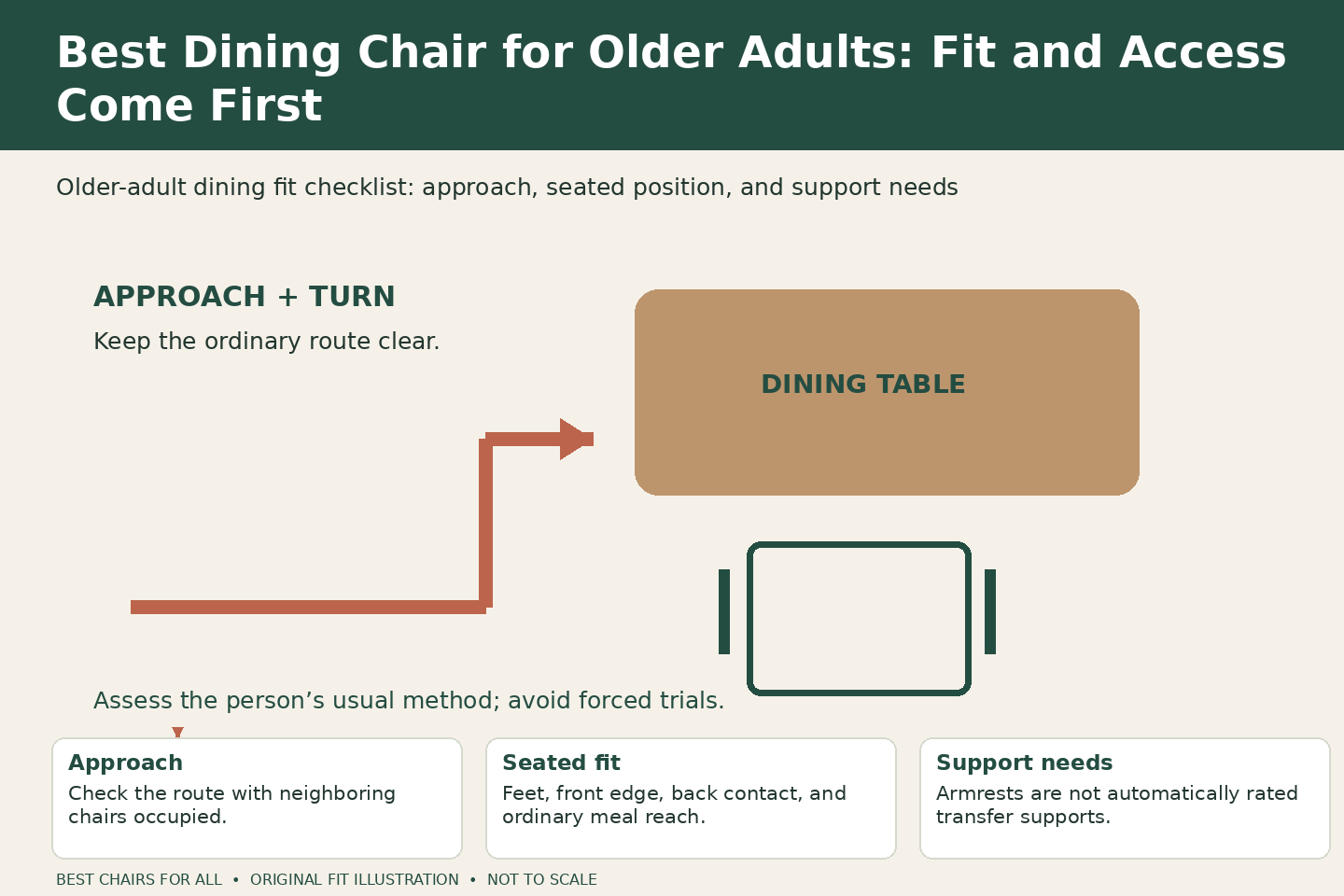
Our practical artifact is a checklist with four stages: approach, sitting position, dining reach, and departure. Use it with a familiar chair first to identify what already works. Then use the same observations for a candidate in a showroom or during an appropriately supported home trial. Do not turn it into a physical challenge, a timed test, or an instruction to attempt a movement the person considers unsafe.
For approach, check whether the route from the usual doorway to the table is clear in normal use. Include the position of neighboring chairs, a walker or cane if used, rugs, pets, and the door swing. A chair that fits beautifully when parked can block the route when another person is eating. Observe the ordinary room, not a temporarily emptied space arranged for a product trial.
For sitting position, note whether feet can rest comfortably and whether the front edge presses at the back of the legs. Check whether the person can use the backrest without perching forward. Write down what the diner reports. A family member’s impression that the chair looks supportive is less useful than the person’s statement that the edge presses or that the back is too far away.
For dining reach, place a plate and cup as they would normally be used. Check whether the chair can approach the table far enough without the arms striking an apron or the thighs contacting a rail. A chair that must stay too far out can force an awkward reach to eat. Raising the plate area or changing the chair may be part of an individual solution, but avoid improvised furniture modifications without suitable advice.
For departure, consider the person’s normal method and any professional guidance already in place. The chair should be assessed in that context. We do not recommend pushing, rocking, or pulling hard on an unverified armrest to see what it can take. If reliance on the arms is essential, ask the manufacturer about intended use and obtain a seating assessment; an overall seating test figure is not a separate transfer-support rating.
Compare depth before choosing the softest chair
MÅRENÄS lists a 16 1/2-inch seat depth, while Harris lists 18.75 inches. That 2.25-inch difference is meaningful when a diner needs to reach the backrest while keeping the feet comfortably placed. The larger depth may suit one person and create an awkward position for another. The thicker-looking cushion is not evidence that it solves the fit problem.
Both are upholstered armchairs, but the structures and care routines differ. MÅRENÄS has a removable cover in the selected Gunnared variant. Harris has velvet with care guidance for blotting spills and professional treatment of persistent stains. A household helping an older relative with laundry should choose a maintenance arrangement that can actually be sustained. An unused chair awaiting a difficult cleaning process is not a practical success.
Zola offers exposed wooden arms and a padded leather seat. The frame provides a clearly visible outline to assess, but its arms are listed at 27 inches high. That can create a table conflict even when the tabletop itself looks high enough. Do not choose it solely because a solid-looking arm seems reassuring; fit and intended loading still require verification.
Worked example: why the apron changes the answer
Suppose the current table is 30 inches high, with its lowest apron at 26 inches. A 27-inch Zola arm cannot pass beneath that apron at the same point. The chair will remain farther from the table unless the table shape provides another clear path. Harris’s 22.75-inch published arm height is a different starting point, but the whole path under the table still needs checking.
Now imagine that the preferred familiar seat is 18 inches high. The shortlisted models are around 18 7/8 to 19.5 inches in published seat height. That may or may not be acceptable once cushions compress and the person sits down. Rather than assuming higher is easier, compare actual foot placement, meal reach, and the person’s usual movement. Keep the familiar measurements as the reference until a candidate proves useful.
If none of these options passes the fit and access checks, do not force a recommendation. The right next step may be a different chair size, a different position at the table, or individually specified seating. The purpose of a shortlist is to narrow sensible trials, not to guarantee that one of three affiliate links must be the answer.
Room details that matter as much as upholstery
Lighting, clutter, and floor surfaces are part of the dining setup. The NIA home-safety tips address lighting and rug hazards. Apply those general points to the route to the table, while obtaining professional advice for individual balance or mobility needs. A new chair cannot compensate for a dark, obstructed path.
Check how the chair moves on the actual floor. Floor protectors should suit the surface and remain securely attached. Extremely slippery contact can change how a chair behaves, while a thick rug can make movement difficult. Do not add casters to a dining chair as a casual convenience, and do not modify legs or arms to work around a fit problem. Use the maker’s approved configuration.
A place at the end of the table may provide more side access, but a trestle, pedestal, or extending mechanism can obstruct the feet. Measure below the tabletop at the intended position. A table that fits one chair on the long side can behave differently at the head. Keep space for any mobility aid in its appropriate ordinary position without turning it into an obstacle for other diners.
Buying and maintaining responsibly
Choose a retailer whose return process is realistic for the household. Confirm packaging requirements, assembly conditions, collection options, and costs before ordering. A trial is useful only if an unsuitable chair can actually be returned. Consider having one complete chair evaluated before buying a matching set, especially when the person has specific access or sizing needs.
After delivery, inspect the frame, hardware, and feet according to the instructions. If the chair wobbles, cracks, or loosens, stop using it and contact the maker or seller. Do not continue because the published load number seems generous. That number does not establish the condition of a damaged or incorrectly assembled item. Keep the instructions and purchase details where the household can find them.
Ask the diner again after ordinary meals rather than relying only on the first impression. Useful feedback is specific: the arm blocks my plate, the seat edge feels wrong, or this chair moves too easily. Resolve those issues within the return period. The most respectful choice is a chair the person can comfortably use in their own routine, with an appropriate professional assessment when support needs go beyond ordinary furniture fit.
Something unclear or out of date? Send a correction with this article’s title and the detail to check.
Sources, research & corrections policy ↗