As an Amazon Associate, we earn from qualifying purchases. Read our affiliate disclosure. Amazon buttons search for matching listings; they do not confirm the exact model, seller, price, or stock.
The best counter height stool with a back is one that lets the diner use that back while reaching the countertop and footrest comfortably. A tall upholstered back, low wooden back, and molded shell create different sitting experiences. Article Svelti counter stool, IKEA SKOGSTA counter-height stool, and Ashley Tallenger D380-724 are three useful candidates for a deliberate personal trial. Their seat heights and depths differ enough that appearance alone is a poor selector.
We researched these exact US listings online on November 6, 2026. This is a comparison of manufacturer specifications, not physical testing or a measured comfort ranking. Missing information is identified rather than guessed. We make no fixed budget promise, and none of these stools is represented as a medical or transfer-support seat.
Why adding a back changes the decision
A backrest provides another contact surface when a diner sits back between bites or during conversation. It can also prevent a stool parking fully under an island, interrupt a view across the room, or meet the edge of the countertop. A back that is valuable during a long chat may therefore cost more space in the parked arrangement. Decide whether that trade is worthwhile before choosing the silhouette.
Most importantly, a back cannot be used well if the seat and footrest do not fit the person. Someone can perch near the front of a deeply upholstered stool and never touch the padded back that seemed like the main benefit. Another person may dislike a short seat despite being able to lean back. The correct question is how the three contact areas work together, not whether a product has the tallest back.
Verify the exact variants in the manufacturer references: Article Svelti counter stool, Pure Black; IKEA SKOGSTA bar stool with backrest, counter height black; Ashley Tallenger counter height bar stool D380-724, Linen/Brown. Specifications were checked November 6, 2026.
1. Article Svelti counter stool, Pure Black
Best for: Molded-shell candidate.
Svelti is worth trialing if you want a continuous molded seat and back without fabric care. Its tall outer profile remains a visible part of the island arrangement.
The counter version lists a 25.25-inch seat height, 17-inch seat depth, and 42.25-inch overall height. Use those exact counter-model figures rather than the similar bar or dining version.
Product Details
| Brand | Article |
|---|---|
| Overall dimensions | 18 W × 20 D × 42.25 H in |
| Seat height | 25.25 in |
| Manufacturer load wording | 300 lb tested |
| Materials | Molded polypropylene/fiberglass; powder-coated metal |
Pros
- No fixed textile upholstery
- 300-pound manufacturer test figure
Cons
- Deep seat requires a personal contact trial
- Tall back changes the parked view across the island
Try the back together with the footrest rather than judging its shape alone.
2. IKEA SKOGSTA bar stool with backrest, counter height black
Best for: Open wooden-back candidate.
SKOGSTA offers a lower, open spindle-back outline and a short sitting surface. It is the logical first comparison when deep upholstered stools feel excessive.
The current black model lists a 24 3/8-inch seat height, 14 5/8-inch depth, and 35 7/8-inch overall height. Its lacquered acacia care differs from other finishes in the same product family.
Product Details
| Brand | IKEA |
|---|---|
| Overall dimensions | 16 1/8 W × 18 1/8 D × 35 7/8 H in |
| Seat height | 24 3/8 in |
| Manufacturer load wording | 243 lb tested |
| Materials | Solid acacia; lacquered finish |
Pros
- Open back preserves a different visual outline
- Exact short-seat dimensions are published
Cons
- Short seat will not fit every longer-legged diner
- Back contact is personal despite the curved outline
Use its 243-pound test figure as a selection limit and confirm the seated geometry.
3. Ashley Tallenger counter height bar stool D380-724, Linen/Brown
Best for: Padded armed-swivel candidate.
Tallenger is the more enclosing option, with polyester padding and a self-returning swivel. It deserves a separate turning-clearance check rather than being treated like a fixed side stool.
Ashley lists a 24-inch seat height, 19.5-inch seat depth, 30.25-inch arm height, and 17 inches between the arms. No equivalent manufacturer loading figure was established from the reviewed page.
Product Details
| Brand | Ashley |
|---|---|
| Overall dimensions | 23.63 W × 23 D × 37.5 H in |
| Seat height | 24 in |
| Manufacturer load wording | No load figure established from source |
| Materials | Wood; polyester upholstery; foam cushioning; self-returning swivel |
Pros
- Inside arm spacing and arm height are published
- Self-returning swivel is explicitly identified
Cons
- Deep seat and arms may obstruct the intended counter approach
- Critical loading needs require an additional maker answer
Confirm the load requirement and full moving outline before buying the set.
The contact-map worksheet
Draw a side outline of the diner at the counter and mark seat, feet, back, and working edge. Beside each point, record what happens during a normal meal. Can the feet rest comfortably? Does the front edge press at the back of the legs? Can the back be used without leaving the plate too far away? Are shoulders comfortable while using cutlery? This map describes a furniture trial rather than diagnosing discomfort.
For each candidate, add the published seat height and depth, then leave blanks for dimensions that are not established. SKOGSTA lists a 24 3/8-inch seat height and 14 5/8-inch depth. Svelti lists 25.25 inches and 17 inches. Tallenger lists 24 inches and 19.5 inches. Those differences make the candidates meaningfully distinct before upholstery or styling enters the discussion.
The deepest and shallowest published seats differ by 4.875 inches. A diner who likes a short sitting surface should not choose Tallenger merely because the back looks soft. A diner who dislikes short seats should not choose SKOGSTA solely because its overall outline seems tidy. Use a familiar comfortable chair as a reference, recognizing that a counter stool’s footrest creates a different arrangement from feet resting on the floor.
Record the intended counter position too. A support bracket, end panel, or shallow overhang can stop a stool or knees before the diner reaches the eating edge. If the person then moves forward and loses the backrest, the problem may be the counter geometry rather than the back shape. A contact map makes that chain visible so you can decide whether a different model would actually help.
Three back formats in practical terms
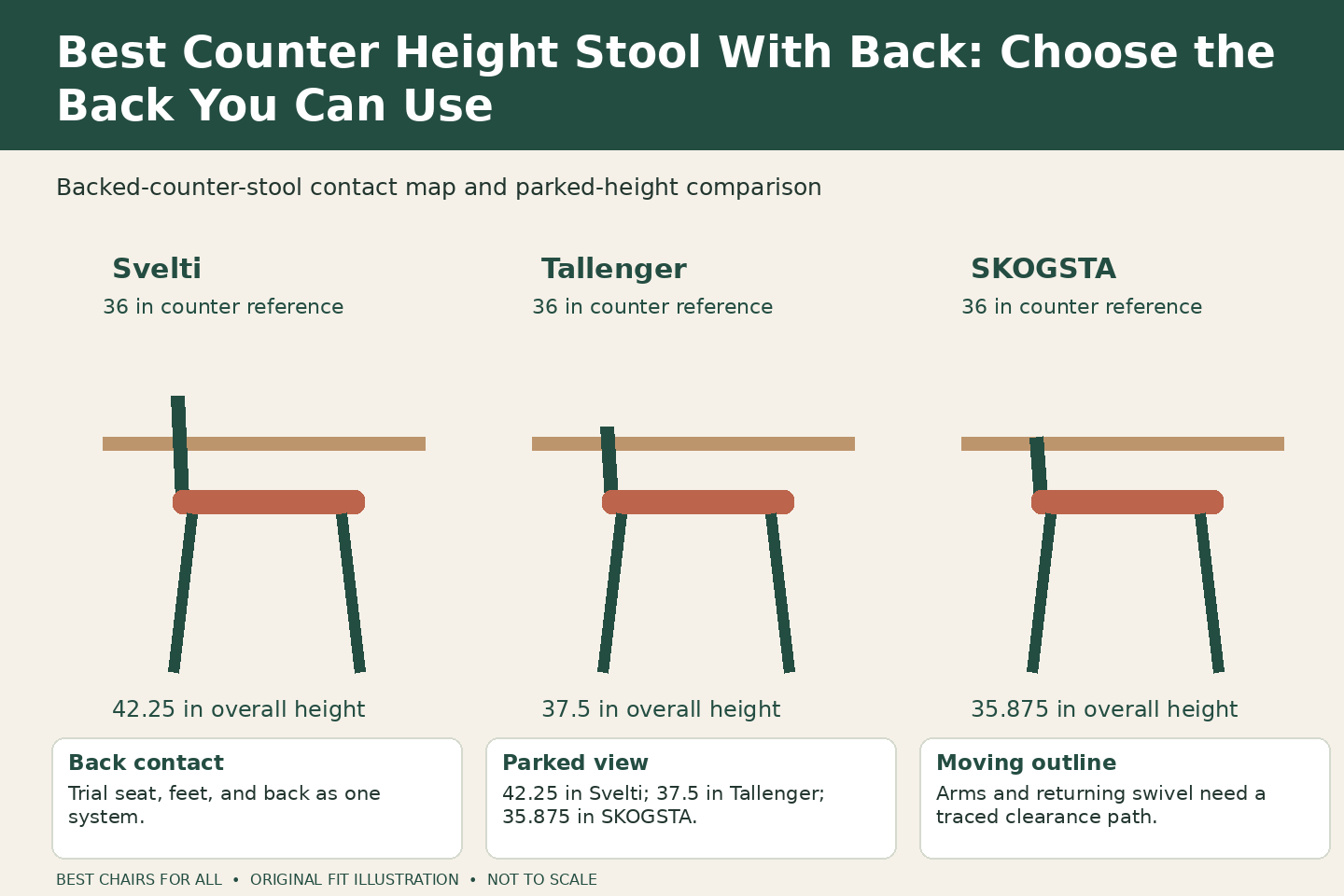
Svelti’s molded shell gives a continuous seat-and-back format without fixed textile upholstery. Its relatively tall overall profile will remain visible above a typical counter. That may be welcome in a colorful modern kitchen or less desirable when a clear view across an open-plan room is the priority. The product’s exact 42.25-inch overall height belongs on the parked-view sketch.
SKOGSTA’s arched wooden back and spindles create a more open outline. The maker lists an overall height of 35 7/8 inches, which is close to the top height of some kitchen counters. That does not establish the size or location of the useful back-contact area for a particular torso. The shape must still be tried while the feet use the footrest.
Tallenger combines a padded back, arms, and a self-returning swivel. It has more mechanisms and surfaces to evaluate than a fixed armless wooden stool. The arms can help define an enclosing sitting space but may obstruct the approach to the counter. Its 30.25-inch arm height and 17-inch inside arm spacing are specifically useful pieces of evidence to compare with the diner and the underside.
A worked back-and-counter view
Imagine a 36-inch-high island seen from the living room. Svelti’s 42.25-inch overall height would extend 6.25 inches above that top when standing on the same level floor. Tallenger’s 37.5-inch overall height would extend 1.5 inches. SKOGSTA’s 35.875-inch overall height would fall just below the top. These are visual planning calculations, not claims about whether a back is supportive.
Now add a low-hanging bracket at the stool position. The back may still look perfect across the room while the person cannot move close enough to eat normally. That is why the view sketch and contact map are separate checks. One answers what remains visible, while the other answers how the person uses the seat at the surface.
Compare the rear photographs as well as the front view. A back can have visible seams, fasteners, or an enclosing shell that defines the room from behind. At an island, the backs are often what you see most. Select the exact fabric or finish because a large upholstered back can create a substantial repeated color field when three stools sit together.
Arms and swivel need extra space
Tallenger’s self-returning swivel should not be confused with a documented unrestricted 360-degree rotation. The current maker description establishes a returning swivel, but we do not infer its full rotation angle. Ask for that information if it is central to your layout. The useful practical question is whether normal entry, conversation, and departure occur without the arms or back meeting the island.
Trace the moving outline with the stool in the intended position. A chair can clear the counter while facing forward and strike it when turned. A neighboring stool, cabinet handle, or wall can be the other collision point. Do not test this by forcefully spinning furniture into an obstruction; use a calm observation and maintain enough separation for normal use.
Armless fixed stools simplify that moving outline, but users still need room to approach and leave. Avoid treating swivel as an automatic accessibility advantage. If someone has difficulty getting onto a counter-height seat or relies on furniture arms to transfer, the appropriate seating arrangement needs individual assessment. Backed stools remain ordinary high seating even when they look like miniature armchairs.
Cleaning where people actually touch
Backrests receive hand contact as stools are repositioned. They also meet clothing and may catch food marks as people turn or leave. A molded shell, lacquered acacia, and polyester upholstery need different maintenance. Keep the selected maker’s care instructions with the receipt rather than cleaning every surface with whatever kitchen spray is nearest.
Svelti’s counter-stool instructions call for a damp cloth and avoiding harsh household cleaners. SKOGSTA’s black lacquered version directs damp-cloth cleaning followed by drying and regular fastening checks. Tallenger’s polyester upholstery should follow the supplied Ashley label and product guidance; do not assume it is machine washable because the cushion looks removable in a photograph.
Inspect the underside and feet during normal cleaning. A loose fastener, damaged glide, or cracked part is a reason to address the condition before continued use. The load figures established here are 300 pounds tested for Svelti and 243 pounds tested for SKOGSTA. We did not establish an equivalent figure from the reviewed Tallenger page, so a buyer with a critical loading requirement should obtain it before considering that model suitable.
How to trial one before ordering the line
Choose the candidate whose geometry is nearest to a known preference, then try it at the actual counter if the return arrangement permits. Use the usual plate and cup positions and ordinary footwear. Sit back, eat, converse, and leave as you normally would. Ask each regular user to describe a specific fit issue rather than accepting one shopper’s immediate enthusiasm as evidence for the whole household.
Keep the packaging until the fit decision is made and confirm the actual return conditions before assembly. Tallenger’s manufacturer listing is a set of two, and different retailers may sell different quantities. A convenient pair can still be an inconvenient first trial if returning an unsuitable product is difficult. Compare the complete transaction, including packaging and transport responsibilities.
If the back is reachable but the seat edge or footrest remains wrong, reject the combination rather than focusing only on the back’s apparent quality. A backed stool should earn its room presence by being useful to the person. It does not need to win every category, but it must work as an entire sitting arrangement.
Which backed stool should you investigate first?
Start with Svelti for a molded shell and a deeper seat than SKOGSTA, within its documented loading figure. Start with SKOGSTA for a shorter seat and a more open wooden back. Investigate Tallenger for a deeply padded, armed, self-returning-swivel format only after confirming any missing load information and the moving clearance.
Keep the contact map and parked-view calculation together while deciding. A backrest is worth buying when it remains usable at the meal and its size makes sense in the room. Those two practical results provide a stronger answer than simply choosing the tallest or most upholstered model.
Something unclear or out of date? Send a correction with this article’s title and the detail to check.
Sources, research & corrections policy ↗