As an Amazon Associate, we earn from qualifying purchases. Read our affiliate disclosure.
The best convertible high chair should earn its extra modes through changes your household will actually make. For an adjustable wooden dining chair that remains useful after the feeding stage, compare the Abiie Beyond Junior Y and Stokke Tripp Trapp. For a light folding product with later low-chair and youth-stool arrangements, investigate the Chicco Zest 4-in-1. Their conversions solve different problems, so a larger advertised stage count is not an automatic advantage.
We researched current US product pages, manufacturer instructions, and CPSC notices on November 6, 2026. This is a specification-based buying guide, not a hands-on durability trial. We distinguish a chair’s present feeding configuration from its future furniture role, explain the parts you need to retain, and provide a conversion-value worksheet. None of these selections is a prescription for when an individual child should transition.
What each conversion really offers
| Chair | Current feeding setup to verify | Later arrangement | Published assembled size |
|---|---|---|---|
| Abiie Beyond Junior Y | Included tray, cushions, correct harness and footrest | Repositioned adjustable dining chair | 21 L × 17.6 W × 34.5 H in |
| Stokke Tripp Trapp | Compatible US Baby Set, harness, required parts; tray if desired | Adjustable chair after infant accessories are no longer required | 19.3 L × 18.1 W × 31.1 H in |
| Chicco Zest 4-in-1 | Supplied tray and five-point harness | Low feeding chair, toddler chair, youth stool as instructed | 21.25 × 26 × 34.25 in |
Abiie Beyond Junior Y: conversion through repeated seat adjustment
The Beyond Junior Y centers its later value on an adjustable seat and footrest. Its published seat-height range is 10.5 to 24.6 inches; the overall chair is 34.5 inches high and weighs 18 pounds. The package includes cushions, tray, and plastic tray cover. That is a useful starting point when comparing complete feeding systems rather than adding up separately photographed accessories.
Its conversion is most relevant for a family that wants one dedicated place at the dining table. As the child changes, you can investigate the next approved seat and footrest position rather than replace the entire frame. Follow the manufacturer adjustment guidance for the exact version and verify each lock after making changes. A broad adult-use capacity should never be read as a capacity for the infant feeding arrangement.
The limitation is that a lasting adjustable chair still occupies lasting floor space. The 21-by-17.6-inch base may work neatly beside a table, but it does not fold into a cupboard. It also does not become two independent seats for siblings merely because it has several settings. Choose it when long-term dining use is plausible and you will keep its removable components. It is less useful if the future plan is to discard the high chair as soon as a booster fits, or if different caregivers are unlikely to maintain the correct adjustments.
Stokke Tripp Trapp: long-term chair, separate infant accessories
The current US Tripp Trapp page clearly labels the bare chair for use from three years and explains the separate Baby Set for the earlier high-chair stage. The base chair was listed at $249 during research, before infant accessories and any optional tray. Treat this as a configurable system whose initial cost depends on the complete US package you select. An inexpensive bare frame is not equivalent to a ready infant high chair.
Stokke’s official demonstration publishes approximately 19.3 inches long, 18.1 wide, and 31.1 high. Its adjustable seat and footplate support the concept of retaining a recognizably ordinary dining chair after the infant accessories are no longer needed. That is a stronger reason to consider it than simply counting newborn, baby, and child pictures as separate valuable stages.
The accessory system is also the main potential failure point in shopping. If buying used or mixing purchases from different years, confirm compatibility through Stokke using the actual chair and accessory identifiers. Do not borrow US restraint advice from a European photograph or assume all Baby Set generations fit every frame. Choose this system when you accept the initial configuration work and expect the later dining-chair role to matter. Pass if the accessory total exceeds your realistic budget or if the current feeding fit requires compromises you are excusing because the frame may last a long time.
Chicco Zest: useful conversions when simple extra seating is enough
The Zest 4-in-1 has an explicit sequence of later uses: standard high chair, lower feeding chair, toddler chair, and youth stool. Chicco lists an assembled weight of 9.5 pounds and dimensions of 21.25 by 26 by 34.25 inches. The Capri listing showed $69.99 and in-stock availability during our review. The wipeable one-piece shell and fold can be as valuable today as the later modes.
Conversions involve removing specific leg sections, tray, or harness at the stages permitted by the instructions. The product family is advertised from six months up to 60 pounds, but that figure does not mean every configuration is appropriate at every size or developmental stage. Keep the complete harness and feeding arrangement until the manual allows the relevant change. A toddler-chair image is not an instruction to remove restraints from an infant setup.
Zest makes sense if the later low chair or youth stool would have an actual home, such as a suitable child’s activity area. It is less convincing when you want the fine seat and foot-platform adjustment of a wooden dining system. Also consider where removed leg sections and restraints will be stored. If a second child may use the high-chair configuration later, losing those parts can erase the conversion value. The best reason to shortlist Zest is a useful present chair plus plausible later simple seating, not the assumption that four named modes guarantee four separate purchases avoided.
A conversion-value worksheet with a worked example
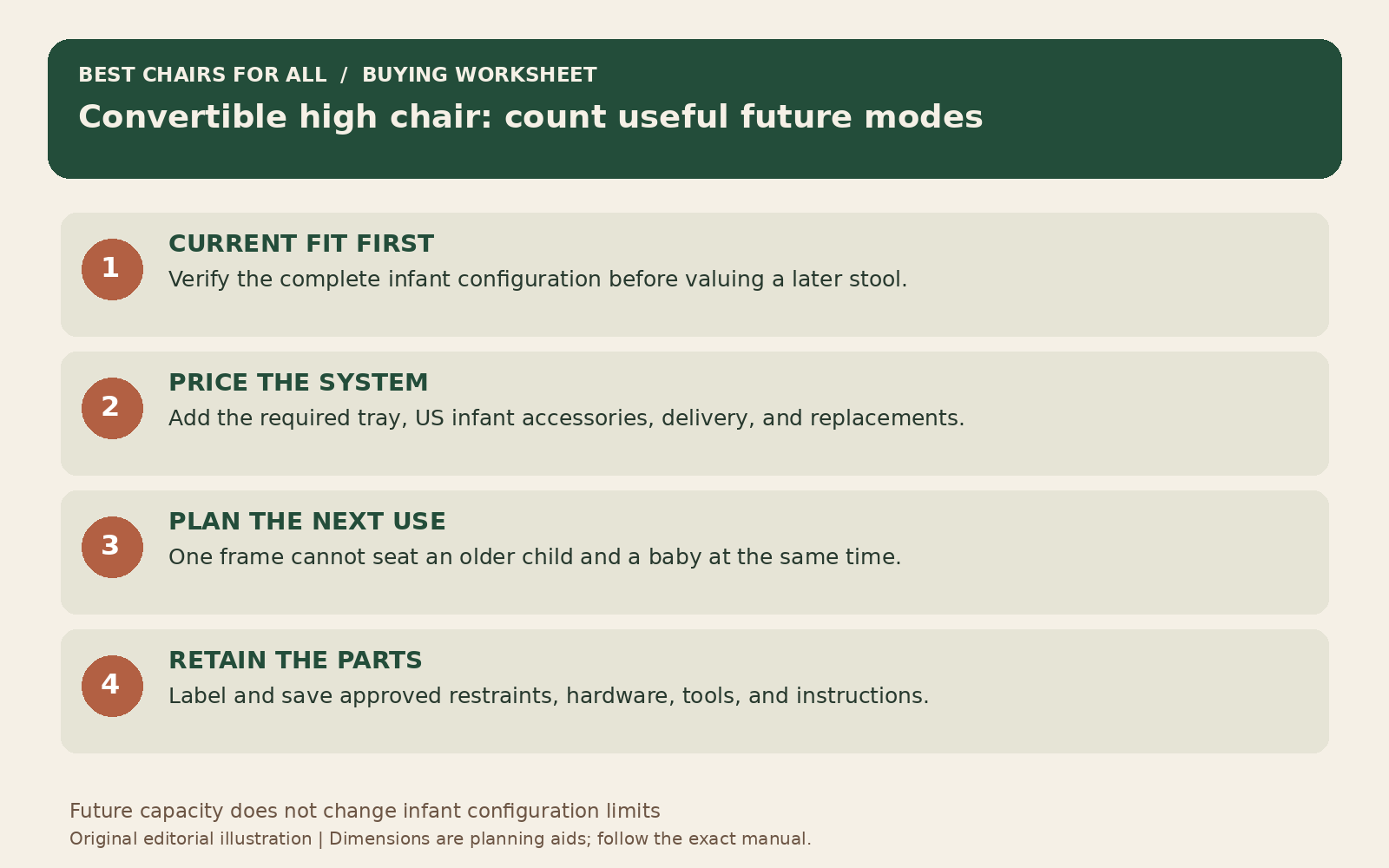
Make five columns: current complete price, required accessories, future use you actually want, parts to retain, and reason the future use might fail. Fill them using the exact selected package. A removable tray may be included, optional, or incompatible with an older accessory version. Delivery and replacement parts can alter the comparison before any future benefit is considered.
Suppose a household is considering a hypothetical $240 complete chair versus a hypothetical $90 chair, and expects either one to serve the same present feeding period. The extra $150 is justified only by real differences: adjustment, fit, included components, cleaning, support, and future use. It is not automatically recovered because the expensive chair advertises adult capacity. If the family would otherwise buy a $60 child’s chair later, that planned future purchase alone does not offset a $150 premium. These are illustrative numbers, not quoted prices for the models in this guide.
Now add a second child. An older child’s continued use of a convertible frame may mean the family needs another infant chair rather than reusing the first one. That does not make the original purchase a failure; it means one frame cannot occupy two places simultaneously. Ask whether you want long-term individual seating or a feeding chair that will be passed down. The answer can change which removable parts you save and how you assess the chair’s later value.
Finally, put a probability next to each future mode: likely, possible, or unlikely. A youth stool for a house that already has suitable children’s chairs may be unlikely; an adjustable dining chair for a child who eats with the family may be likely. Do not turn those categories into fake financial precision. Use them to prevent an attractive set of conversion photographs from displacing the current fit decision.
The parts-retention plan is part of buying
Before assembly, identify every component that might be removed in a later mode. Keep instructions, approved tools, hardware, restraints, and manufacturer packaging labels in a dedicated container away from children. Mark the container with the exact chair model and version. Do not pool small parts from several furniture products: similar-looking bolts can have different lengths and strength requirements.
After a permitted conversion, update a short record of the installed configuration and store the removed parts together. If the chair later returns to infant use, repeat the complete assembly and recall check rather than merely clipping the tray back on. Obtain the correct current instructions from the maker if your saved version is incomplete. A long-lived frame still needs its required original or approved replacement components.
Do not sell or pass on a partially converted chair as an infant high chair without all required pieces and an identifiable label. A missing harness or passive restraint is a substantial change, not a minor accessory omission. The correct response is to ask the manufacturer for supported replacements or describe the product accurately for a permitted later use, never improvise infant restraints.
Current recalls show why mode count is not a safety claim
The October 22, 2026 CPSC Costway convertible high-chair recall concerns products that convert into a table-and-chair set but lack the required passive restraint. Owners of those affected products are directed to stop use and contact the company for the remedy. The notice does not identify the three models in this guide. Its relevance is that convertibility can coexist with a serious design problem; a transformation feature cannot establish safe feeding use.
Likewise, a claim that a wooden frame can support an adult does not validate every infant accessory or make a harness unnecessary. Evaluate the required present restraint and configuration independently. Keep an eye on future notices by registering the product and preserving its model information. A decades-long ownership plan makes ongoing identification and manufacturer support more important, not less.
Compare the conversions you can maintain
For Beyond Junior and Tripp Trapp, ask whether you can correctly reset the seat and foot platform as needed and keep the infant components for later reuse. For Zest, ask whether the lower-chair and stool arrangements have a useful location, and whether the removed sections can be kept securely. Each product solves a different continuity problem.
Do not let future plans excuse a poor current fit, an obstructed dining area, or a cleanup process your household cannot complete. A fixed feeding chair followed later by a separate appropriate child seat can be a perfectly reasonable purchase sequence. Conversely, an adjustable chair that stays useful at the table may be worth paying for even if it does not fold or turn into a play table. The useful measure is repeated appropriate use, not the number printed beside in-one.
Restraints, readiness, and the model label come first
A feeding chair is for a child who meets the exact model’s sitting and developmental requirements. A birthday or advertised minimum age alone does not establish readiness. Use the seat upright for meals; a reclining feature does not make a chair suitable for feeding a younger infant. Keep the child supervised and within reach, use the complete fitted harness every time, and use the required passive crotch restraint. A tray is a work surface rather than a substitute for restraint. CPSC explains these high-chair precautions. Keep the chair away from surfaces the child could push against and never allow standing or climbing.
Check the product label, date code, exact model, and country version against the current CPSC recall database before buying, including secondhand. Our research date is November 6, 2026; this article cannot guarantee a particular unit remains unaffected by a later notice. Register the chair and retain the instructions. Do not interchange harnesses, trays, gliders, or inserts between superficially similar versions, and do not improvise missing restraints. A used bargain without an identifiable label, complete hardware, and manufacturer support is a poor candidate. If any latch, restraint, or frame part is damaged, stop use and contact the maker.
Choose the complete Beyond Junior system for straightforward adjustment at a permanent dining station, Tripp Trapp when its current US accessory package and later chair role suit your plans, or Zest when a lighter folding chair and later simple seating are useful. Confirm each current package and availability before ordering, and treat every conversion as a manufacturer-directed configuration change rather than a reason to remove parts early.
Something unclear or out of date? Send a correction with this article’s title and the detail to check.
Sources, research & corrections policy ↗