As an Amazon Associate, we earn from qualifying purchases. Read our affiliate disclosure. Amazon buttons search for matching listings; they do not confirm the exact model, seller, price, or stock.
A comfortable dining chair needs to support the way you eat, not merely feel soft when you press a cushion with your hand. IKEA BERGMUND, Article Nosh, and Article Harris are worth considering for different bodies and tables. BERGMUND offers a removable full cover and a notably high seat; Nosh offers a shallower padded seat in an armless format; Harris adds arms and a deeper sitting area. None is a universal comfort winner.
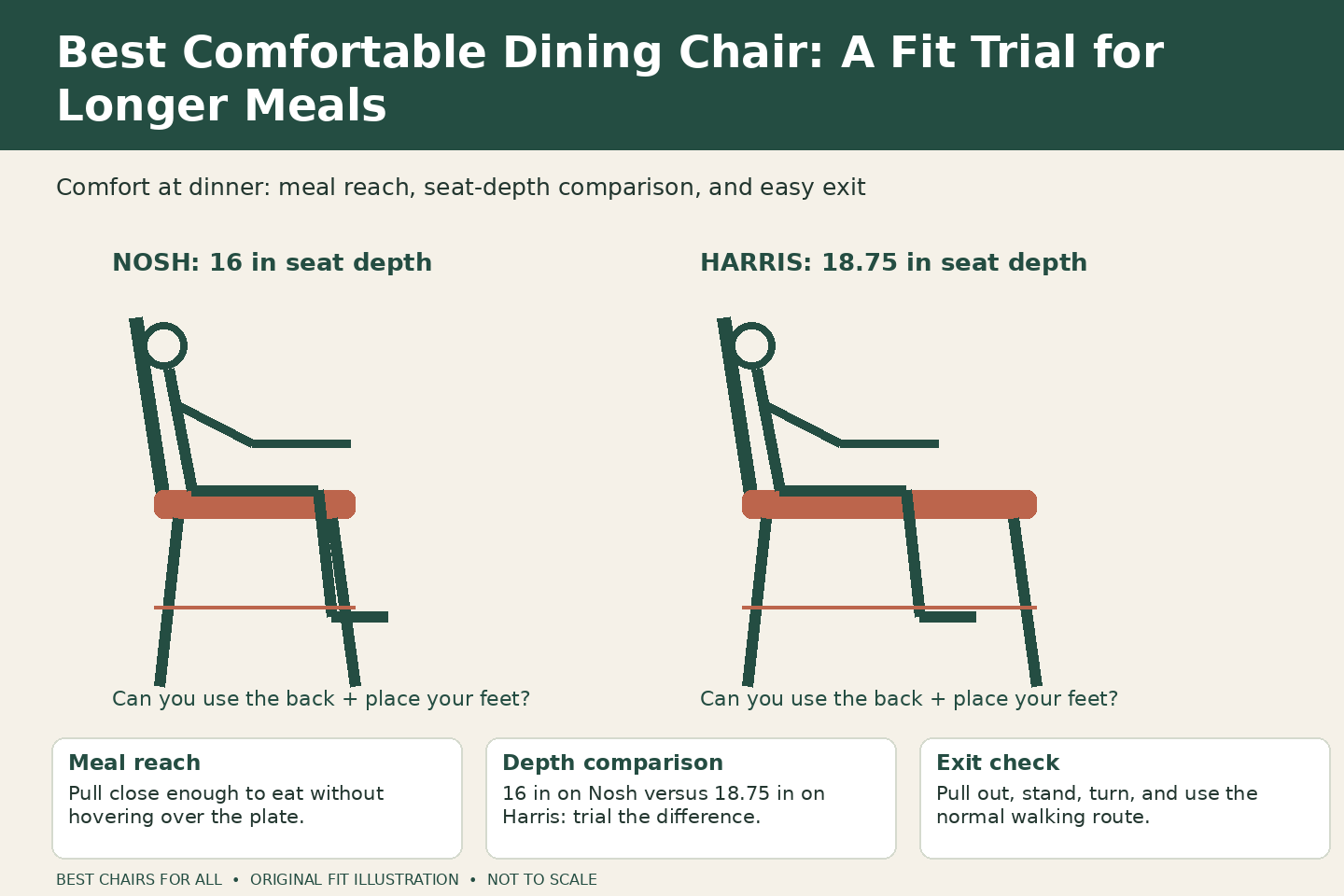
This guide compares manufacturer information researched online on November 6, 2026. We did not carry out hands-on sitting tests. The recommendations are starting points for your own trial, not measured comfort ratings or promises that a chair will relieve pain. Prices and stock vary, so the guide makes no hard budget claim.
Separate softness from comfortable fit
A chair can feel plush for thirty seconds and awkward halfway through dinner. If you must scoot forward to reach the table, the backrest cannot help much. If the seat edge presses behind the knees, more cushion may not solve the depth mismatch. If feet hang without a stable resting position, the padded surface has not made the entire setup comfortable. Look at the chair-table-person combination.
Start with a chair you already like and record its seat height and the usable distance from back contact to front edge. These measurements are personal reference points rather than ergonomic rules. Note whether its cushion compresses noticeably when you sit. Manufacturer seat heights are not guaranteed occupied heights, and different foam constructions can change the comparison once a person is on the seat.
Verify the exact variants in the manufacturer references: IKEA BERGMUND chair, black/Gunnared medium gray; Article Nosh dining chair, Oak and Ratine Ivory; Article Harris velvet dining armchair, Hale Rust. Specifications were checked November 6, 2026.
1. IKEA BERGMUND chair, black/Gunnared medium gray
Best for: For a high upholstered seat.
BERGMUND is worth a first trial if your current comfortable chair sits high and you want both seat and back covered. It is less persuasive for a diner who already struggles to place their feet comfortably.
The seat is listed at 20 1/8 inches high and 16 1/8 inches deep. The full cover is removable; the particular Gunnared cover has machine-washing instructions that should be followed rather than improvised.
Product Details
| Brand | IKEA |
|---|---|
| Overall dimensions | 20 1/2 W × 23 1/4 D × 37 3/8 H in |
| Seat height | 20 1/8 in |
| Manufacturer load wording | 243 lb tested |
| Materials | Solid wood legs; removable polyester cover |
Pros
- Removable cover makes a washing plan possible
- Published seat depth supports a useful personal comparison
Cons
- High seat needs careful apron and foot-position checks
- Bulkier outline can make moving from the table harder in tight rooms
Select it because the sitting height fits, then judge the softness during a meal.
2. Article Nosh dining chair, Oak and Ratine Ivory
Best for: For a shallower armless trial.
Nosh is the sensible starting sample here if you want padding without arms and your preferred seat depth is around 16 inches. The low-looking overall back should not be confused with a low seat.
Article lists a 19-inch seat height, a 16-inch seat depth, and a 31-inch overall height. Ratine Ivory is polyester upholstery; the care directions call for spot cleaning with gentle detergent and professional attention for persistent stains.
Product Details
| Brand | Article |
|---|---|
| Overall dimensions | 20 W × 21 D × 31 H in |
| Seat height | 19 in |
| Manufacturer load wording | 300 lb tested |
| Materials | Polyester upholstery; rubberwood legs and plywood |
Pros
- Armless access works with several seating positions
- A 16-inch published depth is distinct from the deeper Harris
Cons
- The 19-inch height will still be too tall for some diners
- Fixed upholstery requires acceptance of the cleaning routine
Trial the backrest contact point rather than judging it by how padded it looks.
3. Article Harris velvet dining armchair, Hale Rust
Best for: For deeper seating with arms.
Harris is the more enveloping option for a dining area with room to spare. Its arms and greater seat depth make it a different proposition from simply buying a softer Nosh.
The current Hale Rust model lists an 18.75-inch seat depth, 19.25-inch seat height, and 22.75-inch arm height. Its velvet is polyester; the maker specifies dry cleaning for more persistent stains.
Product Details
| Brand | Article |
|---|---|
| Overall dimensions | 23.5 W × 23 D × 31 H in |
| Seat height | 19.25 in |
| Manufacturer load wording | 300 lb tested |
| Materials | Polyester velvet; foam and wood frame |
Pros
- Arms give another resting position during conversation
- Deep seat may fit diners who dislike short sitting surfaces
Cons
- Depth can prevent a shorter diner using the back comfortably
- Wide frame reduces space between neighboring chairs
Measure the apron and test the arms in motion before choosing it for every seat.
Our comfort trial: a meal, a conversation, an exit
Use three ordinary tasks to judge a candidate. First, eat a normal meal at your own table. Bring the plate and cutlery into the usual positions. Your shoulders should not need to stay raised to reach the tabletop, and you should not have to lean over an enormous gap. Check thigh clearance where you actually sit, since a decorative apron can be lower than the tabletop suggests.
Second, remain for the sort of after-meal conversation your household enjoys. Sit back as you naturally would, then change posture. Notice whether the backrest meets you at a useful point or nudges you into a position you keep correcting. Do your feet remain comfortably placed? Are the arms useful, irrelevant, or in the way? Write down the sensation rather than giving the whole chair one star rating.
Third, leave the table. Pull out, stand up, turn, and walk away along the route you normally use. A chair that is pleasant when stationary may be awkward to move on your rug. Arms may make sitting feel contained while complicating side entry. A heavy chair can be welcome to one diner and an obstacle to another. Try these actions before ordering every place setting.
Use a small worksheet with columns labeled activity, body contact, table conflict, movement, and decision. For the meal row, a useful entry is: feet placed comfortably, front edge acceptable, no apron contact, easy to approach, pass. An unhelpful entry is simply: quite comfy. Specific notes make comparisons possible after you have visited a second showroom or returned home from a store.
A depth comparison that changes the shortlist
The documented seat depths differ meaningfully: Nosh is listed at 16 inches, BERGMUND at 16 1/8 inches, and Harris at 18.75 inches. The first two are close on paper; Harris extends substantially farther. That does not make Harris better or worse. A diner with longer thighs may appreciate the extra sitting area, while a shorter diner may find it harder to use the backrest with feet comfortably placed.
Imagine that your current favorite chair has 16 inches of usable seat depth. Harris’s published depth is 2.75 inches greater. Before buying, mark that additional length on the existing seat with a removable paper strip, without using it as a modified seat for sitting. The visual comparison shows the scale of the difference. Then try the actual chair or obtain a returnable sample; a drawing cannot reproduce back angle and cushion compression.
Do not compare overall depth to seat depth. Overall depth includes the relationship between the back, frame, and legs. A chair can take more floor area without giving the diner more usable sitting space. That is why we show both kinds of measurement rather than ranking comfort by the biggest specification. A deep chair in a small room can create two problems at once if it fits neither the person nor the passageway.
How arms affect comfort at the table
Harris’s published arm height is 22.75 inches. That is lower than the top of many dining tables, but the relevant obstacle is the lowest apron or rail, not the tabletop. Measure both the arm’s high point and the path it takes while the chair moves inward. An arm can clear the table edge and still meet an interior rail farther under the top.
Use arms as a preference to test, not a promised accessibility feature. Some people like resting their forearms during conversation; others prefer the freedom of an armless chair while eating or turning sideways. If a diner relies on armrests for transfers, ordinary dining-chair specifications do not establish that they are suitable for the person’s support needs. Seek an appropriate assessment instead of assuming an attractive armchair is a mobility aid.
Cushion and cover decisions
A removable cover is useful when spills are frequent and you can manage the washing process. BERGMUND’s cover instructions include washing limits and drying restrictions; follow the exact label for the version purchased. A spare cover can reduce downtime, but it is an extra purchase rather than a feature included automatically with every chair. Check whether the replacement you want is actually sold for the frame.
Nosh and Harris take a different maintenance route. Their current pages give spot-cleaning or professional-cleaning guidance rather than telling you to machine wash the upholstery. Harris’s velvet also has a directional nap, so appearance can change as the surface is brushed or touched. Choose the material whose care routine you can accept, including after a large gathering when several seats need attention at once.
Avoid treating abrasion numbers as comfort scores. A fabric’s rub count says nothing about whether the backrest fits your torso or the cushion feels right during a meal. Likewise, the word performance does not establish immunity to every food, drink, cleaner, pet claw, or clothing dye. Request a swatch when available and evaluate its feel and appearance in your room; do not run destructive stain experiments on a returnable chair.
Match the chair to the household
For an adult who already likes a relatively high chair, BERGMUND deserves a trial. For someone who needs less depth and prefers no arms, Nosh is the more logical first sample. For a diner who wants a deeper, enclosing chair for long conversations and has enough table space, Harris is the candidate. These are fit hypotheses grounded in dimensions, not predictions of how every person will feel.
A mixed set can be the most comfortable arrangement. Two people with different leg lengths do not need identical chairs merely because the upholstery matches. Keep the seat-to-table relationship workable at each place and compare how the silhouettes look together before ordering. If matching is essential, choose the model that passes the trial for the most constrained user rather than the one that wins a photograph.
Practical checks before you keep it
Inspect the assembled chair on a level surface, follow the supplied instructions, and use the appropriate floor protectors. Keep the return packaging until the household has completed its trial. Confirm which marks or assembly steps affect return eligibility and what return transport costs. An online guarantee is useful only if its conditions work for a chair-sized item at your address.
If discomfort is persistent, severe, or associated with a health condition, furniture shopping alone is not an assessment of the cause. A professional can help with individual seating needs. For ordinary purchasing, your strongest evidence is still a specific trial at the real table: feet, front edge, back contact, meal reach, and exit. Choose the chair that passes those tasks, then decide whether its fabric and appearance justify the upkeep.
Something unclear or out of date? Send a correction with this article’s title and the detail to check.
Sources, research & corrections policy ↗