As an Amazon Associate, we earn from qualifying purchases. Read our affiliate disclosure. Amazon buttons search for matching listings; they do not confirm the exact model, seller, price, or stock.
The best bar stool chair is the right height variant for your raised surface, with a seat and back configuration the user can comfortably use. Article Svelti Bar Stool, West Elm Devon Bar Stool, and IKEA JANINGE adjustable stool are three researched choices with quite different formats. Svelti and Devon provide backed seats; JANINGE is a compact scooped-seat alternative for a person who prefers less surrounding furniture and whose required height falls inside its range.
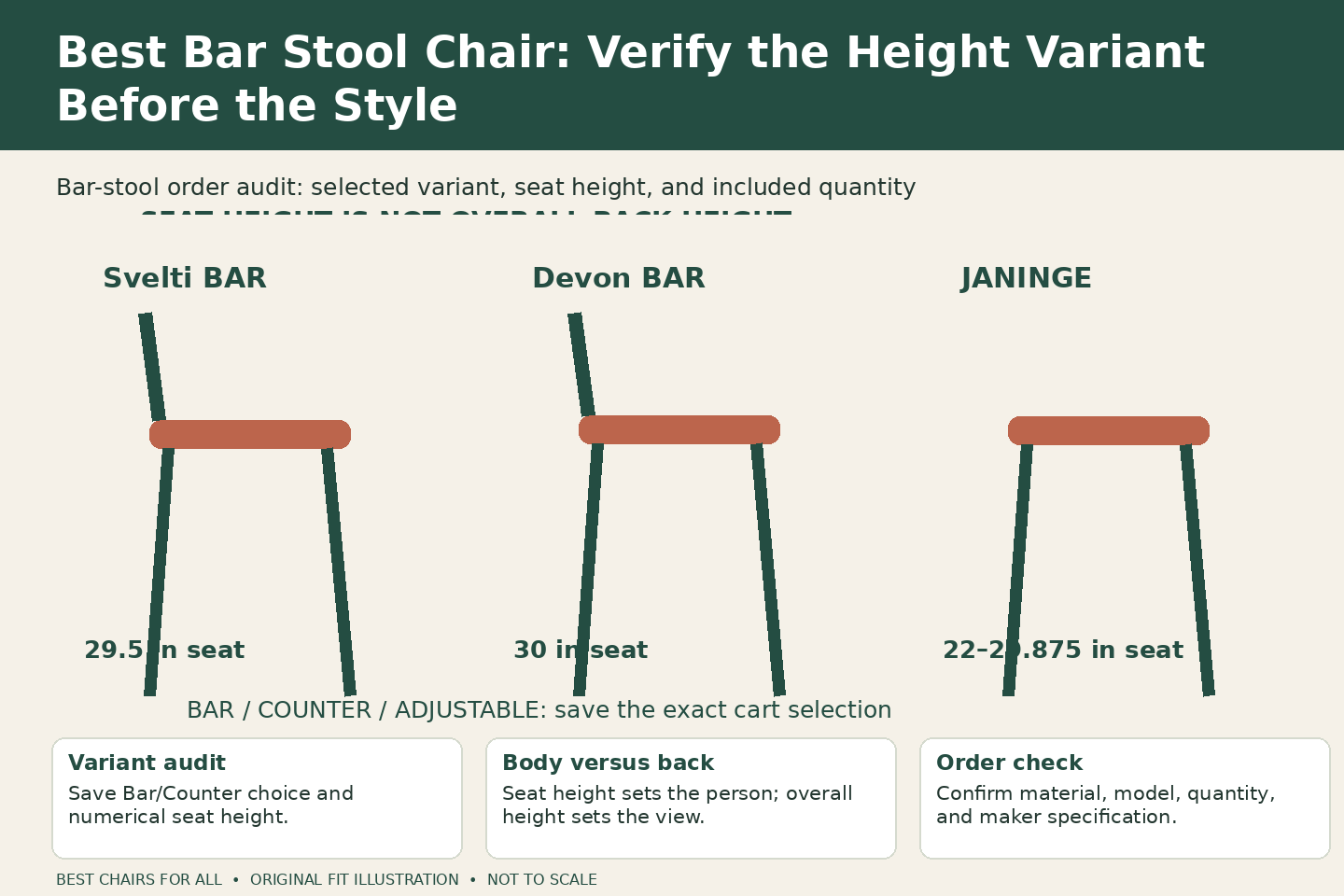
We researched their exact US maker listings online on November 6, 2026. We did not perform sitting tests or inspect the mechanisms. The shortlist makes no fixed price promise. The practical aim is to prevent an expensive variant error and help you choose a useful first sample rather than recommending every product called a bar stool indiscriminately.
The category name is not enough
Retailers sometimes use bar stool as a broad category containing counter-height and adjustable products. A photograph can show the same design at two heights, and a dropdown can change the specification without an obvious change to the main image. The numerical seat height in the selected cart item matters more than the category heading at the top of the page.
A backed bar stool can resemble a dining chair from the seat upward, yet its longer legs create a completely different relationship to a surface and the floor. Overall height includes that back and does not establish where the person sits. A product listed at 46 inches overall may have a 29.5-inch seat. Buying from the larger figure would misunderstand both its intended use and its visual presence.
Verify the exact variants in the manufacturer references: Article Svelti bar stool, Pure White; West Elm Devon swivel bar stool, Toasted Oak; IKEA JANINGE bar stool, white, adjustable. Specifications were checked November 6, 2026.
1. Article Svelti bar stool, Pure White
Best for: Fixed backed bar-height option.
Svelti Bar is the candidate for an exposed molded seat and a fixed four-leg layout. It should not be confused with the lower Counter or dining-chair versions.
The Pure White Bar variant lists a 29.5-inch seat height, 17-inch seat depth, and 46-inch overall height. Article lists the tested-weight field at 300 pounds.
Product Details
| Brand | Article |
|---|---|
| Overall dimensions | 18 W × 20 D × 46 H in |
| Seat height | 29.5 in |
| Manufacturer load wording | 300 lb tested |
| Materials | Polypropylene/fiberglass shell; powder-coated metal |
Pros
- Molded back without textile upholstery
- Exact Bar seat height is clearly specified
Cons
- Tall overall back remains visible above many surfaces
- Fixed format needs ordinary pull-out space
Verify the Bar selection and numerical height in the retailer item.
2. West Elm Devon swivel bar stool, Toasted Oak
Best for: Padded swivel bar-height option.
Devon is the upholstered choice when a backed swivel seat fits the raised bar and room. Select the 30-inch Bar option deliberately; the product family also includes Counter height.
West Elm lists 17.75 inches of seat width, 17.5 inches of depth, and a 275-pound capacity. The reviewed page identifies swivel but does not establish a specific rotation angle.
Product Details
| Brand | West Elm |
|---|---|
| Overall dimensions | 21.4 W × 19.75 D × 38.5 H in |
| Seat height | 30 in |
| Manufacturer load wording | 275 lb stated capacity |
| Materials | Rubberwood frame; foam and engineered wood seat/back; selected upholstery |
Pros
- Seat width and depth are published separately
- Maker gives a 40–43-inch recommended bar-height range
Cons
- Upholstery care varies with the selected fabric
- Rotation clearance and angle need checking if critical
Use the recommended surface range as a filter, then trial the real underside and diner.
3. IKEA JANINGE bar stool, white, adjustable
Best for: Adjustable scooped-seat alternative.
JANINGE is included for a buyer who prefers a compact scooped seat to a substantial upholstered back. That is a different seating brief from the two backed candidates.
IKEA lists a 22- to 29 7/8-inch seat range and a 16 1/2-inch base diameter. The stool has a 243-pound tested figure and should be adjusted only as instructed.
Product Details
| Brand | IKEA |
|---|---|
| Overall dimensions | 15 W × 14 1/8 D × 33 1/8 H in; base diameter 16 1/2 in |
| Seat height | 22–29 7/8 in |
| Manufacturer load wording | 243 lb tested |
| Materials | Reinforced polypropylene seat; steel base; metal footrest |
Pros
- Published adjustable range covers several possible positions
- Scooped reinforced-polypropylene seat avoids fixed fabric
Cons
- Upper seat limit must suit the required surface
- Less surrounding back structure than the chair-style choices
Choose it only if its perching format and complete adjustment range match the intended activity.
Our six-field order audit
Before paying, save six fields from the exact retailer item: full model name, selected height, numerical seat height, overall dimensions, included quantity, and source of the specification. Keep the maker’s page beside the retailer page. If either contains a dropdown, record the selected state. This is a short procurement audit rather than an attempt to make the product page say what you hope it means.
For Svelti, the Bar version here has a 29.5-inch seat and 46-inch overall height. The Counter version is a distinct selection with a lower seat. For Devon, the maker identifies a 30-inch Bar version as well as a 26-inch Counter version. For JANINGE, the useful field is its adjustable 22- to 29 7/8-inch seat range. Those different kinds of data should not be collapsed into one vague tall-stool label.
Next, check the retailer’s model and material against the maker’s construction. Svelti’s molded shell is polypropylene with fiberglass. Devon has a rubberwood frame and a padded seat and back in a selected upholstery. JANINGE has a reinforced polypropylene seat and a pedestal-base format. An unbranded lookalike with similar proportions does not automatically share the same load testing, finish, or replacement support.
Finally, verify whether the purchase is one stool or a set. Per-item prices and pair requirements can make advertised costs difficult to compare. Do not assume a product image showing two stools means two arrive. Also check assembly and return transport before using the first order as a trial. A height mistake is easier to resolve before the carton is opened and the base assembled.
Measure the raised surface as it exists
Record floor-to-top height at the place where the person will eat or drink. Then record the lowest underside, brackets, and panels affecting the seat. A raised bar can have an overhang, decorative rail, or support structure that is difficult to see from above. The nominal room-plan height does not establish usable knee space.
West Elm recommends its Devon Bar version for bar heights of 40 to 43 inches. That is maker-specific guidance, not a guarantee for every surface in that range. Use it as a starting filter and then inspect your underside and diner. A thick top or low rail can change the result. Likewise, IKEA describes a range of suitable surface heights for JANINGE, but the person’s foot and seat relationship remains part of the trial.
Do not modify a standard dining chair to reach the bar with blocks or altered legs. Do not choose a taller stool simply to create an impressive silhouette. If ordinary access to a high seat is difficult, a lower table arrangement may be a better solution. The category’s stylishness does not make it appropriate for every person or task.
Worked variant comparison
Imagine that a shopper sees a Devon listing and intends to furnish a 42-inch raised bar. The page offers a 26-inch Counter selection and a 30-inch Bar selection. Choosing the lower selection changes the nominal seat-to-top difference from 12 inches to 16 inches. That four-inch change is significant before any other factor is considered. The chair’s similar back shape would not reveal the mistake reliably.
Now consider a 36-inch surface with the 29.5-inch Svelti Bar selected. The nominal top-to-seat difference is 6.5 inches. This calculation does not establish a comfort threshold, but it shows why the shopper should return to the numerical selection rather than assuming every stool in the category fits a kitchen counter. The appropriate investigation is the matching Counter version or another measured product.
For JANINGE, confirm that the desired seat height lies inside the stated range rather than barely beyond its maximum. Its 29 7/8-inch upper limit is not permission to extend the mechanism farther. If the fitting trial indicates a higher position is needed, choose another appropriately specified seat. Use only the adjustment allowed by the maker’s instructions.
Backed seat or scooped perch?
Svelti’s molded back and seat create a continuous shell with a 17-inch published seat depth. The shell may suit a person who wants a back but prefers exposed-surface care. Devon’s padded seat and enclosing back create a different contact feel and visual mass. Its 17.5-inch published seat depth and 17.75-inch seat width provide useful comparison points, though neither predicts comfort by itself.
JANINGE offers a scooped seat rather than the larger backed enclosure of the other candidates. This makes it an alternative to consider for short, intentional perching or a user who prefers that format, not an equivalent replacement for a person seeking a substantial backrest. Be clear about the task. A breakfast drink and a long evening gathering can justify different choices even at the same surface.
During the trial, sit as you normally would for the intended activity. Check whether the feet can rest comfortably, the front edge feels acceptable, and the surface is reachable without awkward stretching. For the backed products, notice whether you actually use the back or remain too far forward. If a chair feature never becomes usable, it has not justified the space it occupies.
Rotation changes how the bar works
Devon has a swivel base, while the Svelti Bar model here is a fixed chair. Do not assign a rotation angle to Devon unless the exact maker specification establishes it; the source reviewed identifies swivel without giving an angle. If rotation is critical to your plan, ask for the missing detail rather than assuming all swivel furniture turns freely through a complete circle.
Check the moving outline near the edge, wall, and adjacent stools. A person can turn within a seat while the back or knees meet another object. Allow an ordinary approach-and-exit trial instead of forceful spinning. A swivel can be convenient for conversation, but it does not establish suitability for a person needing transfer support or assistance onto a high seat.
The base also affects housekeeping. A pedestal and a multi-leg frame occupy the floor differently, and stool feet can interfere before seats appear crowded. Mark the actual overall footprint or base diameter in the plan. Keep the floor-contact parts clean and appropriate for the surface, following the maker’s directions rather than changing glides casually to make the stool slide more easily.
Materials at a drinks or food surface
At a bar, spills can reach the front of the seat, footrest, and base as well as the top. Svelti’s maker directs damp-cloth cleaning and avoiding harsh household cleaners. JANINGE’s directions call for a mild soapy solution followed by drying. Devon’s care depends on the selected upholstery, so preserve the label for that exact fabric instead of borrowing another option’s cleaning instructions.
Upholstery can be a deliberate choice for the look and feel of a social room. It still requires an honest care plan. Request swatches where available and view them under the lighting used in the evening. A pale woven fabric, dark molded shell, and white pedestal seat will show different kinds of marks. No material in this shortlist is described as stain-proof.
Loading and long-term condition
Article lists a 300-pound tested figure for the Svelti Bar version, West Elm a 275-pound capacity for Devon, and IKEA a 243-pound tested figure for JANINGE. Preserve the makers’ wording rather than treating the numbers as identical tests. If the required use exceeds a published figure, that product is not a candidate regardless of how well the silhouette matches the room.
Follow assembly and inspection instructions, and contact the supplier about looseness, damage, or an adjustment problem. Do not open or repair a lift mechanism as a home project. A chair that was correctly specified when new can still be unsuitable for continued use after damage or incorrect assembly. Keep the model identification available so questions go to the right maker or seller.
The useful shortlist decision
Choose Svelti Bar for a fixed molded-backed chair at a documented 29.5-inch seat height. Choose Devon Bar for a padded swivel format when its 30-inch seat and footprint fit. Consider JANINGE when an adjustable scooped seat is intentionally preferred and the desired position lies within 22 to 29 7/8 inches. Each is a different response to the same raised-surface brief.
Before ordering the rest, complete the six-field audit and a normal-use trial. A correct variant with workable feet, knee space, and meal reach is a better bar stool chair than a beautiful product ordered in the wrong height.
Something unclear or out of date? Send a correction with this article’s title and the detail to check.
Sources, research & corrections policy ↗