A wall-hugger recliner is designed to operate with relatively little space behind it, usually by moving the seat assembly forward as the back reclines. A conventional recliner may move farther backward and need a larger rear gap. The important word is “may”: these are families of mechanisms, and the model drawing matters more than the label.
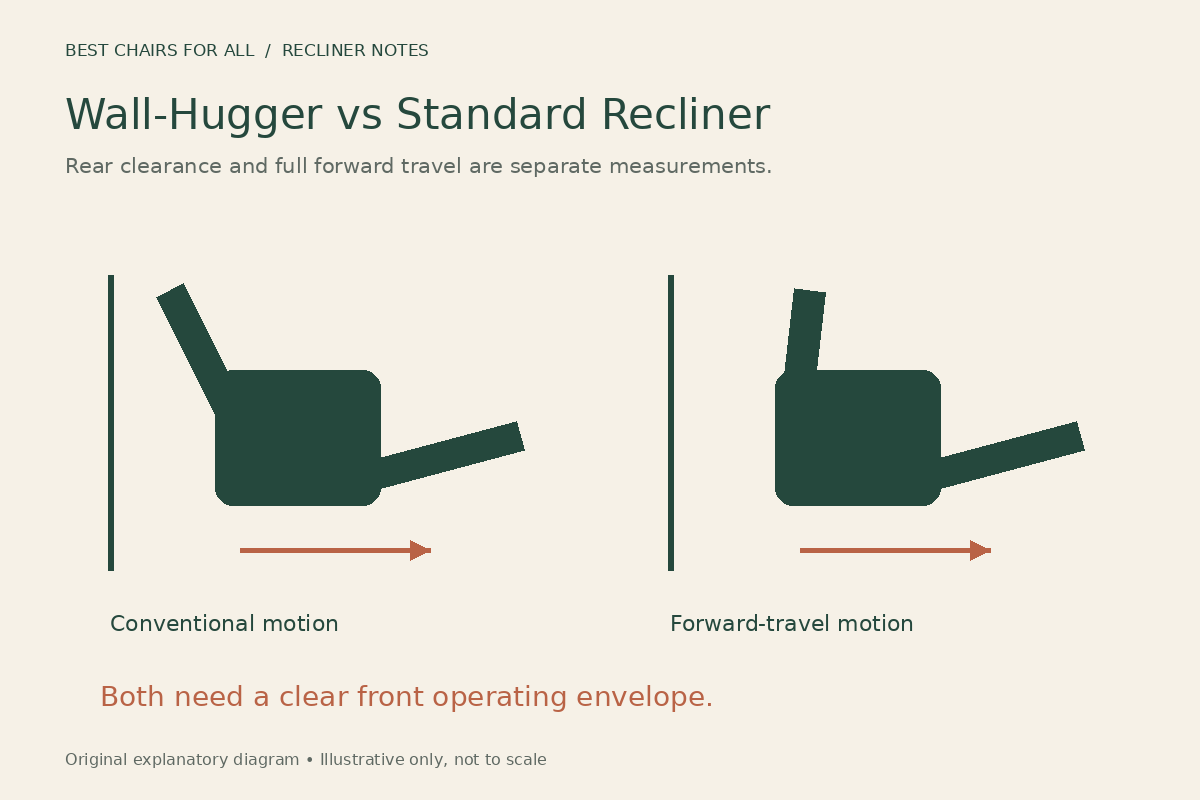
Choose between them by comparing two layouts with the footrests fully open. A wall-hugger can solve a rear-clearance problem without solving a narrow-room problem. This guide explains the tradeoff, provides a comparison worksheet, and shows how to avoid assuming that all compact-looking recliners move in the same way.
What the wall-hugger mechanism changes
Imagine a chair whose back moves rearward around a relatively fixed seat. The wall must stay out of that path. A forward-travel mechanism shifts more of the chair away from the wall during operation, reducing how much empty space is required behind the upright chair. That is the practical distinction buyers usually care about.
The La-Z-Boy Australia wall-recliner explanation describes its glideaway movement as the seat sliding forward rather than pushing the back outward. Its stated 152 mm clearance applies to that range and market. Treat that number as a specific manufacturer’s example, not a universal minimum for anything sold as a wall-hugger.
Names vary: wall saver, wall recliner, space saver and zero-wall may all appear in listings. Do not infer a literal zero-inch clearance from a name. Ask for the exact instruction describing placement, including whether the measurement is taken from the frame, upholstery or top of the backrest.
What the mechanism does not tell you
The label does not establish seat width, seat height, reclined angle, weight rating, upholstery quality or how comfortable the chair will feel. Nor does it guarantee that the chair is compact overall. A wide arm design and thick back cushion can make a wall-hugger larger than a slimmer conventional chair when both are closed.
It also does not establish the controls. A wall-hugger may be manually operated or powered. A conventional chair may have either system as well. Keep mechanism geometry and operating method in separate columns when comparing products; otherwise it is easy to credit the power button for a space-saving benefit that actually comes from the frame design.
Finally, do not assume that a particular motion combines with every other motion. Rocking, swiveling and reclining introduce different paths. Check the exact configuration and assembly instructions before deciding that a chair advertised in one version can do everything shown across a product family.
Compare rear clearance and total depth separately
Rear clearance describes only one piece of the floor plan. The other essential measurement is the distance from the wall to the furthest point of the open footrest, with the chair correctly positioned. That is the dimension that determines whether a coffee table or opposing sofa is in the way.
Here is an invented arithmetic example, not a product specification. Chair A needs its upright back positioned farther from the wall and extends to a wall-to-front distance of 70 inches when open. Chair B needs less empty space behind it but reaches 72 inches forward when open. Chair B solves the rear-gap issue, but Chair A leaves two more inches before the coffee table. You cannot identify either result from the wall-hugger label alone.
When a drawing provides overall reclined depth, confirm whether the separate wall requirement should be added. Some drawings already show wall-to-front distance; others measure only the chair’s physical envelope. Adding a gap twice makes a chair appear bigger than it is. Omitting it makes the room appear bigger than it is.
| Comparison point | Wall-hugger question | Conventional recliner question |
|---|---|---|
| Space behind | What is the specified upright placement gap? | How far rearward does the back travel? |
| Space in front | How far does forward travel carry the footrest? | What is the furthest footrest position? |
| Other movement | Is rocking or swivel offered on this exact model? | What extra area does that motion sweep? |
| Controls | Is the handle or button reachable beside a wall? | Can it be used without leaning into obstacles? |
| Body fit | Does the person fit the seat and back? | Does the person fit the seat and back? |
Read a placement instruction in the correct position
Placement instructions often distinguish the upright chair from the fully reclined chair. A requirement for a remaining gap behind the open back is not the same thing as an upright placement distance. Check the picture, wording and model coverage together.
The La-Z-Boy power-motion placement guide, for the furniture it covers, instructs owners to fully recline before checking the gap behind the back. It also addresses obstacles in the legrest path. The useful lesson is how to read the instruction, not to transfer that manual’s number to an unrelated chair.
Ask the seller to clarify contradictory figures before ordering. If the marketing description says “inches from the wall” but the manual shows a larger distance, use the model-specific manual and obtain written confirmation of any uncertainty. Do not choose whichever figure makes your floor plan work.
Run a two-color tape comparison at home
Draw the closed width and depth of each candidate on the floor with different colors of removable tape. Then add the operating envelope for both. Include the furthest position of the back, the footrest and any permitted swivel or rocking movement. Mark nearby table edges and the actual swing of room doors.
Walk the room with both outlines visible. Which layout leaves the route to the window clear? Which allows a visitor to sit down without moving a table? Does either chair require a side table to sit beyond an easy reach? This test compares useful space rather than just the attractive gap behind the backrest.
Leave the marks for a normal evening, because a room’s shortcomings often appear during ordinary routines. You may discover that the footrest blocks the television cabinet, or that someone carrying a laundry basket has no comfortable route through the room.
Test the chair with the intended occupant
A space-saving mechanism is worthwhile only if the seat works for the person who will use it. At a showroom, sit back naturally, operate the mechanism through the permitted range and return to upright. Check access to controls from your normal seated position. If more than one person will use it, have each person try it.
Compare support and reach instead of relying on the adjectives in a listing. Can the user rest comfortably without sliding forward? Is the footrest the expected length? Does the back position allow the intended activity, whether that is reading or watching television? Bring the actual measurements and a note of the room’s screen position.
Do not interpret this as a medical fitting test. If seating is being selected for a specific mobility or health need, involve the appropriate professional and the individual user. Furniture dimensions and a successful showroom trial do not assess every personal requirement.
Consider access, power and maintenance
Wall-huggers often appeal to people furnishing tight rooms, but tight rooms can also have tight delivery routes. Measure entrance doors, stair turns and landings separately. Ask what components the delivery team can legitimately remove and reassemble; a chair that fits the intended corner may not fit the route into it.
For either powered mechanism, plan the cord route and plug access. Do not run a cable through moving parts just because forward travel creates a convenient-looking void behind the chair. Leave the approved power arrangement accessible for disconnection and care. A powered wall-hugger still needs the exact electrical setup described by its maker.
For maintenance, ask whether a nearby wall or cabinet prevents access required by the owner instructions. Keep the model number and paperwork available. If a chair needs service later, “a brown wall-hugger” is much less useful than the product code and mechanism identification.
When each option deserves a place on your shortlist
Start with wall-huggers when the main restriction is a fixed wall behind the chair and you can preserve enough open space in front. They are particularly worth measuring in a room where an upright conventional chair would have to sit conspicuously forward of surrounding furniture.
Keep conventional models on the shortlist when you have room behind, strongly prefer a particular permitted motion, or find a substantially better fit. A slimmer overall chair can sometimes improve circulation more than a wider space-saving model. Compare measured results rather than deciding that one mechanism is categorically better.
If both options fail the full-open plan, consider a different location, a smaller chair or a stationary armchair with a separate movable ottoman. Do not make a marginal layout work by reducing required clearances or expecting everyone to step over an open footrest.
A decision record you can use in a store
For each candidate, write the exact model and configuration, closed dimensions, verified placement gap and fully open wall-to-front dimension. Add the source of those numbers, your observations from a sitting trial, the delivery plan and any unresolved questions. A comparison with one blank critical measurement is still unfinished research.
Before buying, ask the retailer to demonstrate the operating movement and explain any clearance value you cannot reproduce on paper. Photograph the dimension label or request the manual link. Keep copies because a product page may later change.
Use the recliner room-measuring worksheet to turn the specifications into a layout. The right mechanism is the one that creates a workable room while giving the intended user a chair they can actually use comfortably. Reduced rear clearance is an advantage to measure, not a complete purchasing decision.
Keep the comparison tied to one configuration
When you request a quote, check that the listed mechanism is the same one you measured. Similar upholstery and a shared family name can conceal a different base, control system or size. Put the confirmed dimensions beside the final order details rather than assuming the sales conversation will carry through automatically. If a substitution is offered because of stock availability, repeat the movement and delivery checks before accepting it. A different mechanism deserves a fresh floor-plan comparison even when the replacement looks almost identical.
Something unclear or out of date? Send a correction with this article’s title and the detail to check.
Sources, research & corrections policy ↗