As an Amazon Associate, we earn from qualifying purchases. Read our affiliate disclosure.
The best 4D massage chair should give you a useful combination of roller depth, speed variation, body alignment, and controls, rather than simply a larger number in the product name. Compare Human Touch Super Novo 2.0 for explicitly documented variable-speed programs, Human Touch Novo Flex for a flexible-track premium system with both 3D and 4D programs, and Real Relax PS6500 for a lower-priced model advertised with a 4D mechanism.
Compare 2D, 3D, and 4D massage chair differences before treating the highest-numbered label as proof of a better fit or tolerable intensity.
We checked current manufacturer pages and instructions on November 6, 2026. This is a feature-documentation and buying-process comparison; we have not measured roller motion, force, speed, noise, or durability. Because manufacturers describe 4D differently, the guide explains what the label tells you, what it leaves unknown, and how to build a useful demonstration card without inventing a universal performance score.
Compare the actual description behind 4D
| Model | Manufacturer description | Current published upright size | Observed base price |
|---|---|---|---|
| Human Touch Super Novo 2.0 | S-and-L-track 3D mechanism; 4D programs add variable speed | 63 L × 33 W × 46 H in | $10,999 |
| Human Touch Novo Flex | Air-powered 3D; HT Flex track; 3D and 4D programs | 63 L × 34 W × 47 H in | $7,999 |
| Real Relax PS6500 Brown | 4D mechanism; long SL-track; adjustable intensity | 61.81 D × 30.71 W × 48.82 H in | $2,599.99 |
Super Novo 2.0: a clear explanation of the program dimension
The Super Novo 2.0 manual explains that 2D programs move vertically and horizontally, 3D adds depth, and its 4D programs add speed variation within the massage movement. That is an identifiable feature to investigate, rather than a claim of a fourth physical spatial axis. The product specification still calls the robot an S-and-L-track 3D system with Intellitrack. Those statements can coexist because the program description and mechanism description refer to different aspects of operation.
The chair measures 63 by 33 by 46 inches upright and 74 by 33 by 32 inches reclined, with a 313-pound net weight, 285-pound maximum load, and two-inch rear clearance. It was listed at $10,999 with an active purchase option. The seat is 20 inches wide, 18 deep, and 21 high. Its manual also documents shoulder adjustment and separate massage and air-pressure controls, making it possible to ask focused questions about what the user can change.
Investigate it when variable-speed programs and those controls are features you specifically want to try. It is less compelling if you prefer a simple constant routine, do not fit the seat or leg section, or would not use the broader premium functions. We do not infer better comfort or more human-like touch from the definition alone. A clear manual is useful evidence of how to operate a feature, not proof that everyone will prefer its sensation.
Novo Flex: distinguish the track from the program label
The Novo Flex manufacturer page lists an HT Flex S-and-L-track, air-powered 3D massage, 3D and 4D programs, 16 automatic programs, and a Horizon Rest flat-recline option. The flexible-track and recline descriptions are separate from the 4D label. A buyer should ask how the track behaves through the intended positions and which speed or intensity controls remain available in the chosen program, rather than treating all of those features as one general upgrade.
Published dimensions are 63 by 34 by 47 inches upright and 74 by 34 by 33 inches reclined, with eight inches of rear clearance. The 282-pound chair has a 285-pound maximum load and a seat measuring 21 inches wide, 16 deep, and 21 high. Its observed base price was $7,999 with a cart option. It also includes lumbar and lower-leg heating functions, which may matter to a buyer but do not establish the performance of the 4D programs themselves.
This is worth investigating when the flexible track and alternate recline positions are meaningful preferences alongside variable-speed massage. It is less useful if the only desired difference is stronger pressure or if the room cannot accept its full operating area. Compare the manufacturer premium-chair feature chart for the actual controller, wall-clearance, and other model differences. Do not assume the lower price relative to Super Novo means the same mechanism with fewer decorative features, or that the higher-priced chair must feel better.
PS6500: investigate its controls without importing another brand’s definition
The PS6500 Brown listing advertises a 4D mechanism, long SL-track, 27 automatic programs, five intensity settings, air compression, and an extendable footrest. It also lists a touchscreen, voice interface, and favorite-setting functions. That provides a useful lower-priced comparison at the observed $2,599.99 base price, but we would not assume its 4D designation establishes identical movement timing or independent adjustment to Human Touch’s program definition.
The chair is 61.81 by 30.71 by 48.82 inches upright and 74.02 by 30.71 by 38.98 inches reclined. Current specifications give a 205-pound net weight, 300-pound maximum recommendation, 21.26-inch seat width, and 23.62-inch seat depth. Those inner measurements and the exact fit range deserve attention before any technology comparison. The current page uses ambiguous decimal-foot height notation, and older official pages contain different figures, so confirm the actual offered revision.
Investigate PS6500 when you want to compare the advertised mechanism and control experience at a much lower purchase price. It is less suitable if the maker cannot explain the adjustments you need or if the body fit fails. We do not treat its AI soreness claims as a verified diagnosis or automatically adaptive clinical treatment. Ask for an approved demonstration of the basic roller, intensity, speed, area, and stop functions, with unsupported marketing claims kept separate from the mechanical evidence.
Four questions that make a 4D label useful
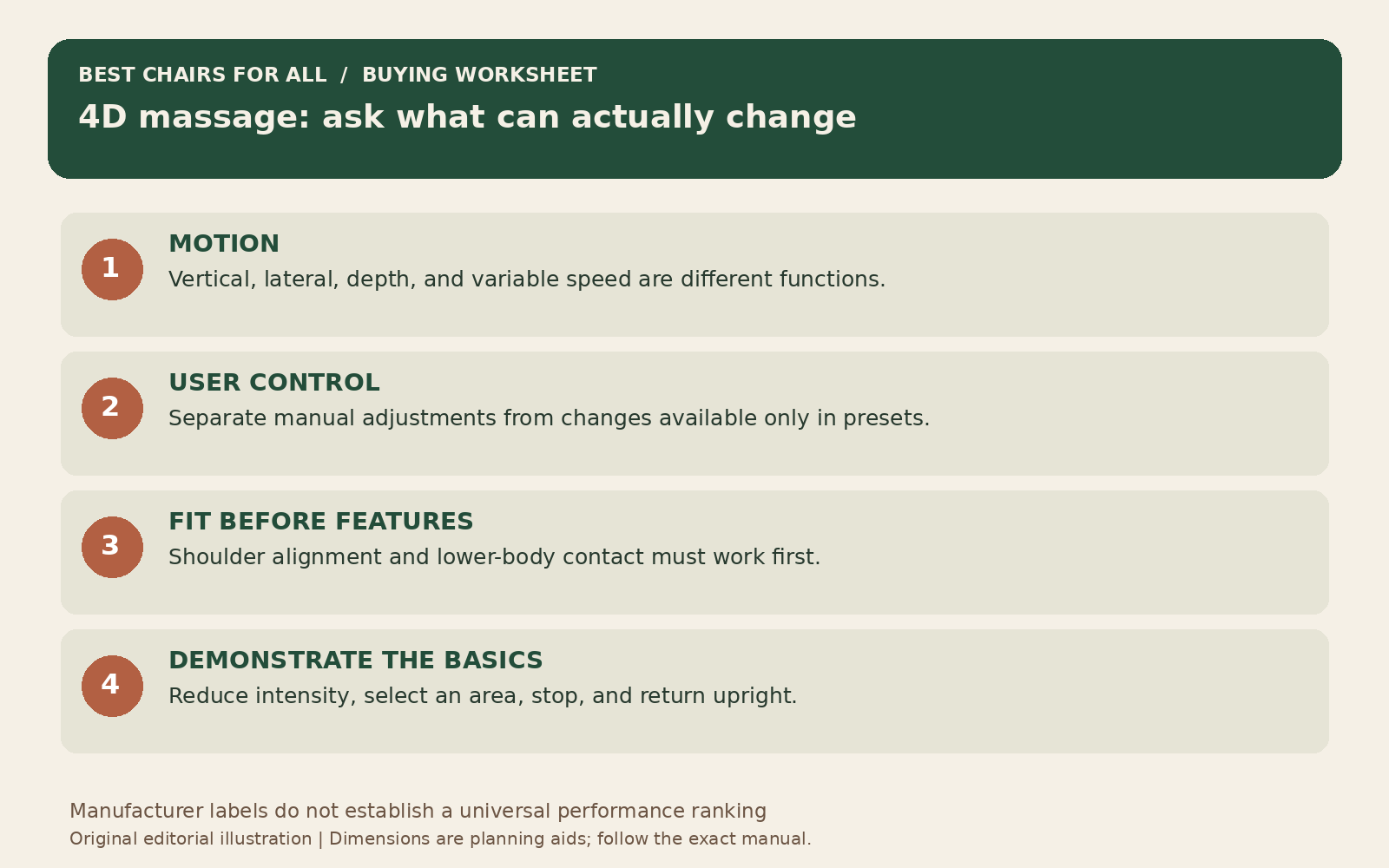
First, what physical motion is being described: vertical travel, lateral width, depth adjustment, or changing speed? Second, which of those the user can adjust independently? Third, which adjustments are available only inside an automatic program? Fourth, how does the chair align the mechanism to the body before those motions begin? These questions translate a broad label into information relevant to the person using the chair.
A chair can offer variable-speed automatic routines while providing a more limited manual mode. Another may use 4D in its mechanism description without documenting the same timing behavior in a comparable way. Neither situation proves a defect, but it prevents a simple feature-count ranking. Ask for the exact manual section and a demonstration of the control you actually intend to use.
Do not confuse depth adjustment with a measured pressure value. The force a user feels can depend on body position, supplied padding, recline, and the mechanism’s movement. We have not measured forces for these chairs. A claim that rollers extend a certain distance cannot be converted into an objective intensity score or a treatment recommendation without further evidence.
A controlled demonstration card
Use one approved starting configuration and a mild program. Record whether the shoulders align, whether the back remains supported, and whether the calf and foot sections fit. Only once that setup works should you compare the permitted roller controls. Changing posture between chairs or deliberately bracing against a mechanism makes the comparison less useful and can conflict with the instructions.
Create four rows on the card: roller depth or intensity, speed or rhythm, width or focus, and air pressure. For each, write separately adjustable, program-controlled, unavailable, or not confirmed. Ask the demonstrator to show the relevant control while keeping the other approved settings as consistent as the model allows. Do not force an unsupported combination simply to make every row look comparable.
Then repeat the same ordinary tasks: lower the intensity, select a different permitted area, switch heat off, stop the program, and return upright. These practical controls can matter more than the peak advertised setting. A variable-speed program is not useful if you cannot make its starting sensation comfortable or easily stop it. Keep comfort impressions personal rather than presenting them as universal laboratory findings.
For a shared chair, reset and repeat the process for the other intended adult. The same program can interact differently with another person’s shoulder height or seat position. Check whether the chair remembers the last user’s settings and how those are cleared. A saved favorite can be convenient, but it does not remove the need to check alignment and pressure when another person uses the chair.
Avoid paying for a label you do not need
The price gaps in this shortlist are substantial: PS6500’s observed $2,599.99, Novo Flex’s $7,999, and Super Novo 2.0’s $10,999. These are different complete products rather than a controlled price ladder for one extra motion axis. Track flexibility, heating, controller design, delivery, warranty structure, and brand support all differ. Decide which verified features account for the extra spending in your particular purchase.
If you prefer a basic repeatable massage routine, an appropriate lower-priced chair may be sufficient even if another product advertises more dimensions or intelligent programs. If a specific premium control makes the experience easier for you, that can be a valid reason to pay more. The decision should be explainable through a demonstrated feature, not an assumption that a larger number always represents a better mechanism.
Crossed-out prices also need caution. A large discount from an asserted list price does not establish a historical transaction saving, and a long program list does not establish distinct useful experiences. Compare the exact current payable total and the settings you will actually use. We have not verified a universal industry performance benchmark that makes every 4D chair directly equivalent.
Installation and support remain part of the technology purchase
A sophisticated controller cannot solve a room or delivery mismatch. These models have reclined lengths around 74 inches and substantial weights. Obtain the current shipping package dimensions and approved installation procedure for the exact model, measure door openings and turns, and confirm the delivery team’s responsibilities. Do not plan powered disassembly to make a chair fit through an uncertain doorway.
Keep written warranty details by component and year, including parts, labor, in-home service, travel, and transport where applicable. Ask who performs service if a controller or actuator fails and whether buying from the selected seller affects coverage. We do not predict response quality from the headline warranty length. Also confirm the oversized-return costs before treating a purchase as an easy home trial.
Use only the model’s approved operation, time limits, and cleaning method. Stop on abnormal discomfort or operation, and contact authorized service if a cord, cover, or mechanism is damaged. A 4D label does not establish medical suitability or treatment benefit. If pressure, heat, or reclining is uncertain because of an individual health concern, obtain qualified advice using the exact product manual.
The 4D buying decision
Start with Super Novo 2.0 when clearly documented variable-speed programs are the priority, Novo Flex when its flexible track and alternate recline are also valuable, or PS6500 when you want to evaluate the advertised mechanism at the lower observed price. Check the current CPSC recall database, exact current version, stock, and complete delivered offer. Buy the chair whose controls, body alignment, and ownership terms work for you, with the 4D label serving as a starting question rather than the final answer.
Something unclear or out of date? Send a correction with this article’s title and the detail to check.
Sources, research & corrections policy ↗