As an Amazon Associate, we earn from qualifying purchases. Read our affiliate disclosure.
The best massage chair for home should work as furniture between sessions as well as provide the functions you actually want during a session. Start with Human Touch WholeBody 7.1 if you prefer an open chair and a shorter operating length. Compare Real Relax PS5200 for a more enclosed SL-track feature set at a lower observed price. Investigate Human Touch Novo Flex if a premium flexible-track chair, heated leg section, and flat-recline option justify a much larger budget and footprint.
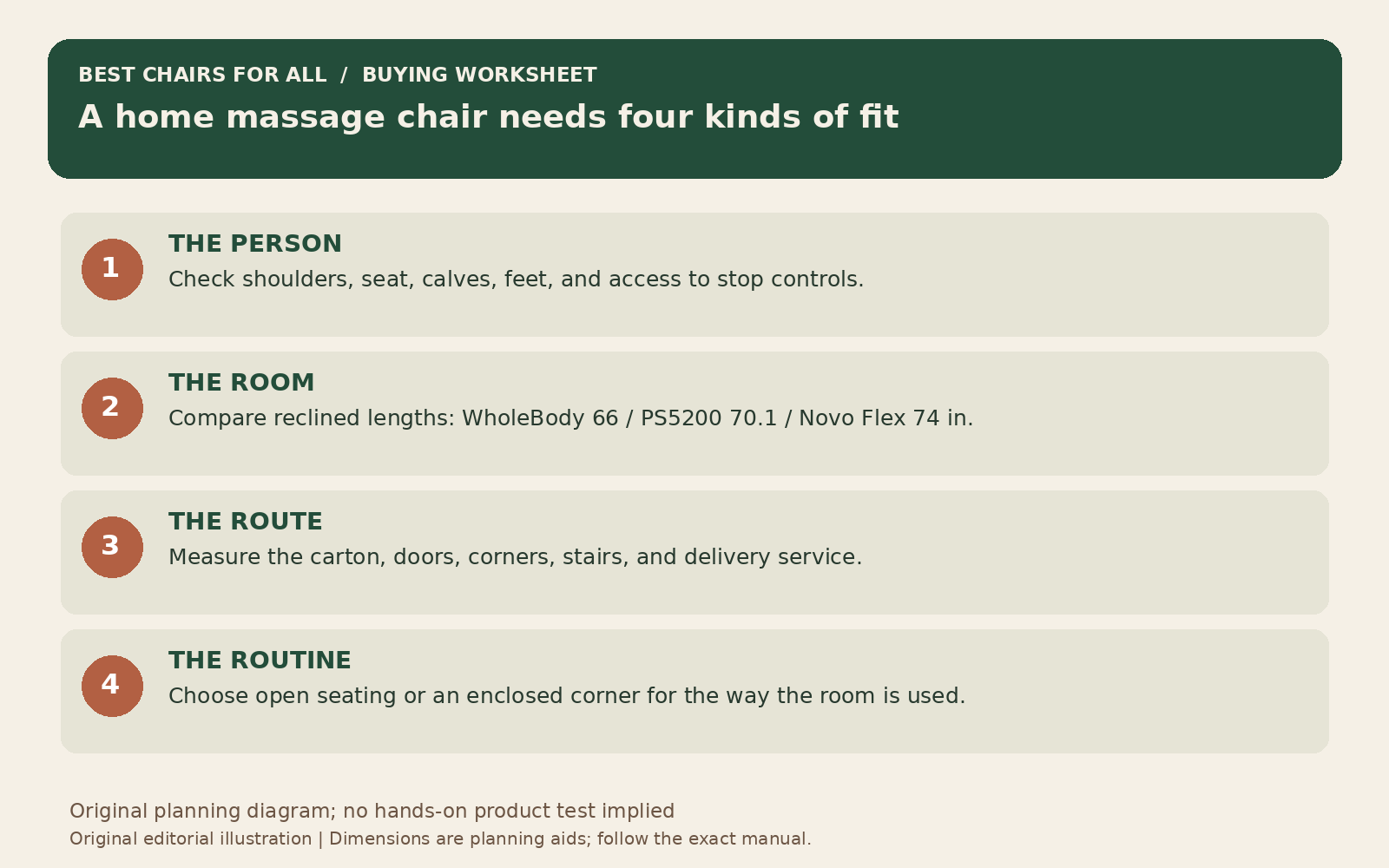
These are three different home-use approaches, not a claim that one chair fits every household. We checked current manufacturer specifications, linked instructions, and price and availability information on November 6, 2026. We have not tested the chairs in a home. This guide supplies a room-and-routine worksheet so you can decide which tradeoff is acceptable before arranging a heavy delivery.
A useful home shortlist
| Chair | Upright size | Reclined size | Observed base price |
|---|---|---|---|
| Human Touch WholeBody 7.1 | 44 L × 28 W × 40 H in | 66 L × 28 W × 29 H in | $2,699 |
| Real Relax PS5200 Black | 57.5 D × 29.1 W × 44.5 H in | 70.1 D × 29.1 W × 38.6 H in | $1,799.99 |
| Human Touch Novo Flex | 63 L × 34 W × 47 H in | 74 L × 34 W × 33 H in | $7,999 |
WholeBody 7.1: a more open living-room chair
The WholeBody 7.1 is the first candidate to investigate when you want the chair to look and feel less like an enclosed capsule. Human Touch publishes a 21-inch-wide, 18-inch-deep seat at a 19-inch height, with open arms and a swiveling base. Its 114-pound weight is still significant furniture, but lower than the other two candidates. The manufacturer listing showed $2,699 and an available cart during research.
Its operating dimensions are 44 by 28 by 40 inches upright and 66 by 28 by 29 inches reclined, with nine inches of rear clearance separately specified. The FlexGlide mechanism, five automatic programs, BodyMap controls, warm-air feature, and retractable foot-and-calf unit create a different feature balance from an SL-track enclosure. Do not assume the open design includes enclosed arm compression or continuous rollers into every area described in a full-body advertisement.
This makes sense for a shared living room where a more open seat, relatively short operating length, and straightforward controls are priorities. It is less useful if your main requirement is an SL-track extending under the seat, zero-gravity positioning, or a deeply enclosed shoulder-and-arm system. Check how the rotating foot-and-calf unit works using the current model-specific manual; it has distinct locking and positioning instructions, so a generic recliner demonstration is insufficient.
PS5200 Black: more functions in a compact-width enclosure
The PS5200 Black page showed $1,799.99 with an active purchase option. It lists a 4D massage mechanism, SL-track, two zero-gravity settings, 20 automatic programs, foot rollers, lumbar heat, and separate massage and air-pressure adjustments. The point of considering it at home is whether that enclosed feature set provides the type of coverage and control you want, rather than whether a specification list is longer.
Its published upright size is 57.5 by 29.1 by 44.5 inches, increasing to 70.1 by 29.1 by 38.6 inches reclined. Net weight is 174.2 pounds. The narrower width compared with Novo Flex may help in some rooms, but the footrest still needs its full movement area. Obtain the correct model-specific rear-clearance and installation directions before marking its location. Current and older official fit ranges disagree, so confirm the exact version if a user is near a listed height limit.
PS5200 is worth investigating for a dedicated relaxation corner where moving-track coverage and adjustable pressure matter more than an ordinary armchair silhouette. It is less attractive when an enclosed seat feels restrictive or the household will not use its controls. Marketing terms such as anion or aromatherapy are not established reasons to choose it, and we do not repeat seller health claims as facts. Ask for a demonstration of the basic stop, intensity, area, heat, and upright controls before deciding that more technology makes home use easier.
Novo Flex: premium functions need a dedicated place
The Novo Flex manufacturer listing showed $7,999 and an active cart. It lists an HT Flex S-and-L-track system, 16 automatic programs, heated extending foot-and-calf massager, dual-lumbar heat, memory functions, and a Horizon Rest flat-recline option. Human Touch describes both 3D and 4D programs; the distinction concerns movement control rather than a medical benefit. Its premium features should be evaluated for your preferences, not assumed to outperform every cheaper model in comfort.
The chair measures 63 by 34 by 47 inches upright and 74 by 34 by 33 inches reclined, with eight inches of rear clearance. It weighs 282 pounds and has a 285-pound maximum load. The seat is 21 inches wide, 16 deep, and 21 high. Those inner dimensions differ from the chair’s substantial outer shell; a large-looking product is not automatically a deep or wide seat for every user.
Investigate Novo Flex when the flexible track, leg heating, and flatter positioning are specific priorities and the room can accept the chair permanently. It is a weak fit for a modest budget, a narrow delivery route, or a household seeking an occasional-use armchair. Flat recline also must not be confused with a bed or a recommendation to sleep during a powered session. Compare the actual controls and the complete delivery arrangement before deciding that its premium features suit your home.
The household routine map
Write down when the chair would be used, by whom, and what happens in the room at the same time. A chair beside a television may share the space with conversation; a chair in a quiet study may be easier to use without interruption. Speakers, fans, motors, and voice prompts can matter in that setting, but we have not measured their noise. Ask for a demonstration in a comparable environment rather than accepting a generic quiet-operation claim.
For two users, record both people’s standing height, sitting proportions, and preferred pressure. Do not assume a single scan or saved program will suit both. Ask how to reset the shoulder position, adjust the leg section, and lower the air pressure. If one person needs help to operate the controls, include that reality in the buying decision rather than treating app connectivity as a cure for a complicated interface.
Then record what the chair must do between sessions. Does it remain visually prominent in the main room? Must a dining chair pass beside it? Will an ottoman or footrest obstruct a route? WholeBody’s open design may suit one household, while another welcomes an enclosed chair in a dedicated corner. Those preferences are legitimate buying criteria independent of roller specifications.
A worked room measurement
Suppose the clear usable floor rectangle is 78 inches long by 38 inches wide. WholeBody’s published reclined 66-by-28-inch body leaves 12 inches of length and ten inches of width overall; PS5200’s 70.1-by-29.1 leaves 7.9 inches and 8.9 inches; Novo Flex’s 74-by-34 leaves four inches in each direction. These are bare arithmetic margins, not approvals for installation.
Each chair still needs the maker’s required placement clearance, safe movement area, entry and exit space, and access to the controls and power connection. A small remaining margin can be consumed by a skirting board, curtain, side table, or the actual recline path. WholeBody and Novo Flex separately list nine- and eight-inch rear clearances; ask how those are measured relative to the chair placement instead of blindly adding or subtracting them from the operating dimensions.
Tape the relevant outlines on the floor and rehearse the room with nearby doors and drawers open. A chair that fits geometrically can still leave no comfortable approach. Keep the entire moving envelope clear of children and pets. If the household cannot preserve that area during use, relocate the chair or reconsider the purchase rather than relying on someone to notice every movement at the last moment.
Delivery is part of fitting the home
Measure the narrowest clear door opening, tight turns, stairs, and the shipping-carton route separately. A product’s assembled width does not prove the carton will pass through. Novo Flex’s 282-pound published chair weight is a particularly strong reason to resolve inside placement and handling before delivery day. Do not plan to solve an uncertain route by taking apart powered internals.
Ask where the standard service leaves the chair and what an inside-delivery upgrade actually includes. Human Touch’s checked pages describe front-door first-floor delivery as standard and paid white-glove options with specific first-floor placement and assembly terms. A top-floor flat or a narrow staircase needs a separate written answer. Confirm packaging removal and whether you should retain cartons for a potential return.
Once delivered, inspect condition, model identity, and supplied parts before discarding paperwork. Assemble only as instructed, photograph the label, and retain proof of purchase. If the delivered unit differs from the listing or has damaged upholstery near the mechanism, contact the seller before use. Heavy furniture is easier to assess while delivery records and packaging are still available.
A home demonstration should answer practical questions
Try a mild setting first and check whether the rollers land where intended. Confirm that feet and calves can sit in the designed supports without forcing a position, and that the hands can reach the stop and upright controls. For shared use, each adult should run through the same checks. A short enjoyable session does not establish clinical suitability, durability, or a reliable decade of ownership.
Review the exact manual’s limits and warnings, particularly those concerning pressure, heat, power, and any relevant health condition. These chairs are consumer relaxation furniture; they do not diagnose or treat a disease because a preset has a medical-sounding name. Seek individualized professional advice where a health concern makes the manual’s suitability unclear, and stop use if the chair causes abnormal discomfort.
Plan upkeep by model rather than by generic upholstery advice. The powered components need the correct electrical precautions, and the covers have material-specific cleaning instructions. Keep pet claws, sharp objects, spills, and blocked air openings away from the chair. A fault is a reason to contact authorized support, not to open the mechanism or bypass a sensor.
Choose the home arrangement before the model
Investigate WholeBody 7.1 for an open living-room form, PS5200 for an enclosed moving-track feature set at the observed lower price, or Novo Flex for specific premium functions in a dedicated space. Check the current CPSC recall database and manufacturer notices, selected-color stock, delivered total, and written return terms before purchase. A chair belongs on your shortlist only after its users, operating footprint, delivery route, and day-to-day place in the home all make sense.
Something unclear or out of date? Send a correction with this article’s title and the detail to check.
Sources, research & corrections policy ↗