As an Amazon Associate, we earn from qualifying purchases. Read our affiliate disclosure. Amazon buttons search for matching listings; they do not confirm the exact model, seller, price, or stock.
The best adjustable bar stool is one whose permitted seat-height range contains the positions your household actually needs, while its seat and footrest fit the users. IKEA JANINGE offers a broad lower range with a scooped seat. IKEA DALFRED provides a threaded-column, round-seat format. West Elm Work Kent is the larger padded backed option with a higher range. Adjustment is their shared feature; they are otherwise quite different furniture.
We researched current manufacturer information online on November 6, 2026. We have not tested adjustment smoothness, sitting comfort, or the mechanisms. No DIY lift servicing or disassembly is recommended. Current price and availability need checking at the actual seller, and this guide makes no hard budget claim.
Start with required positions, not maximum height
A maximum-height number is only useful if the rest of the range works. A household sharing one counter may need a small difference between users. A room with two surfaces may need a larger change. List those uses separately and determine the desired positions through a suitable trial, rather than guessing that the tallest adjustment is the most versatile.
Adjustment also cannot fix every mismatch. Changing the seat height can alter the relationship to a fixed footrest, the counter underside, and the floor. A stool may reach the desired number while leaving the user unable to sit comfortably. Seat depth and width remain fixed on these candidates. Think of height adjustment as one variable inside a complete fitting problem.
Verify the exact variants in the manufacturer references: IKEA JANINGE bar stool, white, adjustable; IKEA DALFRED bar stool, black; West Elm Work Kent height-adjustable stool, armless. Specifications were checked November 6, 2026.
1. IKEA JANINGE bar stool, white, adjustable
Best for: Broad lower-range candidate.
JANINGE deserves the first range check when the household needs positions below 25 inches. Its scooped seat and compact base create a different brief from a padded backed stool.
The current maker range is 22 to 29 7/8 inches at the seat, with a 16 1/2-inch base diameter. IKEA describes one-hand height adjustment; follow the supplied operating instructions.
Product Details
| Brand | IKEA |
|---|---|
| Overall dimensions | 15 W × 14 1/8 D × 33 1/8 H in; base diameter 16 1/2 in |
| Seat height | 22–29 7/8 in |
| Manufacturer load wording | 243 lb tested |
| Materials | Reinforced polypropylene seat; steel base; metal footrest |
Pros
- Lowest minimum in this shortlist
- Clearly published minimum and maximum
Cons
- Scooped format lacks a substantial upholstered back
- 243-pound test figure is a selection limit
Trial both required settings with the feet in their normal resting position.
2. IKEA DALFRED bar stool, black
Best for: Threaded round-seat candidate.
DALFRED is useful for a buyer who intentionally wants a small round sitting surface and a threaded-column format. Its broad base should not be mistaken for a broad seat.
IKEA lists 24 3/4 to 29 1/8 inches of seat height and an 11 3/4-inch seat diameter. The 19 5/8-inch overall width and depth describe the furniture footprint.
Product Details
| Brand | IKEA |
|---|---|
| Overall dimensions | 19 5/8 W × 19 5/8 D in; seat diameter 11 3/4 in |
| Seat height | 24 3/4–29 1/8 in |
| Manufacturer load wording | 220 lb tested |
| Materials | Birch frame; steel footrest and threaded column |
Pros
- Construction identifies a threaded column
- Narrower range may suffice for a specific fixed brief
Cons
- Small seat is unsuitable for many sitting preferences
- 220-pound tested figure is the lowest here
Compare the actual sitting surface before choosing it for more than an occasional perch.
3. West Elm Work Kent height-adjustable stool, armless
Best for: Higher padded-backed candidate.
The armless Kent offers the highest useful range here and a much larger upholstered seat-and-back format. It is closer in scale to a work-style chair than a small kitchen perch.
West Elm lists a 25- to 32-inch seat range, 18-inch seat width, 19-inch seat depth, and 275-pound capacity. Preserve the armless configuration when comparing the quoted dimensions.
Product Details
| Brand | West Elm |
|---|---|
| Overall dimensions | 25.5 W × 27 D × 38.3–45.8 H in |
| Seat height | 25–32 in |
| Manufacturer load wording | 275 lb stated capacity |
| Materials | Bent plywood; polyurethane foam; powder-coated steel five-star base |
Pros
- Range reaches 32 inches
- Seat width and depth are explicitly published
Cons
- Large footprint needs more room than the two IKEA stools
- Cannot reach the lower settings offered by JANINGE
Choose it when both its higher range and larger sitting geometry are required.
Our range-overlap worksheet
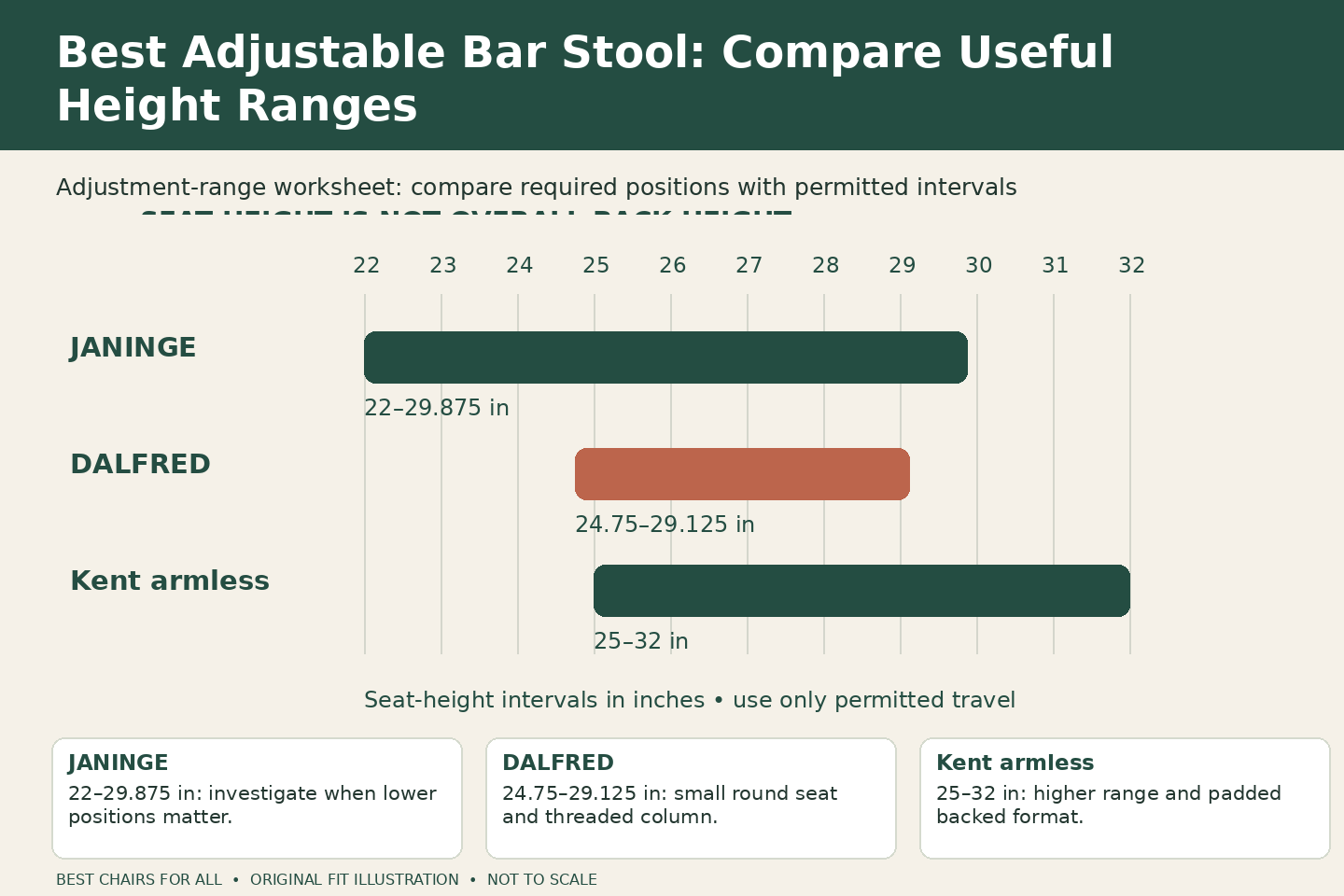
Draw a horizontal scale and mark the seat heights you need. Use only positions established through a realistic fitting trial or appropriate guidance for the person. Then draw the manufacturer’s minimum-to-maximum interval for each candidate. A model remains on the shortlist only if its permitted range includes every essential position. Do not extend a range because a threaded or lift mechanism appears to have more travel.
JANINGE lists 22 to 29 7/8 inches, DALFRED 24 3/4 to 29 1/8 inches, and Kent 25 to 32 inches. The differences are substantial. JANINGE reaches lower than the other two, while Kent reaches higher. DALFRED’s narrower interval may be perfectly sufficient for a fixed household need, but it should not be described as offering the same range as the others.
For a worked example, suppose a household’s established useful positions are 24.5 and 28.5 inches. JANINGE includes both. DALFRED starts at 24.75, so it does not include the lower position. Kent starts at 25, so it also misses that position. The result is an evidence-based rejection of two products for this particular brief, not a claim that either is a poor stool generally.
Now change the hypothetical positions to 26 and 31 inches. Kent includes both; JANINGE and DALFRED do not reach 31. This reversal demonstrates why the worksheet is more informative than a generic best-overall ranking. The useful range depends on the actual needs, and a mechanism outside its permitted range is not an acceptable workaround.
Keep a separate line for the surface underside and any bracket at each position. A desired seat height that leaves inadequate usable thigh space is not a valid requirement simply because it appears on the range drawing. Recheck the complete seated relationship before treating a number as the final target. The worksheet screens adjustment capability after the fitting problem has been understood.
Range width does not describe the seat
DALFRED’s seat diameter is listed at 11 3/4 inches, while the overall base is 19 5/8 inches in width and depth. That is a small round sitting surface on a much broader footprint. A buyer reading only the outer width could expect far more seat room than the product provides. Compare the seat itself with the person and intended duration of use.
JANINGE’s scooped reinforced-polypropylene seat offers a different contact shape and a pedestal-base format. Its published width and depth are not a padded chair-like enclosure. It can be a sensible choice when that format is intentionally preferred, but it should not be sold as a substitute for someone who specifically wants a substantial backrest or arms.
Kent is much larger: the armless listing gives a 25.5-inch overall width and 27-inch depth, with an 18-inch seat width and 19-inch seat depth. That creates a different sitting and room-space proposition. It may appeal to someone seeking a padded back and longer sitting surface, while being excessive for a tight breakfast bar. Adjustment does not make its footprint disappear.
Threaded adjustment and lever adjustment
DALFRED’s construction includes a threaded column. That is a different user interaction from JANINGE’s one-hand adjustment described by IKEA. Read the supplied instructions for how the selected model should be adjusted and whether the person should be seated or unloaded during that action. We do not invent operating steps from a product photograph or turn-count assumptions.
Consider who changes the height and how often. A stool used in one position daily with an occasional change has a different brief from a seat adjusted between several users at every meal. Ease of use needs a personal trial, not a promise that one mechanism type is always easier. If a control is difficult for a user to reach or operate, choose a different arrangement rather than modifying it.
Kent’s maker establishes a 25- to 32-inch adjustment range, but a specification sheet does not show how a particular user will find the control. Trial the exact model where possible. Keep the armed and armless versions distinct; the armed version adds a moving arm-height range that can meet a surface. This guide selects the armless configuration to avoid implying that all Kent versions have the same clearance requirements.
Footrest relationships at two positions
Test the stool at both ends of the useful range, not only in the middle. At each position, check whether feet have a comfortable place while the back or intended sitting surface is used. A footrest can move with the seat assembly or remain attached to another part of the structure depending on the design. Establish the actual behavior from the model and instructions rather than assuming it from the category.
If footrest dimensions are missing, ask for them. A range chart can look perfect while the feet cannot rest comfortably at one required setting. Do not solve that with an unstable box, a loose stack of objects, or a modification to the base. Choose an appropriate product or a lower seating arrangement if the complete fit cannot be established.
Check getting on and off at the highest required position as well. A tall stool may require a movement that one user finds inconvenient. Adjustment is not a universal accessibility solution, and ordinary stool loading figures do not establish suitability for transfers. Individual support needs should be assessed separately from a furniture catalogue comparison.
Floor plan for an adjustable stool
Draw the largest relevant outline, including the base and any back or arms in motion. DALFRED’s small seat can obscure how much room its broad base occupies. JANINGE’s listed base diameter is 16 1/2 inches. Kent’s five-star base and chair body call for a more generous plan. The seat width alone does not tell you where feet or neighboring furniture can collide.
Then test the ordinary routes behind and beside the stool. A high setting may leave more of the seat or back above the counter, changing the parked view. At a shared island, controls should remain accessible without reaching into a cramped gap between bases. These are practical layout questions rather than reasons to choose a particular adjustment technology.
If two stools must sit close together, compare them with users present and height changes completed in the intended manner. Keep fingers and clothing clear of moving parts as the maker directs. Do not deliberately create pinch points to evaluate a mechanism. A normal controlled trial is enough to identify whether the setup is awkward.
Loading, care, and mechanism problems
IKEA lists JANINGE at 243 pounds tested and DALFRED at 220 pounds tested; West Elm lists Kent at 275 pounds capacity. These figures differ, and the makers’ wording should remain visible. A product outside the required loading brief should be removed from consideration even if its range is ideal. Overall size is not evidence of a higher rating.
Follow material-specific cleaning guidance and the supplied hardware checks. JANINGE and DALFRED’s current care pages call for a mild soapy solution and drying. Kent’s selected upholstery needs the relevant maker label rather than an assumed universal fabric cleaner. Keep liquids away from areas where the instructions do not permit them and contact the supplier about unfamiliar stains or faults.
If a stool drops unexpectedly, no longer holds a selected position, binds, or develops significant looseness, stop using it and contact the seller or maker. Do not open a sealed lift or improvise a repair to a height mechanism. The buying decision should include a realistic support and return route, particularly if multiple people will depend on the adjustment each day.
Pick the useful interval and the right seat
JANINGE is the first range comparison when lower positions matter and a scooped seat fits. DALFRED is a narrower-range, small round-seat option when its threaded adjustment and footprint suit a deliberate perch. Kent is the larger padded backed candidate when higher positions up to 32 inches are needed and the room can accept its size.
Keep both the range chart and the footrest trial in the decision. An adjustable stool earns its flexibility by providing several genuinely usable settings within the maker’s limits, rather than merely having the longest-looking column or the largest maximum number.
Something unclear or out of date? Send a correction with this article’s title and the detail to check.
Sources, research & corrections policy ↗