An age recommendation and a weight rating answer different questions. Read both for the exact children’s chair, then check intended use, physical fit and condition. Being below a listed weight does not override a minimum age, and reaching the recommended age does not authorize exceeding a stated load limit.
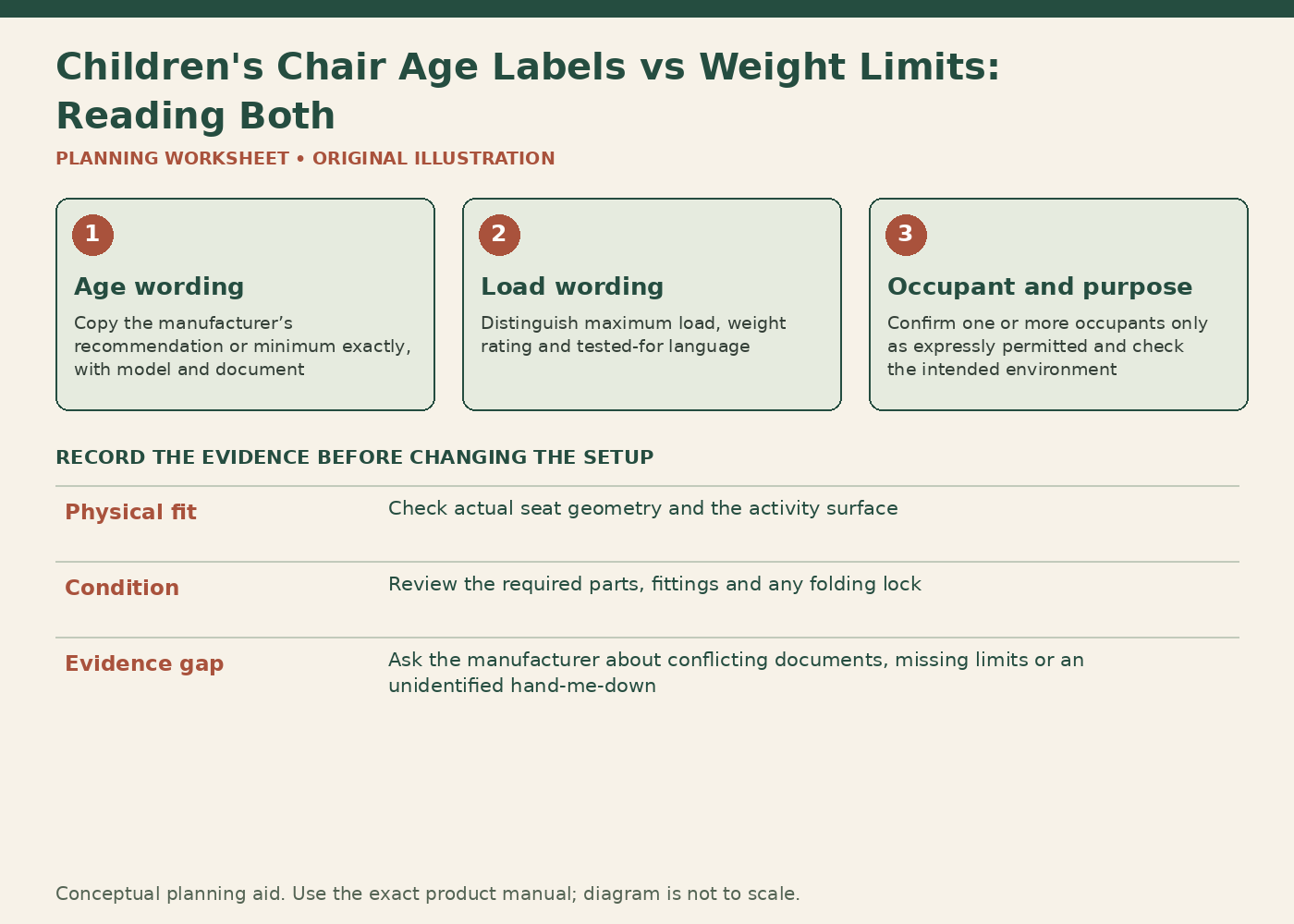
Separate four labels that are often blended together
Create separate fields for minimum or recommended age, maximum occupant weight, intended activity and any size or ability requirement. A product page may use “recommended,” “tested for,” “maximum load” or “weight rating.” Preserve that wording instead of silently treating every number as the same type of limit. Ask the manufacturer when the instructions and listing are unclear.
An age range can reflect the product’s intended user and hazards or the dimensions for which it was designed. A load rating concerns the use described by the manufacturer. Neither tells you that the chair is comfortable, complete or properly assembled. The practical decision requires all relevant conditions to be satisfied at the same time, rather than choosing whichever label makes a desired purchase seem acceptable.
A real example shows why age and weight remain separate
Melissa & Doug’s Wooden Chair Pair, White page identifies the product as three years and older, gives an 11-inch seat height and states a 100-pound weight rating. It also describes testing above the rated weight. The rated figure remains the figure to use; the described test load is not permission for a heavier occupant or home overload testing.
Keep the age and weight entries on different lines. A smaller younger child below the weight rating has not thereby met the age recommendation. An older person weighing more than the rating has not gained permission because the chair appears sturdy. For another model from the same brand, obtain its own specifications. A similar finish or a matching activity table does not establish identical limits.
Do not turn “tested for” into a new promise
The IKEA USA ÖRFJÄLL child’s desk chair listing uses “Tested for: 243 lb” while separately recommending that model for children eight years and older. That language should be reported as written. It does not establish the permitted use of another chair, make the eight-year recommendation irrelevant or mean that a child of any size will fit the seat.
When a marketplace changes a manufacturer’s “tested for” field into “maximum capacity,” go back to the manufacturer’s current page and manual. Ask for clarification if the practical allowable load remains uncertain. Avoid calculating your own safety factor from a test statement or assuming any extra margin authorizes jumping, two occupants or other loads outside intended sitting use. A controlled test and everyday instructions are different kinds of evidence.
Find the manual that matches the product in front of you
The IKEA MAMMUT advice document recommends that chair for children between three and seven years old and includes placement and inspection warnings. Older catalogs and current accessory listings may show different age wording, which is why a remembered range is weaker evidence than a matching current instruction. Preserve the model or article number and document revision.
An age label is also not a lifespan guarantee. A chair can become unsuitable before the child reaches the upper suggested age if it no longer fits, is damaged or is used for a different activity. Conversely, do not extend use beyond a stated restriction because the child still likes it. Contact the manufacturer when an older hand-me-down cannot be positively identified or its instructions are missing.
Check size and the activity independently
Seat height, depth, width and the relationship to the table determine whether the child can use the intended activity area comfortably. A child within both age and weight criteria can still find a seat too deep or a desk too high. Check the actual seated arrangement without forcing an exact body position from a generic chart. Special support needs or persistent discomfort warrant appropriate professional advice.
A low playroom chair is not automatically suitable as a booster on another chair, an outdoor seat, a bath chair or a step. Read the intended environment and purpose. Do not use the load rating to justify placing it on a raised surface. A product rated for sitting on a floor does not acquire permission for an entirely different support arrangement because its frame can hold the user’s weight.
Treat multiple occupants and movement as new loads
Unless the manufacturer specifically permits it, do not have two children share a one-person chair or let an adult sit with a child on the seat. Adding the two body weights and staying below a number does not establish the intended arrangement. Distribution, movement, the usable surface and the chair’s stability also matter. Keep climbing, jumping and standing outside ordinary sitting use.
For folding chairs, use the exact opening and locking directions and keep children clear while the chair is folded or adjusted. CPSC’s children’s folding-chair guidance addresses hazards including pinching, finger injuries and tip-overs; it does not provide a universal capacity for every small chair. Do not defeat a lock or replace a fastener to make a chair easier for the child to fold themselves.
Condition can end use before either label is reached
Inspect the model’s specified joints, feet, locks and seat components. Stop for broken or missing parts, a cracked support, unexpectedly loose hardware or a mechanism that cannot be secured. A chair does not remain acceptable simply because the child weighs less than its rating. Use manufacturer-approved replacement parts and the stated assembly method. Avoid glue, extra screws or a generic replacement foot as an unverified structural repair.
When passing the chair to another household, pass the actual limits and document with it. Record the model and any approved part replacement. Remove a damaged or recalled product from use according to the appropriate official instructions instead of describing it as “fine for a lighter toddler.” Reducing the occupant weight is not a remedy for an unresolved defect.
Write a clear purchasing decision
A useful record can fit on a small card: exact product identity, the age wording, the load wording, intended setting, fit observations and unresolved questions. Put the original units beside any conversion. If a retailer and manufacturer disagree, keep the discrepancy visible until it is resolved. Do not select the larger number or broader age range because it extends the product’s apparent value.
For a sibling handoff, assess the new user rather than inheriting the previous child’s conclusion. A younger sibling can be taller but still outside the product’s stated age range, while an older child can outgrow the physical seat without exceeding a weight rating. The card makes these distinctions easy to discuss without turning every mismatch into a claim that the product itself is defective.
Children’s chair label-reading card
| Check | Evidence and decision |
|---|---|
| Age wording | Copy the manufacturer’s recommendation or minimum exactly, with model and document. Do not replace it with a retailer’s broad age category. Being lightweight does not answer an age restriction. |
| Load wording | Distinguish maximum load, weight rating and tested-for language. Record the stated use and units. Do not multiply a rating by a claimed test factor or treat test loading as permission for everyday overload. |
| Occupant and purpose | Confirm one or more occupants only as expressly permitted and check the intended environment. Adding two weights is not a method for approving a shared seat. A floor chair is not automatically a booster or step. |
| Physical fit | Check actual seat geometry and the activity surface. Note the child’s experience and any special support needs. Age and weight eligibility do not prove the chair fits the desk or the child. |
| Condition | Review the required parts, fittings and any folding lock. Remove damaged or incomplete furniture from use. A smaller occupant is not an approved repair for cracks, loose joints or a recalled mechanism. |
| Evidence gap | Ask the manufacturer about conflicting documents, missing limits or an unidentified hand-me-down. Save the response with the label photograph. A blank field is a reason to clarify, not permission to invent a capacity. |
Worked example
A hypothetical chair is labeled for ages three and older with a 100-pound rating. A two-year-old weighs 30 pounds. The weight comparison passes one numerical condition but does not override the age wording. A 110-pound adult also cannot use a claimed 300-pound test load to turn the 100-pound rating into a larger everyday allowance. These are two different errors with the same cause: substituting one field for another.
Now consider an eligible four-year-old who finds the seat too low for the chosen craft table. The chair’s age and load information can both be satisfied while the activity setup remains unsuitable. The family can select a better matched table or an appropriately documented chair rather than raising the existing seat on blocks. The decision card preserves all three results: label eligibility, load wording and observed fit. Passing one does not erase an unresolved requirement elsewhere. Keep any pound-to-kilogram conversion beside the original manufacturer value and avoid rounding upward to create extra capacity. When a chair will be used near a stated upper limit, ask the manufacturer how it defines that limit and which documented configuration it covers. Do not use a conversion discrepancy as a reason to exceed either published instruction.
Sources checked November 6, 2026
Use the current document for the exact model, market and production revision. These sources establish the cited instructions and distinctions; they do not certify an individual chair or replace a personal assessment where one is needed.
- Melissa & Doug: Wooden Chair Pair, White, age and weight rating
- IKEA USA: ÖRFJÄLL child’s desk chair 805.018.85 dimensions and age recommendation
- IKEA USA: MAMMUT children’s chair advice and instructions
- CPSC: Children’s folding chairs and stools
- CPSC recalls and product safety warnings
Something unclear or out of date? Send a correction with this article’s title and the detail to check.
Sources, research & corrections policy ↗