As an Amazon Associate, we earn from qualifying purchases. Read our affiliate disclosure. Amazon buttons search for matching listings; they do not confirm the exact model, seller, price, or stock.
The best counter height chair starts with the height of your actual surface and its underside. Article Svelti counter stool, IKEA ROSENTORP counter-height stool, and IKEA SKOGSTA counter-height stool are three backed choices with distinct seat heights and materials. Svelti gives a molded seat, ROSENTORP a painted cross-back format, and SKOGSTA a solid-acacia spindle design. None should be selected solely because a retailer calls it a kitchen stool.
We checked the exact US manufacturer listings online on November 6, 2026. This guide is based on published specifications and original fit calculations, not hands-on sitting or stability tests. We make no hard price ceiling claim. Confirm the exact counter-height variant, current cost, and delivery terms before ordering; bar-height versions of similar furniture can look almost identical in a product image.
Seat height and overall height are different
The seat height determines where the diner sits. Overall height includes the backrest and tells you more about the chair’s visual presence and possible contact with a counter edge. For example, Svelti’s counter stool is listed at 42.25 inches overall but 25.25 inches at the seat. Confusing those fields can lead to a completely wrong order.
The IKEA models here sit lower: ROSENTORP at 24 3/4 inches and SKOGSTA at 24 3/8 inches. Those are specific current variants, not measurements for every stool sharing the family name. Save the full product number and selected height with the order. A listing with a dropdown for counter or bar height needs the numerical confirmation in the cart, not just a reassuring photograph.
Verify the exact variants in the manufacturer references: IKEA SKOGSTA bar stool with backrest, counter height black; IKEA ROSENTORP bar stool with backrest, counter height/white; Article Svelti counter stool, Pure Black. Specifications were checked November 6, 2026.
1. IKEA SKOGSTA bar stool with backrest, counter height black
Best for: Lower solid-acacia reference.
SKOGSTA is the first comparison here if you prefer exposed acacia and a lower counter-height seat. This is the black model with a backrest, not a backless stool with the same family name.
IKEA lists a 24 3/8-inch seat height and 14 5/8-inch seat depth. Its lacquered acacia construction has specific wiping and hardware-check instructions.
Product Details
| Brand | IKEA |
|---|---|
| Overall dimensions | 16 1/8 W × 18 1/8 D × 35 7/8 H in |
| Seat height | 24 3/8 in |
| Manufacturer load wording | 243 lb tested |
| Materials | Solid acacia; lacquered finish |
Pros
- Lowest published seat height in this shortlist
- Solid-acacia component description is clear
Cons
- Compact seat may not suit a larger sitting preference
- Footrest position needs a personal fit check
Use its exact finish guidance; care instructions for another SKOGSTA item may differ.
2. IKEA ROSENTORP bar stool with backrest, counter height/white
Best for: Painted cross-back reference.
ROSENTORP is the traditional painted option for a counter-height setting. Its narrow outline may help with furniture spacing, but the usable seat must still suit the person.
The seat is listed at 24 3/4 inches high, 15 3/4 inches wide, and 14 1/8 inches deep. The frame is solid wood while the painted seat and back include fiberboard.
Product Details
| Brand | IKEA |
|---|---|
| Overall dimensions | 15 3/4 W × 17 3/4 D × 36 1/4 H in |
| Seat height | 24 3/4 in |
| Manufacturer load wording | 243 lb tested |
| Materials | Solid wood frame; fiberboard seat/back; acrylic paint |
Pros
- Published seat width and depth aid a precise comparison
- Backrest and footrest suit a backed counter-seat brief
Cons
- Narrow and short seat will not fit every diner
- Optional padding changes the sitting height
Confirm counter-height/white product 506.181.94 rather than ordering from appearance alone.
3. Article Svelti counter stool, Pure Black
Best for: Higher molded-seat reference.
Svelti is the higher-seated molded alternative with the deepest published seat in this group. It is useful to trial when a diner prefers that sitting geometry and a contemporary metal base.
Article lists a 25.25-inch seat height, 17-inch seat depth, and 300-pound test figure. Its overall 42.25-inch height includes the back and must not be confused with the seat.
Product Details
| Brand | Article |
|---|---|
| Overall dimensions | 18 W × 20 D × 42.25 H in |
| Seat height | 25.25 in |
| Manufacturer load wording | 300 lb tested |
| Materials | Molded polypropylene/fiberglass; powder-coated metal |
Pros
- Molded seat avoids fixed textile upholstery
- Exact counter version has a documented 300-pound test figure
Cons
- Highest seat leaves less nominal thigh clearance at the same counter
- Overall width does not establish usable seat width
Verify the Counter selection and numerical seat height in the cart before ordering.
Our counter-seat worksheet
Record floor-to-top height, floor-to-lowest-underside height, overhang depth, clear width for seating, and the position of brackets or cabinet panels. Then record the stool’s seat height, usable seat depth and width, overall footprint, and footrest arrangement. If the maker does not publish a critical footrest measurement, ask rather than inventing it from a picture.
Measure at the actual seating positions. An island’s top can overhang farther in one area than another, and a support bracket may hang lower near a planned stool. A counter that looks uninterrupted from above can contain a different obstruction for every diner’s knees. The worksheet should show those differences so one good place does not get mistaken for proof that all places work.
For overhang, measure the useful knee-space depth from the edge toward the nearest obstruction. The nominal countertop size is not the same as available legroom. A thick decorative panel can change how close a person can sit, while the stool back or seat may stop the chair moving inward sooner. Use the entire person-stool-counter combination in the final trial.
Worked height calculation for a hypothetical island
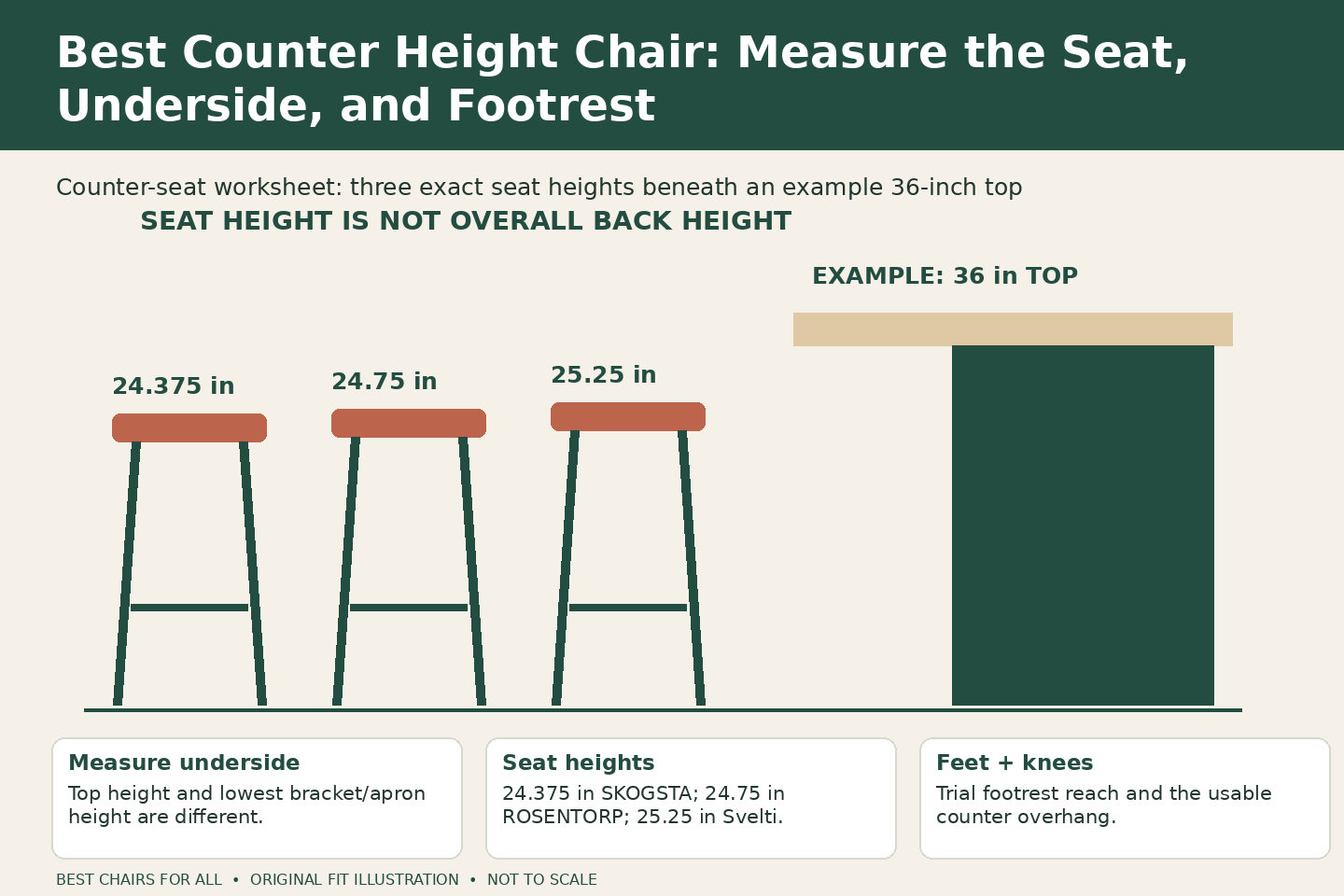
Suppose the top is 36 inches above the floor and its lowest relevant underside is 34.5 inches. Subtract the published seat height from each measurement. SKOGSTA’s 24.375-inch seat leaves 11.625 inches to the top and 10.125 inches to the underside. ROSENTORP’s 24.75-inch seat leaves 11.25 and 9.75 inches. Svelti’s 25.25-inch seat leaves 10.75 and 9.25 inches.
These are arithmetic comparisons, not universal comfort thresholds. They do not account for the person’s thighs, cushion compression, posture, or how far the seat goes beneath the top. Their value is to make the relative difference visible: in this example the highest stool leaves 0.875 inches less vertical room than the lowest. The person still needs to try eating at the actual surface.
Now suppose a bracket drops to 32 inches at one place. Every candidate loses another 2.5 inches of nominal underside space there. A stool that worked at the center may be unsuitable beside that bracket. Moving the seat location or choosing a different arrangement may be necessary. Do not assume a higher countertop top surface cancels a lower obstruction underneath.
Footrest fit belongs in the first trial
At counter height, most adult feet will not use the floor as they do in a dining chair. The footrest’s location and shape therefore matter to ordinary sitting comfort. Check whether you can place the feet comfortably while using the back and approaching the surface. A footrest that looks substantial in the photograph may be in the wrong position for a particular person’s leg length.
Ask for the floor-to-footrest height and its relationship to the seat if those dimensions are not established. Do not use an invented specification merely to complete a comparison table. Try the exact model, or buy with a realistic return option if a personal trial is necessary. We do not rank these three by footrest comfort because no hands-on evidence supports that ranking.
Use the stool in its intended way. A footrest is not automatically a step for climbing, and the back is not a handle for hauling the whole body upward. If getting onto or off a high seat is difficult or requires assistance, a lower dining-height arrangement may be more suitable, with individual advice where needed. A counter stool is ordinary furniture rather than an accessibility aid.
Seat dimensions change the choice
ROSENTORP’s seat is listed at 15 3/4 inches wide and 14 1/8 inches deep. SKOGSTA’s is 16 1/8 inches wide and 14 5/8 inches deep. Svelti lists a 17-inch seat depth, but its 18-inch overall width should not be treated as a verified usable seat width. Keep the fields separate and obtain missing inside measurements if they matter for the diner.
A deeper seat may suit someone who likes more sitting surface, but it can make it harder for another person to use the backrest and footrest together. A shorter seat can simplify reaching the back while feeling too short to a longer-legged user. There is no single counter-stool dimension that establishes comfortable fit for all adults.
The overall footprint matters below as well as above the seat. Splayed legs can meet neighboring stools or island panels when the seats look well separated. Mark the base outline on the floor, then try ordinary entry, foot placement, and departure. The spacing that works with everyone facing forward may change as one diner turns to leave.
How many stools can the counter actually use?
Start with the clear seating run after subtracting end panels, brackets, and unusable corners. Draw each stool’s overall width and leave room to assess elbow movement. For a 60-inch clear run, three 18-inch-wide Svelti frames total 54 inches before any gaps. Three 15 3/4-inch ROSENTORP frames total 47 1/4 inches. The different remaining widths are useful planning facts, not proof of comfortable capacity.
Place ordinary plates and glasses along the run and have the intended diners sit or use a sensible stand-in arrangement. Consider whether a wall at one end restricts movement. It may be more pleasant to use two everyday stools than squeeze in three because the arithmetic technically fits. Keep the occasional guest arrangement separate from the daily one.
Behind the seats, account for a person leaving and for the room’s main circulation route. An island often sits near an appliance or the route between cooking and cleaning areas. Check those functions with the stool occupied and pulled out. Avoid making hot-food carrying part of the experiment; a calm layout trial is enough to reveal overlapping space.
Three materials for three counter settings
Svelti’s molded polypropylene-and-fiberglass seat with coated metal legs suits a contemporary counter and an exposed-surface cleaning preference. Its 300-pound manufacturer test figure differs from the dining-height Svelti’s 225-pound figure, another reason to verify the exact model. Follow the counter version’s care guidance rather than borrowing specifications from the family name.
ROSENTORP has a solid wood frame and painted fiberboard seat and back. It is the cross-back option for someone who wants a traditional painted outline, but it is not all solid wood. IKEA’s directions call for a mild soapy solution and drying, with hardware checks as specified. A pad can change the sitting height and attachment needs, so evaluate the complete arrangement if one is added.
SKOGSTA’s current black counter-height model uses solid acacia and a lacquered finish. Its lower published seat height and compact seat depth make it a different fitting candidate from Svelti, not just a wood alternative with identical proportions. Use the maker’s damp-cloth-and-dry instructions and inspect fastenings as directed. Do not borrow oiling instructions from another SKOGSTA product with a different finish.
Delivery details that prevent the wrong-height order
Check the full model name, product number, color, selected height, quantity, and numerical seat height in the retailer listing. A matching Amazon search can show bar stools, dining chairs, or lookalikes. Compare the actual item to the manufacturer page before relying on a convenient button. Confirm assembly and return terms because a high seat that does not fit the counter is a bulky item to send back.
Inspect the assembled stool on a level surface and address wobble or damaged parts through the supplier. Do not cut legs, add improvised blocks, or modify a footrest to turn the wrong height into the right one. Selecting an appropriate fixed-height model is simpler than changing its intended structure.
Start with SKOGSTA for the lower acacia-seat reference, ROSENTORP for a painted cross-back, or Svelti for a deeper molded seat and a higher sitting position. Let the worksheet and a personal trial determine the final answer. Counter height is a product category; good fit is a relationship among the stool, surface, feet, and person.
Something unclear or out of date? Send a correction with this article’s title and the detail to check.
Sources, research & corrections policy ↗