As an Amazon Associate, we earn from qualifying purchases. Read our affiliate disclosure. Amazon buttons search for matching listings; they do not confirm the exact model, seller, price, or stock.
The best breakfast nook chair is the one that works with the fixed parts of the nook: a banquette or wall, the table base, and the route into the corner. IKEA LISABO is a first candidate for an exposed armless chair at a lower sitting height. Article Nosh offers a padded alternative. Article Sylvo adds a shallow overall profile and documented two-high stacking when occasional chairs need to move. The nook’s geometry should choose the first trial.
We researched the exact US chair models online on November 6, 2026. This is a specification-based buying guide with original layout examples, not physical product testing or custom banquette design. All numerical room examples are hypothetical. Confirm the actual table, bench, and chair measurements before making a purchase or modifying fixed furniture.
Treat the nook as a system
A breakfast nook often combines unlike seats: a fixed bench on one or two sides and loose chairs on the open side. The bench may be unusually deep, high, or padded. The table may be pushed toward the bench, leaving the loose chair on the other side with a different relationship to the edge. A chair that is comfortable at another table can fail here because the fixed geometry is different.
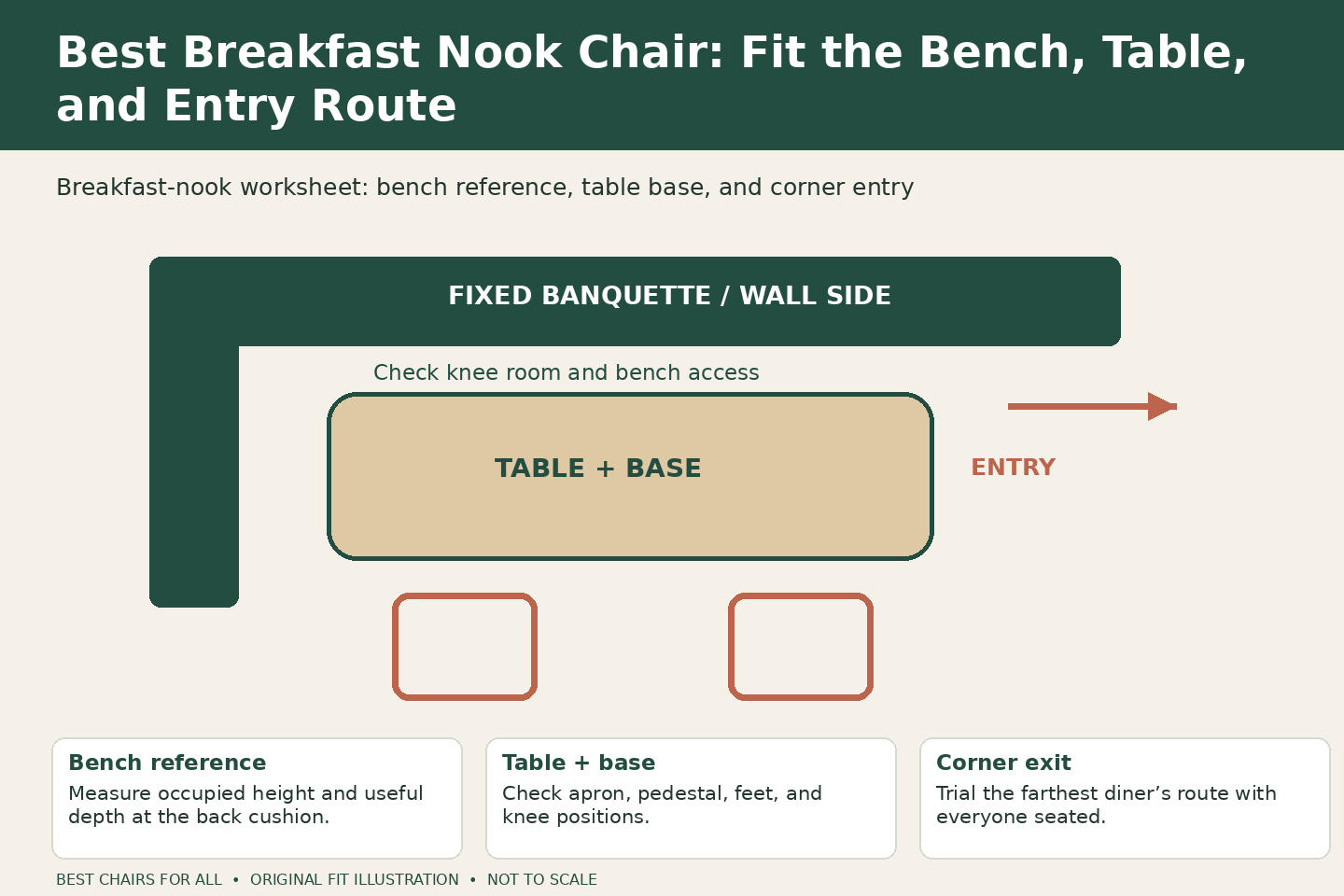
Begin by drawing the fixed surfaces. Include the bench front, back cushion, wall, window sill, radiator, table base, and the only practical entrance. Then mark the dining position of each loose chair. You are choosing furniture for those particular places, not finding an abstract small chair for a generic corner.
Verify the exact variants in the manufacturer references: IKEA LISABO chair, black; Article Nosh dining chair, Oak and Ratine Ivory; Article Sylvo stackable dining chair, Walnut. Specifications were checked November 6, 2026.
1. IKEA LISABO chair, black
Best for: Lower exposed-seat reference.
LISABO is a useful first trial when the banquette is around a lower dining-chair height and you want an open armless frame opposite it. Its bare seat keeps fabric care out of that place.
The maker lists a 17 3/4-inch seat height, 15 3/8-inch seat depth, and 20 1/8-inch overall depth. Compare those different measurements with the bench and the walking route separately.
Product Details
| Brand | IKEA |
|---|---|
| Overall dimensions | 18 1/8 W × 20 1/8 D × 31 1/2 H in |
| Seat height | 17 3/4 in |
| Manufacturer load wording | 243 lb tested |
| Materials | Birch frame; veneer seat and back |
Pros
- Lower seat provides a distinct pairing reference
- Exposed frame avoids a full textile surface
Cons
- Hard seat may not suit a longer breakfast routine
- No assumption of stacking or complete tuck-under fit
Try it with the bench occupied and the corner exit in use.
2. Article Nosh dining chair, Oak and Ratine Ivory
Best for: Padded opposite-bench option.
Nosh is the padded armless alternative if the nook should feel softer and you accept its upholstery care. The 19-inch published seat height should be compared with the occupied bench height.
The Ratine Ivory model lists a 16-inch seat depth and 21-inch overall depth. That extra room footprint relative to Sylvo may matter on the only open side of a tight nook.
Product Details
| Brand | Article |
|---|---|
| Overall dimensions | 20 W × 21 D × 31 H in |
| Seat height | 19 in |
| Manufacturer load wording | 300 lb tested |
| Materials | Polyester upholstery; rubberwood legs and plywood |
Pros
- Padded seat and back offer a different contact preference
- Armless entry avoids an arm-to-apron conflict
Cons
- Fixed fabric needs the stated spot-cleaning routine
- Higher and deeper body needs a full-layout trial
Do not assume a bundle photograph establishes fit with your own bench or table.
3. Article Sylvo stackable dining chair, Walnut
Best for: Shallower overall outline.
Sylvo is worth investigating when the loose-chair side has limited projection room. Its documented two-high stacking may also suit occasional extra places with an appropriate storage location.
Article lists 18.75 inches overall depth, an 18-inch seat height, and 15.75 inches seat depth. Follow the supplied felt-sticker and assembly guidance when stacking to avoid scratches.
Product Details
| Brand | Article |
|---|---|
| Overall dimensions | 20.25 W × 18.75 D × 30.75 H in |
| Seat height | 18 in |
| Manufacturer load wording | 300 lb tested |
| Materials | Solid and veneered walnut, rubberwood, plywood |
Pros
- Shallow overall body helps a specific floor-plan comparison
- Two-high stacking is documented for this model
Cons
- 20.25-inch width still needs table-opening checks
- Stacking has little value without a useful storage destination
Compare occupied movement as well as the compact parked outline.
The banquette-pairing worksheet
Record five measurements: occupied bench height, useful bench depth, tabletop height, lowest underside obstruction, and table-base position. Then add each candidate’s seat height, seat depth, overall width, and overall depth. Keep occupied bench height separate from the unloaded cushion measurement, since a soft bench can sit differently once a person is on it. Use a normal sitting observation rather than pressing the cushion with a hand and guessing.
Useful bench depth means the sitting space available in front of the back cushion where a diner actually sits. A very deep box with thick loose back pillows may provide a much shallower useful area than the carpentry dimension suggests. That distinction matters when comparing a loose chair: the chair’s published seat depth and the bench’s total platform depth are not like-for-like measurements.
The table underside is especially important where a custom bench already sets the sitting height. Measure the apron or mechanism at both the bench side and the loose-chair side. A rectangular table can have different obstructions near its ends. A round pedestal can simplify some positions yet place a broad base directly where the diner’s feet want to go. Record what is present rather than assuming one table shape always solves a nook.
Finally, draw the entry route for the person seated farthest into the corner. If that person must slide along the bench or move a loose chair to leave, include the action in your trial. The chair cannot be evaluated only in its parked position. A nook that looks efficient when empty may be inconvenient once everyone is eating breakfast at the same time.
Worked seat-height comparison
Suppose the bench sits at an occupied height of 18 inches. LISABO’s published seat height is 17 3/4 inches, Sylvo’s is 18 inches, and Nosh’s is 19 inches. Those are reasonable comparison points, but they do not guarantee visual or personal equivalence. Nosh’s cushion compression and each diner’s body fit still require a trial. The one-inch published difference may be more noticeable to one person than another.
Now suppose the bench is actually 20 inches high when occupied. None of the published chair heights should be assumed an exact match. More importantly, matching the bench does not automatically make the table relationship comfortable. The bench could itself be too high for a particular diner or too close to an apron. Assess both sides of the table rather than using an existing installation as proof of correct fit.
If a loose chair needs a cushion, remeasure the combination. A decorative pad can change height and depth and may move during entry. Do not stack loose cushions to equalize a bench and chair by appearance alone. If the fixed bench setup is unsuitable, a furniture or seating professional may need to review the combination instead of solving it through another online chair order.
Open-side depth and the walking route
The loose chairs often occupy the only open side of a nook, so their overall depth matters. Sylvo is listed at 18.75 inches, LISABO at 20 1/8 inches, and Nosh at 21 inches. The deepest and shallowest differ by 2.25 inches. That gives you a useful floor-plan comparison, but the actual projection beyond the tabletop depends on how far each chair can move inward.
Mark the candidate outline with low-tack tape and use an existing chair to simulate eating and departure. Check whether a person can pass behind, reach a cupboard, or open a nearby appliance without a repeated conflict. Do the trial at the busiest expected time rather than with the entire kitchen cleared. A nook is usually valuable because it supports an everyday routine, so that routine belongs in the layout check.
If the open-side route is too tight, reducing the number of permanent chairs may be more helpful than choosing the narrowest chair available. A stored spare can be added for an occasional visitor. Sylvo’s documented stacking up to two high can help only if there is a sensible destination for that pair. It does not create extra circulation space while both chairs are occupied.
Table-base conflicts under a small top
A small tabletop does not guarantee usable room for feet. At a pedestal table, check the diameter and height of the base near the loose chair. At a four-leg table, check the diagonal path used to enter from the corner. A chair can fit centered on the edge but become awkward when angled to let a bench diner out.
Use actual footwear during the trial and leave space for the knees to move naturally. Do not evaluate only with chair legs neatly aligned for a photograph. The relationship among the chair feet, diner feet, and table base can be the deciding factor even when the seat-height comparison looks excellent. Move the trial chair through the full ordinary approach and exit path.
A trestle table can be particularly different at its end from its long side. If the nook forces a chair near that end, inspect the lower crossbeam before selecting from a product page. We do not provide a universal minimum clearance because the base shape and the person’s needs vary. A measured trial is more useful than a single generic spacing number.
Back height, windows, and visual openness
Breakfast nooks often sit beside a window, making the chair backs prominent in the view from the kitchen. LISABO is listed at 31 1/2 inches overall, Nosh at 31 inches, and Sylvo at 30.75 inches. Although the top lines are similar, their visual mass differs. A padded back presents a solid textile area, while exposed shaped wood reveals more of the background around the frame.
Choose deliberately if the window view or built-in bench is the feature you want to keep visible. A lower-looking back can still be relatively broad, and a narrow back can sit above a wide seat. Compare rear and side photographs, not only the front. In a corner, the chair may be seen from behind most of the day.
Keep practical access to the window, radiator, or bench storage in the plan. A chair that must be moved for every cupboard opening may be acceptable if it is occasional; it may become tiresome every morning. Storage lids and drawers need their own clearance. The nook should remain usable for its non-dining functions after the chairs arrive.
Morning mess and upholstery choices
Nosh’s Ratine Ivory upholstery requires the manufacturer’s spot-cleaning routine, with professional cleaning advised for persistent stains. That may be acceptable for a household that wants padding and manages spills promptly. It is a different care commitment from an exposed seat. A pale upholstered chair beside a brightly lit window may also show marks differently than it did in an online image.
LISABO and Sylvo have exposed wood or veneer surfaces with specific wiping instructions. Follow those directions and dry as required rather than treating a breakfast chair as a washable outdoor object. A cushion added to either introduces its own care and attachment requirements. Choose the complete seat arrangement you can maintain, including after coffee, toast crumbs, and daily handling.
A practical trial for a complete nook
Bring one candidate into the intended place if the retailer’s terms allow a useful home trial. Have the usual diners take their ordinary seats, place breakfast items on the table, and check the corner person’s route out. Note the relationship to the bench, the base, and the main walking route. Keep the trial gentle and ordinary; there is no need for a dramatic squeeze or forced maneuver to prove that a layout technically fits.
Start with LISABO for a lower exposed-seat reference, Nosh for a padded armless place, or Sylvo for a shallow overall outline and limited stacking. If the chair passes by itself but the nook fails with everyone seated, reconsider the layout rather than keeping an inconvenient system. The best nook chair helps the entire corner work as a place to eat, enter, leave, and clean every morning.
Something unclear or out of date? Send a correction with this article’s title and the detail to check.
Sources, research & corrections policy ↗