As an Amazon Associate, we earn from qualifying purchases. Read our affiliate disclosure. Amazon buttons search for matching listings; they do not confirm the exact model, seller, price, or stock.
The best dining chair for lower back support is one whose backrest you can actually use while eating comfortably. A lumbar-looking curve is of little practical value if excessive seat depth or a table obstruction makes you perch forward. IKEA TONSTAD, Article Nosh, and IKEA BERGMUND offer three different shapes to trial. None has adjustable lumbar support, and we do not recommend any of them as a treatment for back pain.
We researched the exact US models and an official ergonomics source online on November 6, 2026. This is a fit-based shortlist, not a clinical assessment or a record of physical testing. If pain is persistent or you have a condition affecting seating, obtain individual advice. The guide’s purpose is to make an ordinary furniture trial more specific.
Start by identifying what stops back contact
Before replacing a chair, observe the current combination at the table. Can you rest against the back while your feet are comfortably placed? If yes, does the need to reach the plate pull you away from it? If no, is the front edge too far forward, the seat too high, or the back’s shape simply wrong for your torso? These are different purchasing problems and should lead to different questions.
The Canadian Centre for Occupational Health and Safety’s ergonomic-chair guidance discusses fit, including seat depth that permits back support without pressure behind the knees. It concerns work chairs, not dining-chair certification. We use the general fitting distinction as context; we do not apply its office-chair mechanisms, caster recommendations, or adjustability expectations to these fixed dining chairs.
Verify the exact variants in the manufacturer references: IKEA TONSTAD chair, brown oak effect/Fridtuna light beige; Article Nosh dining chair, Oak and Ratine Ivory; IKEA BERGMUND chair, black/Gunnared medium gray. Specifications were checked November 6, 2026.
1. IKEA TONSTAD chair, brown oak effect/Fridtuna light beige
Best for: Shorter-seat starting point.
TONSTAD is the first fit candidate if a long seat prevents you using the backrest. Its exposed shaped back and padded seat should be assessed together at the table.
The Fridtuna version lists a 15-inch seat depth and an 18 1/2-inch seat height. This fixed design does not have a separately adjustable lumbar pad or seat depth.
Product Details
| Brand | IKEA |
|---|---|
| Overall dimensions | 16 1/2 W × 18 7/8 D × 34 5/8 H in |
| Seat height | 18 1/2 in |
| Manufacturer load wording | 243 lb tested |
| Materials | Solid wood frame; cotton/polyester removable seat cover |
Pros
- Documented shorter seat provides a useful trial reference
- Padded seat without a full upholstered back
Cons
- 16.5-inch seat width will not fit everyone
- A shaped back is not a medical support claim
Choose it when its dimensions address the observed fit issue, then trial the contact location.
2. Article Nosh dining chair, Oak and Ratine Ivory
Best for: Padded-back comparison.
Nosh is worth comparing when you prefer padded contact without arms. Its foam-wrapped back is described by the maker as providing mid-level support, which still requires personal validation.
The seat depth is listed at 16 inches and height at 19 inches. Neither can be adjusted, so compare them to a comfortable chair and to the table before ordering a set.
Product Details
| Brand | Article |
|---|---|
| Overall dimensions | 20 W × 21 D × 31 H in |
| Seat height | 19 in |
| Manufacturer load wording | 300 lb tested |
| Materials | Polyester upholstery; rubberwood legs and plywood |
Pros
- Armless approach can simplify table reach
- Published depth and height aid a precise comparison
Cons
- Fixed back may contact the wrong place for a particular torso
- Upholstery softness alone does not establish lower-back fit
Use an ordinary meal trial to determine whether the back remains usable while eating.
3. IKEA BERGMUND chair, black/Gunnared medium gray
Best for: Higher upholstered comparison.
BERGMUND is a candidate if a higher seat is already known to fit and you prefer an upholstered seat and back. It should not be the automatic choice just because it looks more padded.
The current variant lists a 20 1/8-inch seat height and 16 1/8-inch seat depth. Its removable cover is a maintenance feature rather than evidence of additional ergonomic adjustment.
Product Details
| Brand | IKEA |
|---|---|
| Overall dimensions | 20 1/2 W × 23 1/4 D × 37 3/8 H in |
| Seat height | 20 1/8 in |
| Manufacturer load wording | 243 lb tested |
| Materials | Solid wood legs; removable polyester cover |
Pros
- Removable cover for planned care
- Distinct higher-seat fit to compare
Cons
- Height can compromise foot position or apron room
- No independently adjustable lumbar mechanism
Reject it if the height forces a poor table relationship, regardless of initial cushion feel.
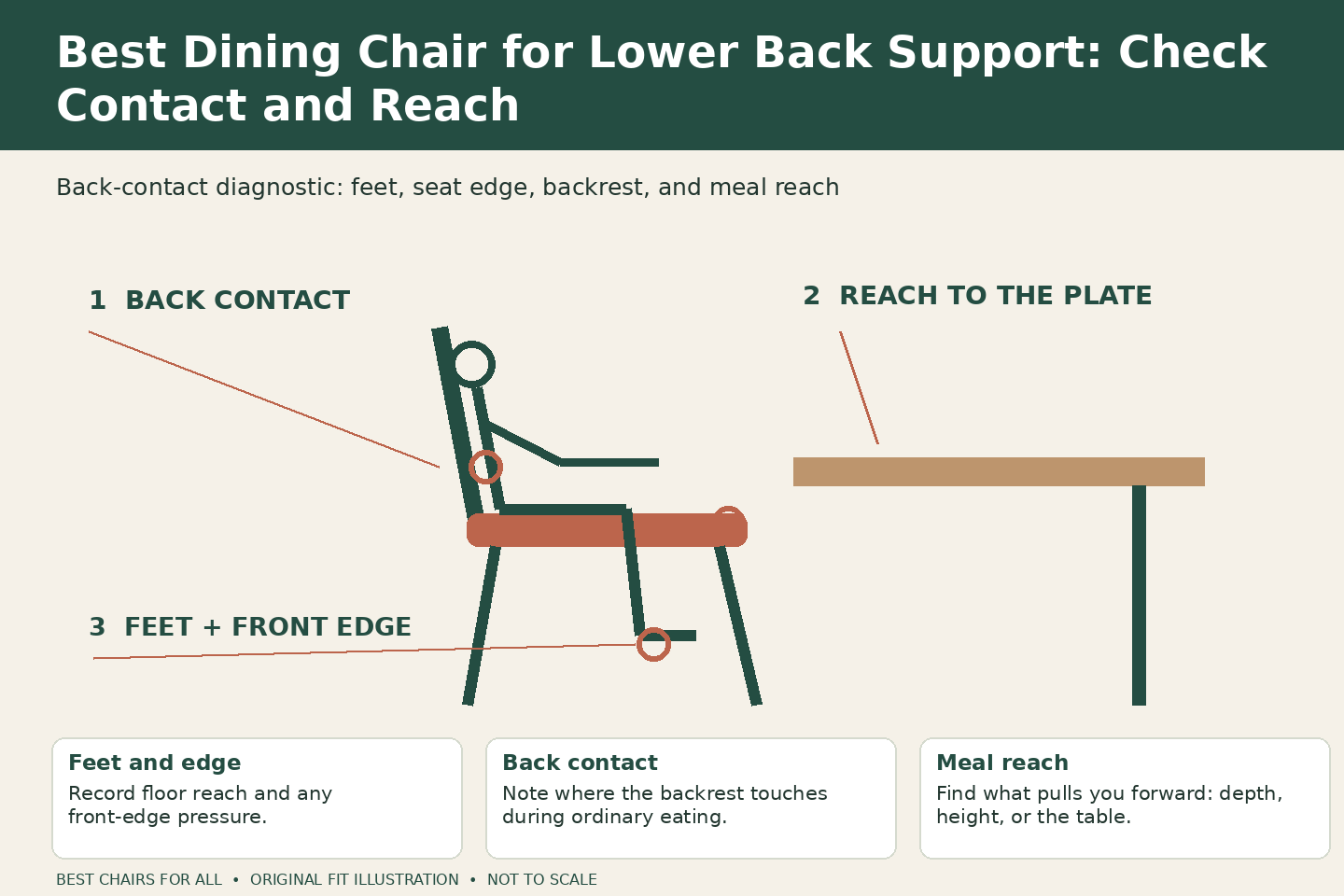
A contact-and-reach diagnostic worksheet
Draw four boxes labeled feet, seat edge, back contact, and table reach. Use ordinary dining activity and record observations without trying to hold a rigid pose. The worksheet is a way to describe furniture fit, not a self-diagnosis of the cause of discomfort. Stop the trial if it is painful rather than trying to push through to complete a score.
In the feet box, record whether the floor is comfortably reachable when you sit in the part of the seat intended for normal use. Do not compare only the total height of the chair back. The candidates differ in seat height, from TONSTAD’s 18 1/2 inches to BERGMUND’s 20 1/8 inches. That difference can change how easily one diner reaches both the floor and the table.
In the seat-edge box, note whether the front of the seat presses at the back of the legs while you use the backrest. TONSTAD lists a 15-inch seat depth, Nosh 16 inches, and BERGMUND 16 1/8 inches. Those differences do not specify personal comfort, but they give you an evidence-based way to choose a first trial. Compare them to a seat you already like before assuming that more depth means more support.
In the back-contact box, describe where you feel the backrest and whether the contact remains useful when eating. A padded back can spread the feel of a contact area; an exposed shaped back can feel more definite. Neither provides a universal result. The position of the contour relative to your body matters more than a promotional word such as supportive.
In the table-reach box, note whether you can use cutlery without repeatedly leaving the backrest because of distance. Check the table apron, legs, and any brace that prevents the chair coming closer. If the table is the obstacle, buying another chair with an attractive curve may repeat the same problem. You may need a different chair position or table relationship rather than additional padding.
Worked example: depth creates the apparent back problem
Imagine a diner whose familiar comfortable seat has 15 inches of usable depth. A candidate has 18.75 inches. To place their feet comfortably, the diner sits forward and loses contact with the back. It might be described as insufficient lumbar support, even though the backrest has a strong curve. The first issue to investigate is the 3.75-inch depth difference, not a more prominent lumbar shape.
Now consider the shortlisted chairs. TONSTAD’s 15-inch depth gives a closer starting reference for that diner than the deeper candidate. Nosh’s 16 inches may also be worth a trial. Their back shapes and seat heights still differ, so the numbers cannot determine the winner. They can prevent wasting time on a chair that is obviously far from the known comfortable geometry.
Do the reverse comparison for someone who finds short seats restrictive. A shallow chair may allow easy back contact while leaving too little of the thigh comfortably supported. That person may need another model outside this shortlist. We do not make a shallower-is-always-better rule; the worksheet exists precisely because two people can need different dimensions.
Worked example: the table removes the benefit
Suppose the table has a 25.5-inch underside at a deep apron. A taller chair moves the person upward and can reduce nominal thigh space. If the diner responds by staying farther away or perching at the front, the apparent back-support issue may begin below the tabletop. Measure the obstruction at the actual seat position rather than using the table’s advertised overall height.
In a different room, a pedestal spreads near the floor. The chair clears the tabletop but the diner’s feet cannot use the intended position. Moving the plate closer cannot solve that obstacle. Try an alternative position around the same table before ordering another chair. The useful observation is what makes the person move away from the backrest during a real meal.
This is also why a showroom trial should use a table of similar height and underside design where possible. Sitting in a chair alone can establish a first impression, but it cannot reproduce the eating reach. Ask about a returnable sample if the table relationship is the major uncertainty, and check the return conditions before assembly.
How the three shapes differ
TONSTAD’s exposed shaped ladder back is the first sample for someone who wants a relatively short seat and does not require a padded back. Its seat cushion gives it a different feel from an entirely bare wooden chair, while the 16 1/2-inch width deserves checking with the person. A useful back shape cannot compensate for an undersized sitting area.
Nosh uses a foam-wrapped upholstered back and an armless outline. The manufacturer describes mid-level back support, which is a product description rather than proof of an individual result. Its 19-inch seat height and 16-inch depth are useful intermediate reference points in this group. Test whether the back contact is in a comfortable location for your torso at the table.
BERGMUND is taller and fully covered. Its seat and back upholstery may fit a preference for softer contact, but the height is a significant selection factor. Do not choose it because more fabric suggests more support. The 20 1/8-inch seat height needs to work with the feet, apron, and reach before its contour becomes relevant.
Added cushions change the original geometry
A separate back cushion can reduce usable depth, but it also changes the relationship to the chair’s own backrest and can move around. An added seat pad can raise the diner and reduce apron clearance. Those effects are not automatically harmful or helpful; they need individual evaluation. Avoid using multiple loose cushions as a way to make an unsuitable chair seem acceptable.
If an accessory has been recommended for your individual needs, include it during the chair trial and follow its instructions. Measure the combination, not just the bare chair. A chair chosen from a catalogue without the intended accessory may produce a different sitting position once everything is in place. Keep any professional fitting guidance ahead of a general shopping article.
Longer sitting needs a broader brief
A dining chair used for an occasional meal is a different purchase from a chair used for a full day of computer work. The models here do not offer office-chair seat-height, depth, or lumbar adjustments. If the dining table doubles as a daily workstation, evaluate that activity separately, including screen and work-surface arrangement. Do not assume a dining chair with a curved back is an adequate ergonomic workstation solution.
Also leave room to change position naturally during meals and conversation. A chair should not require continuous effort to hold a single idealized pose. Describe the fit you prefer and choose furniture that allows ordinary movement. We make no promise that a specific posture, chair material, or upholstered back will prevent or cure a medical problem.
Making the purchase decision
Order the model that best addresses the specific barrier your worksheet identified. TONSTAD deserves an initial trial for a short padded seat with an exposed back, Nosh for an armless upholstered contact surface, and BERGMUND for a deliberately higher upholstered fit. All remain conditional on the person’s own experience and the table relationship.
Keep the worksheet through the return period and record feedback after normal meals. A good decision can be stated precisely: the back is reachable, the front edge is comfortable, feet have a suitable position, and the plate is usable without an awkward reach. That is a more defensible purchasing result than claiming a dining chair has medically proven lumbar support.
Something unclear or out of date? Send a correction with this article’s title and the detail to check.
Sources, research & corrections policy ↗