Massage chair tracks describe the route followed by the back rollers. They do not tell you how the rollers feel, whether a chair fits your shoulders, or whether its controls are usable. For a useful comparison, separate three questions: where can the rollers travel, how can their pressure be adjusted, and does that travel line up with your body?
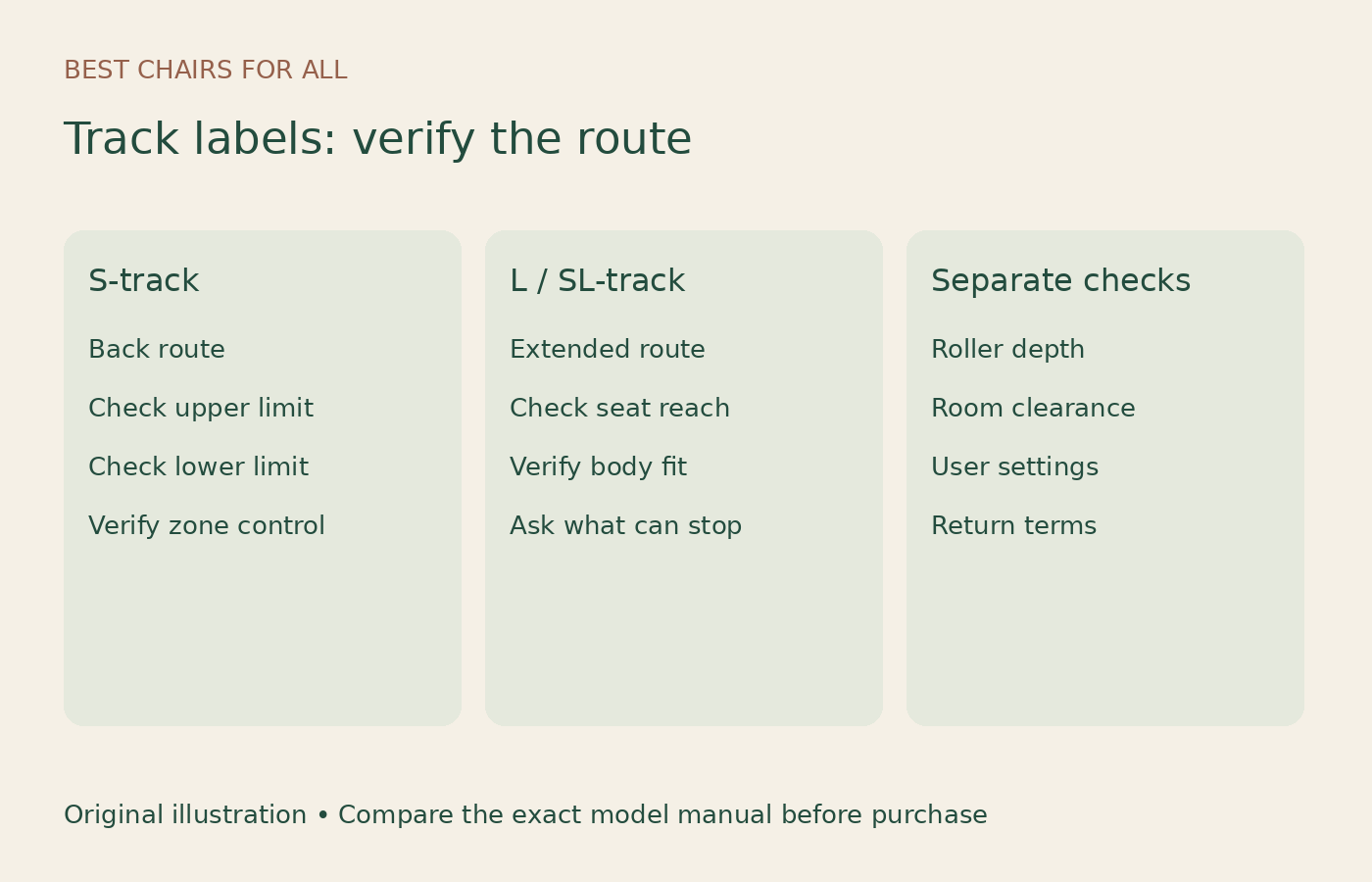
This guide explains S-track, L-track and SL-track terminology, then gives you a showroom worksheet you can use without specialist equipment. It is a specification and buying-method guide, not a report of hands-on product testing.
The short explanation
An S-track follows the curved back area. An L-track extends the roller route beneath the seat. SL-track generally describes a contoured back route combined with that lower extension. These terms are useful starting points, but a listing that says only “SL-track” leaves important questions unanswered. Ask for a diagram showing the roller path and a manual explaining which areas you can select independently.
Osaki’s track explanation distinguishes the contoured back route from the extended under-seat route. Treat its language as the manufacturer’s description of the category, rather than a promise that every similarly labeled chair reaches identical locations.
| Label | Useful interpretation | Question to verify |
|---|---|---|
| S-track | Back-focused roller route | Where does travel stop on my body? |
| L-track | Route extending under the seat | Can I select or disable the seat portion? |
| SL-track | Contoured back route with lower extension | Does the contour and lower reach suit me? |
| Flexible track | Articulating route on the specified design | What actually moves as the chair reclines? |
Track shape and roller depth are different specifications
A track is the guided route. The massage mechanism is the assembly traveling along it. A chair can combine an extended track with relatively simple roller controls, or a shorter route with more adjustable depth. Do not infer the second feature from the first.
For example, “4D SL-track” contains two separate descriptions. The SL part concerns the route; the 4D part usually concerns depth and changes in speed or rhythm. A product comparison needs separate columns for both. Otherwise, you can accidentally award extra credit twice for one feature while overlooking the feature you actually wanted.
Osaki’s buyer guide presents back mechanisms and roller tracks as separate buying decisions. That separation is helpful even if you are considering a different brand. Copy it into your own notes: route, controls, fit, and installation should each have their own row.
Why the longest published track is not automatically the best fit
A published length measures part of the chair, not your personal coverage. Two people of the same standing height can have different torso and leg proportions. Seat position, shoulder registration, backrest angle and footrest adjustment also change where a person sits relative to the mechanism.
Imagine two shoppers who are both 5 feet 10 inches tall. One has a longer torso; the other has longer legs. A specification that lists only a height range cannot establish that the upper roller limit falls in the same place for both. It can eliminate an obvious mismatch, but it cannot complete the fit assessment.
Also check what is included in a track-length claim. If the specification does not say whether it is measuring the rail, roller-center travel, or some other dimension, do not use that number to calculate a promised body location. Request clarification in writing rather than making a precise comparison from ambiguous measurements.
A seven-step showroom coverage check
- Record the exact model. Include a suffix or revision. Photograph the product label if permitted. Similar names sometimes describe different configurations.
- Adjust the footrest and sit fully back. Begin with the manufacturer’s fitting instructions. A half-slouched position can make a useful mechanism feel misplaced.
- Let the body-positioning routine finish. If the chair offers manual shoulder correction, ask the salesperson to show it. Write down how it works.
- Start at a low intensity. Your first question is whether the route lines up, not how much pressure the chair can deliver.
- Select the upper, middle and lower areas. Confirm whether the manual mode actually lets you isolate them. Note the controls you used.
- Compare upright and reclined positions. Observe whether your position changes enough to alter the contact you prefer.
- Repeat the relevant steps for each regular user. A good fit for one household member does not establish a good fit for another.
Use descriptive notes such as “upper travel feels too high after shoulder correction” or “can select lower seat section independently.” Avoid writing only “comfortable” or “strong.” Specific observations are more useful when you compare a second chair a week later.
Flexible tracks: ask what the flexibility changes
Some chairs use an articulated or flexible route. The useful question is how the back and seat portions move relative to each other during recline. A flexible label does not establish a specific reclining angle or explain every program that uses the movement.
The Infinity Sensation DualFlex specification sheet, for example, identifies a Flex-L track and lists its track length separately from the reclining dimensions. This illustrates why you should obtain the actual specification sheet: the mechanism and room requirements need different checks.
Ask for a demonstration of the program you intend to use. Does the backrest move while the lower mechanism stays in contact? Can the motion be stopped? Can the chair return to an easy exit position with a straightforward command? Record observable behavior instead of adopting broad marketing phrases about advanced stretching.
Do not confuse roller coverage with airbag coverage
A full-body description can include several mechanisms. The back rollers may follow one route while airbags act around the arms, calves or other sections. Foot rollers are another separate mechanism. An illustration showing colored zones across the whole chair may combine all of these.
Ask the seller to identify which component operates in each highlighted area. If your priority is an under-seat roller section, airbag activity in the seat does not answer that requirement. Conversely, an extended back track does not explain how adjustable the arm airbags are.
Make a simple diagram of your own with four labels: back rollers, seat roller extension, airbags and foot mechanism. It does not have to be artistic. Its purpose is to stop a general coverage diagram from becoming a substitute for an actual feature list.
A comparison worksheet that avoids double counting
Create one sheet per model and give each item one of three results: confirmed, unsuitable, or unresolved. Do not turn unresolved features into a positive score because the chair is expensive. The following fields cover the decisions most likely to be blurred together:
- Exact track description and published diagram.
- Manual control over upper and lower travel limits.
- Independent adjustment of roller depth, where provided.
- Fit result for each intended user.
- Behavior during your preferred recline position.
- Whether unwanted zones can be disabled.
- Room and delivery clearance from the installation instructions.
- Return costs if fit remains uncertain after delivery.
If you must compare remotely, send this list to the seller before ordering. Ask them to answer by model, rather than with a link to a general brand buying guide. Keep the reply with your order confirmation. That creates a more useful record than screenshots of a rotating promotional banner.
Three buying situations and how to handle them
You want back-focused sessions. Begin with the adjustable zones and the fit of the upper and lower back route. An under-seat extension may be welcome, irrelevant, or something you prefer to disable. Do not pay for it simply because a comparison table presents it as the next mandatory tier.
Different household members will share the chair. Prioritize repeatable fitting controls and saved settings, if available. Try switching users rather than adjusting the chair once and assuming the settings will transfer. Write down whether the model requires a fresh scan each session.
You cannot visit a showroom. Give more weight to clear documentation and practical return terms. Ask who pays for collection, whether original packaging is required, and whether assembly affects eligibility. A detailed track description still cannot guarantee personal preference.
Questions worth asking before paying
Ask, “What exactly does SL mean on this model?” Then ask for the lowest and highest areas the back mechanism can target, which travel limits are adjustable, and whether the seat section can be turned off. If the seller gives only a general reassurance, request the relevant manual page.
Ask how the chair behaves after a power interruption and how to bring it back to its normal exit position. These are operating questions for the specific mechanism; they should be answered from documentation. Do not assume that a flexible track or premium roller label provides a particular emergency-return feature.
Finally, ask which costs apply if the mechanism works as described but the fit does not suit you. The most expensive comparison mistake is treating a mechanical description as a guarantee of personal comfort. A clear trial and return arrangement can be more valuable than a longer list of undefined features.
How to make the final choice
Choose the route that covers the areas you actually want, then verify that the chair lets you control that coverage at an intensity you accept. Follow with fit, room measurements and service arrangements. Keep those decisions separate until every essential requirement is confirmed.
For the next stage, use our massage chair room and delivery measurement guide and roller technology comparison. A useful purchase record should explain why the exact chair works for your household, rather than simply repeating the longest track or largest number printed in the advertisement.
A five-row fit record for two users
Draw a table with one column per person. Use rows for shoulder registration, upper travel, lower travel, seat-extension preference and exit position. Enter observations in each cell after the same manual sequence. This makes it easier to identify a shared requirement rather than choosing the chair that suits the most enthusiastic shopper.
For example, one person might record that the low setting is comfortable and the seat section can be disabled. A second person might record that the upper travel stays misplaced after the available correction. That second result is an unresolved fit issue, even if the published height range includes both people. Ask the seller to demonstrate a documented adjustment before accepting a promise that you will get used to it.
Keep the seating position consistent when repeating the check. If you add a manufacturer-approved pad, note that change on the sheet and repeat the relevant controls. Do not compare one chair with an extra cushion against another without noting the difference. Your record should explain the conditions that produced the result.
Something unclear or out of date? Send a correction with this article’s title and the detail to check.
Sources, research & corrections policy ↗