As an Amazon Associate, we earn from qualifying purchases. Read our affiliate disclosure.
A good foldable high chair makes the space between meals easier to use without turning each meal into an assembly project. The Chicco Zest is the lighter, simpler candidate. The Chicco Polly offers more seat-height adjustment and a documented folded-size specification, with stock needing confirmation for the exact style. The Peg Perego Siesta is a heavier adjustable alternative with a current three-axis folded measurement.
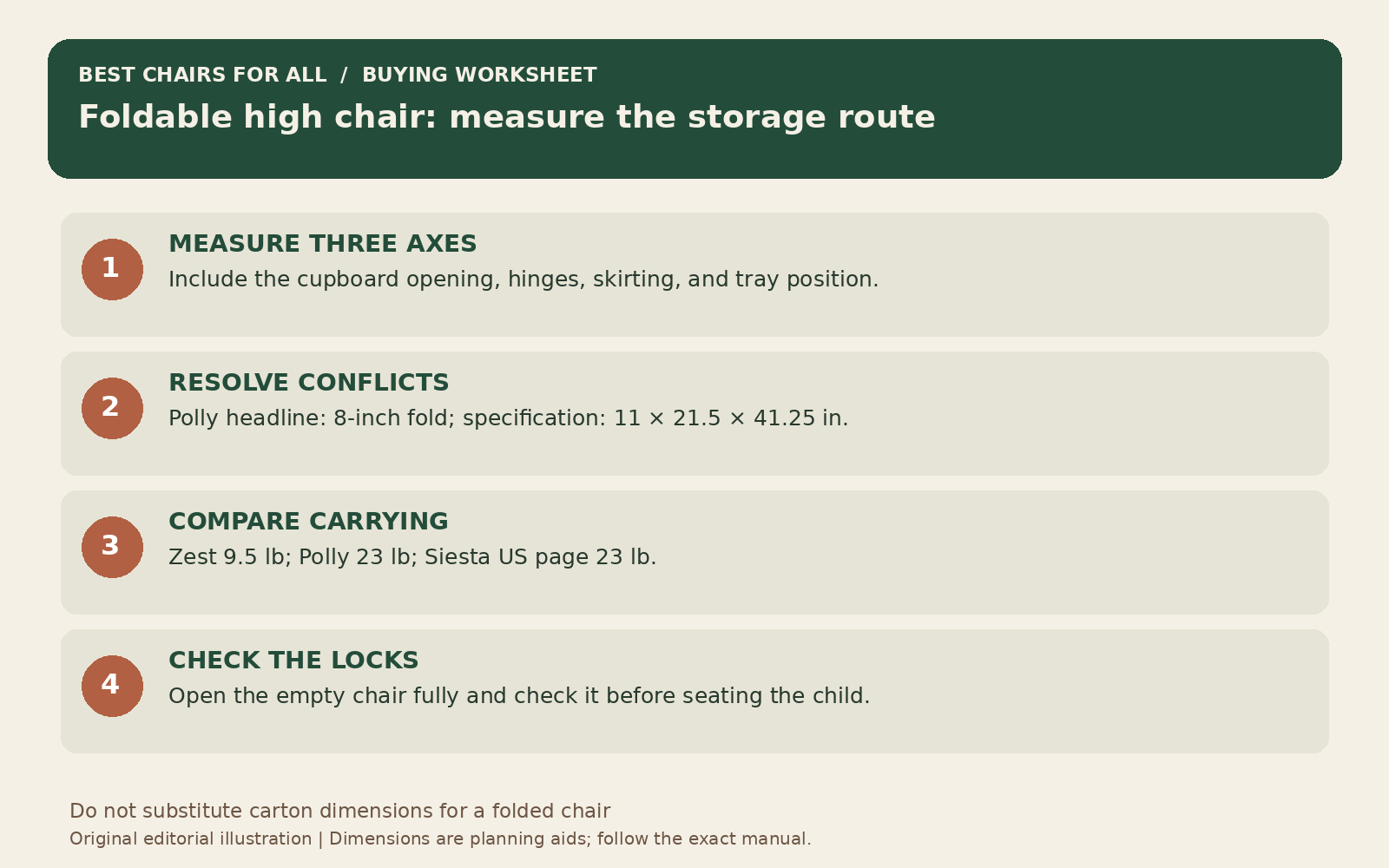
This comparison focuses on the storage sequence: open, secure, feed, clean, dry, fold, and put away. We checked manufacturer specifications, linked instructions, and current listings on November 6, 2026. We have not timed the folding mechanisms or performed hands-on stability testing. A compact marketing description receives less weight here than an actual measurement and a realistic place to store the product.
Folding comparisons with the uncertainty left visible
| Chair | Open dimensions, inches | Published folded information | Published weight |
|---|---|---|---|
| Chicco Zest | 21.25 × 26 × 34.25 | Compact fold; complete folded size not given in current text listing | 9.5 lb |
| Chicco Polly Chakra | 33 × 21.5 × 41 | 11 × 21.5 × 41.25 in specifications | 23 lb |
| Peg Perego Siesta US | 29.75 × 23.75 × 41.5 | 11.66 × 23.5 × 33.66 in on current US page | 23 lb on current US manufacturer page |
Chicco Zest: a practical lighter frame if the folded shape fits
The Zest 4-in-1 Capri page showed $69.99 and in-stock availability during research. At 9.5 pounds, it is materially lighter than the other two published chairs. That matters when you need to carry an empty chair across the kitchen every day rather than roll it a short distance. Its one-piece wipeable seat and rear-leg tray storage also support a straightforward reset after meals.
Chicco publishes assembled dimensions of 21.25 by 26 by 34.25 inches, but the current text listing does not provide a complete folded-size measurement. Ask for the exact folded dimensions with the tray in the intended storage position before ordering for a fitted cupboard. A chair can be light and compact yet still have an awkward protrusion at the tray or feet. We would not use the carton size or measurements from a different Zest version to approve a tight storage slot.
Choose Zest when carrying weight and wiping the seat matter more than extensive height adjustment. Its later low-chair and youth-stool arrangements are separate configurations; they do not justify removing required feeding parts to make storage easier. The five-point harness still needs cleaning: Chicco specifies warm water, mild detergent, and air drying, and says not to machine wash the harness. A chair you fold every day should be dry and free from food around the mechanism before storage.
Chicco Polly: more adjustment, with a folded-size discrepancy to resolve
The Polly Chakra page lists an assembled 33-by-21.5-by-41-inch chair weighing 23 pounds, with seven height settings, a removable tray liner, and a five-point harness. Those features can suit a chair that stays near the dining area and folds into an adjacent recess. They are less helpful if it must be carried up stairs twice a day. The style page showed a $139.99 price, but did not establish a presently shippable selected style; confirm stock with the seller.
There is an important measurement issue on that page. The marketing text describes an eight-inch fold, while the specification section gives folded dimensions of 11 by 21.5 by 41.25 inches. Use the more conservative specification when beginning your planning, then ask Chicco to confirm what the smaller number excludes, particularly the tray. Do not buy for a nine-inch gap on the strength of the headline claim. This discrepancy is exactly why folded-size research should extend beyond the feature bullets.
Polly makes sense when the verified folded package and height adjustment solve your room problem. It is a conditional candidate rather than a firm stock recommendation until the exact model is available. Read the US Polly manual for the supplied version. Secondhand buyers must also consult the historical Polly recall: it concerns specified models manufactured before October 13, 2010, rather than every chair carrying the Polly name.
Peg Perego Siesta: useful adjustment, heavier storage routine
The US Siesta manufacturer page publishes an unfolded size of 29.75 by 23.75 by 41.5 inches and a 23-pound weight. It describes nine height positions, five recline positions, a removable tray, and a folding design. For this feeding comparison, judge the upright meal configuration; a reclining feature does not make it a sleep space or a reason to feed a child before they meet the model’s readiness requirements.
The current US page lists folded dimensions of 11.66 by 23.5 by 33.66 inches. Those three axes give a much firmer storage reference than the incomplete two-number measurements on older Siesta pages. Confirm the exact current US version and whether the supplied tray is in the same storage position as the published measurement. Do not borrow European Siesta Follow Me dimensions simply because the product photographs look similar.
The Strolleria US listing showed a Siesta at $329.99 with an in-stock shipping message during research; finishes and delivery terms can change. This makes it a current purchase candidate, subject to model verification, rather than relying only on an old support page. Choose it when you want the adjustment features and have a nearby storage location. It is harder to justify if the main objective is a light chair that an adult can easily carry a long way after every meal.
Build a storage gauge before buying
Measure the storage space in three directions, then measure its narrowest entrance. A cupboard can be 24 inches wide inside but have a 20-inch opening because of its hinge and frame. Add any shelf lip, door handle, and change of direction on the route. Record whether the chair needs to stand upright, lie flat, or be lifted above an obstruction. Only then compare the exact folded product measurements.
For a worked example, imagine an alcove 22 inches wide, 12 inches deep, and 43 inches high. Polly’s specification of 11 by 21.5 by 41.25 inches appears to leave one inch of depth, half an inch of width, and 1.75 inches of height. That is an extremely close paper fit, not a purchase approval. Tray position, protective floor pads, a skirting board, and access to the folding handle can consume those margins. Ask the manufacturer to explain the measurement discrepancy and make a cardboard gauge before relying on that alcove.
Now compare the current Siesta specification. Its 23.5-inch folded width exceeds the hypothetical alcove’s 22-inch width by 1.5 inches in that orientation, so it fails that storage plan despite fitting in depth and height. Do not assume tilting or rotating the chair creates a permitted secure storage arrangement. For Zest, the absence of a complete folded measurement leaves the question open until the manufacturer supplies it. Your worksheet should distinguish a known size failure from a missing measurement.
Test the route and the work, not only the closed package
A folding mechanism can be convenient in a showroom and inconvenient beside a full dishwasher. Rehearse where you would stand to remove the child, clean the chair, operate the release, and lift or roll the empty product. Keep the child safely elsewhere during folding. Fingers, straps, loose clothing, and nearby pets should be clear of moving joints. Never fold or adjust a frame around a seated child to save time.
Think about where the tray goes at each stage. Rear-leg tray storage is useful only when the tray is fitted correctly, clean, and dry enough for the storage location. If the folded chair blocks access to the tray at the next meal, a nominally small package may create extra handling. If your storage plan requires leaning a chair against a wall, check the manual’s permitted storage position and secure it against being pulled over by a child.
At the next meal, opening should conclude with a deliberate lock check before the child is seated. Do not mistake an unfolding sound for confirmation that every frame joint is secured. Follow the exact model’s check procedure, and inspect the harness and tray attachments while the chair is empty. Folding convenience should make the meal easier to prepare, without replacing these checks with habit.
Fold frequency changes what is worth paying for
For a once-a-week storage need, a heavier adjustable chair can be reasonable because the carrying burden is occasional. For three meals a day in a multipurpose room, the difference between a 9.5-pound frame and a 23-pound frame deserves serious attention. Published weight is not a measure of ease by itself, though: handles, balance, wheels, thresholds, and stairs affect the actual task. We have not measured any of those handling qualities.
Calculate the recurring sequence honestly. If folding requires removing a wet tray and moving it to a different room, a slimmer chair may produce less benefit than leaving a suitable fixed chair beside the table. A folding product earns its premium only when you have a safe destination for it and the complete process fits the household. Do not select a heavy feature-rich model simply because the word compact appears beside its photograph.
Restraints, readiness, and the model label come first
A feeding chair is for a child who meets the exact model’s sitting and developmental requirements. A birthday or advertised minimum age alone does not establish readiness. Use the seat upright for meals; a reclining feature does not make a chair suitable for feeding a younger infant. Keep the child supervised and within reach, use the complete fitted harness every time, and use the required passive crotch restraint. A tray is a work surface rather than a substitute for restraint. CPSC explains these high-chair precautions. Keep the chair away from surfaces the child could push against and never allow standing or climbing.
Check the product label, date code, exact model, and country version against the current CPSC recall database before buying, including secondhand. Our research date is November 6, 2026; this article cannot guarantee a particular unit remains unaffected by a later notice. Register the chair and retain the instructions. Do not interchange harnesses, trays, gliders, or inserts between superficially similar versions, and do not improvise missing restraints. A used bargain without an identifiable label, complete hardware, and manufacturer support is a poor candidate. If any latch, restraint, or frame part is damaged, stop use and contact the maker.
The storage-based shortlist
Start with Zest for a light, simple folding routine after confirming its collapsed measurements. Investigate Polly for height adjustment and the documented specification, resolving the eight-inch versus 11-inch distinction before committing to a tight gap. Compare Siesta when the adjustable seat, documented folded dimensions, and confirmed seller stock justify a heavier frame. Keep the CPSC sleep guidance in mind: the purpose of any folding high chair is feeding and the activities permitted by its manual, never replacing an appropriate infant sleep surface.
Something unclear or out of date? Send a correction with this article’s title and the detail to check.
Sources, research & corrections policy ↗