Leather and faux leather office chairs can look very similar in a product photograph while using substantially different materials. Start by identifying the actual surface, backing, and material used on each part of the chair. Then compare the documented cleaning requirements, surface feel, wear risks, and replacement options. “Leather look,” “premium,” and “vegan” do not provide enough detail to make that decision.
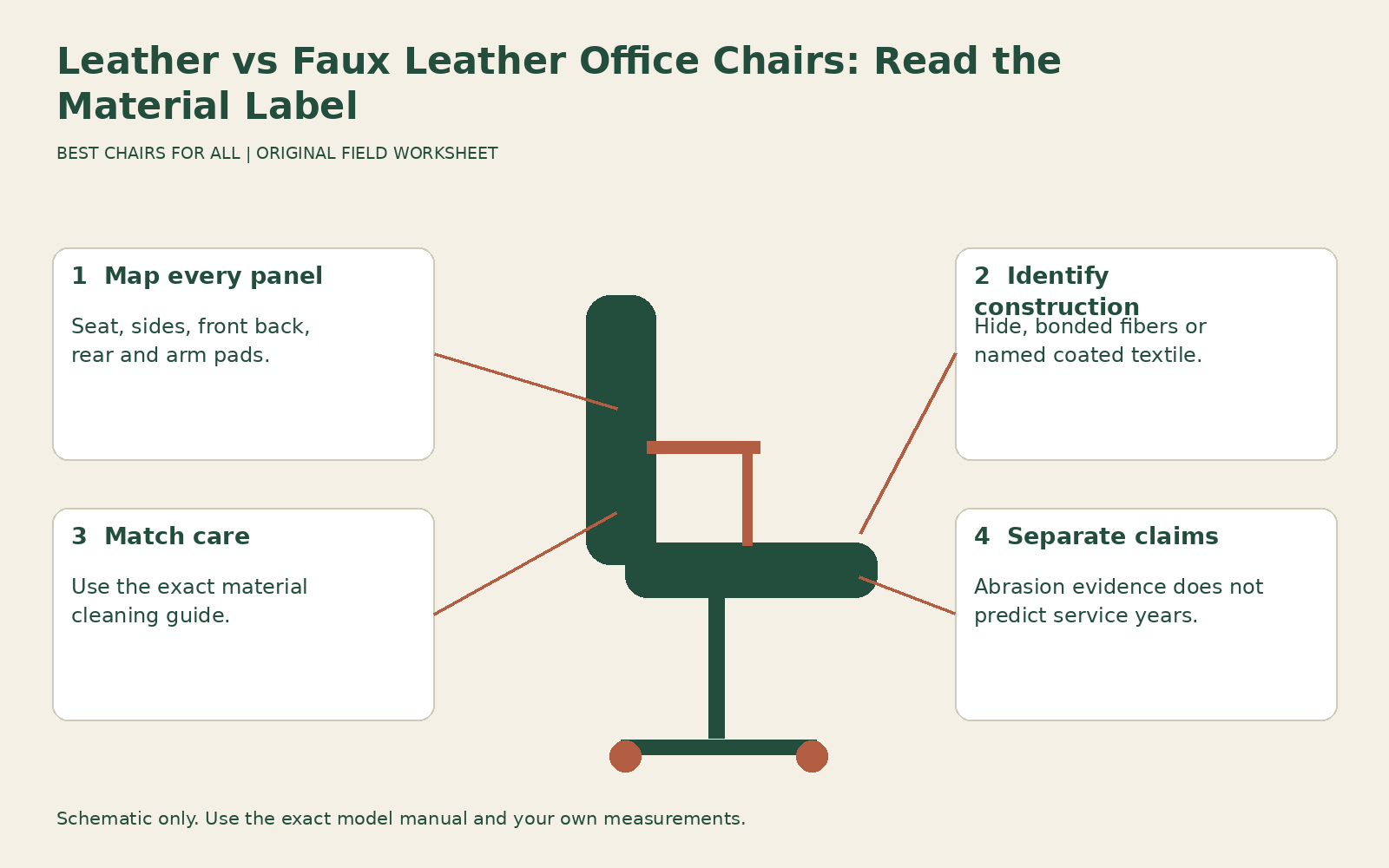
This guide uses a material map rather than ranking all leather above all synthetic upholstery. It also separates upholstery choice from chair fit: the same seat shape can feel different in another covering, while a luxurious surface cannot correct unsuitable depth or arm placement. For mesh and conventional woven fabric, see our mesh and upholstered seat comparison.
Translate the material description first
Real leather is derived from an animal hide or skin, but a listing should tell you more than that. The grain layer, finishing process, coatings, and intended use influence the surface you touch. Full grain, top grain, split leather, and finished leather are not interchangeable descriptions. Ask for the named upholstery and manufacturer’s material sheet rather than trying to judge quality from a close-up photograph of texture.
The Competition Bureau Canada furniture leather terminology distinguishes faux leather, bonded leather, and bi-cast leather. Its consumer explanation describes faux leather as man-made, bonded leather as leather fibers combined with a binder, and bi-cast as split leather with a polyurethane surface layer. These categories help you ask better questions, but sellers may use shorthand inconsistently. In particular, “PU leather” can be ambiguous unless the underlying construction is stated.
Do not assume that every chair marketed with leather wording contains a continuous hide surface on every panel. It may combine one material on the seat and front backrest with another on the outside or sides. Ask which parts are covered by each term. That matters for cleaning and future replacement, even when the mixed construction is clearly disclosed and perfectly acceptable to you.
Understand what faux leather includes
Faux leather is a broad appearance category, not one standardized recipe. A coated fabric can use a polyurethane surface, another polymer system, a textile backing, and additional layers. Different constructions can behave differently under moisture, repeated flexing, cleaning chemicals, and abrasion. A low-cost unspecified covering should not be treated as identical to a named performance upholstery simply because both resemble leather.
A useful primary example is the Ultrafabrics Ultraleather Original composition and test sheet. The sheet identifies a polycarbonate polyurethane surface and reinforced rayon backing for Ultraleather Original, and reports tests for that named material. The point is the level of specification, not a recommendation of a particular chair or a promise that every synthetic covering has the same construction. A branded material name should lead to a traceable sheet and applicable care guide.
“Vegan” indicates a purchasing concern about animal-derived materials, but it does not tell you the polymer, backing, cleaning compatibility, or service life. If avoiding animal materials is important, ask about the complete upholstery construction and other relevant chair components rather than inferring it from the surface appearance. Environmental and durability claims also need specific evidence; the category name alone cannot establish either.
Make a panel-by-panel material map
Draw the chair in simple front and rear views. Label the seat top, seat sides, front backrest, outer backrest, and arm pads. Beside each, write the stated material, material code, and cleaning document. If a panel is described only as matching material, ask what that means. A matching color can conceal a different construction with different care limits.
Add seams and exposed edges to your map. These are useful inspection locations for construction and wear, although they do not let you authenticate material by sight alone. Do not scratch, burn, stretch, or peel a showroom sample or used chair to test it. Ask for an actual labeled swatch and documentation instead. Destructive folk tests can damage a surface without reliably distinguishing a heavily finished hide from a coated textile.
For an illustrative comparison, Chair A might specify leather on the contact surfaces and polyurethane fabric on the rear, while Chair B uses one named coated textile throughout. Neither description is automatically superior. A could meet your preference for a hide surface; B could offer a more straightforward single-material care routine. Your map makes that tradeoff visible before an accidental cleaning mistake exposes it.
Compare care instructions before buying cleaners
Leather care is finish-specific. Herman Miller leather care and maintenance gives instructions for Herman Miller’s applicable leather furniture, including routine dusting and procedures for soiling and spills. It also advises against drying leather with an external heat source. Those are instructions for the manufacturer’s relevant materials, not permission to apply one soap, conditioner, or solvent routine to every leather-covered office chair.
For a synthetic upholstery, obtain the current care guide for the exact material and colorway where relevant. A named coated textile may allow certain cleaning agents that another does not. Do not transfer a disinfectant instruction from a commercial performance material to an unspecified chair coating. The acceptable concentration, contact method, residue removal, and drying procedure can all matter, so follow the complete applicable instructions.
Make the care comparison practical. Write what you will actually clean: ordinary dust, occasional drinks, skin oils on arm pads, or marks from work clothing. Then find whether the manufacturer provides a method for that concern. If your workplace requires a particular cleaning product, ask the material supplier about compatibility before ordering the chair. “Wipe clean” without a method leaves a purchasing question unresolved.
Avoid buying a universal leather conditioner simply because the chair looks like leather. Some finished hides need no such product, and synthetic coverings can be incompatible with treatments intended for other materials. Ask the chair maker which products, if any, are approved. A cleaner sold beside a chair is not automatically documented as suitable for its exact upholstery.
Evaluate feel with the complete seat
Surface feel depends on more than the category name. Finish, texture, thickness, backing, cushion construction, room conditions, and clothing all affect the experience. A leather chair can feel smooth or strongly textured; a synthetic can feel supple or stiff. Compare actual swatches and occupied chairs rather than assuming every hide breathes freely or every faux surface feels sticky.
If warmth is your main concern, sit in the exact covering for a realistic trial rather than relying on a general breathability claim. Do not compare a leather chair in an air-conditioned showroom with a synthetic chair used in a warm home office and attribute the difference solely to upholstery. A fair comparison keeps the seat design, clothing, environment, and task as consistent as practical.
Also check whether the surface allows you to stay comfortably in place. A slippery covering combined with a forward seat angle may encourage sliding; a highly grippy surface can make repositioning feel different. This is an occupied fit observation, not a judgment that the material is universally poor. If a showroom has only a different upholstery option, record the material result as unresolved.
Read wear claims without converting tests into years
Abrasion results can inform a material comparison, but the method and tested material must be identified. Different test methods are not a simple shared scoreboard. A large rub count does not predict a particular number of years in your office and does not cover every failure mode. Flexing, coating adhesion, cleaning compatibility, seams, and localized edge wear may matter alongside abrasion.
The Ultraleather sheet, for example, lists several kinds of performance information for a specific construction. Use that as a model for asking what a durability claim actually measures. Do not copy the number onto another fabric or infer that it proves the complete chair’s longevity. Upholstery performance and mechanism durability remain separate questions, even when both appear on the same sales page.
For a used chair, inspect for lifting surface layers, cracks at flex points, sticky or brittle areas, seam separation, and worn contact edges. Natural-looking variation is not enough to establish leather authenticity, and a peeling surface does not identify its entire composition. Ask the seller for the original material code and disclose observed wear when seeking a repair quote.
Compare repair and replacement paths
Find out whether a replacement seat, back panel, or arm pad is available and whether it must match a particular production version. Re-covering a simple upholstered cushion differs from replacing a complex suspended or molded assembly. Ask whether a proposed upholstery change is approved for the chair and who will do the work. The ability to buy generic fabric does not establish that the complete seat can be reupholstered successfully.
When comparing costs, keep them tied to actual offers: purchase price, approved care supplies if needed, and a documented repair quote. Do not assume leather always lasts longer or synthetic always costs less to maintain. A well-documented repair path can be more useful than an unsupported promise that the surface will last a lifetime. Warranty coverage should be checked for the exact upholstery and type of damage.
If appearance changes matter to you, ask for a sample and discuss how that material is expected to age. Some buyers appreciate variation and a developing patina; others want consistent color and texture across a shared office. Neither preference establishes structural quality. Write your appearance expectation explicitly so you can compare it with the material’s documented characteristics.
Finish with a material decision sheet
Use six rows: construction and code; panels covered; approved care method; occupied surface feel; relevant performance evidence; and replacement route. Mark each verified, unresolved, or unsuitable for your needs. Add a short preference statement, such as wanting a particular hide finish or avoiding animal-derived upholstery, without treating that preference as a substitute for specifications.
Choose only after the chair itself passes your fit checks. The most informative description is specific: “This named coating has a care method our office can use, feels suitable in our trial, and has replacement seat support.” Or: “This leather finish meets our preference, its mixed panels are documented, and we accept its care requirements.” That evidence gives you a useful comparison while keeping broad material labels in their proper place.
Something unclear or out of date? Send a correction with this article’s title and the detail to check.
Sources, research & corrections policy ↗