As an Amazon Associate, we earn from qualifying purchases. Read our affiliate disclosure.
The best wooden high chair is easier to choose once you separate the infant feeding setup from the later child’s chair. The Stokke Tripp Trapp suits buyers who want a configurable chair and understand its accessory system. The Abiie Beyond Junior Y makes the complete included feeding package easier to compare. The Keekaroo Height Right with Tray is worth considering for its clearly published seat and foot-platform dimensions, provided you select the correct infant configuration.
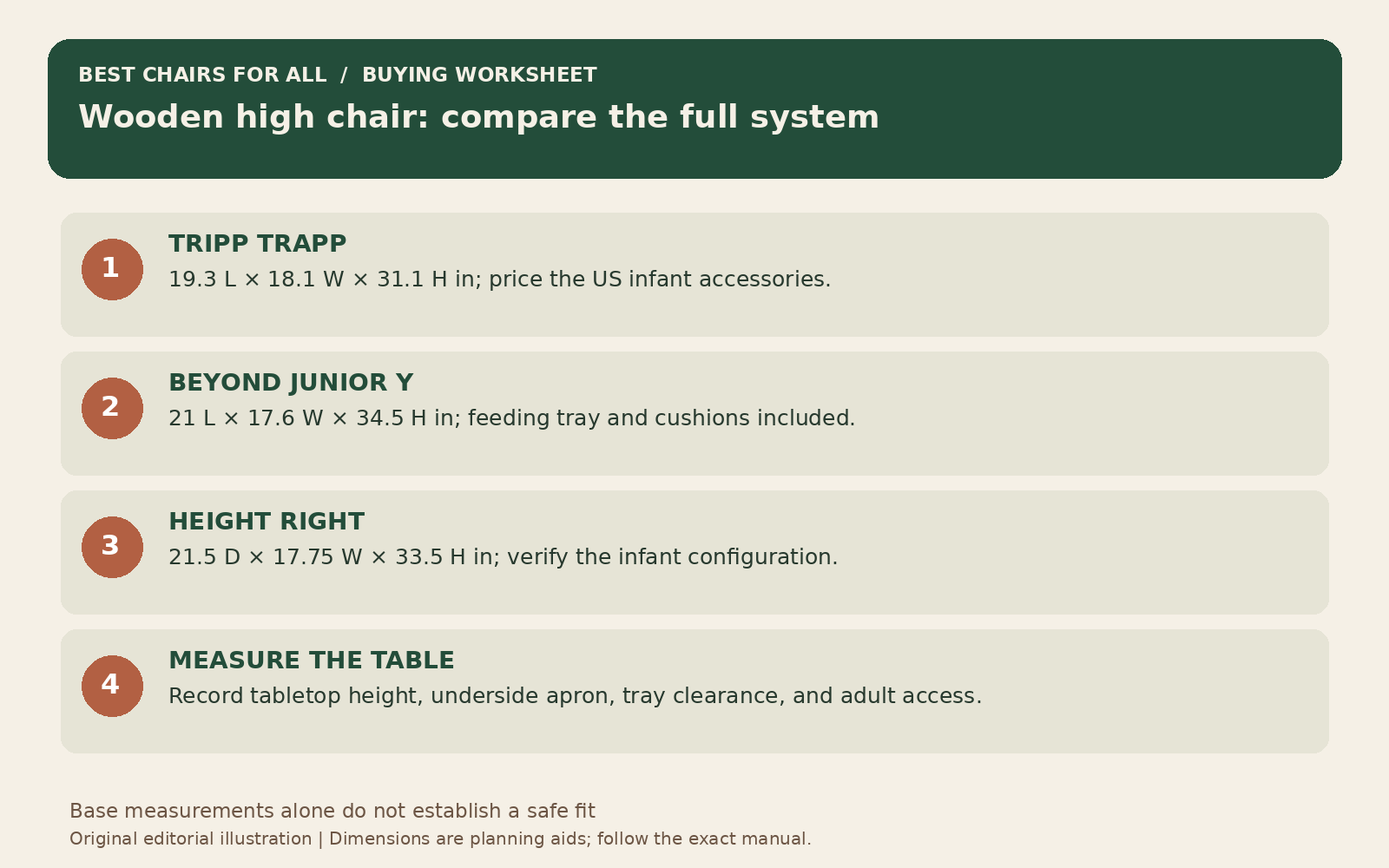
All three are real adjustable wooden chair systems, but their parts and age modes are not interchangeable. This is a research-based buying guide using manufacturer specifications and manuals, not a hands-on comparison. We reviewed current product pages and official recalls on November 6, 2026. The useful question is how the complete chair fits your child and table today, then how much adjustment you realistically expect to use later.
Compare complete systems
| Chair system | Published overall size | What to confirm in the box | Main limitation |
|---|---|---|---|
| Stokke Tripp Trapp | 19.3 L × 18.1 W × 31.1 H in | US Baby Set and harness for infant high-chair use; tray if wanted | Bare chair listing is not the infant setup |
| Abiie Beyond Junior Y | 21 L × 17.6 W × 34.5 H in | Cushions, tray, plastic tray cover | Permanent assembled footprint |
| Keekaroo Height Right + Tray | 21.5 D × 17.75 W × 33.5 H in | Tray, restraint configuration, appropriate infant insert if required | Read configuration-specific manual; no casual part substitutions |
Stokke Tripp Trapp: best for buyers willing to specify the configuration
The current US Tripp Trapp chair page lists the bare chair from three years and explains that the Baby Set is a separate addition for use from around six months. The basic chair showed $249 and in-stock status during research. Do not treat that as the cost of an infant feeding package. Price the compatible US Baby Set, its harness, and the tray if you want a separate eating surface; packages and finishes can change the total.
Stokke’s official product demonstration publishes overall dimensions of 49 by 46 by 79 centimeters, approximately 19.3 inches long, 18.1 wide, and 31.1 high. The adjustable seat and footplate are the central reason to consider it. You can choose a suitable seat position as the child grows instead of accepting one permanent bucket shape. Adjustment still requires the correct instructions, hardware, and accessory combination; it should not become an experiment in modifying the chair.
Choose Tripp Trapp if you value a chair that can remain part of the dining room and are comfortable checking serial numbers and accessory compatibility. It is less convenient if you want every necessary feeding component in one unmistakable box. The same model family has existed for decades, so secondhand chairs particularly need their exact version and compatible parts verified. A listing photograph with a baby in the chair does not prove that the seller includes the complete current US infant setup.
Abiie Beyond Junior Y: easier complete-package comparison
The Beyond Junior Y listing names the included frame, seat cushion, backrest cushion, tray, and plastic tray cover. Its footprint is 21 by 17.6 inches, overall height 34.5 inches, and chair weight 18 pounds. Seat height ranges from 10.5 to 24.6 inches. Those numbers help compare both room fit and the adjustment range rather than relying on a broad claim that the chair grows with a child.
The practical appeal is reducing the number of separate accessory decisions. A household can investigate one supplied feeding system and then follow the manufacturer’s EZ-Seat adjustment instructions. It is still necessary to verify the current product version, readiness requirements, harness arrangement, and all stated configuration limits. An adult-use capacity advertised for a later chair arrangement does not describe infant high-chair use.
This is a good shortlist choice for a permanent dining station where the chair’s narrow base works and a caregiver will occasionally reset the seat and footrest. It is a less useful purchase if you mainly need folding or frequent transport. Its wooden components also need deliberate care: Abiie says not to submerge them, use running water over them, or place them in the dishwasher. Follow the manufacturer’s different instructions for the pads and plastic pieces. The wipeable cushion package can be convenient, but it should not encourage spraying every component with the same household cleaner.
Keekaroo Height Right with Tray: good published geometry, careful infant setup
The Height Right with Tray page lists an overall width of 17.75 inches, depth of 21.5 inches, and height of 33.5 inches. The published seat plate is 9.5 inches deep by 16.5 wide, while the footplate is 11.5 by 16.5 inches. Seat-plate height is listed from 16 to 24 inches; the footplate range is four to 21.25 inches. Those dimensions make it possible to ask specific fit questions before buying.
The tray package includes a wooden tray with plastic cover, a passive crotch restraint, and a three-point belt. However, Keekaroo also has an infant-insert configuration with its own installation directions. Read the official high-chair manual and obtain the correct setup for your child’s stage. Do not combine the insert, crotch piece, belt routing, or hardware based on photographs of a different version. If buying used, confirm the exact missing parts with Keekaroo before paying.
The manufacturer advertises a 250-pound maximum user weight for the chair, but that later-use capacity is not an infant tray-mode allowance. This chair is most attractive when the published geometry and adjustable wooden platform meet a household’s needs and the correct infant components are available. It is less appealing for buyers seeking a folding product or a configuration that requires no initial research. We also would not use an old standards reference on a product page as proof of current compliance for a particular unit; inspect its label and documentation.
A table-and-chair measurement worksheet
Write the table’s top height and the lowest underside obstruction, including any apron, on a sheet. Add the clear floor width and depth where the chair will stand. Next, copy each candidate’s complete footprint and the range of its seat adjustment. Finally, list the tray, infant support, harness, and any stabilizing components required by that exact model. This gives you a complete physical system to investigate rather than a name and an attractive finish.
For example, a buyer might have a conventional table with a 29-inch top and a 26-inch underside apron. A chair with an adjustable seat may bring the child’s eating position closer to the tabletop, but the tray, arm structure, or Baby Set could still collide with the apron. The difference between those two table measurements is three inches; it is not spare clearance you can assume the chair will use. Ask the maker for the relevant tray or accessory height, and check the fit without forcing the chair under the table.
A second useful calculation concerns the room. In a hypothetical 22-inch-wide alcove, the Tripp Trapp’s approximately 18.1-inch width leaves 3.9 inches overall; Beyond Junior’s 17.6-inch footprint leaves 4.4 inches; Height Right’s 17.75-inch width leaves 4.25 inches. Those small numerical differences should not decide the purchase alone. A tray may extend beyond the base, and an adult needs considerably more functional room to place and restrain a child. Use the measurements to eliminate obvious failures, then rehearse actual access.
Adjustment should be a repeatable maintenance task
Choose a chair whose adjustments you can understand and perform exactly as the manual directs. Record the initial setting and keep the correct tool with the instructions, away from children. After an adjustment, check that the seat, footplate, tray, restraints, and required gliders or stabilizers are secured. Never operate a partly tightened wooden chair while waiting to decide whether the new position feels right.
Review the setup as the child grows rather than waiting for an obvious squeeze at the tray. The purpose is an appropriate current fit, not reaching a fashionable geometric rule by adding blocks, cushions, or homemade straps. If a child slumps or the supplied setup does not fit, contact the manufacturer or a qualified clinician familiar with feeding needs instead of altering the frame. No adjustment system eliminates developmental readiness requirements.
Wood care and secondhand value
A wooden chair’s longevity depends on more than the finish color. Read whether the manufacturer permits mild soap, a damp cloth, or a specific cleaner, and dry joints after wiping. Do not soak a wooden frame in a bathtub, leave it outdoors to dry, or assume a disinfecting spray is harmless to the coating. Abiie explicitly restricts immersion; Keekaroo describes wiping with mild soap and warm water. These are model-specific directions rather than one universal wooden-chair cleaning recipe.
Secondhand value depends on completeness. A low-priced frame that needs a tray, harness, infant support, replacement screws, and shipping may cost more than a complete supported setup. Check current replacement-part availability before buying. Reject a chair with cracks, altered woodwork, unidentified hardware, or a missing label. Do not drill new holes, borrow another brand’s restraint, or copy a homemade tray solution. Saving the original parts after a permitted conversion also matters if a younger sibling may eventually use the feeding configuration.
Restraints, readiness, and the model label come first
A feeding chair is for a child who meets the exact model’s sitting and developmental requirements. A birthday or advertised minimum age alone does not establish readiness. Use the seat upright for meals; a reclining feature does not make a chair suitable for feeding a younger infant. Keep the child supervised and within reach, use the complete fitted harness every time, and use the required passive crotch restraint. A tray is a work surface rather than a substitute for restraint. CPSC explains these high-chair precautions. Keep the chair away from surfaces the child could push against and never allow standing or climbing.
Check the product label, date code, exact model, and country version against the current CPSC recall database before buying, including secondhand. Our research date is November 6, 2026; this article cannot guarantee a particular unit remains unaffected by a later notice. Register the chair and retain the instructions. Do not interchange harnesses, trays, gliders, or inserts between superficially similar versions, and do not improvise missing restraints. A used bargain without an identifiable label, complete hardware, and manufacturer support is a poor candidate. If any latch, restraint, or frame part is damaged, stop use and contact the maker.
A current recall reminder for convertible wooden-style listings
A conversion claim is not evidence of safe design. The October 22, 2026 CPSC Costway notice covers convertible high chairs with missing passive restraints and directs owners to stop using the affected products. It does not identify the three chair systems compared here. The practical lesson is to match the exact product and notice rather than assuming a wooden appearance, large capacity number, or many advertised modes establishes safety.
For a configurable long-term chair, investigate Tripp Trapp’s complete US infant package. For included feeding components and quick seat adjustments, start with Beyond Junior Y. For clearly documented platform geometry, investigate Height Right with the correct infant setup. In every case, the best purchase is the complete supported configuration that fits your child and table today.
Something unclear or out of date? Send a correction with this article’s title and the detail to check.
Sources, research & corrections policy ↗