As an Amazon Associate, we earn from qualifying purchases. Read our affiliate disclosure.
The best high chair for small spaces depends on which space is scarce. A narrow dining corner favors a compact permanent footprint such as the Abiie Beyond Junior Y. A room that changes function between meals favors the Chicco Zest. A suitable sturdy table may make the Chicco FastLock hook-on chair useful because it has no floor legs, but a hook-on is conditional on the table meeting every manufacturer restriction.
This guide compares those three approaches with published dimensions and a room-planning exercise. We did not perform hands-on stability or cleaning tests. Manufacturer information and the CPSC recall database were reviewed on November 6, 2026. The aim is to avoid buying a supposedly compact chair that blocks a door, has nowhere to dry, or cannot attach to your actual table.
Compare the occupied room, not only the seat
| Candidate | Manufacturer measurements | Space it addresses | Space it still needs |
|---|---|---|---|
| Abiie Beyond Junior Y | 21 L × 17.6 W × 34.5 H in | Narrow permanent base | Adult approach and child removal |
| Chicco Zest 4-in-1 | 21.25 × 26 × 34.25 in; 9.5 lb | Folding between meals | Full open base during meals; storage |
| Chicco FastLock | 17.5 × 14 × 13 in open; 17.5 × 14 × 4 in collapsed | No floor legs; flat packed shape | Compatible table edge and underside |
Abiie Beyond Junior Y: strongest starting point for a narrow permanent station
At 17.6 inches across its published footprint, the Beyond Junior Y offers a useful starting point when the gap beside a dining table is narrow. Its complete length is 21 inches and height is 34.5 inches. Measure the widest supplied component too: a footprint describes the base, whereas the tray and a caregiver’s elbows can occupy additional working space. Do not judge this chair from a front-facing photograph alone.
The adjustable seat and footrest can help retain one dining location as a child grows. Abiie publishes seat heights from 10.5 to 24.6 inches and includes cushions, a tray, and a plastic tray cover. A permanent station can be convenient precisely because nothing must be unfolded for breakfast. The tradeoff is that the chair does not disappear into a slim storage slot after dinner. If you intend to move it away from the table daily, rehearse where an 18-pound chair and its tray would go.
Choose this model when the full base, tray, and adult approach all work in a fixed location. Pass if the only free space is a narrow closet or a passage that must remain open. For cleanup, follow Abiie’s wood-care rules: do not submerge the wooden parts or place them under running water. A small kitchen with a tiny sink may actually favor this wipe-clean routine, provided you have a separate place for the removable tray cover to dry.
Chicco Zest: best comparison when the room needs to reset
The Zest 4-in-1 is an assembled 9.5-pound high chair with a published size of 21.25 by 26 by 34.25 inches. Chicco describes a compact fold with the tray stored on the rear legs. A light frame can make the difference between a folding feature you use three times a day and one you abandon after a week. The seat is a wipeable single shell rather than a large padded insert.
However, folding has no value if the chosen storage location cannot hold the folded chair and tray without falling into the walkway. The current text listing does not give a complete folded-size specification we can confidently use here. Obtain that measurement for the exact model and tray position before choosing it for a closet with only an inch to spare. We would rather leave that measurement unresolved than substitute an unrelated package size.
The Capri page showed $69.99 and in-stock status during research, with accessories listed separately. Count the official optional footrest if you want it. The Zest is a sensible choice for a kitchen that becomes a home office after meals, but it still occupies its full open footprint while the child eats. Do not try to partly fold the frame to create more room, and keep children away while operating any folding mechanism. Its simplicity serves storage needs better than households seeking numerous height settings.
Chicco FastLock: saves floor area only with an eligible table
The FastLock manufacturer listing gives open dimensions of 17.5 by 14 by 13 inches, collapsed dimensions of 17.5 by 14 by four inches, and a five-pound chair weight. That is a much flatter package than most standalone feeding chairs. Because the chair attaches to the table, there are no spreading floor legs to step around. This makes it worth investigating in a small dining area with an appropriate permanent table.
Eligibility is strict. Chicco specifies table thickness from 0.75 to 1.5 inches and excludes glass tops, loose tops, table leaves, card tables, single-pedestal tables, tablecloths, and placemats. An attractive apartment pedestal table can therefore rule this option out immediately. A table’s thickness alone is insufficient: the upper grips and lower clamps need full correct contact, and any underside apron must be compatible with the exact manual. Read the official FastLock installation instructions rather than borrowing advice from another hook-on model.
The FastLock should be a considered table-and-chair system, not a way to suspend a baby from whatever surface happens to be free. Check the exact sitting and weight limits before use, fasten its restraint, and perform the manual’s attachment check each time. It is our conditional choice for floor space, particularly when a household will also take the flat chair to known compatible tables. It fails the shortlist when the table is prohibited, the underside cannot be inspected easily, or compatibility remains uncertain.
The three-rectangle apartment test
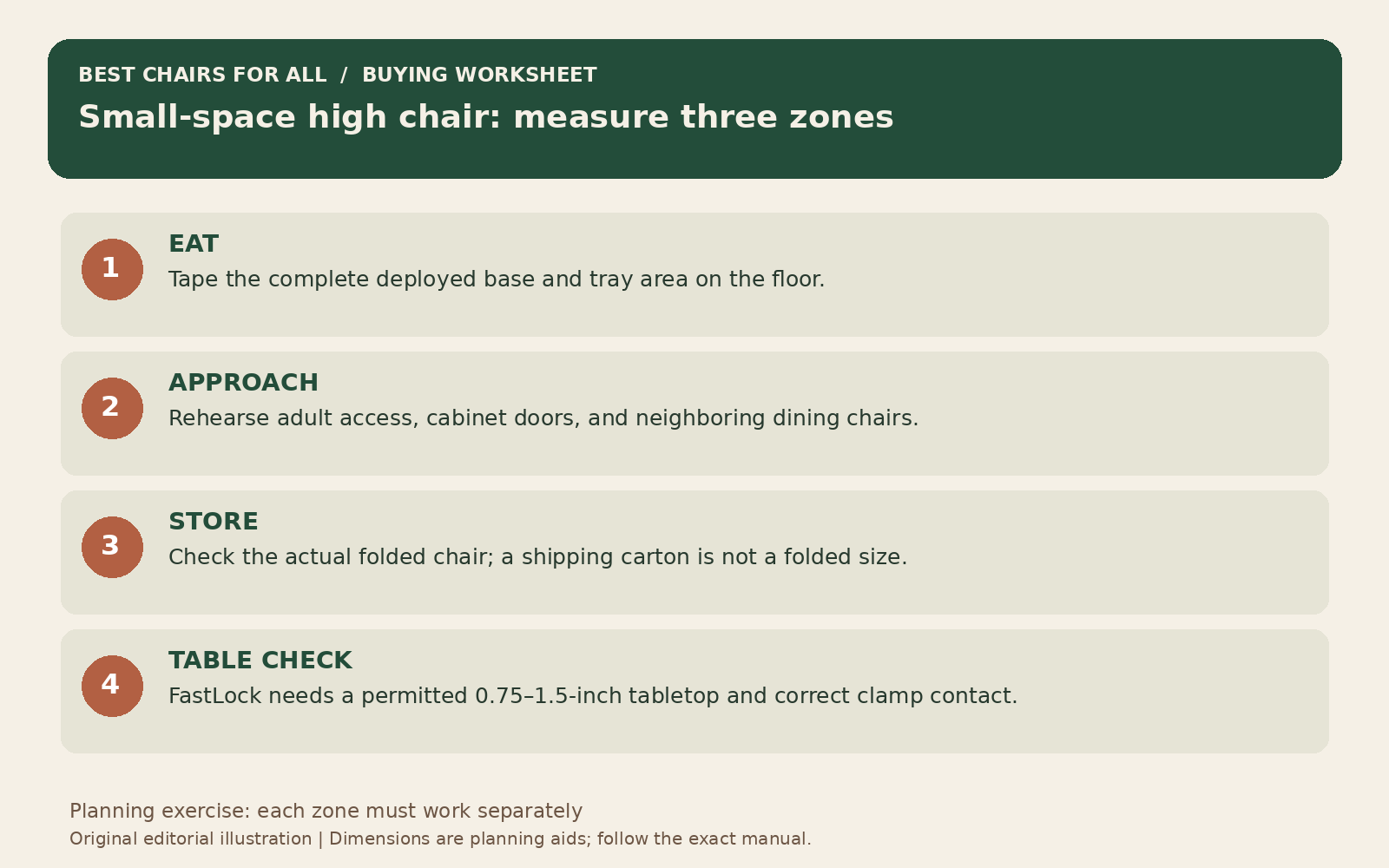
Draw three rectangles on a sheet of paper: eating space, access space, and storage space. The eating rectangle is the full deployed chair and tray. The access rectangle is where an adult stands to seat, restrain, feed, and remove the child. The storage rectangle is where the empty product goes when the room resets. A product must pass all three relevant checks; a small seat cannot offset a blocked exit.
Consider a kitchen nook with a clear 24-by-30-inch floor patch. The Beyond Junior’s 17.6-by-21-inch base leaves 6.4 inches of spare width and nine inches of spare depth in total. That does not mean a caregiver fits in those margins. A Zest’s published 26-inch dimension also needs to be oriented correctly in the room; turning it to make a number fit can place the tray in the wrong direction. Tape the bases on the floor, pull neighboring dining chairs out, open cabinets, and simulate the adult approach with the product area empty.
Now test storage separately. A hypothetical cupboard with an 18-inch-wide, five-inch-deep slot might appear to accept the FastLock’s collapsed 17.5-by-14-by-four-inch package when turned appropriately. That calculation still needs real door-opening clearance, a clean and dry chair, and a way to keep the package secure. Its flat folded size does not establish table compatibility. For the Zest, obtain the actual folded measurements first; do not compare the shipping carton with the cupboard.
Record the maximum usable dimensions in each place, then write one reason a candidate could fail. Examples include a narrow cupboard door, an obstructing table apron, a dishwasher door that opens into the chair, or a pet feeding station beneath the tray. This forces the shortlist to address the room you use rather than the room shown in product photographs.
Small kitchens make cleaning and drying space important
A chair can have a small base and a surprisingly large cleanup footprint. A wet tray laid across the counter may occupy the only food-preparation surface. A removable seat cover may need overnight drying, while a folding frame needs to remain accessible for the next meal. Decide where each component goes before selecting an elaborate removable-parts design.
The Zest’s harness is spot-cleaned and air dried; Chicco says not to machine wash it. FastLock’s removable seat pad is machine washable according to Chicco, with the product label and manual controlling the exact cycle. Beyond Junior has wooden components that should not be soaked. These differences matter more than a generic claim that all three are easy to clean. Choose a material routine that your household can complete without balancing wet parts on an unsafe surface.
Avoid the tempting space-saving shortcuts
Do not remove a required tray support, crotch restraint, stabilizer, or leg component to reduce the footprint. A chair that interferes with a passage should be relocated when empty or replaced with a suitable model. Do not attach a hook-on to a prohibited table simply because it feels solid during an informal test. Likewise, do not rest a suspended chair on another seat or improvise extra support underneath it unless the model’s instructions specifically require that arrangement.
A low purchase price can also hide the cost of buying a second chair after discovering the first cannot fold or fit. Ask the seller to confirm the exact assembled and collapsed measurements, whether the tray is included in each measurement, and the return conditions after assembly. Save the answer beside the product manual. If the household eats at a counter rather than a normal-height table, verify that the chair is intended for that use; a compact high chair is not automatically a counter-height product.
Restraints, readiness, and the model label come first
A feeding chair is for a child who meets the exact model’s sitting and developmental requirements. A birthday or advertised minimum age alone does not establish readiness. Use the seat upright for meals; a reclining feature does not make a chair suitable for feeding a younger infant. Keep the child supervised and within reach, use the complete fitted harness every time, and use the required passive crotch restraint. A tray is a work surface rather than a substitute for restraint. CPSC explains these high-chair precautions. Keep the chair away from surfaces the child could push against and never allow standing or climbing.
Check the product label, date code, exact model, and country version against the current CPSC recall database before buying, including secondhand. Our research date is November 6, 2026; this article cannot guarantee a particular unit remains unaffected by a later notice. Register the chair and retain the instructions. Do not interchange harnesses, trays, gliders, or inserts between superficially similar versions, and do not improvise missing restraints. A used bargain without an identifiable label, complete hardware, and manufacturer support is a poor candidate. If any latch, restraint, or frame part is damaged, stop use and contact the maker.
Which one should occupy the shortlist?
Choose Beyond Junior Y when the narrow permanent floor area works and adjustable seating matters. Choose Zest when you have verified a practical folded storage location and want a light chair to reset the room. Consider FastLock only after your table passes every restriction. The best small-space choice leaves a workable place for an adult, a child, a meal, and cleanup; its measurements should support that complete sequence.
Something unclear or out of date? Send a correction with this article’s title and the detail to check.
Sources, research & corrections policy ↗