A dining chair fits a table only when three relationships work together: the seat is at a comfortable distance below the eating surface, the person’s legs clear the lowest structure underneath, and any arms can pass beneath the table when the chair is pushed in. Buying by “standard dining height” checks none of those relationships completely.
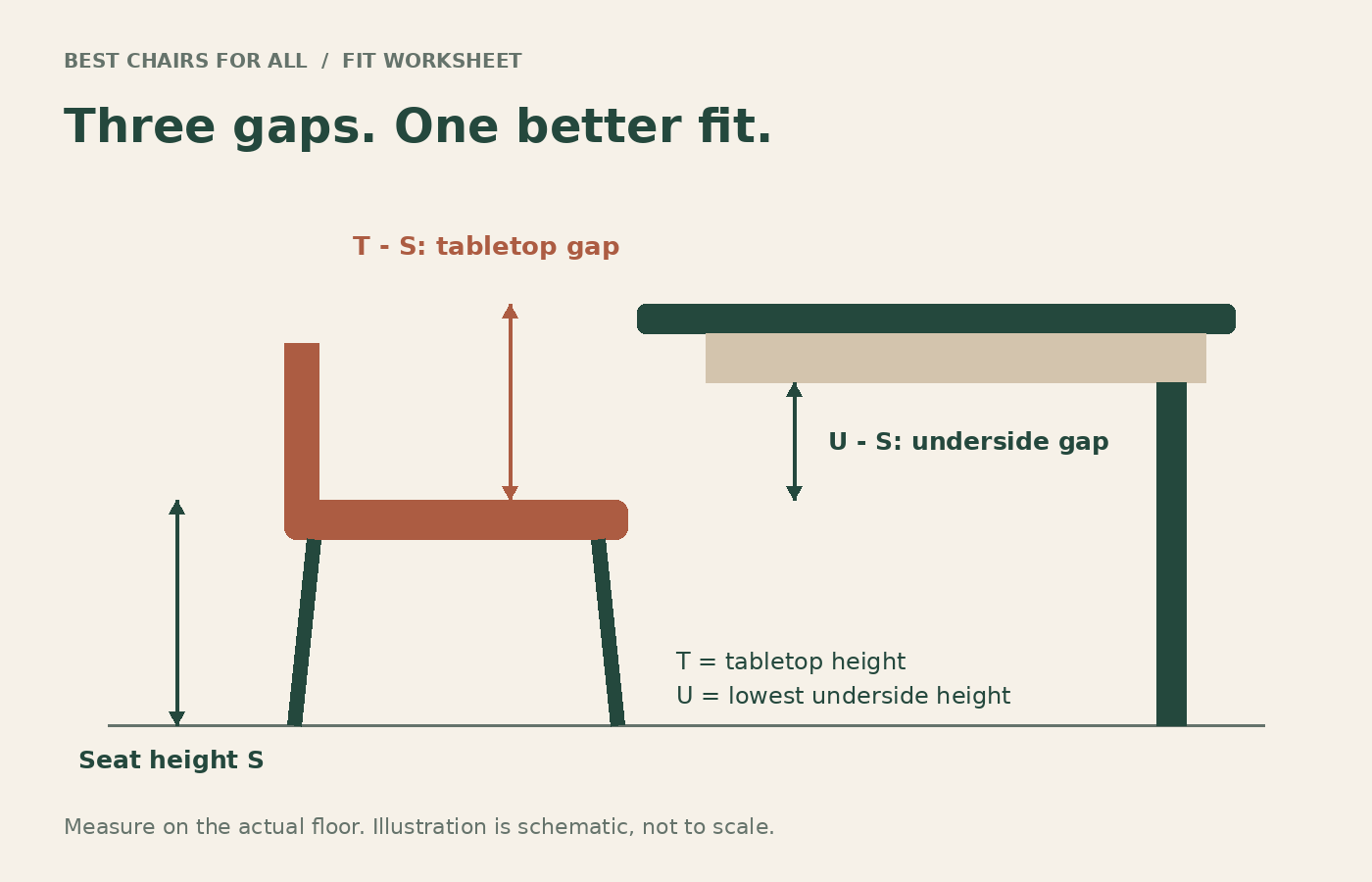
Start with the actual table, a tape measure, a rigid ruler and a chair somebody already finds comfortable. This guide gives you a measurement sheet and two worked examples so you can reject incompatible chairs before ordering. The numerical examples are planning exercises, not results of product testing.
The quick answer: use the tabletop gap as a first filter
Ashley recommends approximately 10–12 inches between the seat and tabletop as an initial shopping reference, followed by a seated check. That makes an 18-inch seat a plausible candidate for a 30-inch tabletop, but not an automatic match. Its dining-chair fit guide also emphasizes the apron and armrest checks. Keep those measurements separate rather than using “legroom” to describe every gap.
The most useful question is therefore not “What is the correct dining chair height?” It is “Which seat height works with this table and these people?” A table that suits a high seat but has a deep apron can fail the second question. A very soft seat can change height enough under the user to alter the first answer.
Make a five-number measurement card
Measure on the actual floor where the furniture will stand. A thick rug under the chair but not the table changes their relative heights. If the floor is uneven, note the variation instead of averaging it away. Record inches to the nearest quarter inch, or use millimeters throughout; mixing units invites avoidable mistakes.
| Label | What to measure | What it checks |
|---|---|---|
| T | Floor to top of table | Eating-surface height |
| U | Floor to lowest obstruction along the sitting position | Available space above thighs |
| S | Floor to seat surface | Person’s sitting height |
| A | Floor to highest point of chair arms | Whether arms tuck under |
| W | Clear width between table legs or supports | Whether the chair enters its position |
The underside measurement should follow the chair’s route into position. A table may have a central rail, a drawer box or a bracket below an otherwise thin top. Looking beneath the middle is insufficient if a lower component sits exactly where knees or armrests will travel. Photograph the underside and mark the intended seating positions.
For a prospective purchase, ask the seller for the missing number rather than estimating it from photographs. Overall chair height means floor to the top of the back. It does not tell you seat height. Similarly, tabletop thickness may exclude an apron beneath it. A dimensioned drawing is more useful than a lifestyle photograph.
Calculate three different gaps
Use T minus S for the seat-to-eating-surface gap. Use U minus S for the space between the seat and the lowest underside obstruction. Use U minus A as an initial armrest clearance check. The last calculation works only if U describes the path of the arm; a curved table or sloping arm can need more careful inspection.
These calculations answer different questions. A chair might produce a sensible tabletop gap while leaving a large person’s thighs crowded below the apron. Another chair might provide comfortable dining posture yet stop short of the table because its arms are too high. That second outcome is not necessarily unusable, but it increases the chair’s parked footprint.
Do not turn an underside gap into a universal comfort guarantee. People differ in thigh thickness, preferred posture and mobility. A measurement can expose an obvious clash; a sitting trial determines whether the remaining space works for the intended user.
Worked example: two tables with the same advertised height
Imagine two tables, both 30 inches high. Table One has a thin top and a lowest underside height of 28.5 inches. Table Two has a decorative apron descending to 25 inches. Pair each with an 18-inch seat. Both combinations have a 12-inch seat-to-top gap, yet their seat-to-underside gaps are 10.5 inches and 7 inches respectively.
That difference is why a standard-height label cannot settle the purchase. The lower apron removes 3.5 inches of potential space without changing the eating surface. If the chair has 25.5-inch-high arms, those arms sit below the underside of Table One but above the underside of Table Two. The chair may tuck beneath only the first.
Notice that lowering the chair is not a free solution. A 17-inch seat gains another inch beneath the apron, but also moves the user farther from the eating surface. You must assess both changes together. The appropriate response may be another chair, another table, or accepting a chair that does not fully tuck in after confirming room clearance.
Account for cushions without guessing their compression
Product pages commonly list an unloaded seat height. A padded seat can settle under a person, but the amount depends on its construction, condition and user. Do not subtract a fictional inch from every upholstered chair. Ask how the manufacturer measures the seat and test a sample if possible.
If you already own the chair, place a rigid straightedge beside the cushion at the user’s sitting area and have another adult note the occupied level without creating a trip or pinch hazard. Compare that with the unoccupied measurement. You are observing your chair, not establishing a specification for similar-looking models.
A removable cushion also raises the unloaded seat, and a wedge can change the angle as well as the height. Assess the arrangement in the form it will actually be used. A cushion that slides or hangs over the seat edge introduces another problem and should not be treated as a convenient way to rescue a poor match.
Check the person before ordering the set
Use a familiar chair as a reference point. When sitting naturally, can the user reach the floor comfortably? Can they approach the table without knees striking the apron? Can they rest their forearms during a meal without repeatedly lifting the shoulders or folding forward? These are observational questions, not a medical assessment.
Trial the activities the table supports: eating from a bowl, cutting food, writing, or playing a board game. A chair that works for a short meal may feel awkward when somebody spends an evening at the table. Check the tallest and shortest regular adults rather than making everyone adapt to the person who does the shopping.
If a person has a disability or needs support to transfer, use their individual requirements and professional guidance where appropriate. A generic dining-height chart cannot prescribe a transfer setup. In particular, do not assume a higher seat or arms are beneficial for every person simply because a listing calls the chair accessible.
Armchairs need a moving fit check
Measure the highest arm point and the widest arm-to-arm dimension. Then compare both with the opening beneath the table. An arm can clear the apron vertically yet strike a splayed table leg horizontally. Rounded arm fronts can also meet the underside before the chair reaches its intended parking position.
Room & Board’s dining-room planning guide identifies chair width, arm height, seat height, apron construction and leg placement as interconnected fit variables. Apply that observation by checking the whole route into the table, not just a single number at rest.
When evaluating online, draw the side profile at a rough scale or place painter’s tape at the apron height beside an existing chair. This can reveal a likely collision, but it cannot confirm an unknown shape. Ask for an arm-height drawing or a sample chair when the available margin is small.
Standard, counter and bar labels are shopping categories
Retail labels help narrow a search, but the measured seat-to-surface relationship still decides compatibility. An unusually low vintage table may not work with a modern dining chair. A counter-height chair can be confused with a bar-height stool because listings show similar silhouettes. Read the seat dimension in the specification box every time.
For raised seating, also check the footrest and how the person reaches the seat. The floor may no longer support the feet, making the location and form of the foot support significant. Do not solve a mismatch with improvised chair or table risers unless the furniture manufacturer explicitly approves that arrangement.
A purchase worksheet that prevents expensive returns
- Write T, U and W for each intended chair position.
- Record S, A and overall chair width for each candidate.
- Calculate the tabletop gap and underside gap separately.
- Check the user in a comparable seated arrangement.
- Confirm the chair’s parked depth if the arms cannot tuck underneath.
- Ask about a one-chair order, sample or return option before buying several.
- Save the dated specification page and seller’s written answers.
For example, if you need six chairs but the preferred style is available individually, a single-chair trial can answer questions that a dozen measurements cannot: whether the cushion is too soft, the front edge presses into the legs, or the back angle forces the person away from the table. Confirm return terms before using this approach.
When a set arrives, check one chair before unpacking everything. Verify the model and dimensions, assemble according to the instructions, and repeat the measurements on the actual floor. Report discrepancies promptly with photographs. Do not shorten legs or alter the frame to address a dimensional error; modification can affect stability and return eligibility.
Frequently asked fit questions
Can a chair be too low even when there is plenty of legroom?
Yes. The generous underside space may come from a low seat, leaving the tabletop awkwardly high for the person. The two gaps should be evaluated together. Raising the seat with a cushion changes both and requires a fresh check.
Should every chair around a table have the same seat height?
Similar occupied heights usually make a mixed set easier to plan, but individual needs can justify differences. Compare the actual sitting surfaces rather than the back heights, which may differ dramatically without changing the user’s position at the table.
What if the seller provides only overall dimensions?
Request seat height, arm height if applicable, and a dimensioned side view. A missing critical measurement is unresolved uncertainty. If the seller cannot provide it and returns are costly, choose a candidate with better documentation.
After the vertical fit is resolved, use our dining-chair spacing worksheet to check side-to-side room, table legs and the path behind occupied chairs. Height and layout are separate decisions; both need to pass before a set belongs on the shortlist.
Something unclear or out of date? Send a correction with this article’s title and the detail to check.
Sources, research & corrections policy ↗