As an Amazon Associate, we earn from qualifying purchases. Read our affiliate disclosure.
The best toddler reading chair is a seat your child is old enough to use, can enter without a climbing project, and can share a book beside comfortably. Start with the reading routine rather than a matching nursery color. A compact foam chair, a larger soft seat, and a framed children’s armchair solve different problems.
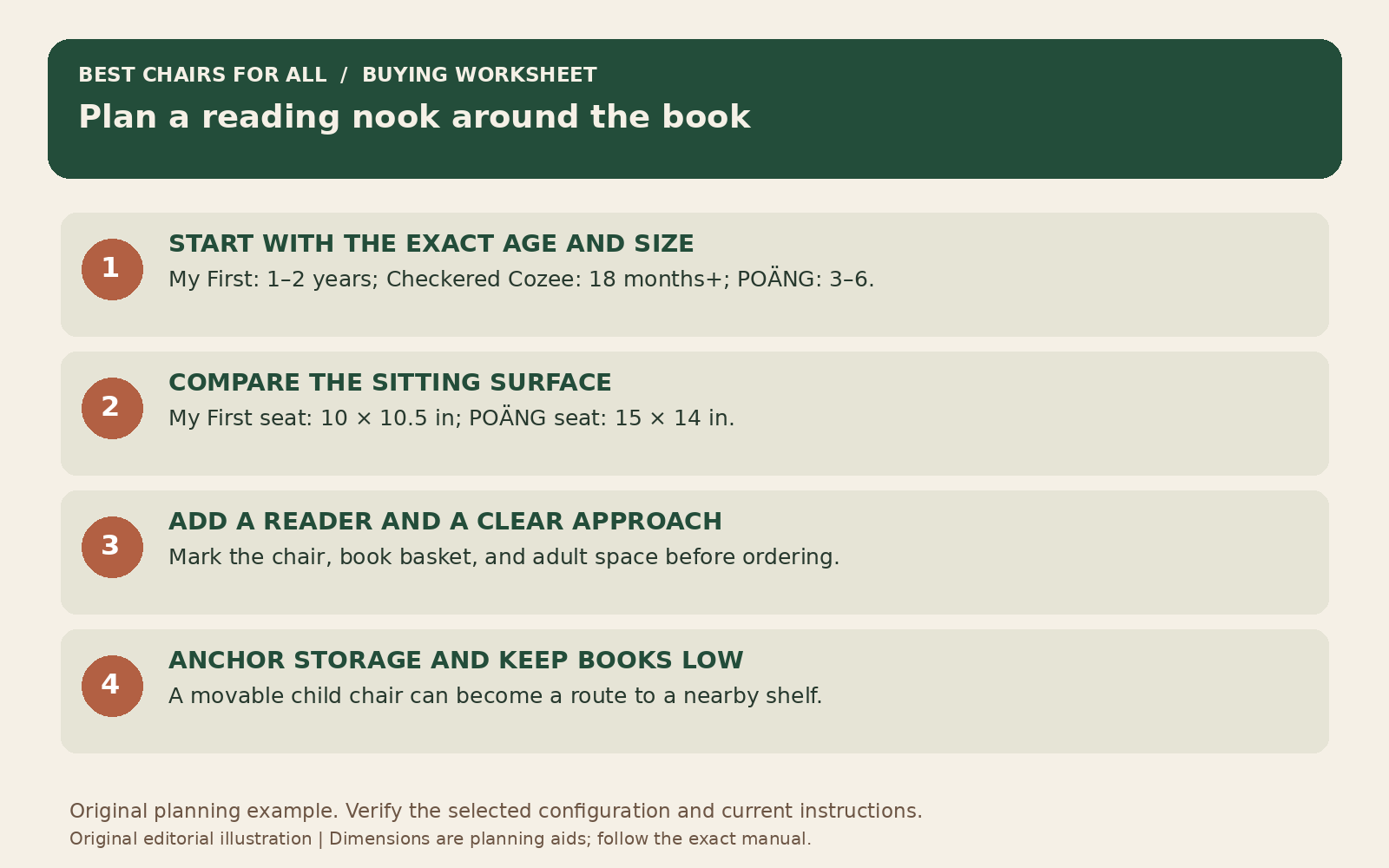
Our shortlist is the Pottery Barn Kids My First Anywhere Chair for the smallest published seat in this comparison, Delta Children’s Checkered Cozee Chair for a washable soft-seat option starting at 18 months, and IKEA’s kids POÄNG for children within its stated 3–6-year recommendation. The POÄNG is an older-toddler or preschool option, not our pick for an 18-month-old. We have researched current manufacturer information, not performed hands-on testing.
The three candidates at a glance
The dimensions below belong to the named US configurations. Check the selected size and color before ordering: family names often cover different inserts, cushions, and age ranges. Research was checked November 6, 2026. IKEA’s listed price was $69.99, with local availability dependent on location. We could not reliably verify a selected complete-chair checkout price and delivery date for the other two, so neither receives a budget or immediate-availability promise.
| Named configuration | Maker age guidance | Published chair / seat measurements | Best reason to compare |
|---|---|---|---|
| Pottery Barn Kids My First Anywhere Chair | My First size: 1–2 years | Overall 20.5 W × 16.5 D × 17.75 H in; seat 10 W × 10.5 D, 6.5 H in | Small, low soft chair; verify complete insert plus cover |
| Delta Children Checkered Cozee Chair, FC85623GN | 18 months+ | Maker lists 18 W × 25 D × 18.5 H in; seat 13 L × 15 W in | Larger published sitting surface and removable washable cover |
| IKEA POÄNG kids, birch veneer / Skogbo, 295.989.18 | 3–6 years | Overall 18½ W × 22 D × 26¾ H in; seat 15 W × 14 D, 9½ H in | Framed alternative with a separately identified cushion |
My First Anywhere Chair: choose the size deliberately
The Pottery Barn Kids Oatmeal listing distinguishes My First, labeled for ages 1–2, from the regular Kids size. The Navy product family dimensions and care information gives the smaller My First measurements used here. Confirm those measurements on the selected order rather than assuming every Anywhere Chair is identical. A replacement slipcover is also different from a complete chair with the matching insert.
This is our first model to investigate when a small toddler-sized seat is the goal. Its 6.5-inch published seat height provides a useful comparison point against POÄNG’s 9.5 inches, but a low measurement alone does not establish that a particular child can use it appropriately. Check the age label, how the child enters, and whether the feet and legs fit naturally during a short reading session.
The tradeoff is its small 10-inch seat width. A large illustrated book may extend beyond that sitting area, and a growing child may want more room sooner than expected. That does not make the next size automatically appropriate: compare its age guidance and dimensions independently. Buy this size for the present child and routine, with a realistic understanding that a name personalized on the cover does not extend its useful fit.
Checkered Cozee: a soft option from 18 months
The Checkered Cozee manufacturer page specifies ages 18 months and older, a removable machine-washable slipcover, and a 6-pound chair. The page lists the seat as 13 inches long by 15 inches wide and gives overall dimensions in the unusual order shown in our table. We have preserved the maker’s labels rather than borrowing dimensions from a different Cozee model. If its footprint is decisive, confirm the width and depth with Delta before ordering.
This chair is worth comparing when a child meets its age recommendation and the family prefers a soft, movable seat with more published seat width than My First. A lightweight handle makes repositioning part of the appeal, but it also means the reading spot may migrate. Decide where it can be used and return it to that area instead of assuming it will remain safely beside the original book basket.
Delta says to allow up to 48 hours for the foam chair to expand after unpacking. That matters for a gift: do not judge its final shape immediately after opening a compressed package or plan the reading reveal for the moment the parcel arrives. Follow its care label when removing and washing the cover. A washable slipcover does not establish that the entire foam insert can go into a washing machine.
Kids POÄNG: a framed choice for ages 3–6
The US POÄNG kids configuration combines the birch-veneer children’s frame with the Skogbo animal-pattern cushion. IKEA recommends it for ages 3–6 and publishes the seat and overall measurements in the table. Treat that age range as part of the recommendation, even if a customer review describes a younger child using it. The adult POÄNG is a separate product; its familiarity does not make the child version suitable for an adult reader.
The clear frame and separate cushion make this a different ownership proposition from the foam chairs. It can work in a preschool reading corner where the child is ready for its higher sitting surface and an adult sits alongside on separate furniture or the floor. It is less appealing when the plan depends on an adult squeezing into the same small chair for story time.
Check that the order contains both components. For this named combination IKEA identifies frame 804.180.56 and cushion 305.976.92. The cushion may be machine washed warm on a normal cycle but should not be tumble dried; the frame and support fabric have their own wiping instructions. A generic instruction to put every removable cover in the dryer would be wrong for this choice.
Draw the reading nook around a real book
Use painter’s tape to mark the overall chair outline, then add the space a child uses to approach, turn, and sit. Set the usual book basket beside the outline without blocking that approach. Finally, sit in the adult’s intended position. A nook that fits the chair perfectly can still fail when an adult cannot reach a dropped book or sit close enough to turn pages together.
Here is a simple book-room exercise. Imagine an open board book that measures 13 inches across and 10 inches front to back. On paper, its width exceeds the My First chair’s 10-inch published seat width by 3 inches. That does not mean the book cannot be read there; books commonly extend beyond a lap. It means you should try the actual book position rather than interpreting the seat rectangle as a tabletop or guaranteed lap area.
The same book is narrower than the 15-inch published seat width of Checkered Cozee or POÄNG, but a child’s legs, arms, and the chair’s contours also occupy space. Those dimensions are a starting point for comparison, not a capacity test. If the book must rest against the arms or be held awkwardly to stay open, a nearby adult or a different reading arrangement may be more useful than another decorative cushion.
Next test a picture book held by the adult. Where will the child look, and where can the adult comfortably place it? If the child spends the whole session turning around to see the pages, move the adult’s seat before replacing the child’s chair. For reading aloud, the relationship between two seats often matters more than choosing the largest possible toddler armchair.
Decide who moves the chair and who stores the books
A soft chair with a handle can suit a living room that changes between reading and play. A framed chair can suit a defined corner where you prefer a more permanent arrangement. Neither plan should rely on placing the chair on a bed, raised platform, countertop, or another piece of furniture. Evaluate it on the floor in its intended setting.
Keep a small selection of books reachable without standing on the chair. A basket or low shelf can reduce the temptation to climb for a favorite cover, but the surrounding storage still needs attention. Leave a clear route to the seat; avoid a narrow gap where the child must step over toys while carrying a book. Reassess that route whenever the furniture is rearranged.
An adult companion space need not be elaborate. A comfortable nearby floor position may serve better than forcing two people into a one-child chair. If an adult needs a separate armchair, include that footprint from the beginning. Do not read the child’s product weight or an online customer’s experience as an adult load rating. We found no basis here for recommending these toddler chairs for shared adult-and-child seating.
Plan for the actual mess, including drying time
Reading chairs collect crumbs, washable-marker accidents, and damp clothing. Before choosing a fabric, ask what happens when the chair is unavailable for a day. A second reading place may be simpler than buying a spare decorative cover that does not fit the insert. Keep the care label with the receipt, because attractive covers within the same brand can use different materials.
Pottery Barn separates slipcover washing from insert care. Its listed slipcover instructions include cold washing and low tumble drying, while the insert is spot cleaned and air dried rather than machine washed. IKEA’s selected POÄNG cushion, in contrast, prohibits tumble drying. Delta identifies its slipcover as machine washable; use the attached label for the cycle and drying method rather than importing either competitor’s directions. Clean and dry parts fully before reassembly.
Inspect the chair after cleaning. A cover that is fitted incorrectly can change the seat shape or expose parts that should be enclosed. Check seams and closures and follow the product instructions for reassembly. Retire the chair from use while damaged; do not conceal torn material with a blanket and assume the original enclosure remains intact.
Keep the whole corner suitable for a young child
The CPSC Anchor It campaign advises anchoring furniture with shelves, drawers, or doors to the wall and avoiding tempting objects that encourage climbing. Apply that to the bookcase beside the reading chair. Moving a small chair next to a tall shelf can create a new stepping route, so review the whole arrangement after the child starts repositioning furniture.
These are awake-use children’s seats. Do not use a soft toddler chair as an infant sleep surface; follow CPSC safe-sleep guidance for babies and move a sleeping infant to an appropriate sleep space. A cozy product photo does not change that boundary. Keep cords and window-covering controls out of reach and follow the room’s furniture instructions.
Before buying, compare the exact label, model, and date information with the current CPSC recall database, especially for secondhand chairs or separately sourced inserts and covers. Our research date is November 6, 2026; later notices and individual units still need checking. Choose My First for its specifically small size, Checkered Cozee for its age-appropriate soft-seat layout, or POÄNG for a child within the older stated age range. The useful outcome is a workable reading spot, without promises about literacy, attention, or development.
Something unclear or out of date? Send a correction with this article’s title and the detail to check.
Sources, research & corrections policy ↗