As an Amazon Associate, we earn from qualifying purchases. Read our affiliate disclosure.
The best kids ergonomic chair is the one whose adjustments solve a specific mismatch at your child’s desk. A tall back, curved shell, or prominent ergonomic label cannot tell you whether the seat is too deep. Start with the child, the work surface, and the movements needed for homework. Then pay for adjustments that you can actually use.
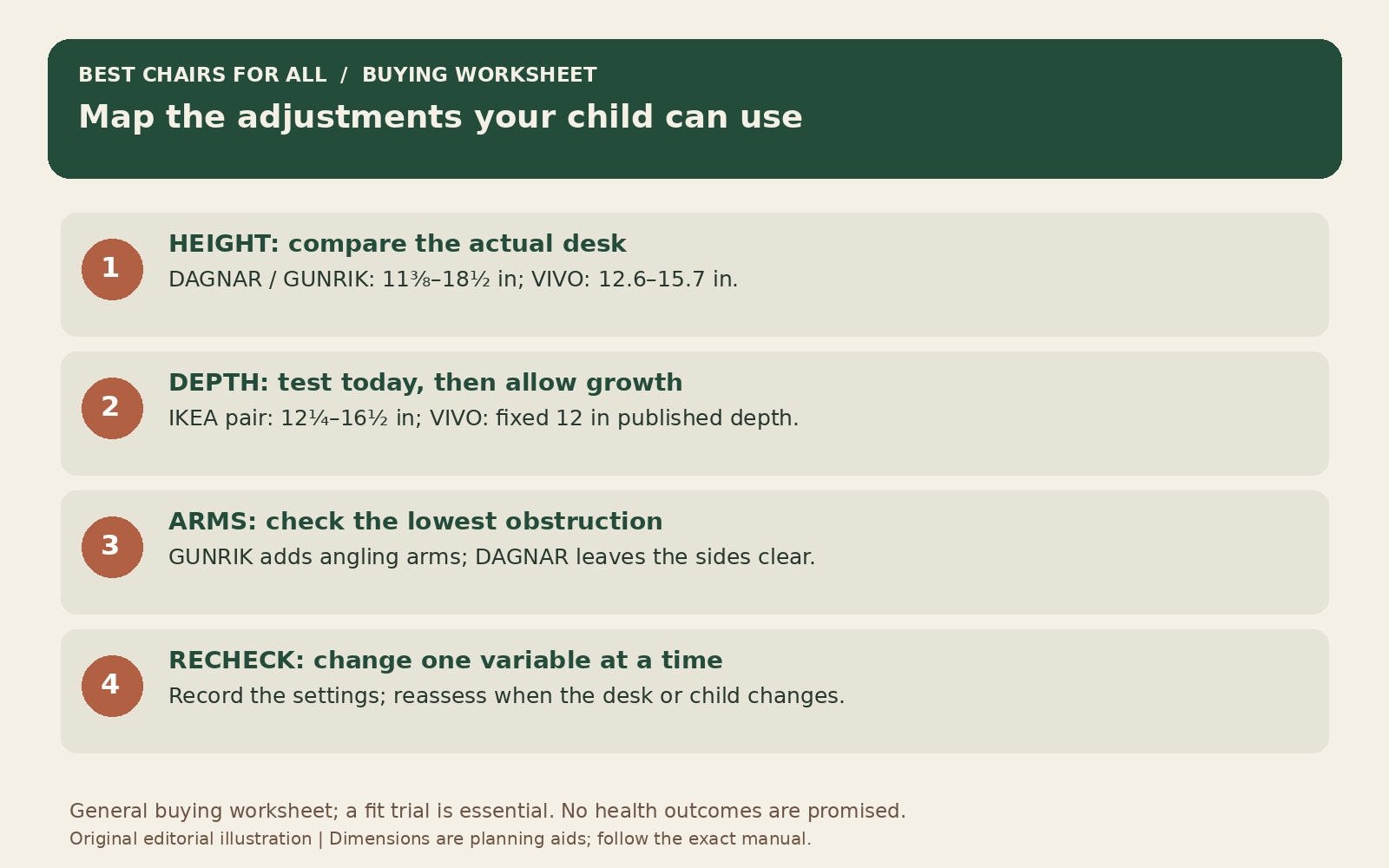
Our research shortlist is IKEA DAGNAR for adjustable depth without armrests, IKEA GUNRIK when armrests are useful and fit the desk, and VIVO DESK-V201G-CH for a less expensive, simpler seat with a narrower height range. These are researched recommendations, not hands-on test results. We do not claim that a chair treats pain, corrects a medical condition, or produces better grades.
Compare adjustment choices before comparing upholstery
Prices below were observed on the US manufacturer pages on November 6, 2026, before tax or delivery. IKEA’s availability display requires a location and interactive checkout; a live page is not proof of local stock. VIVO’s page showed its chair in stock. Follow the exact model’s instructions and check dimensions again before ordering.
| Exact US model | Verified seat adjustment | Purchase context | Reason to shortlist |
|---|---|---|---|
| IKEA DAGNAR, Yellow, 205.637.15 | Height 11⅜–18½ in; depth 12¼–16½ in | $179.99 observed; local availability unconfirmed | Independent depth adjustment without arms |
| IKEA GUNRIK, Turquoise, 005.637.16 | Height 11⅜–18½ in; depth 12¼–16½ in | $199.99 observed; local availability unconfirmed | Similar adjustment range with angling armrests |
| VIVO DESK-V201G-CH | Height 12.6–15.7 in; fixed 14 × 12 in seat | $49.99 observed; listed in stock | Budget option when its fixed depth already fits |
The two IKEA models are closely related alternatives, rather than two different levels of therapeutic support. Their shared height and depth ranges make the armrest decision particularly clear. VIVO provides a useful contrast: a family can spend less if the smaller adjustment envelope works now, but should not assume it offers equivalent depth or backrest control.
IKEA DAGNAR: our first choice for adjusting depth
The current DAGNAR US specification allows separate changes to seat depth, seat height, and back height. Its published body-height guidance is 45–72 inches, with a maximum load of 220 pounds. Those figures describe the manufacturer’s range; they do not replace trying the chair at the actual desk. An armless layout leaves fewer parts to collide with a drawer or apron when the child moves closer to a workbook.
Choose DAGNAR when the main problem is a seat that leaves the child sitting forward to avoid its front edge. Reducing seat depth can preserve usable back contact while freeing space behind the knees. That is a mechanical purchasing reason for the adjustment, without promising a health outcome. Test the shallow setting as carefully as the deepest one; a range is useful only when at least one setting works for the child today.
Its limitation is size and complexity relative to a basic school chair. Tape out the rolling base, allow room to pull back, and check that a low desk does not restrict the adjustment controls. For assembly, use the DAGNAR instructions for this article number. Do not buy a damaged used example on the assumption that generic office-chair parts will restore the original function.
IKEA GUNRIK: choose it for arms you will use
The GUNRIK US page publishes the same seat adjustment ranges as DAGNAR and the same 220-pound maximum. Its distinguishing feature here is a pair of armrests that can angle when the chair goes under the desk. The arms make it worth considering for a child who likes a place to rest forearms between tasks, provided they do not block access to the work surface.
Do a collision check before paying the observed $20 difference. Measure the lowest obstruction beneath the desktop, including a center drawer rather than only the visible top. Ask the retailer to confirm the arm position and clearance at your intended seat setting if those measurements are not published. A chair parked partly outside the desk can consume more room than its catalog footprint suggests.
Do not assume angled arms eliminate every interference. The important position is the one used while working, not just the one used for storage. A child should be able to reach the page without continuously perching at the seat edge because the arms meet the table first. If arms make that impossible, DAGNAR is the more straightforward candidate even though it costs less. Assemble GUNRIK using its own manufacturer instructions, because the two models’ hardware and additional components should not be treated as interchangeable.
VIVO DESK-V201G-CH: a sensible fixed-depth alternative
The VIVO manufacturer listing recommends ages 4–10, lists a 17.3 × 13.7-inch base, and gives the seat dimensions and height range shown above. Its manufacturer instruction sheet identifies the exact chair. This is the budget candidate for a small dedicated desk when the child fits its fixed seat, rather than a substitute for every adjustment on the IKEA pair.
The buying question is whether 12 inches of published seat depth is suitable in use. A child who needs a substantially deeper sitting surface later will not gain that depth by raising the chair. Conversely, a child who cannot use the current depth comfortably should not be asked to grow into it. A height lever and a padded back do not make an unsuitable seat shape adjustable in every direction.
VIVO is also the model to eliminate early when a taller workstation requires more height than 15.7 inches. Do not stack loose cushions or make homemade changes to the mechanism to expand that limit. A more expensive chair may be justified when it prevents replacing the entire seat for a predictable fit mismatch. If the fixed dimensions work and the desk is appropriate, extra controls can be unnecessary expense.
Build a three-variable fit record
Record seat height, usable seat depth, and work-surface height on one sheet. Keep these as separate variables. Raising the seat changes the child’s relationship to the floor and desktop. Changing depth changes where the backrest meets the torso relative to the front edge. Moving a backrest alone may have a different result from sliding the whole seat. Use the controls as the manual describes rather than assuming similarly placed knobs do the same thing.
For a worked example, imagine a child who fits a roughly 13-inch seat height at a low table but currently needs a shallower sitting surface than a large adult office chair provides. Both IKEA ranges include 13 inches; VIVO’s range does too. The decisive next check is depth in use. The IKEA models can move from 12¼ inches upward, while VIVO’s published depth stays at 12 inches. Those numbers narrow the trial; they cannot establish the right result without the child sitting down.
Now imagine that the table is replaced and the useful seat setting becomes 17 inches. The IKEA ranges include it; VIVO’s does not. At that point the budget comparison changes even if the upholstery remains in good condition. This is why an adjustment map is more informative than an unsupported claim that a chair will last a certain number of years.
Do not infer that all three dimensions must form exact right angles or that one position should be held all afternoon. The practical trial is whether the child can use the page, change position, and get in and out without the furniture getting in the way. For persistent discomfort or an individual disability, seek advice for that child’s needs rather than treating these general measurements as a clinical fitting prescription.
Test arms, feet, and drawers as one system
Place the chair at the real desk with the usual pencil case, workbook, and device. Start with a brief ordinary task. Watch whether a drawer forces the knees sideways, whether the chair rolls away during entry, and whether a book has to sit too far forward. These observations identify furniture conflicts; they are not a posture score or a diagnostic test.
If the desktop requires a raised seat that leaves the feet unsupported, reassess the workstation rather than buying the chair in isolation. A suitable stable foot support may be part of the setup, but its size, position, and stability matter. A loose storage box that slides under the desk is a poor substitute. Include any needed accessory in the final space and cost calculation.
An angled GUNRIK armrest may help with parking while still leaving an inconvenient working position. An armless DAGNAR removes that particular collision but cannot fix a desk that is too high. VIVO can be the simplest choice at a lower table while becoming the wrong choice after the table changes. Evaluate these combinations explicitly rather than declaring one model universally ergonomic.
Keep the useful settings and inspect the moving parts
Photograph or write down the initial settings so another caregiver can restore them after cleaning or adjustment. Recheck when the child noticeably grows, changes desks, starts a different activity, or reports that a setting no longer feels workable. A calendar reminder can help, but growth is uneven; no fixed interval guarantees fit. Invite the child to explain what feels awkward instead of tightening controls into a position chosen only for appearance.
Rolling chairs need a clear floor area. Keep bags, cords, and small objects out of the base’s travel path. Teach ordinary seated use: the chair is not a climbing aid or a ride between rooms. Put frequently used supplies within reach without standing on the seat. Any adjustment that requires adult handling should stay with the adult according to the manual.
IKEA directs owners to secure and periodically check hardware, stop using a chair with missing or broken parts, and obtain appropriate replacement parts. Cleaning is also model specific: both IKEA pages distinguish wiping the frame from washing the removable cover and prohibit tumble drying that cover. Do not transfer those instructions to VIVO upholstery. A cover that dries slowly may need a spare-chair plan during cleaning.
Before purchase, search the CPSC recall database using the brand, exact model, and identifying label; our check date is November 6, 2026. That is a current research checkpoint rather than a guarantee about every individual unit or later notice. Retain the receipt, article number, and manual. The final choice should be easy to explain in one sentence: adjustable depth without arms, adjustable depth with usable arms, or a lower-cost fixed depth that already fits your child’s workstation.
Before ordering, confirm whether an assembled chair can be returned after a normal fit trial and who pays return shipping. Save the packaging until the fit decision is complete. A low advertised price can be less attractive when the family cannot evaluate seat depth without losing the practical return option.
Something unclear or out of date? Send a correction with this article’s title and the detail to check.
Sources, research & corrections policy ↗