As an Amazon Associate, we earn from qualifying purchases. Read our affiliate disclosure. Amazon buttons below search for matching listings; they do not confirm stock, an exact seller, or a current price.
The best lab chair is the approved seating configuration that fits the worker, bench, task, floor, and laboratory’s environmental requirements. The word laboratory does not establish chemical compatibility, cleanroom suitability, or electrostatic performance. Our manufacturer-researched comparison covers BEVCO Doral, BEVCO Everlast, and Bimos LABSIT. These product families offer different seating materials and adjustment approaches, and each needs an exact configuration on the purchase order.
We checked manufacturer sources on November 6, 2026. We have not tested these chairs in a laboratory, measured particle generation, performed electrical testing, or assessed resistance to a chemical. Current prices and availability are not verified. The laboratory’s responsible safety, facilities, ergonomic, and quality personnel should identify the requirements and approve the evidence for the specific room and work before procurement.
Define the laboratory before defining the chair
A teaching laboratory, instrument room, electronics lab, and controlled-environment workspace can require different seating. Even within one organization, a chair suitable at an administrative desk may not be appropriate beside a process bench. Write down the room and permitted task category first. Do not assume that every product marketed as lab seating meets the requirements of your own facility.
Separate ordinary fit from environmental performance. Seat depth and working height concern the worker and bench. Surface material, cleaning compatibility, electrostatic properties where required, and controlled-environment documentation concern the room and process. Both sets of requirements must be met by the same supplied configuration. A comfortable demonstration model with different upholstery or wheels does not prove the ordered version meets the environmental specification.
Review lab stool upholstery cleanability and confirm compatibility with the laboratory’s approved cleaning products before choosing the covering.
Ask the relevant laboratory personnel which documents the supplier must provide. They may require an exact material description, current test report for the configuration, approved cleaning instructions, or another facility-specific record. This guide does not assign a universal cleanroom or electrostatic class. The correct evidence depends on the actual application, and marketing badges should not replace the review.
Three documented starting points
| Model family | Verified manufacturer distinction | Reason to investigate | Configuration issue |
|---|---|---|---|
| BEVCO Doral | 18-by-17-inch upholstered seat; several control choices | A configurable upholstered task-seat format | Standard, ESD, and controlled-environment versions differ |
| BEVCO Everlast | 18.5-by-17-inch polyurethane seat | A molded nonfabric surface for a suitable process | Specific chemical and cleaning compatibility still needs evidence |
| Bimos LABSIT | Low and high versions; glides or sit-stop caster choices | A flexible-back laboratory seating format | Height, surface, wheels, and ESD selection must remain linked |
BEVCO Doral: evaluate the selected material and control mechanism
The Doral manufacturer page lists an 18-by-17-inch seat and small or medium back choices. It distinguishes non-tilt, tilt, and deluxe-tilt controls, along with standard and specialized environmental configurations. Mid and tall versions include a foot ring. The family name alone is therefore not a complete order specification.
Investigate Doral when an upholstered seating format and its documented size suit the task and the selected material is acceptable to the laboratory. Its limitation is the risk of assuming that one version’s environmental claims cover every fabric, base, and wheel combination. Ask the supplier for a unique configuration code, exact height range, surface, controls, base, wheels or glides, and the evidence required by the facility. Compare the actual approved combination with the demonstration chair.
Check matching BEVCO Doral laboratory chair listings on Amazon (paid link)
BEVCO Everlast: a molded surface with specific compatibility questions
The Everlast manufacturer page describes self-skinned polyurethane seating with an 18.5-by-17-inch seat and a 16.5-by-12.5-inch back. It offers different controls and specialized configurations, with a foot ring on mid and tall versions. Those options should be treated as parts of the complete product identity.
Consider Everlast when the laboratory’s process permits the molded surface and the worker fits its geometry. Its limitation is that a broad chemical-resistance description cannot establish compatibility with a specific agent, concentration, contact time, temperature, or cleaning frequency. Obtain written confirmation for the actual process. Do not interpret an antibacterial surface description as approval for a biological workflow or as a replacement for the required cleaning and disinfection procedure.
Check matching BEVCO Everlast polyurethane lab chair listings on Amazon (paid link)
Bimos LABSIT: configure height and floor behavior together
The LABSIT US configurator distinguishes ESD selection, height ranges of 450–650 or 520–770 millimeters, and glides or sit-stop casters according to the configuration. The manufacturer product page describes a flexible back and front seat edge and optional arm support. Confirm the exact current US combination and available materials with the supplier.
Investigate it when that operating format and selected range suit the bench and worker. Its limitation is the temptation to combine a preferred caster, height, and surface independently without checking permitted combinations. Ask for the complete configured model code and applicable documentation. A dynamic back is a design feature, not a guarantee of pain prevention, and a general laboratory description does not establish suitability for every process.
Check matching Bimos LABSIT laboratory chair listings on Amazon (paid link)
Original artifact: the configuration evidence passport
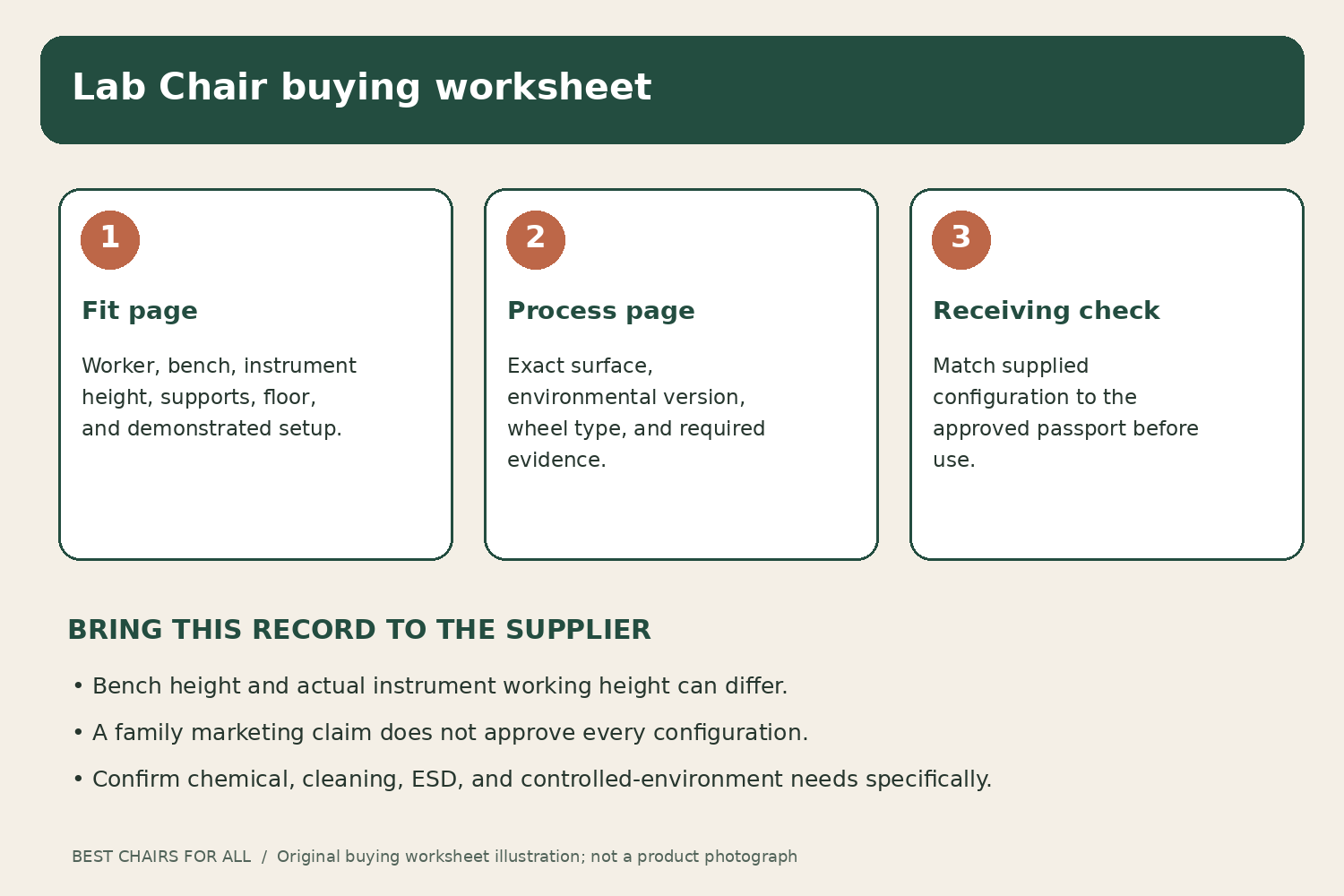
Create a passport with one page for fit and a second for process approval. The fit page identifies the worker or user group, bench, ordinary task, required operating range, foot support, under-bench access, and floor. Record the exact demonstration chair and any differences from the proposed order. This prevents an upholstered low chair trial from silently becoming evidence for a tall specialized variant.
The process page records the precise material, environmental version, base, wheel or glide, and required supporting documents. Add fields for the facility reviewer, approval date, applicable room, and any conditions. If a supplier’s evidence applies to a family of products, ask the reviewer to establish whether the actual configuration is covered. Leave an unverified field visibly open rather than copying a marketing badge into it.
For an invented example, a laboratory might approve a particular surface for one cleaning agent at its specified process conditions but have no evidence for another solvent. That does not justify a general “chemical resistant” approval. The passport should list the approved process and refer the unverified chemical to the responsible personnel. A change in the laboratory procedure can require a new review even when the chair has not changed.
A second example concerns a wheel substitution. Replacing a specialized caster with a visually similar general-purpose one may change the configuration evidence as well as movement and seat height. Ask the manufacturer to confirm the exact approved replacement and let the facility review any relevant performance effect. Do not treat every wheel stem that physically fits as an equivalent part.
Bench height is only the first measurement
Measure the actual working surface and the available under-bench space, including drawers, crossbars, and equipment. Then consider the task’s working level, which may be above the surface because of an instrument or sample holder. A chair that aligns with the empty bench can still leave the worker in an unsuitable relationship to the real task. Have an appropriate professional evaluate the complete setup where needed.
For an illustrative calculation, a bench might be 36 inches high while an instrument’s relevant working area is another six inches above it. That produces a 42-inch task level, but it does not prescribe a seat height. Visibility, reach, support, instrument position, and the worker’s needs still matter. The point is to measure the actual task rather than choosing a tall chair solely because the furniture is called a laboratory bench.
Record foot-support requirements during the assessment. A ring on a high chair is not automatically suitable for every user or activity. Ask the supplier to demonstrate the permitted height and ring adjustments and confirm how the base behaves on the actual floor. Do not extend the operating range with an unapproved cylinder or raise the chair on an improvised platform.
Mobility and stability must match the work
Glides, freely rolling casters, sit-stop casters, and other braking arrangements serve different operating purposes. Ask the supplier to explain the selected type and its behavior under the manufacturer’s instructions. Do not infer the mechanism from a wheel photograph. The floor finish, task, chair height, and facility requirements all belong in that decision.
A stool that must remain stationary for a task may need a different approved arrangement from a chair used to move between nearby work positions. The laboratory should assess the actual workflow and any restrictions on movement between areas. This guide does not authorize moving contaminated equipment into another room or prescribe how a laboratory controls those boundaries.
Check whether arms or a back support collide with the bench or instrument before the worker can reach the intended position. Additional supports can be helpful or obstructive depending on the task. A demonstration should use the approved settings and actual equipment. If the required work cannot be accommodated, revise the bench arrangement or seating choice with the relevant professionals rather than forcing a posture around the purchased chair.
Cleaning requirements and material claims need reconciliation
Ask for current care and compatibility instructions for the exact seat, back, base, controls, and wheels. A molded seat, fabric, coated material, and optional support can need different treatment. The responsible facility personnel should confirm that the required cleaning or disinfection process and the furniture instructions agree. A wipeable surface is not sufficient evidence on its own.
Retain the actual agent, concentration, contact time, temperature, and frequency where the facility’s review requires them. If the material guidance conflicts with a required process, resolve that before procurement. Do not reduce a required contact time or substitute an unverified cleaner simply to preserve the finish. Supplier confirmation should concern the precise process and configuration rather than an informal statement that the material tolerates most chemicals.
Inspectability also matters. Ask how ordinary cleaning reaches joints, controls, and accessible underside surfaces under the manufacturer’s instructions. Do not dismantle sealed components for routine cleaning. The passport should identify approved replacement parts and the action to take if a surface cracks, a support fails, or a chair behaves abnormally. Facility procedures determine whether it can remain in the work area while a remedy is arranged.
Receive and maintain the specified configuration
The receiving check should compare the exact configuration code, labels, materials, controls, height, foot support, and wheels with the approved passport. Keep required test or performance documents with the purchase record. Resolve substitutions with the supplier and responsible reviewers before the chair is put into the intended process. A color match does not establish material or environmental equivalence.
Have the supplier demonstrate normal controls and provide the matching manual. Pneumatic lifts and other sealed mechanisms should be serviced through the authorized route rather than opened by a laboratory user. Record failures and the approved replacement identity. If the equipment moves between users or benches, retain enough configuration information to reassess the new task without guessing.
Ask for the full quotation, return rules for configured equipment, warranty, parts availability, and labor or shipping arrangements. No price ceiling is verified here. Choose Doral when its approved upholstered configuration fits, Everlast when its molded surface and task geometry meet the evidence review, or LABSIT when the configured height and floor behavior suit the work. The strongest lab-chair purchase leaves a traceable fit and process-approval record for the exact supplied product.
Something unclear or out of date? Send a correction with this article’s title and the detail to check.
Sources, research & corrections policy ↗