As an Amazon Associate, we earn from qualifying purchases. Read our affiliate disclosure. Amazon buttons open matching-model searches; verify the seller, exact version and checkout total.
Include the intended user in the decision
The best lift chair for seniors is chosen with the person who will use it, around their own fit, preferences and assessed abilities. Buying a chair as a surprise can miss the most important information: whether the seat feels right, whether the controller is understandable and whether the person wants that movement in their daily routine. Age does not select a seat size or prove that lift assistance is needed.
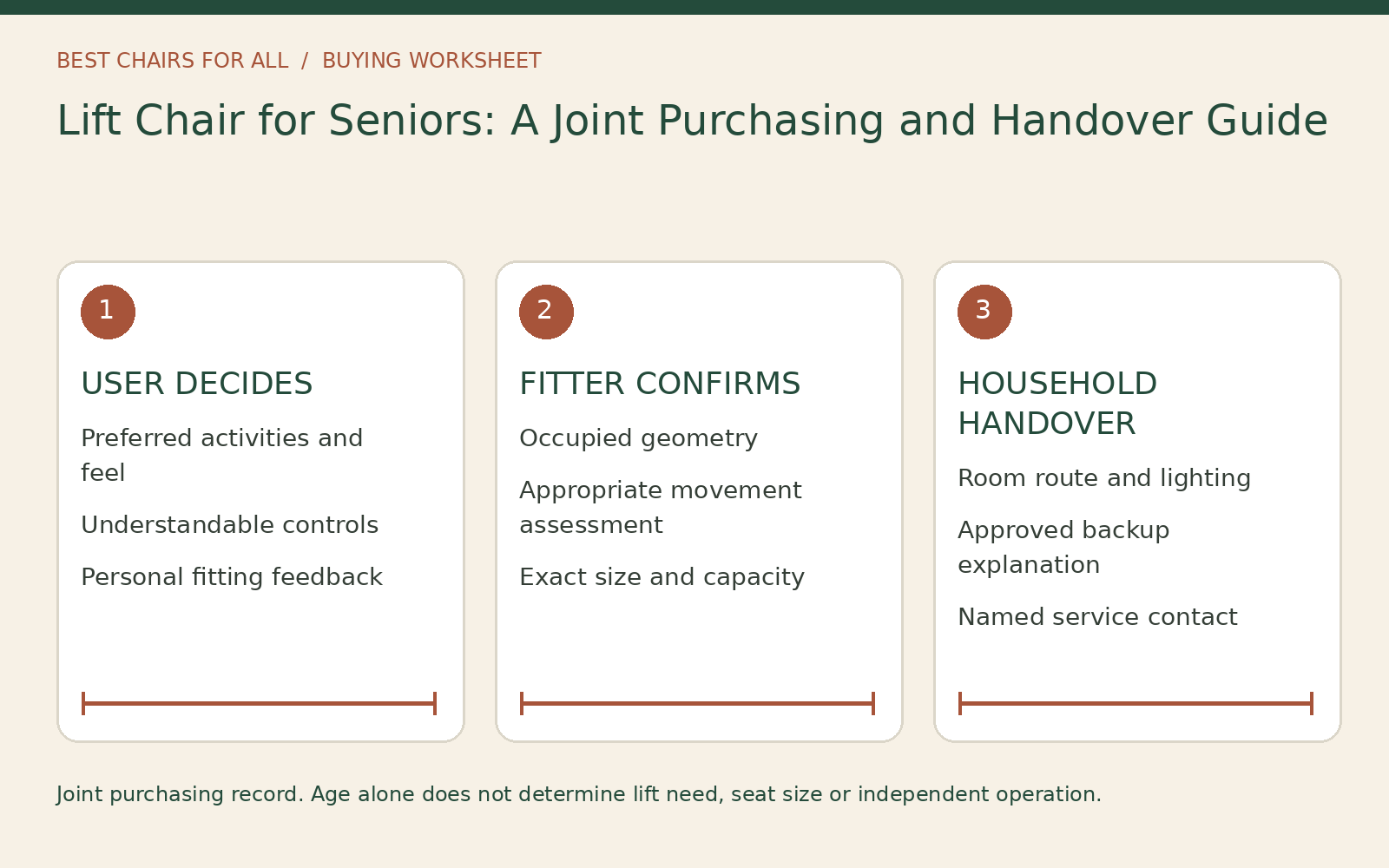
Pride VivaLift Ultra Small is the shorter-seat comparison, Golden MaxiComforter PR535-MED is the narrower-body medium option, and MCombo R7777 is the wider 500-pound option. These are three distinct geometries to investigate, not an age-based ranking. The purchasing record below assigns decisions to the user, fitter and household support person so the final order reflects the actual situation.
This is a research-based buying guide, not a hands-on test. We compared the linked manufacturer specifications and current product documentation on November 6, 2026. Recommendations reflect the fit and ownership tradeoffs below; published dimensions do not establish personal comfort, long-term durability or a medical outcome.
Model specification links: Golden MaxiComforter PR535-MED; MCombo R7777 Heavy Duty Dual Motor Lift Chair; Pride VivaLift Ultra PLR-4955S.
Chairs worth comparing for this use
1. Pride VivaLift Ultra PLR-4955S
Best for: For a shorter and shallower seat comparison.
Ultra Small supplies an 18-inch seat height and 18-inch depth, making it a useful alternative when a medium lift chair leaves the user sitting forward or without comfortable foot contact. Its 20-inch seat width is a separate fit limit.
The Small Ultra has a 25-inch back above the seat and 41-inch overall height. It includes independent powered back, footrest, headrest and lumbar adjustment, tilt and lift, plus lithium backup. Small, Medium and Large Ultra versions use different seating geometry despite a shared family name. The Small model still has detailed powered adjustments and a lithium backup. A shorter seat does not make the controller simpler, and its 37-inch overall width still needs room planning. Let the user try the functions they need rather than assuming a small label makes the entire chair appropriate. The model-specific specification source is linked in this guide.
Product Details
| Brand | Pride Mobility |
|---|---|
| Capacity | 400 pounds |
| Seat dimensions | 20 W ×18 D inches |
| Seat height | 18 inches |
| Overall width | 37 inches |
| Rear clearance | 15 inches |
Pros
- Lower and shallower published seat than the medium candidates
- Independent head, lumbar, back and leg support
Cons
- Complex functions can be excessive for some routines
- Small sizing does not establish a suitable lifting movement
ChoosePLR-4955Swhen its geometry and usable controls fit the person. Do not substitute a Medium Ultra in the same cover without repeating the fitting.
2. Golden MaxiComforter PR535-MED
Best for: For a narrower outer body in a shared living room.
Golden Medium’s 32-inch overall width makes it worth comparing when a lift chair must fit beside existing household furniture. The 21-inch seat width and 19-inch depth create a different fitting option from Ultra Small.
The current PR535 medium sell sheet specifies two independently adjustable comfort zones, pocketed-coil seating and a 9-volt battery backup arrangement. Heat and vibration massage are optional. This model does not provide power-adjustable lumbar or an articulating headrest. Its 20-inch seat height is 2 inches higher than the small Ultra’s nominal figure. That could be useful or unsuitable depending on the person; a narrower exterior should not be confused with a lower seat. The 23-inch rear clearance also needs an honest room drawing. The model-specific specification source is linked in this guide.
Product Details
| Brand | Golden Technologies |
|---|---|
| Capacity | 400 pounds |
| Seat dimensions | 21 W × 19 D inches |
| Seat height | 20 inches |
| Overall width | 32 inches |
| Rear clearance | 23 inches |
Pros
- Specific medium measurements and two main control zones
- Narrow body can preserve space beside a sofa or table
Cons
- No powered headrest or lumbar to change the fixed contour
- A significant rear gap despite the compact width
ChoosePR535-MEDif the user likes the fixed back shape and can use the controller. Keep the exact size suffix on the purchase record because otherPR535 versions change fit and backup details.
3. MCombo R7777 Heavy Duty Dual Motor Lift Chair
Best for: For a user who specifically needs width and capacity.
R7777 offers a 28-inch seat and 500-pound rating, which can address a genuine width-and-load requirement. Its separate back and footrest adjustment adds positioning choice without establishing any clinical outcome.
R7777 has independent powered back and footrest movement, lift assistance, a pull-out cupholder and a remote-retaining loop. Use the current R7777 product page rather than relying on older URL wording or similar-looking MCombo chairs with lower ratings. The maker’s height guidance is 5 feet 7 inches to 6 feet 2 inches. This wide chair should not be chosen for a shorter person merely because they need more room between the arms. Request the exact seat height, depth and controller details, then evaluate arm and control reach. The model-specific specification source is linked in this guide.
Use the lift-chair sizing checklist to compare the seat, armrests, and lift motion with the intended user and any relevant care guidance before ordering.
Product Details
| Brand | MCombo |
|---|---|
| Capacity | 500 pounds |
| Seat width | 28 inches |
| Maximum recline | 165 degrees |
| Maker height guidance | 5 feet 7 inches–6 feet 2 inches |
Pros
- Wide published seat and 500-pound capacity
- Remote-retaining loop can help establish a consistent storage place
Cons
- Extra width can put arm surfaces and controls farther away
- Other fit dimensions need seller confirmation for the exact unit
ChooseR7777 only after the person and fitter agree that its geometry is useful. Capacity is an eligibility requirement, while comfort, reach and the lift movement need separate assessment.
The joint purchasing record
Make three named columns: user, fitter or clinician, and household support. In the user column, record preferred activities, cover feel, ordinary seated comfort and the controller they can understand. In the fitter column, record the measurements and any assessed movement requirements. In the support column, record room preparation, installation attendance and whom to call for help.
This division keeps relatives from unintentionally replacing the user’s preferences with a feature checklist. A family member may value a large cupholder or an impressive recline, while the person using the chair cares most about a familiar button and a back cushion that does not push the head forward. Both practical needs and preferences should be heard before money is committed.
Where the person needs support making or carrying out the decision, involve the appropriate people while still seeking their participation and comfort. The purpose of the record is clarity, not a test of independence. A purchase can be arranged around agreed assistance; it should not claim independent use simply because a salesperson calls the remote easy.
Use existing habits as fitting evidence
Ask which chair the person currently prefers and what works or fails in it. Useful observations include sitting forward to reach the floor, avoiding a recline lever, losing a remote beside a cushion or placing extra pillows behind the back. These describe the routine without turning the discussion into an unqualified medical diagnosis.
Measure a comfortable existing seat as comparison information. The 18-inch height and depth of Ultra Small,20-inch height and 19-inch depth of Golden Medium, and 28-inch width ofR7777 offer different starting points. They do not decide the purchase by themselves. Cushion compression, arm shape and back contour need an occupied trial.
Avoid choosing by age bands or assuming every older adult needs a low seat. A low seat can help one person’s foot contact and make another person’s standing task harder. If balance, strength, pain or another condition affects use, have an appropriate professional assess the arrangement. This article does not prescribe a seat height or transfer method.
The controller discussion should be specific
Ask the user to identify the few functions that matter most. Those may be raising the legs, changing the back or using an appropriately assessed lift movement. Begin the demonstration with those tasks, leaving optional sensations and unfamiliar features aside. A broad menu of functions can otherwise obscure whether the ordinary controls are understood.
After the explanation, ask the person to show the needed functions within their abilities and with appropriate support. Record the words or symbols they find clear and where they want the handset stored. Do not silently retrieve it or prompt every button press while declaring the chair independently usable. Any needed assistance belongs in the plan.
A consistent storage loop or pocket can be helpful only when it remains reachable in the person’s actual sitting positions. R7777 includes a retaining loop; the other models have their own controller arrangements. Evaluate the supplied design instead of attaching an improvised holder near moving parts. If a controller is unsuitable, ask the provider about approved alternatives or another chair.
Prepare the room around the person’s route
Walk through the normal route to the chair with the intended user or an appropriate assessor. Include the lighting used in the evening, nearby furniture and the location of frequently needed items. A lift chair can be correctly assembled yet placed where a low table, rug edge or electrical cable makes the room harder to navigate.
NIA guidance recommends keeping walking paths clear, placing cords near walls and choosing suitable seating height. Apply those principles to the whole setting rather than only the chair. Keep a telephone or agreed call device, glasses and necessary items within appropriate reach. A household member should not need to move a large table every time the chair operates.
If a walking aid or personal assistance is part of the routine, its placement and use should be assessed individually. Do not derive a universal position from a chair advertisement. Leave enough space for the approved movement and any helper without putting equipment in the linkage. The final layout needs to work for the actual person and support arrangement.
The delivery handover is part of the purchase
Arrange for the user and any agreed support person to be present when the chair is explained, if practical. Compare the supplied model and size with the fitting record before the installer leaves. A different suffix can change seat height, depth, width or backup arrangement even when the upholstery looks identical.
Have the installer identify the approved power connection, controller storage, normal stopping function and model-specific backup procedure. Ask for an explanation in language the household understands, and keep a simple contact note with the full manual. This is a handover of the supplied chair, not a substitute for a clinical assessment or individualized training.
Clarify what the household should do if the controller becomes intermittent or the chair stops in a reclined position. Do not plan to force the footrest or dismantle powered components. Record the authorized service contact and any after-hours arrangements the provider actually offers. A claim of a long warranty is less useful than knowing the first step when help is needed.
Agree on a follow-up review without inventing a clinical schedule
During the seller’s return or adjustment period, revisit the user’s original priorities. Is the seat still comfortable in ordinary use? Are the needed buttons reachable? Does the chair occupy the planned space? Has the handset acquired an inconvenient storage position? These are practical ownership questions rather than a prescribed rehabilitation program.
If the person’s abilities or health change, seek appropriate reassessment rather than assuming the original chair remains suitable indefinitely. Pride’s owner guidance calls for the intended user’s ability to operate the product to be assessed and reevaluated. The relevant professional can advise where additional support or a different arrangement is needed.
Check current model-specific recall information for secondhand or clearance stock, and retain the production labels and purchase record. Choose Ultra Small for a demonstrated shorter-seat fit, Golden Medium for its particular compact-width geometry, orR7777 for an assessed wider-capacity requirement. The successful purchase is the one the person can use within an agreed support plan, with clear ownership of installation and service—not the chair chosen solely because it is marketed to seniors.
Research sources
Sources were checked November 6, 2026. Configuration, stock and prices may change. Pride Ultra Small exact seat and capacity specifications; GoldenPR535-MED current manufacturer size sheet; MComboR7777 current width and capacity; NIA home layout and clear-path guidance; Pride current intended-user and operation guidance; CPSC specified current powered-furniture recall.
Something unclear or out of date? Send a correction with this article’s title and the detail to check.
Sources, research & corrections policy ↗