As an Amazon Associate, we earn from qualifying purchases. Read our affiliate disclosure.
Compare the DaVinci Piper for its published 360-degree swivel and manual recline, the Babyletto Kiwi for electronic adjustment with explicitly upright gliding, and the Namesake Crewe for a different taller-backed electronic configuration. The best swivel glider recliner is the one whose permitted movements match the directions and positions you actually need. Counting swivel degrees does not replace checking the room or the adult’s fit.
This shortlist uses manufacturer pages reviewed November 6, 2026. We have not measured swivel arcs, tested movement locks, or verified every combination of glide and recline. Unknown combinations remain questions for the exact manual or manufacturer. Shopping links open matching Amazon searches and may show related versions; identify the selected product before transferring a specification from this guide.
These chairs are for awake adult caregiving, not infant sleep. If there is any chance you may fall asleep while feeding, avoid an armchair or couch and follow NICHD safe-sleep guidance. Move a sleeping baby to an appropriate separate infant sleep space; a reclined nursery chair is not that space.
Separate swivel, glide and recline
Swivel changes the direction the chair faces. Glide moves the seat through a fore-and-aft path according to the mechanism. Recline changes the supported position and typically deploys a leg rest. A product that offers all three does not necessarily permit all three at the same time. A common purchasing error is to treat the feature list as a promise about every possible position.
Write down your intended sequence before shopping: face the supply table, return forward, glide while upright, adjust for adult reading, then return to leave. That sequence exposes the settings where you need motion and the points where you want predictable stillness. If a lock or limiter is essential, ask for explicit documentation. None should be assumed because a different chair in the same brand has one.
Manufacturer evidence for the three candidates
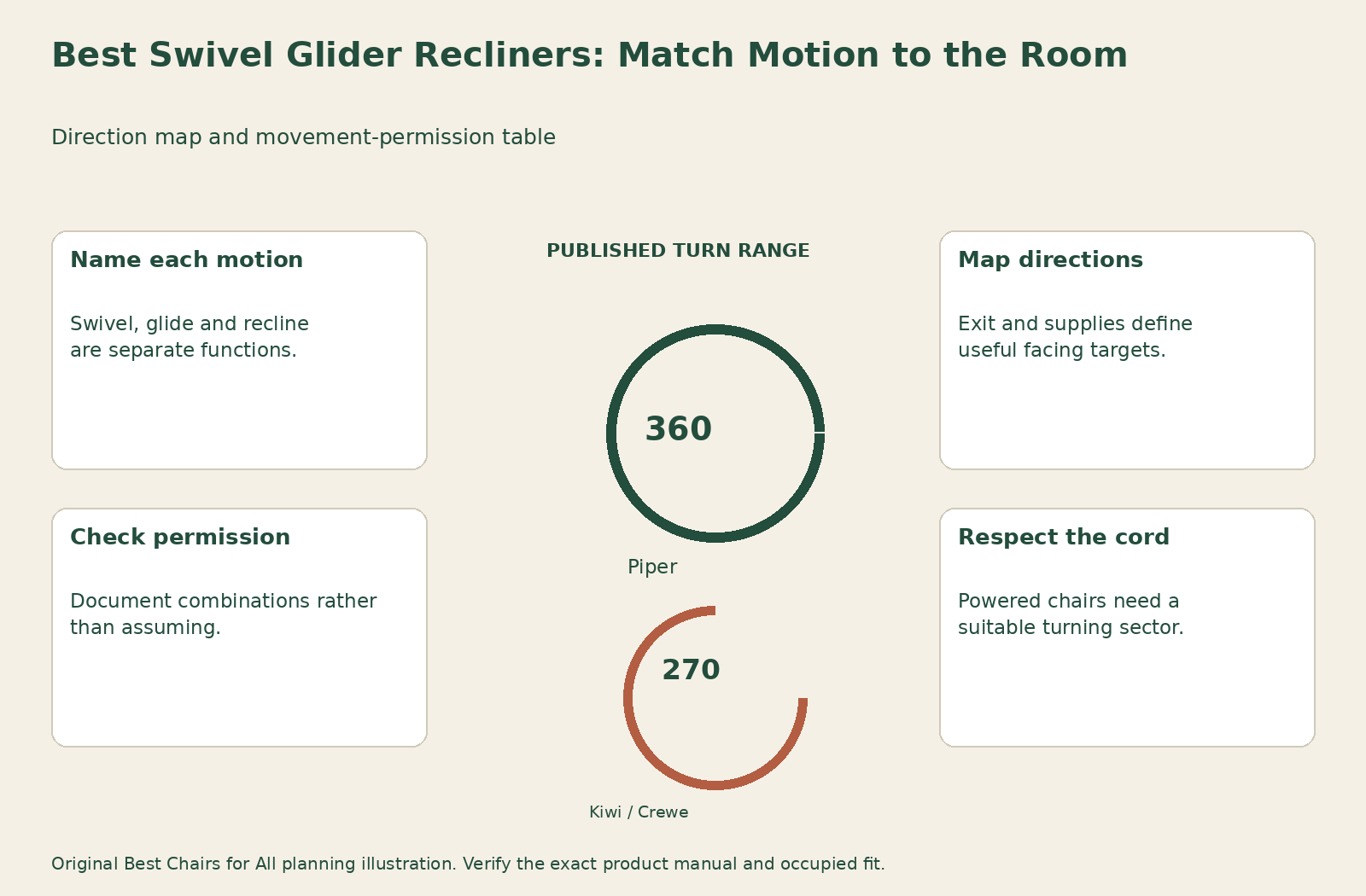
The DaVinci Piper Recliner and Swivel Glider page specifically describes 360-degree swivel, gliding, and a manual pop-up leg rest. The Babyletto Kiwi Electronic Recliner and Swivel Glider states a 270-degree swivel and gliding in an upright position. The Namesake Crewe Electronic Recliner and Swivel Glider describes 270-degree swivel, gliding, and electronic recline. Those are the documented starting points. Questions about locking, simultaneous movement, or particular reclined positions need further confirmation for the exact model.
Do not use a retailer’s generic title to resolve a conflict. A listing may place several related models under one parent page, while a manufacturer’s comparison section may discuss the collection generally. Prefer the model-specific description, dimensions, and manual. Save a copy of any written answer about a movement you need so the final order can be checked against it.
Three motion systems to investigate
1. DaVinci Piper Recliner and Swivel Glider
Best for: a broad published swivel range with manual recline.
Piper is the candidate to investigate if turning range matters and you prefer manual reclining. DaVinci describes a 360-degree swivel as well as gliding and recline. That is a useful distinction from the two 270-degree electronic models here, but it does not establish that you can use every movement simultaneously or rotate into any nearby furniture.
Map the desired facing directions before deciding the extra sector is valuable. A side table and the room exit may both fall within a smaller useful arc. Piper’s 30.5-inch exterior width and 61.75-inch extended length still need operating space, and the manual recline cycle must work for you. The published turn angle is a capability to verify, not a reason to fill the full circle with routine movement.
Product Details
| Brand | DaVinci |
|---|---|
| Dimensions | 34 in deep × 30.5 in wide × 39.25 in high |
| Seat | 22 in deep × 22 in wide; 20 in high |
| Back above seat | 26 in |
| Fully reclined length | 61.75 in |
| Motion | Manual recline, swivel and gliding |
Pros
- A full-circle swivel is stated on the specific product description.
- Manual reclining avoids a powered seating cord.
Cons
- The broader arc can increase the number of nearby objects to check.
- Movement combinations and any lock behavior need exact-manual confirmation.
Choose Piper when the extra facing range serves a real layout need and manual operation passes your trial. If you only face two nearby directions, evaluate those positions instead of rewarding a number you will not use.
2. Babyletto Kiwi Electronic Recliner and Swivel Glider
Best for: a clearly stated upright-gliding use case.
Kiwi is useful for shoppers who want the manufacturer to distinguish the gliding position explicitly: Babyletto states gliding in the upright position alongside its 270-degree swivel and electronic recline. That makes it a practical candidate for a motion map that separates upright movement from adjusted positions instead of treating every feature as always available.
Its 29-inch overall width can help when turning near a side table, but the actual swept shape remains unverified from a width number alone. The back and arms can meet an object before the base does. A power cord adds another reason to respect the documented turn limits and arrange the outlet around intended use rather than encouraging repeated twisting around the base.
Product Details
| Brand | Babyletto |
|---|---|
| Dimensions | 38 in deep × 29 in wide × 41 in high |
| Seat | 22 in deep × 21.75 in wide; 20.25 in high |
| Back above seat | 25.5 in |
| Fully reclined length | 64 in |
| Motion | Power recline; 270-degree swivel; glides upright |
Pros
- Upright gliding is explicitly identified by the manufacturer.
- Narrower exterior body than Piper or Crewe in this comparison.
Cons
- Do not infer reclined gliding from the upright statement.
- Power and cord routing constrain room planning.
Investigate Kiwi when its documented upright movement fits your routine and powered adjustment is wanted. It should fail the shortlist if a desired facing position cannot be reached without pulling the cord or crowding the room.
3. Namesake Crewe Electronic Recliner and Swivel Glider
Best for: a taller-backed electronic chair to test through several directions.
Crewe combines a stated 270-degree swivel and forward-and-back gliding with electronic recline. Its 28.5-inch back above the seat and 21.5-inch seat height distinguish the body geometry from Kiwi, so it deserves a separate turning-and-contact trial if those measurements fit the adult. The motion label alone does not make the chairs interchangeable.
The upright chair is listed at 40 inches deep, and full extended length reaches 64.5 inches. A taller moving back can also create a conflict with shelves or items above the base. Check the entire body at each intended orientation. Crewe’s electronic product must be distinguished from manual or similarly named versions when reviewing the manual and matching retail results.
Product Details
| Brand | Namesake |
|---|---|
| Dimensions | 40 in deep × 30.5 in wide × 42 in high |
| Seat | 20.5 in deep × 22 in wide; 21.5 in high |
| Back above seat | 28.5 in |
| Fully reclined length | 64.5 in |
| Motion | Electronic recline, 270-degree swivel and gliding |
Pros
- Electronic recline and a defined swivel range are documented.
- Different back and seat geometry provides another fitting option.
Cons
- Largest upright depth in this three-chair comparison.
- Exact permitted combinations and electrical setup remain product-specific.
Keep Crewe when its fit is useful and your desired directions remain clear at every required setting. Do not buy it solely because a larger chair looks more stable; suitability requires documentation and an occupied trial.
Draw a direction map with useful targets
Place the chair on a rough floor plan and draw arrows toward the exit, supply surface, and other intended adult-facing direction. Note which targets must be reachable without changing the chair’s position. The best map is economical: frequently used items should be within a useful reach rather than requiring repeated extreme turning or reaching behind the backrest.
Do not translate a 270-degree label into an assumed starting orientation or a guaranteed centered arc. Ask how the swivel is arranged on the particular product. Nor should you infer that a 360-degree swivel is a recommendation to rotate continuously. Identify the required directions and verify them according to the manual, with the intended electrical arrangement for powered models.
Then draw the nearby obstructions at several heights. A low ottoman affects the leg-rest zone; a side table affects arms; a shelf can meet the back. The caster-free base or small central support does not define the chair’s whole moving footprint. Keep the infant sleep space and its required surroundings separate from the adult chair’s motion area.
Make a movement-permission table
Use rows for upright facing forward, upright turned toward the table, an ordinary reading adjustment, and the position required to leave. Add columns for swivel, glide, recline adjustment, locking if present, and clear exit. Fill a cell only from the exact documentation or an appropriate demonstration. Write unknown when the source does not establish it; unknown is more useful than a confident guess.
For Kiwi, an initial documented cell can say upright gliding stated. It should not automatically populate the reading-recline row. For Piper, the full swivel range belongs in the capability record but does not resolve whether a nearby wall permits it in your chosen layout. For Crewe, electronic recline does not answer whether a specific preferred movement combination is supported. This table keeps capability and room permission distinct.
If a salesperson demonstrates a motion, confirm that it follows the manual rather than merely being physically possible. A chair can be forced or misused in ways that are not intended. Never test an undocumented movement with an infant in your arms, and do not ask a child to stand near a mechanism as a clearance marker. Use a clear empty area for the initial demonstration.
Check cords and the turning sector together
For electronic Kiwi and Crewe, locate the outlet before fixing the orientation map. Route the cord as instructed, away from moving parts and walking routes. A restricted swivel range does not eliminate the need to check tension or wrapping. If the intended sector pulls the connector or drags a cable where someone walks, change the layout or reject the arrangement.
Do not add an improvised rotating power connection or modify a stop to gain more range. Ask the manufacturer about any power accessory or contingency feature you need. If a particular facing direction is unavailable in a suitable electrical arrangement, record it as a limitation. The point of the direction map is to reveal these constraints before installation, not invent a workaround afterward.
Trial the motion without chasing maximum range
Once the assembled chair and room are ready, rehearse only the movements you expect to use, initially empty-handed. Notice whether supplies remain reachable, whether the back or arms approach objects, and whether returning to the exit position is straightforward. Keep children and pets clear and follow the manual’s precautions around the moving base and footrest.
A useful test result is concrete: “table reachable from upright position without using the end of the swivel range,” or “reading adjustment blocks the route to stand.” Avoid unsupported claims about silent operation, smoothness, or easier soothing unless you have appropriate evidence. A manufacturer describes a mechanism; your own trial determines whether its behavior suits your preferences and actual room.
Choose the verified sequence
Select Piper if its full-circle capability serves your layout and the manual reclining sequence works. Consider Kiwi if upright gliding, a narrower body, and electronic adjustment align with the intended motion table. Compare Crewe when its body geometry fits better and the larger footprint remains clear. If a required movement or lock is unverified, resolve it before treating the chair as suitable.
Match the order to the exact model and base, retain the instructions, and review the direction map after rearranging furniture. The successful choice supports a small, useful set of movements with predictable transitions. It does not need the largest possible arc or the greatest number of features; it needs the documented motions your awake caregiving station can actually accommodate.
Something unclear or out of date? Send a correction with this article’s title and the detail to check.
Sources, research & corrections policy ↗